

Can the Depth of a Prefabricated Pool Be Changed?
How much can depth change in one-piece fiberglass, polyester and panel prefab pools? Options before and after installation, water volume and safety.
How much can depth change in one-piece fiberglass, polyester and panel prefab pools? Options before and after installation, water volume and safety.
One of the most common questions from people planning a prefabricated pool is this: can the depth of a model chosen from the catalogue be adapted to their needs? Some want a shallow pool that children can use comfortably; others want a deeper shell for swimming and exercise. The answer does not fit in one sentence, because the term prefabricated pool covers several different production technologies.
In a one-piece fiberglass or polyester pool the depth is fixed by the production mould and cannot be changed on site. In a panel-system prefabricated pool there is flexibility within defined dimensional limits, as long as it is decided before the project starts. At Çilek Havuz we evaluate depth together with the intended use, the age of the users, safety requirements, the ground conditions of the garden, the step design, filtration capacity and total water volume, rather than by appearance alone.
In everyday language a prefabricated pool sounds like a single product, but the heading covers one-piece fiberglass pools, polyester pools, steel or composite panel systems, liner-lined prefabricated pools and modular pools installed above ground. Because the load-bearing structure, production method and installation technique differ, the depth options they offer also differ.
For this reason, when you request a quotation for a prefabricated pool, ask in writing for the production type, the floor structure, the panel or shell height and the dimensions of the shallow and deep zones, not just length and width. A single depth figure in a catalogue does not always express the usable water depth.
In one-piece pools the shell is produced in the factory as a single unit inside a specific mould; steps, seating areas, floor slope and depth are all part of that mould. Cutting the floor of a one-piece model listed at 1.40 metres to reach 1.70 metres on site is not a safe practice. Such an intervention damages the structural integrity of the shell, its resistance to water pressure, the surface coating and the manufacturer's warranty. The catalogues of fiberglass manufacturers such as Latham and Thursday Pools also present each model with its own fixed length, width and depth; the customer does not modify the mould, they select the model that fits.
| System | Choice before installation | Change after installation | Main limitation |
|---|---|---|---|
| One-piece fiberglass pool | Selection among catalogue models | Not applied | Depth tied to the production mould |
| One-piece polyester pool | Limited to existing mould options | Cutting the shell is not recommended | Structural integrity and warranty |
| Panel-system prefabricated pool | Adjustable according to project and panel system | Possible to a limited extent with extensive renovation | Panel height and floor engineering |
| Liner-lined modular pool | Sloped or flat floor can be formed | Requires new floor and new liner | Load-bearing structure and liner dimensions |
| Above-ground prefabricated pool | Limited by wall height | Practically unchangeable | Factory panel or shell height |
| Reinforced concrete pool | Widely customisable at project stage | Possible, but extensive | Structural, waterproofing and plumbing works |
As the table shows, the phrase depth can be changed does not mean the same thing for every product. In a one-piece product a change means choosing a different model; in a panel-system pool the floor level and panel height can be rearranged during the project. If full dimensional freedom is required, a reinforced concrete pool is the more suitable choice, because it offers a much wider design range for length, width, floor slope, seating steps and different depth zones than ready-made moulds.
A one-piece fiberglass shell resembles a boat hull produced as a single unit in a factory. Just as cutting and deepening a hull afterwards disturbs load distribution and watertightness, an uncontrolled intervention in the floor of a fiberglass pool creates the same risks. The number of layers, the resin structure, the reinforcement zones, the floor form and the wall transitions are all produced according to the mould geometry.
Digging a deeper pit on site does not make the shell deeper. On the contrary, it leads to voids under the shell, uneven backfill, settlement problems and surface deformation over time. This is why, when buying a fiberglass pool, the real water depth must be checked as carefully as the external dimensions in the catalogue.
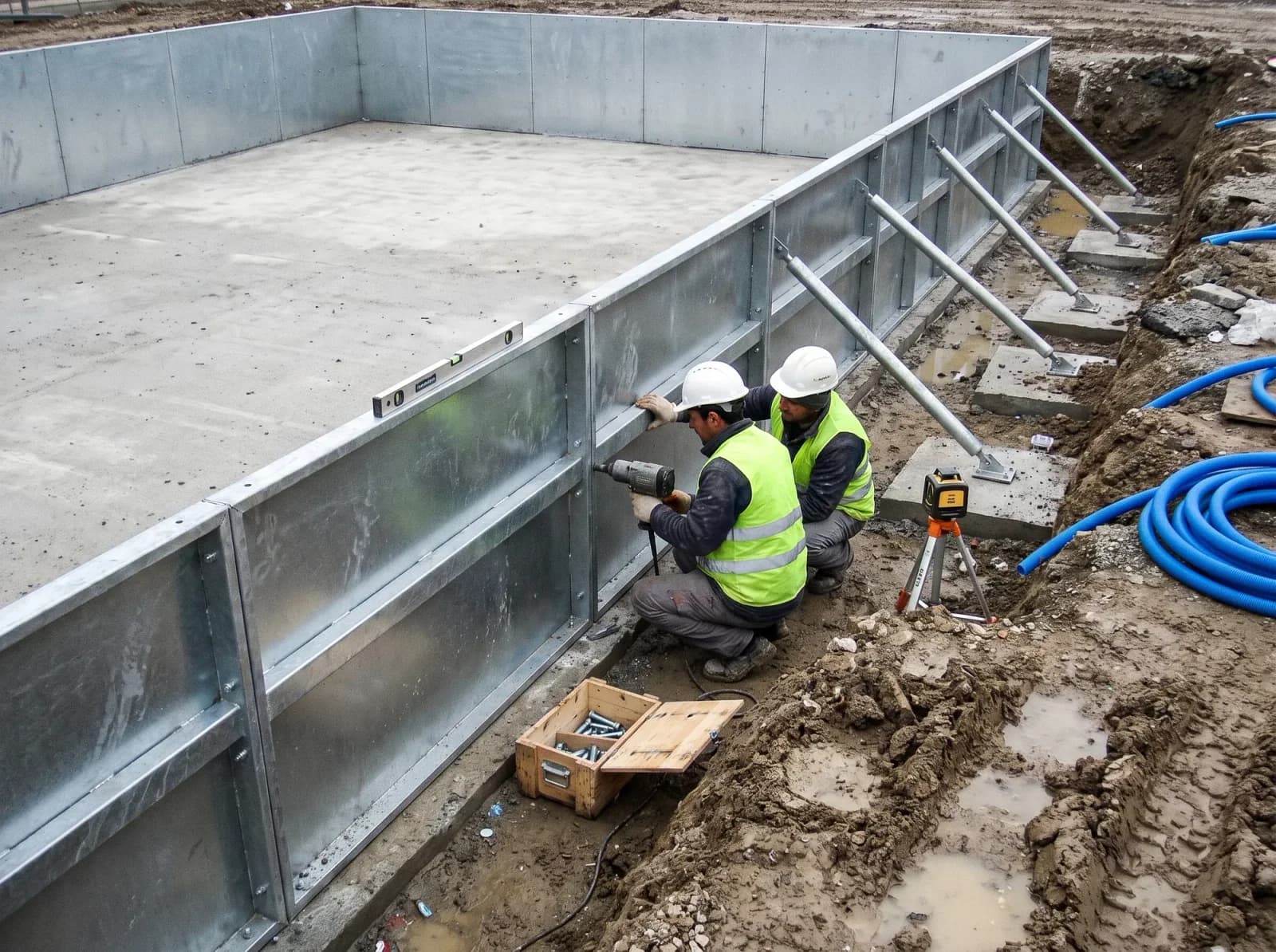
In prefabricated pools built with steel, composite or similar load-bearing panels, the walls are made of modular parts, so there is more dimensional flexibility at the project stage than with a one-piece shell. A flat-floor family pool, a sloped floor deepening towards one end, or a shallow resting zone in one section can all be created. This change, however, is not simply a matter of digging a little deeper.
What must be calculated together when depth changes in a panel pool
- Panel height and panel joint details
- Floor concrete thickness and support elements
- A custom-sized liner for the new geometry
- Level changes of steps and seating benches
- Position of return inlets and main drain elements
- Soil and groundwater pressure on the walls when the pool is empty
If a liner is used, a custom-sized liner must be prepared for the new geometry. Stretching a previously manufactured liner towards a deeper floor causes excessive tension, wrinkles or openings at the joints. As the water volume grows, the amount of water the pump must circulate also grows; therefore the filter, the pool pump and the pipe diameters are re-evaluated for the new volume.
Pool depth should not be chosen with the logic that deeper is better. As depth increases, water volume, filling time, heating demand, chemical consumption and maintenance load increase too. If the pool will mostly be used for cooling off, sitting and spending time as a family, a wide shallow section is more functional than a deep pool.
Depth orientation by user profile
- Children and relaxation: shallow, flat floor and wide entry steps
- Family use: balanced depth, no steep slope over a short distance
- Swimming and sport: uninterrupted swimming length and turning space before depth
- Water exercise: a flat-floor section where users can stand
Flat-floor prefabricated pools offer an easily understood depth for family use, water exercise, play and social use; the user does not meet an unexpected depth change in different parts of the pool, and a cleaning robot works more evenly. A sloped floor creates shallow and deep zones in the same pool and serves different users; but if the slope changes sharply over a short distance, slipping, loss of balance and reduced comfort follow.
In compact gardens, choosing a balanced depth that matches the user profile instead of a steep floor slope gives a more usable result in most projects. Deepening one end by a few tens of centimetres may look like an advantage on paper, but if the transition length is insufficient, users cannot comfortably use a significant part of the pool. Think of the floor like the floor of a house: where it rises and falls determines comfort as much as the room's floor area.
A depth change directly affects the total water volume. In a flat-floor pool 8 metres long and 4 metres wide, raising the average depth from 1.40 to 1.60 metres increases the theoretical water volume by about 6.4 cubic metres. The net figure differs once steps, seating areas and the real water level are included, but the example shows the effect of depth on operation.
What to re-check for the new water volume
- Filter capacity and pump flow rate (turnover time must not increase)
- Pipe diameter, main drain layout and return nozzles
- Disinfection plan and pool chemical doses (based on real volume and measurements)
- Heating capacity: a larger water mass reaches the target temperature later
- First-fill water consumption and winter protection volume
Deepening the pool without changing the existing equipment lengthens the turnover time and leaves insufficient water movement in some zones. Users who want to extend the season should decide on depth together with the heating system capacity; otherwise they face insufficient performance or high consumption.
Deepening an installed one-piece fiberglass or polyester pool afterwards is not recommended; removing, cutting or adding parts to the floor of the shell changes the factory-made load-bearing structure. In some repairs a fiberglass layer can be applied, but repair and changing the geometry of the pool are not the same job. If the depth requirement has changed significantly, removing the existing shell and installing a new model of suitable depth is in most cases the more reliable route.
In a panel-system, liner-lined pool, deepening is technically possible; but it is not a simple renovation, and the decision should be made within the scope of pool consulting after the structure, ground and plumbing have been examined together.
Work sequence for deepening a panel pool
- The pool is emptied and the liner is removed
- The floor is broken out or reshaped
- Load-bearing panels and support details are checked
- Plumbing levels are adjusted to the new depth
- A liner for the new dimensions is prepared and laid
- The system is refilled, commissioned and tested
What to clarify before the depth decision
- Who will use the pool most, and can the users swim?
- Will the pool be used for sport or for relaxation?
- Is a separate shallow section needed for children?
- Will the pool be entered by ladder or by wide steps?
- Is an in-water seating area wanted?
- Will the pool be heated, and how long will the season be?
- Do the ground and groundwater conditions in the garden allow the chosen depth?
- Is the depth in the catalogue the shell depth or the real water depth?
Increasing depth does not simply mean more excavation; groundwater, drainage, backfill stability, external pressure when the pool is empty and the level of the plant room are also affected. In Çilek Havuz projects the pool model, ground survey, mechanical capacity and architectural expectations are evaluated together. You can browse completed examples of different systems on the projects page to get an idea of dimensions, form and landscaping.
A representative example describes the decision process. A family with two children chooses a one-piece pool they like in the catalogue; shortly before the shell arrives on site, they ask for the depth to be increased. Because the model is produced from a single-piece mould, no safe change is possible. Instead of trying to modify the shell, the technical team proposes another, deeper model with similar width and design.
At first the family sees this as an unnecessary delay; but once the shallow section for the children, the adults' swimming expectations and the real water depth are re-evaluated, they realise the different model meets their needs better. The depth of a prefabricated pool is like a shoe size: instead of forcing the product into a different size after production, choosing the model that fits you from the start gives a safer, more economical and longer-lasting result. To determine the right system and depth alternatives for your garden, you can request a free site survey and quotation.
Solutions for your project
Explore services and product categories related to this topic.
Company & Contact
To talk about your project, we are one call away.
Legal Name
Çilek Havuz
Founded
1998 · Istanbul
Head Office
Çilek Plaza, Eyüp Sultan Mah. Yakacık Cd. Feshane Cd. No: 2 D:4 D:1, 34885 Sancaktepe / İstanbul
Service Area
All of Türkiye · exports to 14 countries
Related articles
Keep reading.
References
- 1.Fiberglass pool shapes and sizes catalogue — Latham Pool Products
- 2.Fiberglass pool models and dimensions — Thursday Pools
- 3.EN 16582-1 Domestic swimming pools, Part 1: General requirements including safety and test methods — CEN (European Committee for Standardization), 2015
Frequently Asked Questions
Our readers' most asked; with expert answers.
Çilek Havuz Content & Technical Team
Guides & Technical Content
- Response Time
- Same day
- Channels
- Phone · E-mail · WhatsApp
If the answer you are looking for is not here, send your question directly to us and our team will reply as soon as possible.
Book a free site surveyNo. The depth is set by the production mould; cutting the shell on site damages structural integrity and the warranty. A different model is chosen for a different depth.
Çilek Havuz Content & Technical Team
Yes, within defined limits at the project stage. Panel height, floor concrete, liner dimensions and plumbing levels are calculated together.
Çilek Havuz Content & Technical Team
Not recommended for one-piece shells. Possible in panel and liner systems, but it is an extensive renovation that requires emptying the pool, rebuilding the floor and fitting a new liner.
Çilek Havuz Content & Technical Team
Usually it is the shell height. Because of the top edge allowance, overflow level and floor thickness, the usable water depth is less; ask for it in writing.
Çilek Havuz Content & Technical Team
Because water volume increases, filter capacity, pump flow rate, chemical doses and heating power are re-checked for the new volume.
Çilek Havuz Content & Technical Team