

Infinity pool cost: what rises versus a standard pool?
Infinity pool cost is the total of the extra items created by the balance tank, overflow-edge workmanship and second pump line, compared to a skimmer pool of the same size.
Infinity pool cost is the total of the extra items created by the balance tank, overflow-edge workmanship and second pump line, compared to a skimmer pool of the same size.
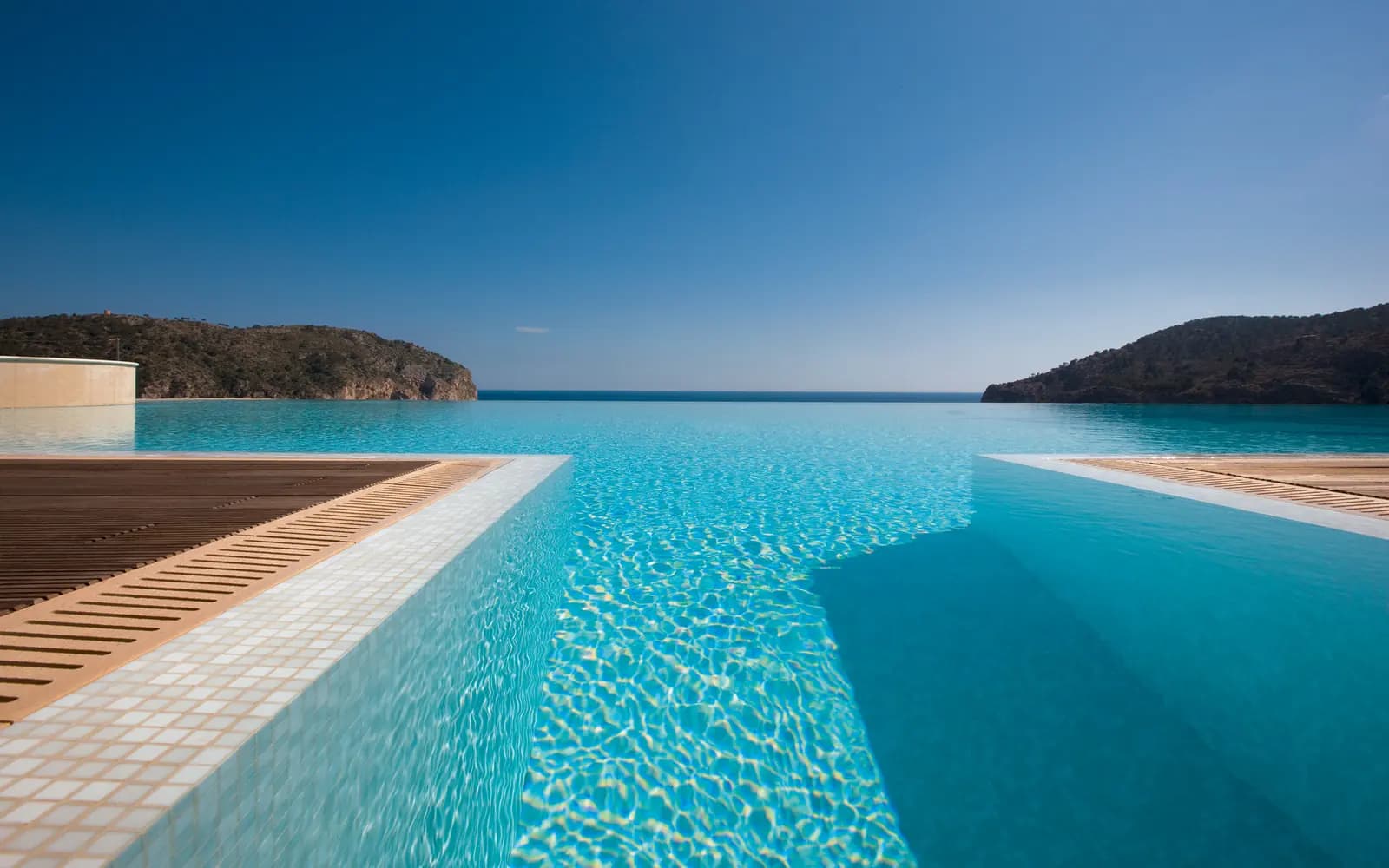
Infinity pool cost is the total of the extra items carried by the pool type where water overflows from one or more edges to give the appearance of a boundless water surface, compared to a skimmer pool of the same surface area. As Wikipedia defines it, an infinity pool is a pool that produces a boundless water effect by having water flow over one or more edges; the edge is finished as a weir sitting 2 to 6 mm below the required water level, and the water spilling into the catch basin under the weir is pumped back into the pool. The entire cost difference comes out of these three sentences: a weir level, a catch volume, and a return line.
This article is not a price list and does not contain a single monetary amount; because material and labour markets vary by project, only the item headings and their proportions relative to each other are discussed here. The article also does not explain how infinity pool design is done; the hydraulics of the overflow edge, cladding selection and visual composition are a separate topic. There is only one question here: when a pool project of the same size is built with an overflow edge instead of a standard skimmer, where do the budget items grow, and by how much.
For the comparison to be meaningful, the two pools' surface area, depth and cladding class are held constant. The only thing that changes is how the water level is held. In a skimmer pool, water sits a few centimetres below the edge stone, and surface water is drawn through the skimmer mouth. In an overflow-edge pool, water sits above the weir level and flows out continuously; the volume that flows out has to be collected somewhere and pumped back. The table below shows how this single difference spreads across items.
| Item | Standard (skimmer) pool | Infinity pool | Difference |
|---|---|---|---|
| Balance tank | None; level compensation happens directly in the pool shell | A separate reinforced-concrete volume, 8 to 10 percent of the pool's surface volume | A new item: excavation, formwork, reinforcement, waterproofing, cover |
| Edge level tolerance | A deviation of a few millimetres in the edge stone is invisible | A fixed level within a 2 to 6 mm band along the weir | Noticeable increase in labour hours for formwork, screeding and level adjustment |
| Circulation | Single line, single filtration pump | Two lines: filtration line and overflow (return) line | Second pump, second valve group, extra pipe run, panel expansion |
| Shell structure | A single-stage foundation is enough on flat ground | A retaining wall or bored piles may be needed at a slope edge | Depends on the soil survey, the most variable item |
| Waterproofing | A single layer inside the shell | A double layer on the shell, the weir face and the balance tank | Waterproofing area and number of layers increase |
| Edge finishing | Precast edge stone, standard profile | Natural stone or marble weir stone, custom chamfer and joint | Material class and stonework increase |
| Automation | A simple make-up valve for skimmer level | Level float in the balance tank, dry-run protection, automatic make-up | Panel, sensor and commissioning items are added |
| Commissioning | Completed within a day | Flow balancing and level touch-up along the weir spread over several days | Extra site days |
The total of these eight rows produces an increase of roughly 25 to 40 percent compared to a skimmer pool of the same size, on flat or gently sloping ground. The lower end of the range is for projects with a single overflow edge, a balance tank poured adjoining the pool shell, and flat ground. The upper end is for projects with two or three overflow edges, a tank located separately, and a slope edge. This is not a price schedule but a field observation based on the item breakdown seen in completed jobs; as ground slope increases, the structural item can go beyond this range altogether.
In an overflow-edge pool, water level has to be held fixed at the weir level. When a person enters the pool, when wind creates waves, or when the pump stops, the volume flowing down over the weir has to be held somewhere; this volume is the balance tank. The tank's size is generally taken as 8 to 10 percent of the pool's surface volume. Surface volume here is not the pool surface area multiplied by the difference between weir level and working level, but the equivalent of the dynamic load: user displacement, the water layer over the weir, and the stagnant volume in the pipework are added together to find it.
The tank is designed as a small reinforced-concrete pool in its own right. Excavation, blinding concrete, reinforcement, formwork, waterproofing, ventilation, cover and the equipment connections inside it are budgeted separately. Within the total of extra items in an infinity pool, the tank's share is, in most projects, the single largest item and on its own takes up between a third and half of the total extra cost. The tank's location directly changes this share: there is a marked difference, in excavation, formwork and pipe run, between a tank poured next to the pool shell, in the same excavation pit and, where possible, sharing a common wall, versus a tank excavated separately at another point in the garden.
A weir is a well-known structure in hydraulics: flow rate depends on weir length, the flow coefficient and the head of water over the weir, and for a horizontal weir the height exponent is 3/2. The practical consequence is this: because the water layer over the weir is only a few millimetres, a one-millimetre deviation in level changes flow at that point by tens of percent. A one-metre section sitting 3 mm low draws water toward itself, cutting off the sheet at neighbouring sections, so an even water film never forms along the edge.
For this reason, the formwork, screeding and stone cladding of an overflow edge fall into a different labour class than a standard pool edge. The formwork is set with a laser level, level is measured after the concrete pour, the weir face is ground down for correction if needed, the edge stone is set with no joint or a very fine joint, and once water is added, point touch-ups are made along the edge. Compared to the labour for standard edge stone at the same length, the total of these steps corresponds to two to three times the labour hours per metre of edge. Looked at as a line item, the material difference is limited; what increases is almost entirely man-hours.
The second circulation line is a result of this same precision. While the filtration line cleans the water, the overflow line pumps the water in the balance tank back into the pool at a fixed flow rate, feeding the sheet over the weir. This second pump is selected independently of the filtration pump; its flow rate is calculated from weir length, its suction is taken from the lowest point of the tank, and it is locked against dry running by a level float. Its budget counterpart is not just the pump: the second valve group, check valve, extra pipe run, panel output and cabling are all part of the same item.
Most overflow-edge pools sit at the edge of a slope facing a view; the ground does not continue below the edge. As Wikipedia notes, the cost of these pools rises noticeably because of the foundation systems that anchor them to the hillside, and a solid structural solution becomes mandatory on difficult terrain. At this point two different items come into play, and both concern not the pool itself but the ground the pool stands on.
A retaining wall is the structure that resists the lateral thrust of the soil behind it. Lateral earth pressure starts at zero at the top and increases with depth; if it is not resisted, the wall overturns or slides. Gravity walls resist this thrust with their own mass, while cantilever walls do so with an inverted-T reinforced-concrete body, and both need a rigid foundation going below frost depth. Drainage behind the wall is not optional; it is the mandatory detail that prevents hydrostatic pressure from building up. When the pool shell sits right in front of, or on top of, this wall, the wall is no longer a landscape element but the pool's structural system, and its cost is written into the pool item.
When soil bearing capacity is insufficient, or the sound layer lies deep, the solution is a deep foundation. A bored pile is a pile type made by filling a drilled shaft with reinforcement and concrete; compared to driven piles, it allows larger diameters and can work in harder layers. It transfers the load from the pool shell down to the sound layer at depth. In a project where a pile item enters, the outcome changes clearly: the extra cost can no longer be described within the 25 to 40 percent band, because pile count, diameter and length depend entirely on the soil survey and can, on their own, take up as much as the pool shell itself. For this reason, on a pool project on sloped ground, the soil survey is done before the architectural drawings.
Glossary of terms
- Overflow edge (weir)
- A pool edge finished 2 to 6 mm below water level, over which water flows continuously. Because its level tolerance is narrow, it is the detail that sets the labour class.
- Balance tank
- A separate reinforced-concrete volume where water overflowing the weir is collected and held before being pumped back. Sized at roughly 8 to 10 percent of the pool's surface volume.
- Overflow channel
- The channel directly beneath the weir that collects water along the edge and carries it to the balance tank. Its cross-section is set by weir length and design flow rate.
- Overflow pump
- The second pump that returns water from the balance tank to the pool. Operates independently of the filtration pump; its flow rate is chosen to feed the water sheet over the weir.
- Retaining wall
- A wall that resists the lateral thrust of the soil behind it. When the pool sits at a slope edge, it is not a landscape element but part of the structural system; drainage behind it is mandatory.
- Bored pile
- A deep foundation element made by filling a drilled shaft with reinforcement and concrete. Transfers load from a weak surface layer down to a sound layer at depth.
The second topic that deserves as much discussion as the initial investment difference is the annual expense after the pool is put into use. Two items stand out here. The first is evaporation: the thin sheet of water flowing over the weir noticeably enlarges the surface in contact with air, the flow motion continuously disperses the stagnant moisture layer above the surface, and this effect multiplies at a view edge exposed to wind. Water make-up need rises compared to a skimmer pool of the same surface area; if the water is heated, evaporation loss also comes back directly as energy loss.
The second is pump hours. In a skimmer pool, the filtration pump runs at set hours of the day, and when it stops, the pool's appearance does not change. In an overflow-edge pool, the weir is only visible while the overflow pump is running; once the pump stops, water level drops below the weir level and the edge dries out. For as long as the pool is meant to remain visually active, the second pump also has to run. The difference in annual electricity cost follows from this and depends on the usage scenario: there is a significant difference between a hotel pool run continuously and a villa pool switched on only in the evening. A variable-speed (frequency-controlled) overflow pump and a time schedule set through automation are the two decisions that cut this item down.
A third expense item is on the maintenance side. The balance tank is part of the pool's water; sediment accumulates in it, biofilm can form on its walls, and it needs to be drained and cleaned periodically. When an access cover, lighting and ventilation for the tank are not thought through at the project stage, this cleaning turns into a separate job every single time. The half day set aside for the tank's cover dimensions at the project and pool construction stage is recovered again and again in the years that follow.
All the decisions that pull the extra cost down are made at the project stage; none of them can be reversed once construction begins. The first is the number of edges: the difference between a single overflow edge and three overflow edges is not just weir length, but overflow channel length, tank volume and pump flow rate. In most plots the view faces one direction only; finishing the other edges with a skimmer or a plain overflow channel shrinks the extra items noticeably without spoiling the look. The second is the tank's location and formwork: a tank sharing a common wall with the pool shell, completed in the same excavation pit and on the same pour day, saves on every one of excavation, formwork, labour and pipe items compared to a separately excavated tank. The third is having the weir stone arrive on site pre-worked to size; cutting on site means both waste and extra labour hours.
What to ask line by line when comparing proposals
- How many m3 is the balance tank volume, and what was it calculated from; are the tank's excavation, reinforcement, waterproofing and cover listed as separate lines in the proposal.
- Where is the tank located; does it share formwork with the pool shell or is it separately excavated; how many metres of pipe run between them.
- How many edges will overflow; how many metres of weir in total; how are the other edges finished.
- Is the overflow pump separate from the filtration pump; are its flow rate and head written down; is it frequency-controlled.
- Is dry-run protection and a balance tank level float included in the proposal; does the automation panel have a second pump output.
- How many layers of waterproofing, on which system; is the weir face and the tank's interior surface included in scope.
- What material is the weir stone, does it arrive pre-worked; is level tolerance written into the contract.
- Was a soil survey done; are retaining wall or bored pile items in the proposal, and if not, on what assumption were they excluded.
- How many days are set aside for commissioning, level touch-up and flow balancing; is this covered under warranty.
- What assumption was made about how many hours a day the overflow pump will run, for annual operating cost.
Most of the difference between proposals often comes not from pricing policy but from some of these ten lines being missing from the proposal altogether. A proposal that leaves out the balance tank, leaves the structural item to assumption, or gets by with a single pump looks cheap; the missing items come back as extra work during construction. Comparing proposals without lining the items up under the same headings means comparing two different jobs.
None of the techniques used here are specific to the pool industry. A weir is a classic structure used in river and drainage engineering to measure flow and hold level; carried over to a pool edge, its measuring function turns into a visual effect while the calculation stays the same. Retaining walls and bored piles are carried over from road, harbour and building foundation engineering. An infinity pool budget is the total of items from these three disciplines, and a pool construction proposal should be read as a document that writes these three headings out separately.
Solutions for your project
Explore services and product categories related to this topic.
Company & Contact
To talk about your project, we are one call away.
Legal Name
Çilek Havuz
Founded
1998 · Istanbul
Head Office
Çilek Plaza, Eyüp Sultan Mah. Yakacık Cd. Feshane Cd. No: 2 D:4 D:1, 34885 Sancaktepe / İstanbul
Service Area
All of Türkiye · exports to 14 countries
Related articles
Keep reading.
References
- 1.Infinity pool — Wikipedia, 2026
- 2.Weir — Wikipedia, 2026
- 3.Retaining wall — Wikipedia, 2026
- 4.Deep foundation — Wikipedia, 2026
- 5.Swimming pool — Wikipedia, 2026
Frequently Asked Questions
Our readers' most asked; with expert answers.
Çilek Havuz Content & Technical Team
Guides & Technical Content
- Response Time
- Same day
- Channels
- Phone · E-mail · WhatsApp
If the answer you are looking for is not here, send your question directly to us and our team will reply as soon as possible.
Book a free site surveyOn flat or gently sloping ground, an increase of roughly 25 to 40 percent is seen compared to a skimmer pool of the same size. This range is based on field observation and applies to projects with no structural item. When a retaining wall or bored piles are needed at a slope edge, the increase can go beyond this band.
Çilek Havuz Content & Technical Team
The general approach is to size the tank at 8 to 10 percent of the pool's surface volume. The exact volume is found by adding together weir length, design flow rate, user displacement and the stagnant volume in the pipework. A tank chosen too small makes the pump draw air; a tank chosen too large carries unnecessary excavation and formwork cost.
Çilek Havuz Content & Technical Team
In an overflow-edge setup, filtration and overflow are two separate jobs. The filtration pump cleans the water, while the overflow pump returns water from the balance tank at the flow rate needed to feed the weir. In solutions that combine both jobs with a single pump, the water sheet over the weir becomes uneven and the filtration schedule ends up tied to how the pool looks.
Çilek Havuz Content & Technical Team
Two decisions stand out: limiting the number of overflow edges to the single direction with the view, and pouring the balance tank in the same excavation, sharing a common wall with the pool shell. The first shrinks weir length, channel length, tank volume and pump flow rate together; the second saves on excavation, formwork and pipe items.
Çilek Havuz Content & Technical Team
Two items stand out. Because the thin sheet of water flowing over the weir enlarges the surface in contact with air, evaporation and water make-up increase; if the water is heated, this is a direct energy loss. Second, because keeping the edge visible depends on the overflow pump running, annual pump hours rise compared to a skimmer pool.
Çilek Havuz Content & Technical Team