

Natural pool construction
We size the natural swimming pond by its regeneration area, and build it together with the planting.
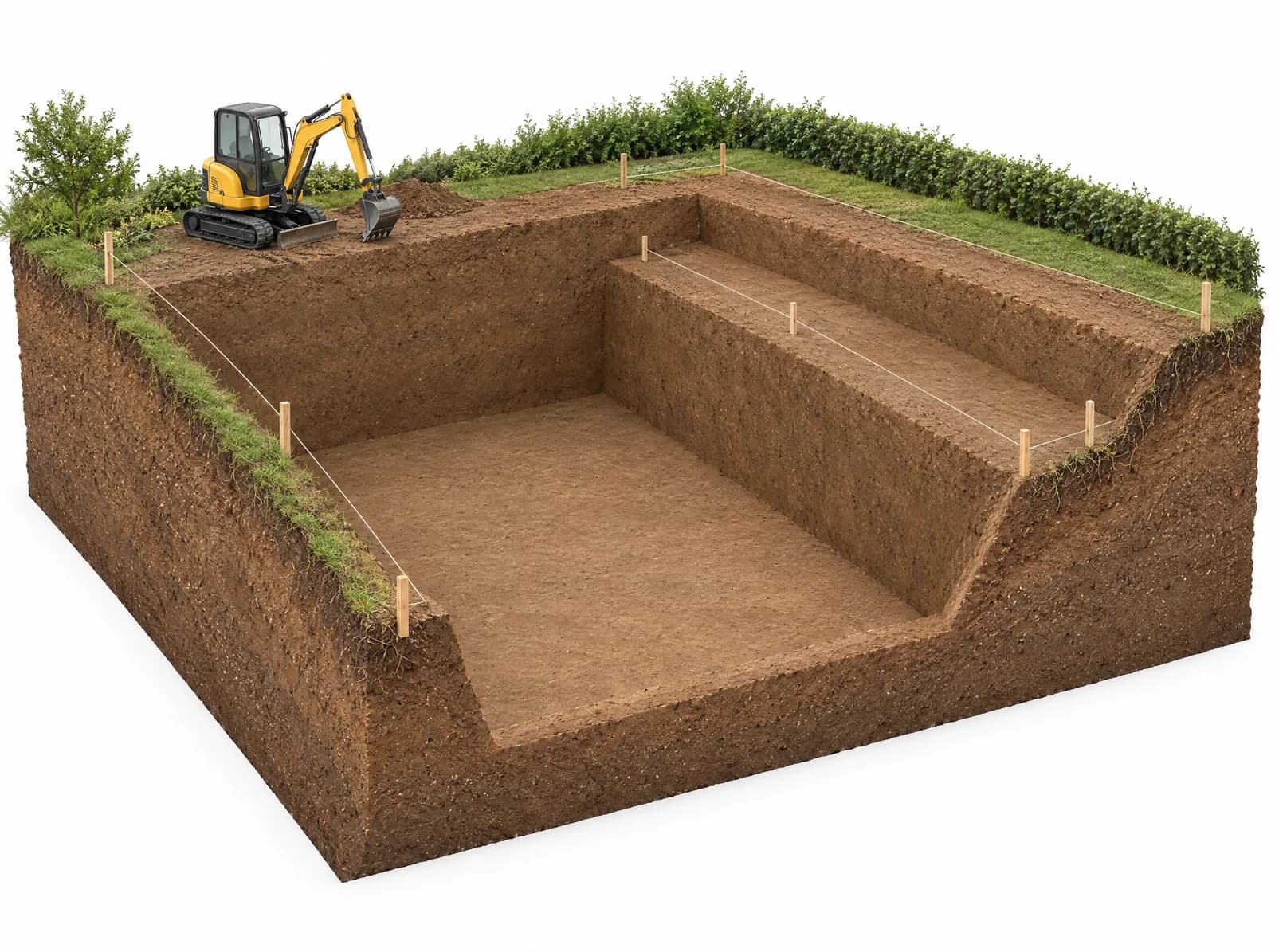
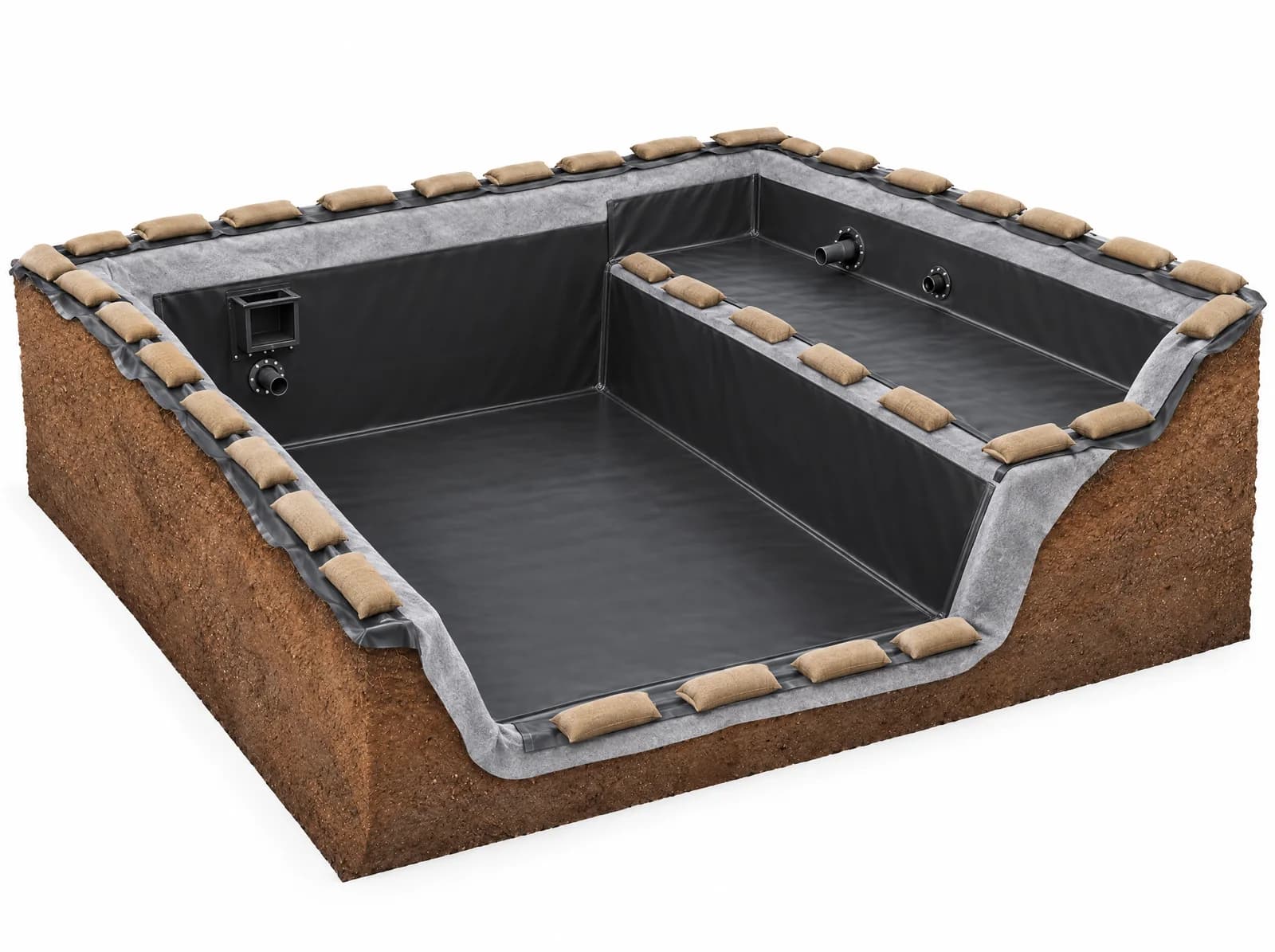
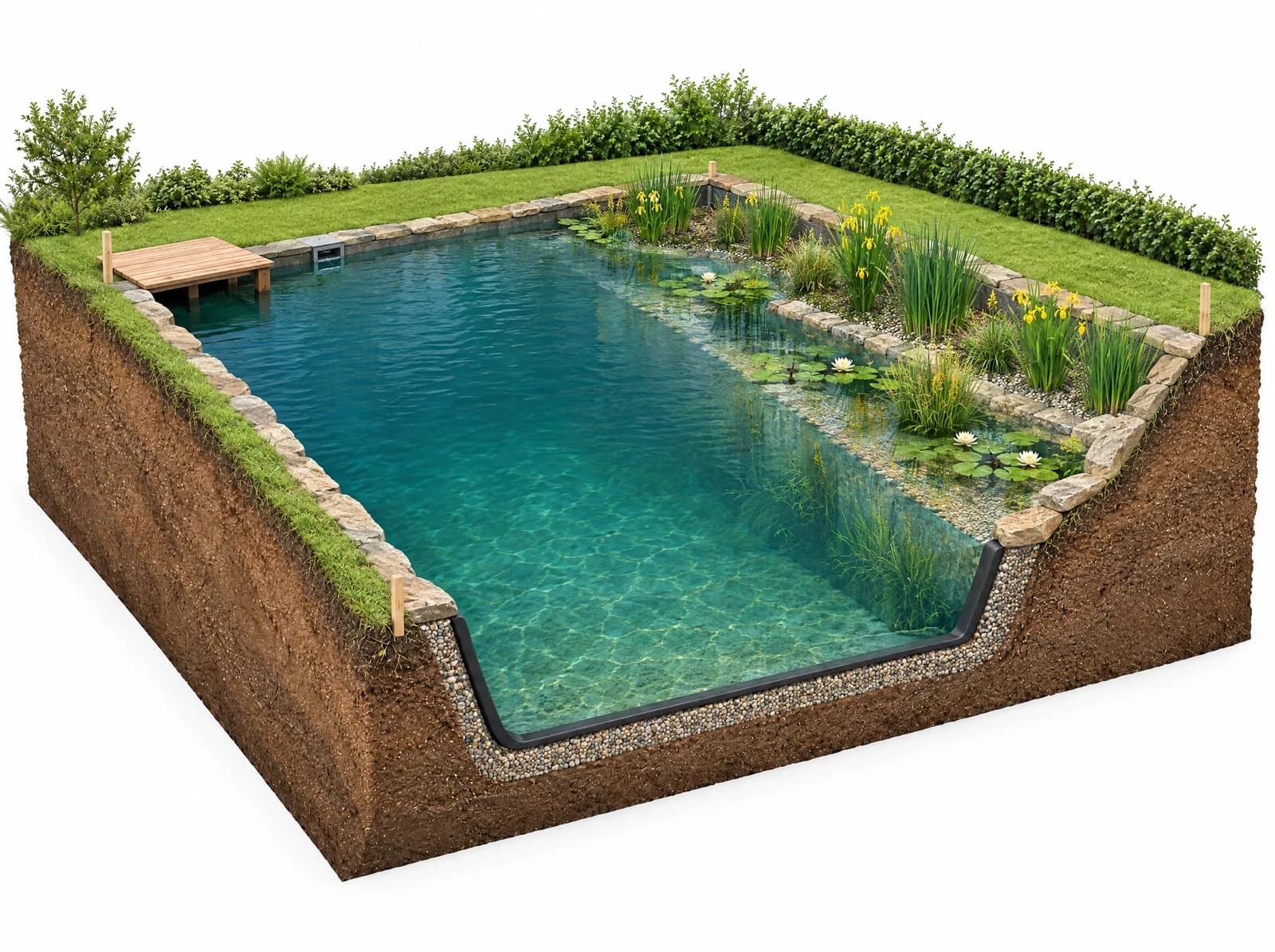
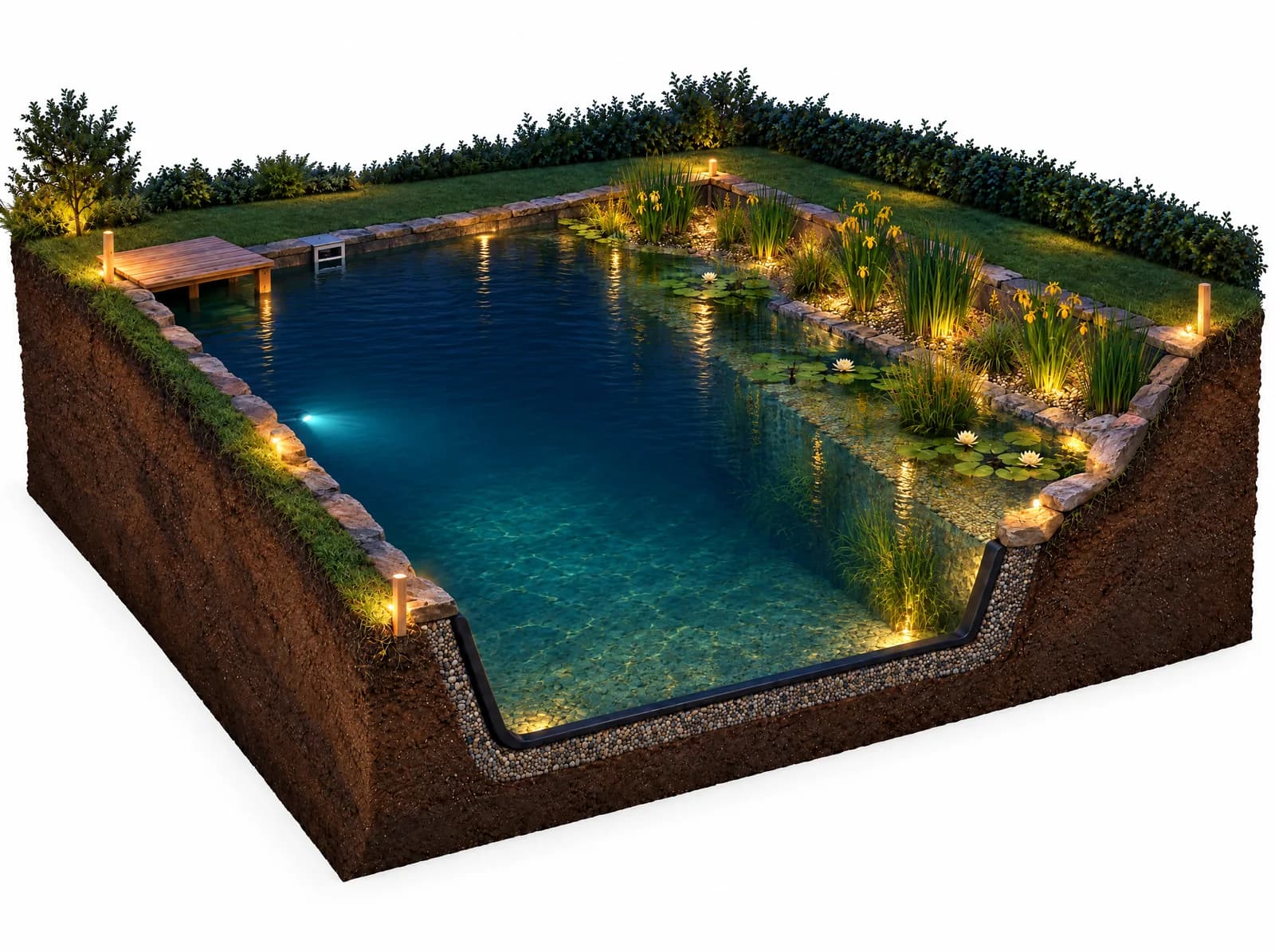
Natural pool construction process
01 / 04
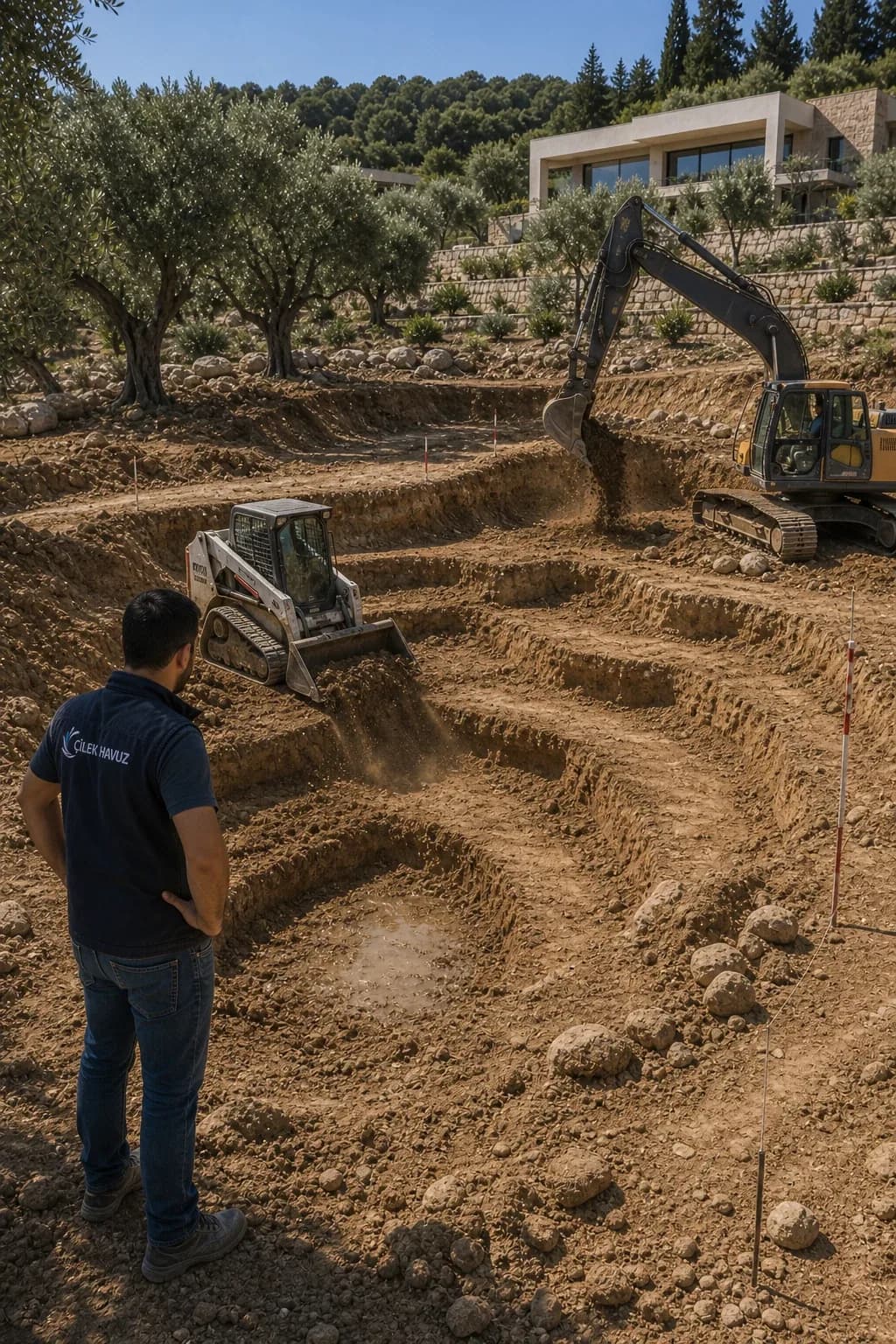
Excavation and terracing
Days 7-14- 01
- 02
- 03
- 04
Natural pool construction at Çilek Havuz
We build natural pools with the same engineering discipline as swimming pools.
One team handles the survey, the ecosystem design, the sealing and the commissioning, and the quotation is itemised line by line.
- Year founded
- 1998
- Years in the industry
- 33+
- Export countries
- 14
- Workmanship warranty
- 2
// 01 · Decision
A natural pool starts with four questions, and the proportions follow from the answers.
How clear a pond stays is decided before excavation begins, in the choice of location and zone proportions. We first clarify how the pond will be used, then what the site and the filtration method allow.
01
Purpose and users of the pond
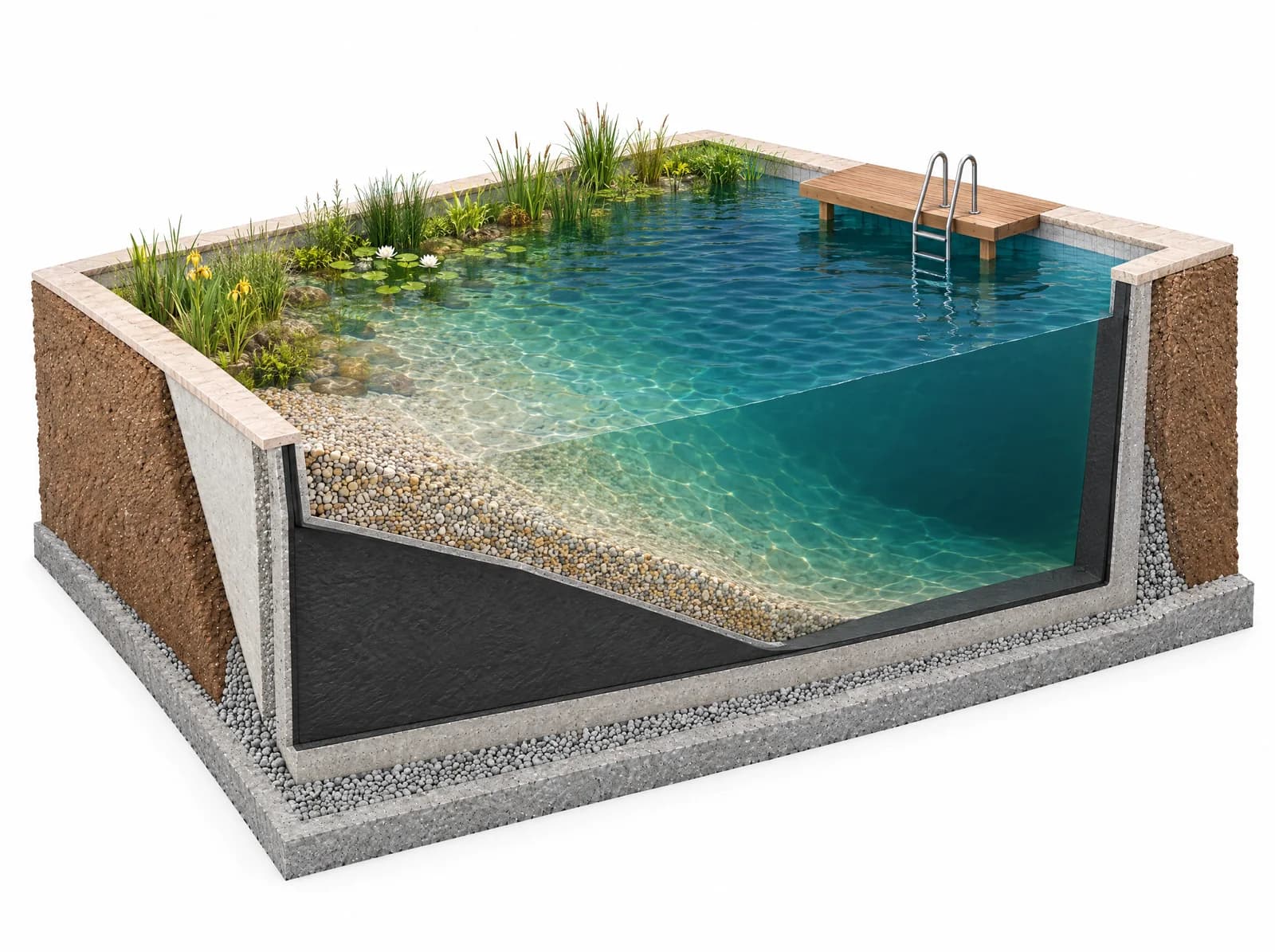
A swimming pond, a cooling pond or a purely ornamental water surface each call for a different depth and proportion. In ponds meant for swimming, the swimming zone is drawn at least 2 metres deep; if children will use it, a shallow entry and a supervision point are planned from the start.
- Swimming, cooling or ornamental use
- Family, villa or hotel use
- Shallow entry and safe exit points
02
What the site allows
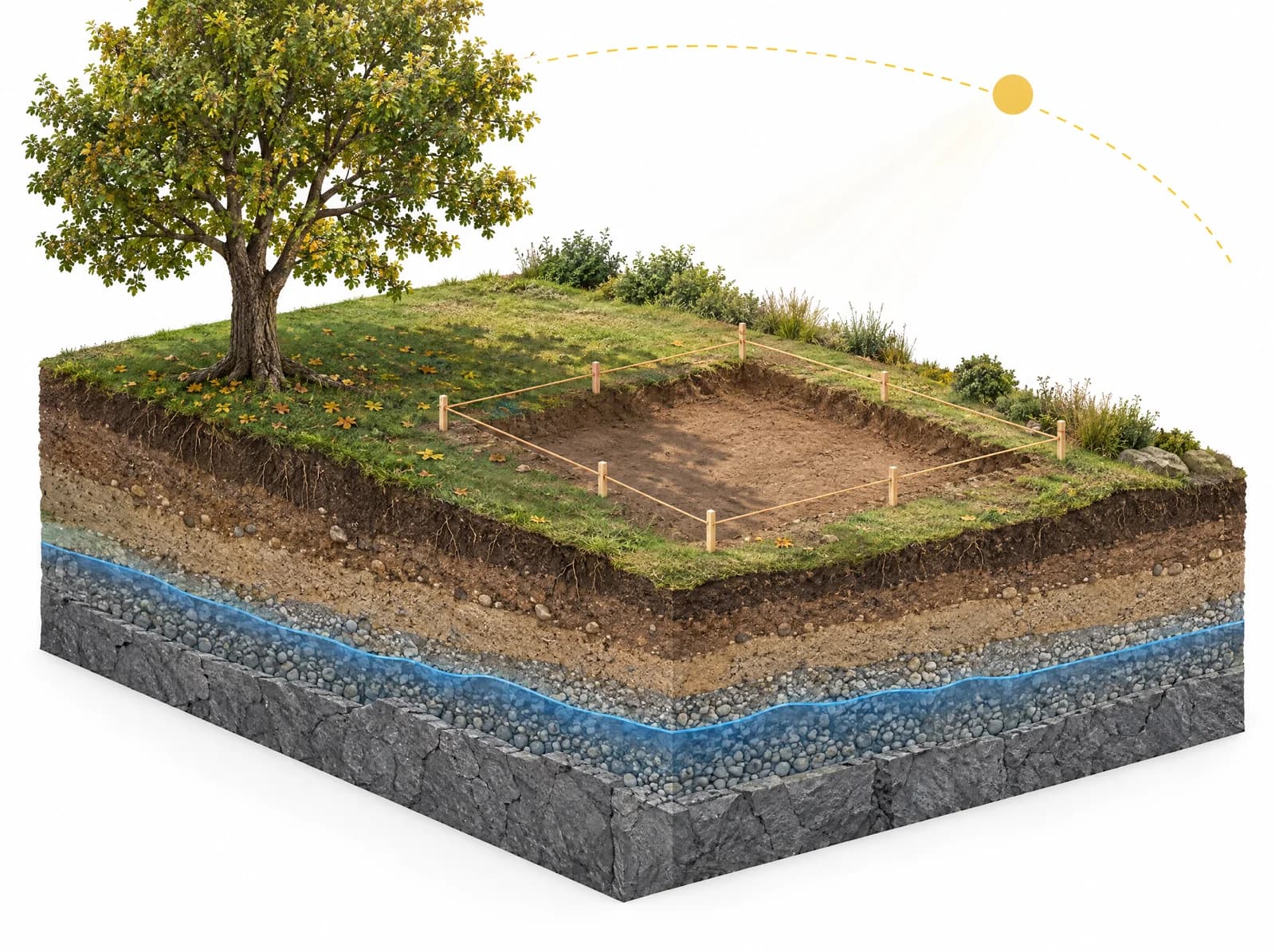
Soil, slope, groundwater and the spread of sun and shade through the day are examined on site during the survey. Leaf load from nearby trees and the source of top-up water directly affect how long the balance will hold.
- Soil, slope and groundwater
- Sun and shade distribution
- Trees, leaf load and water source
03
Choice of filtration method
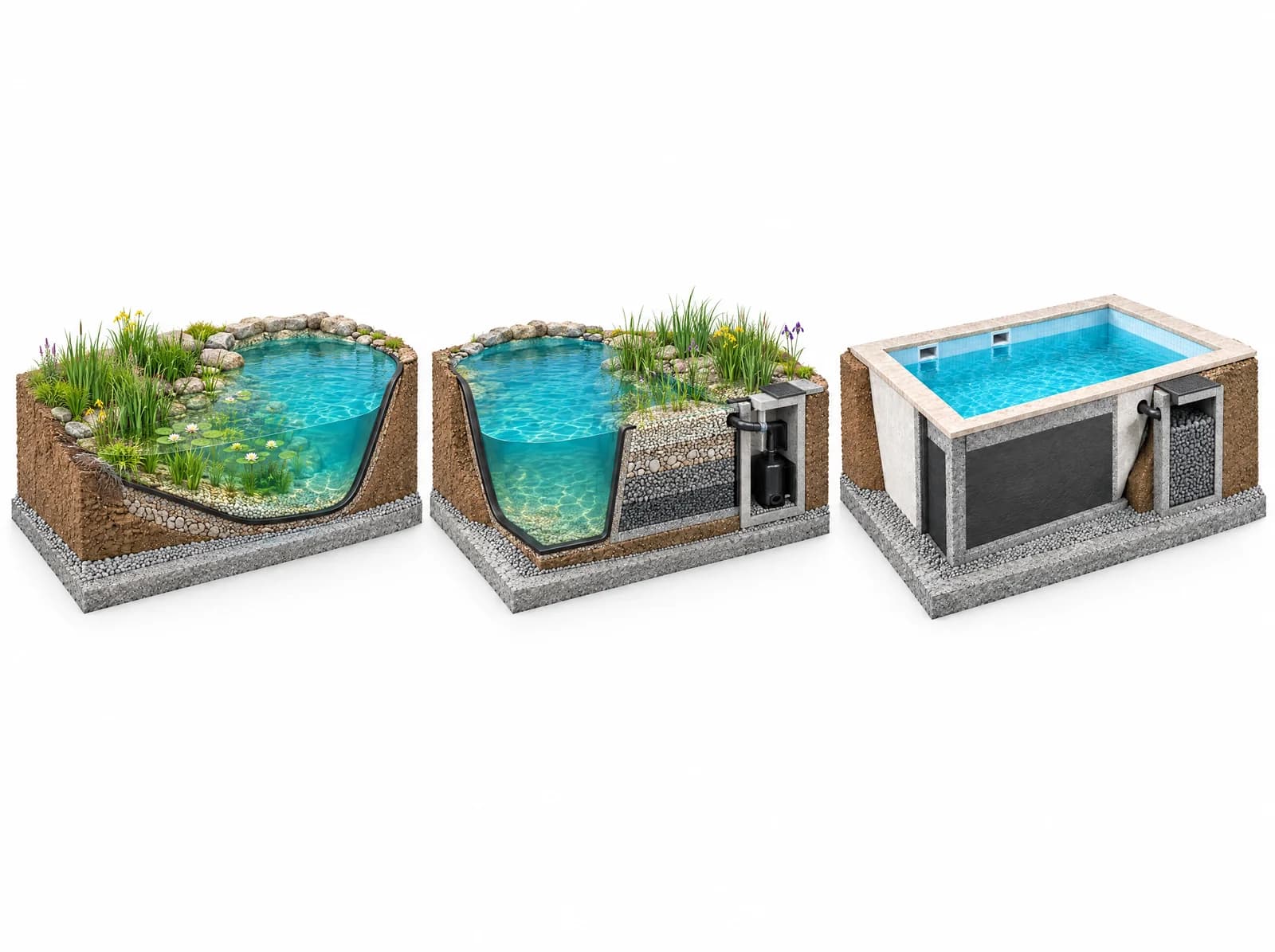
The water can be cleaned by plants alone, or a planted gravel filter and a biofilm filter can share the work. The more technical support there is, the smaller the planted zone becomes and the more regular the basin; chlorine and UV are not used in any type.
- Plant-filtered swimming pond
- Planted gravel filter
- Natural pool with biofilm filter
04
Calculating the regeneration area
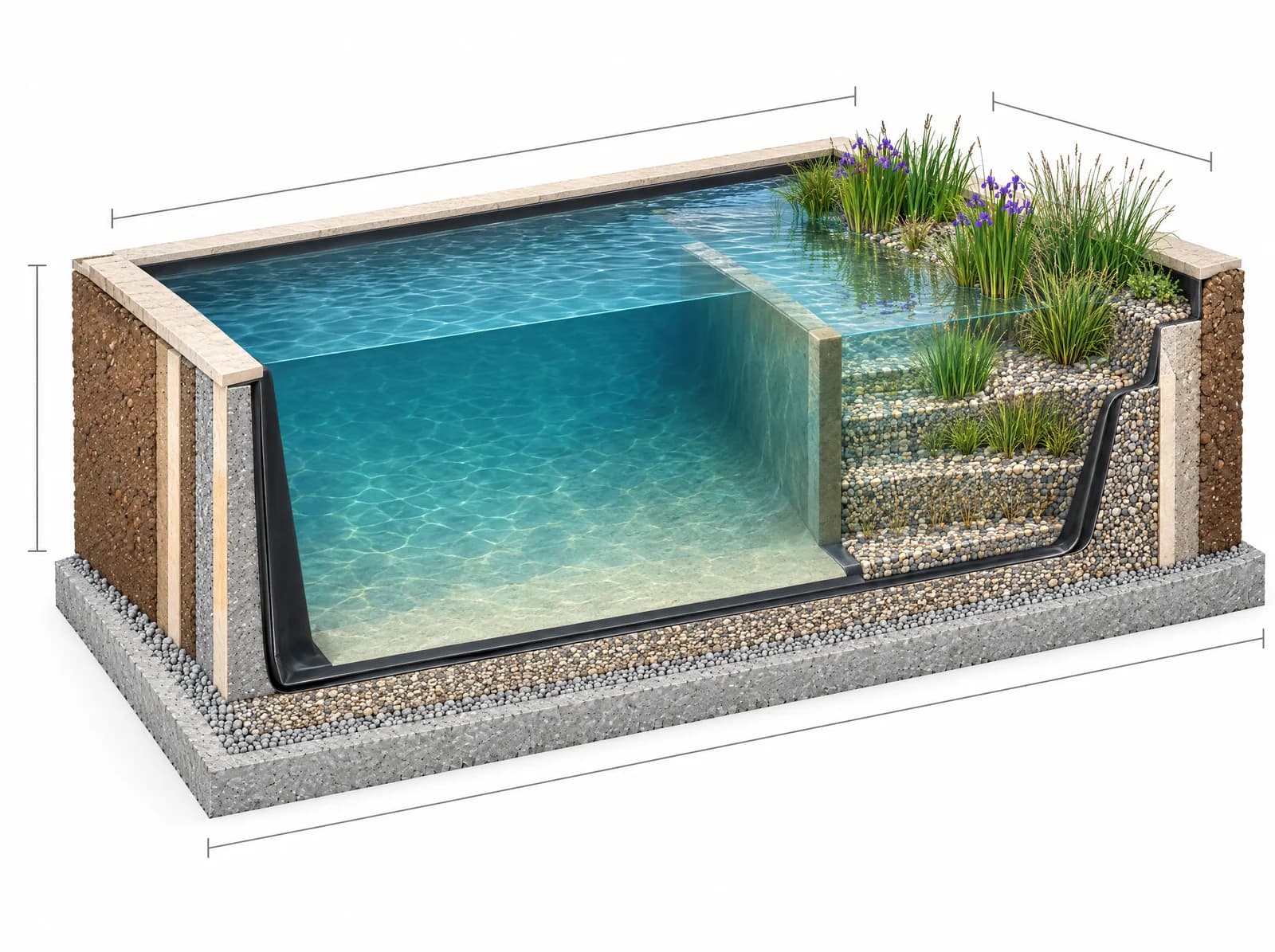
The share of the regeneration area in the total water surface depends on the method: at least 50 percent with plant-based flow filtration, 30-40 percent with a planted gravel filter and at least 25 percent with a biofilm filter. Balance is easier to reach when the total water surface is 30-40 m² or more.
- Swimming zone size and depth
- Regeneration share by method
- Total water surface and liner area
// 01 · Natural pool types
There are six types of natural pool, and we choose by the site.
We build six types: the plant-filtered swimming pond, the gravel-filtered swimming pond, the natural pool with biofilter, the two-basin pond, the pond with a beach entry and the conversion of an existing pool. The type is chosen at the site survey according to the land and the intended use.
01 / 06
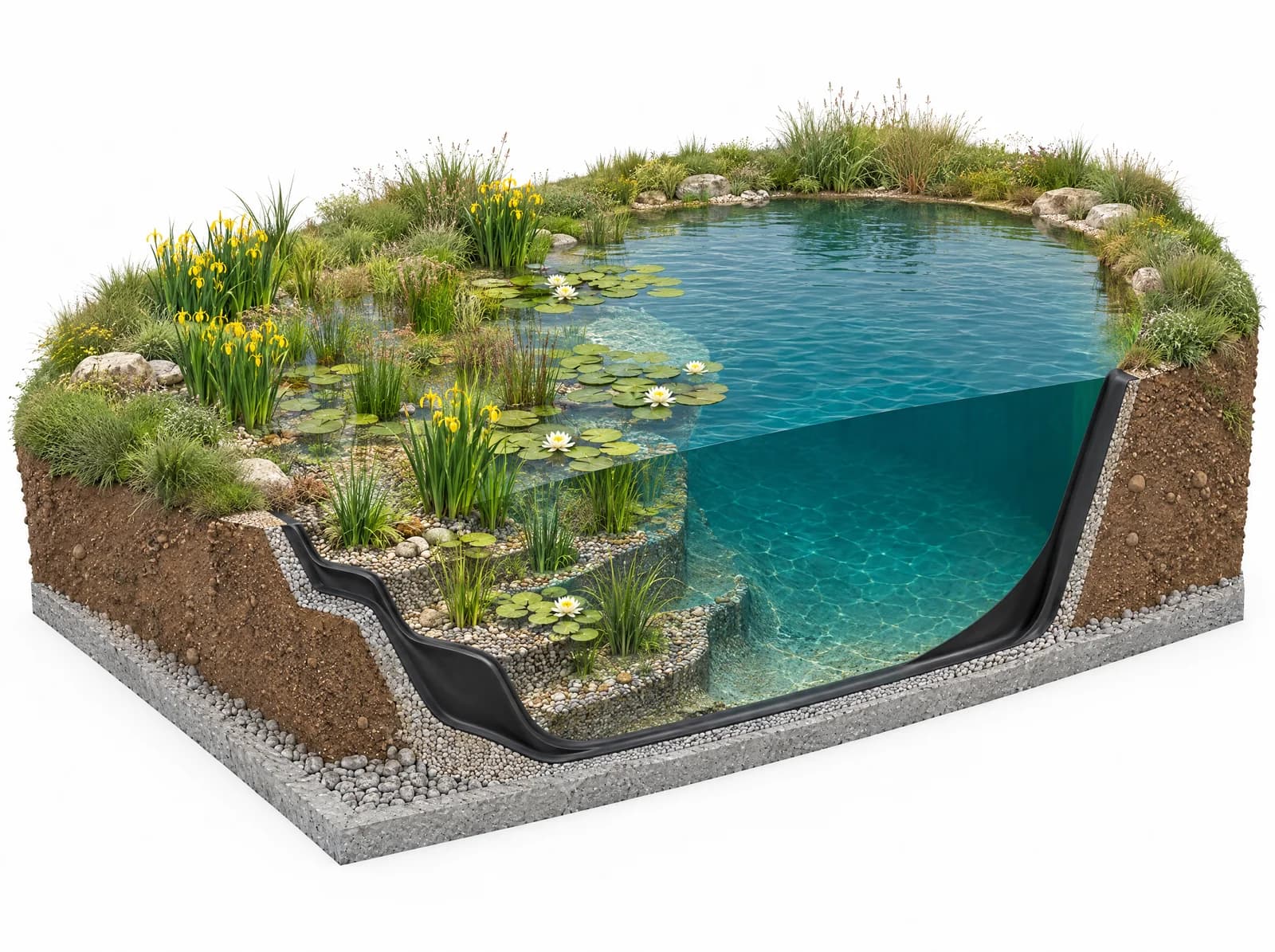
Plant-filtered swimming pond
Only the planted zone cleans the water.
- Filtration
- Plants and slow flow
- Regeneration area
- At least 50 percent of surface
- Appearance
- Natural-edged pond
- Sealing
- Liner or clay
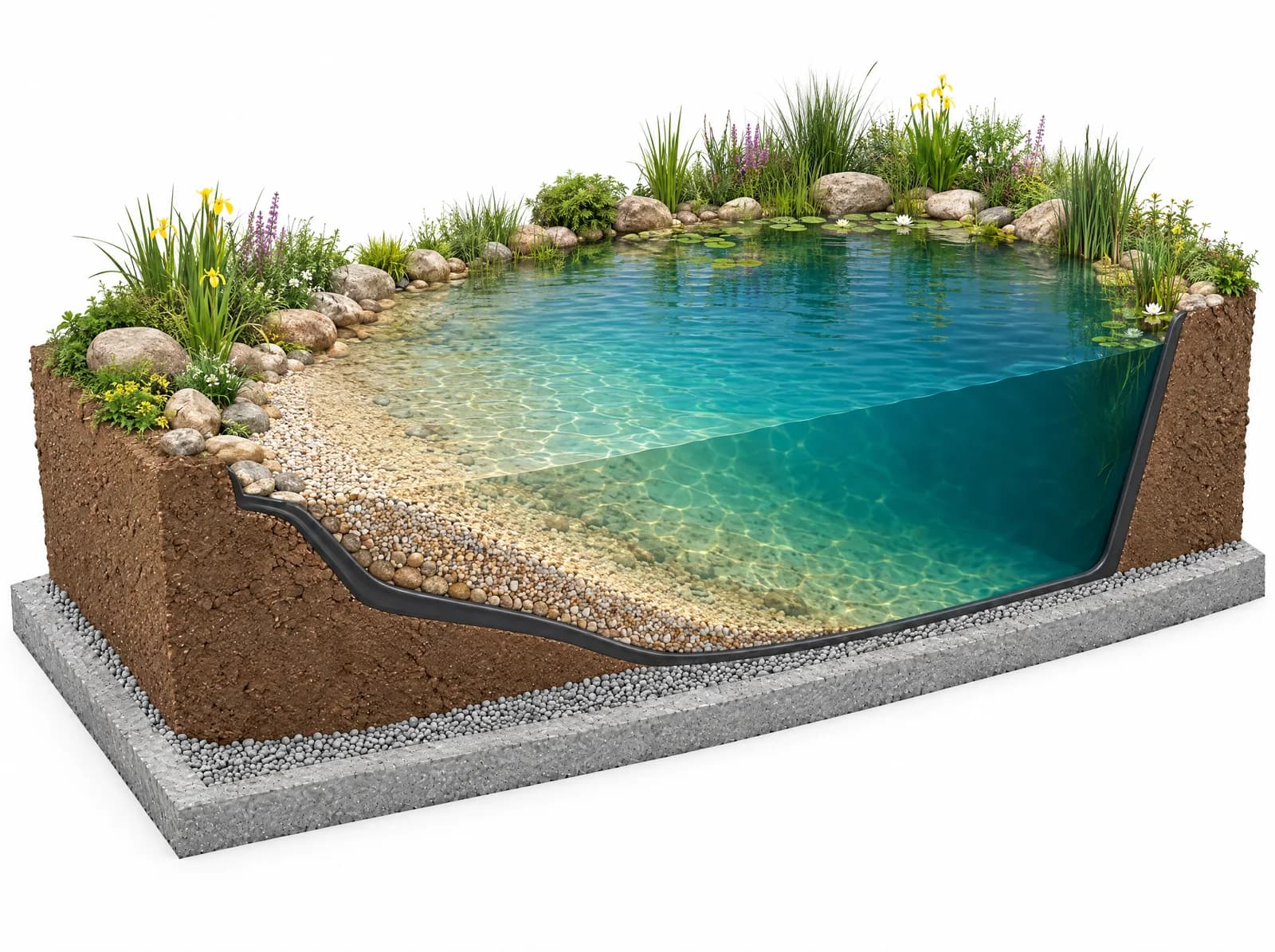
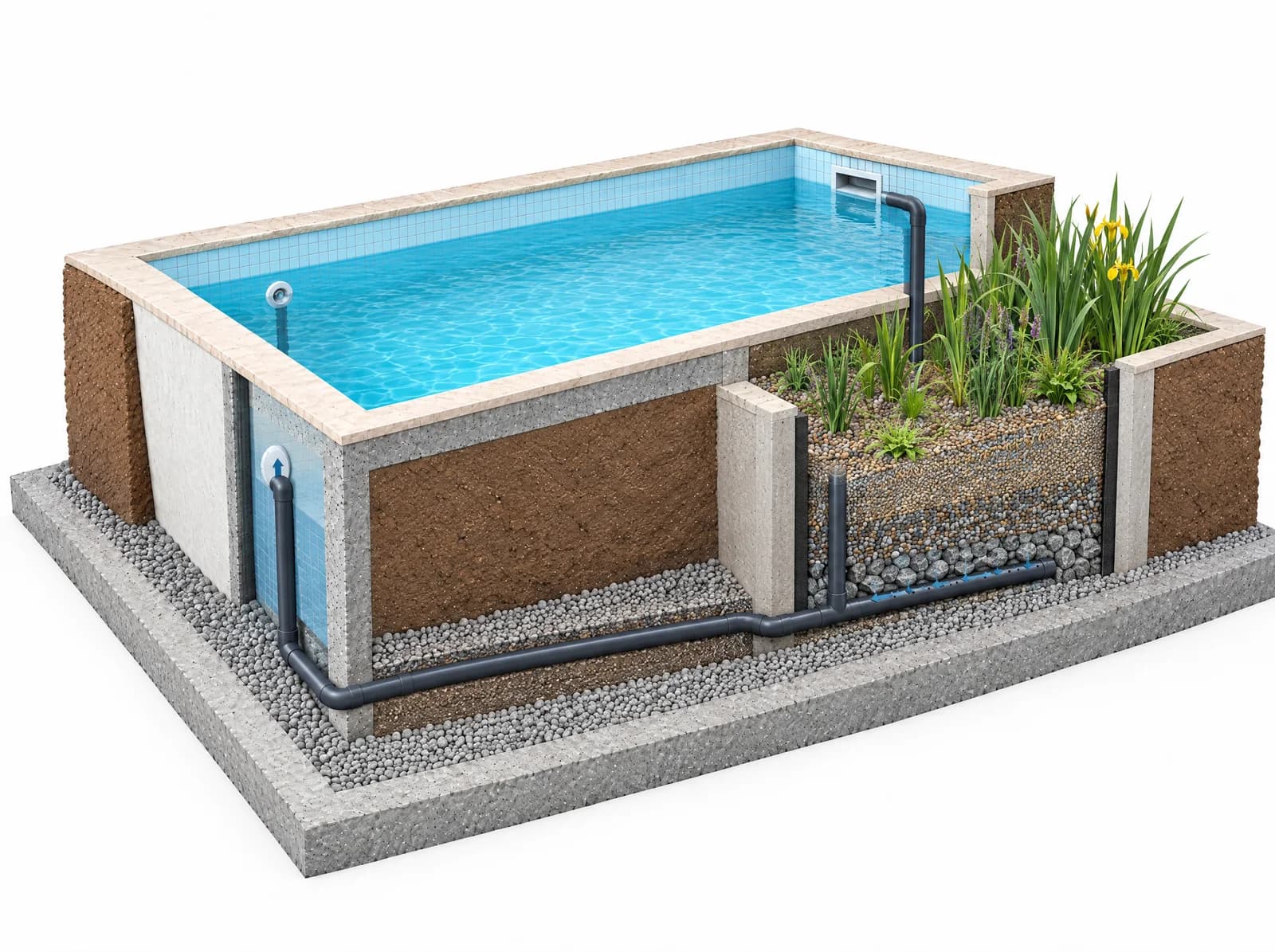
Water flows slowly from the swimming zone into the shallow planted zone, where plant roots and bacteria colonies in the gravel consume excess nutrients. The regeneration area covers at least half of the total surface and the edge looks entirely natural.
Best suited toLarge villa garden
View in detail: Plant-filtered swimming pondOnly the planted zone cleans the water.
- Filtration
- Plants and slow flow
- Regeneration area
- At least 50 percent of surface
- Appearance
- Natural-edged pond
- Sealing
- Liner or clay
Water flows slowly from the swimming zone into the shallow planted zone, where plant roots and bacteria colonies in the gravel consume excess nutrients. The regeneration area covers at least half of the total surface and the edge looks entirely natural.
Best suited toLarge villa garden
View in detail: Plant-filtered swimming pond01 / 06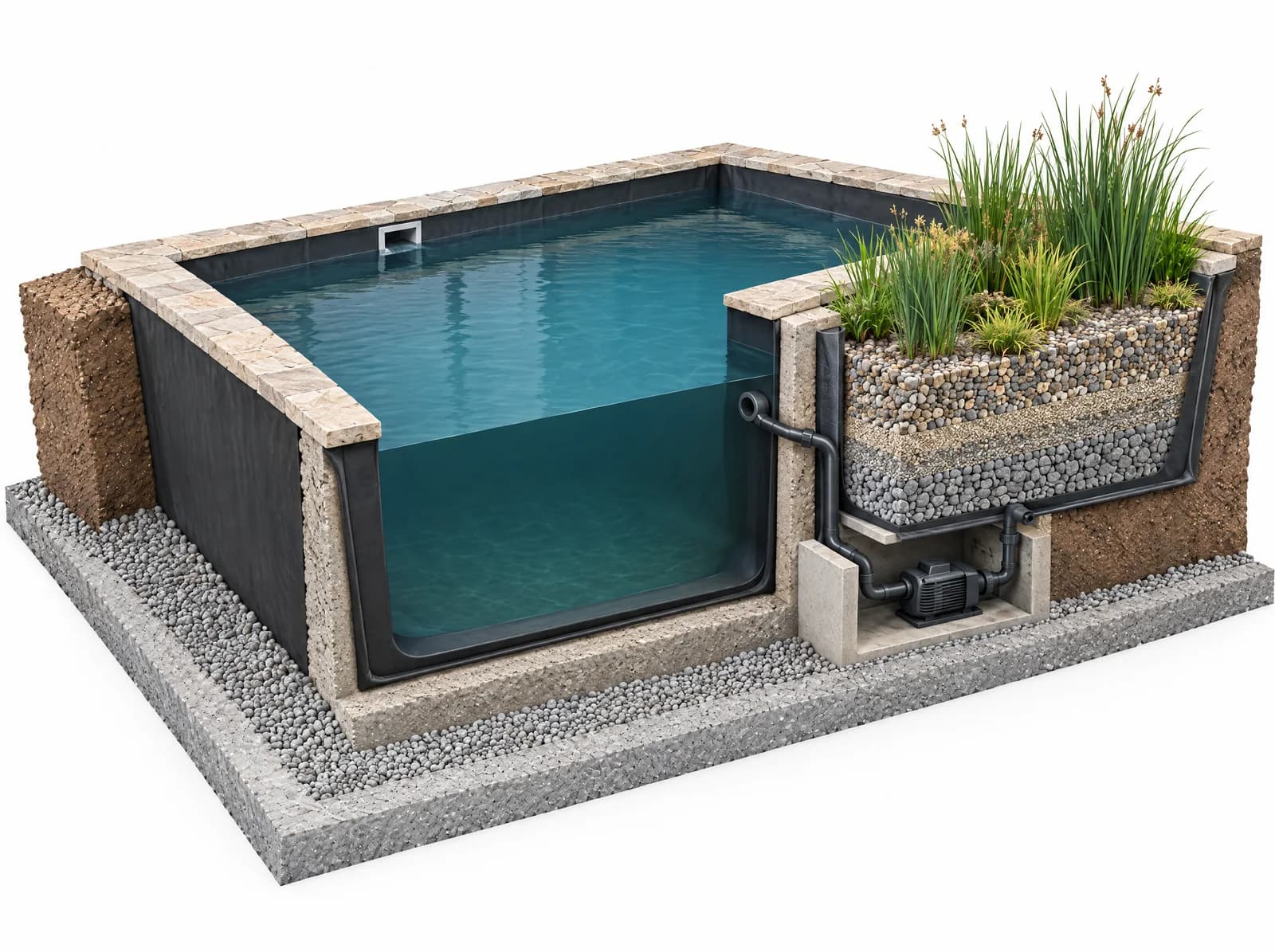
Plant-filtered swimming pond
- Filtration
- Plants and slow flow
- Regeneration area
- At least 50 percent of surface
- Appearance
- Natural-edged pond
- Sealing
- Liner or clay
Water flows slowly from the swimming zone into the shallow planted zone, where plant roots and bacteria colonies in the gravel consume excess nutrients. The regeneration area covers at least half of the total surface and the edge looks entirely natural.
Best suited toLarge villa garden
View in detail: Plant-filtered swimming pondGravel-filtered swimming pond
- Filtration
- Planted gravel filter
- Regeneration area
- 30-40 percent of surface
- Appearance
- Natural edge, regular lines
- Sealing
- Liner
The pump passes the water through a planted gravel filter bed with a slow, even flow. Because the filtering surface is larger, the regeneration area drops to 30-40 percent of the total surface.
Best suited toVilla and residential garden
View in detail: Gravel-filtered swimming pondNatural pool with biofilter
- Filtration
- Biofilm filter
- Regeneration area
- At least 25 percent of surface
- Appearance
- Geometric basin
- Sealing
- Liner or reinforced concrete
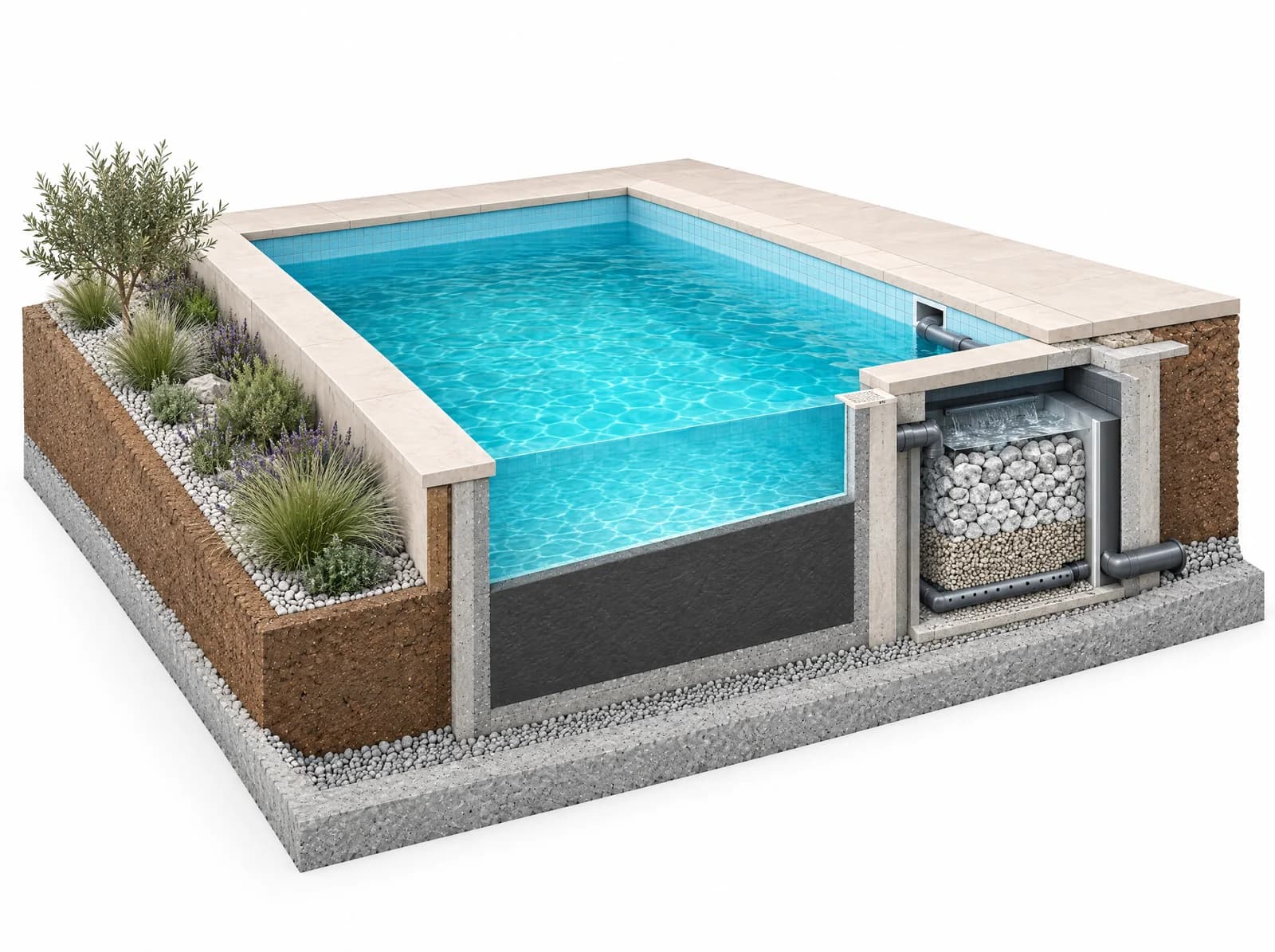
Water passes through a fast-flow substrate filter, and the cleaning is done by the biofilm layer that forms on the surface of the filter grains. The regeneration area drops to a quarter of the total surface, the basin is drawn as regularly as a classic pool and plants play an ornamental role.
Best suited toModern villa and compact garden
View in detail: Natural pool with biofilterTwo-basin pond
- Filtration
- Separate filter basin
- Regeneration area
- In a separate basin
- Appearance
- Regular basin, separate planted basin
- Sealing
- Liner or reinforced concrete
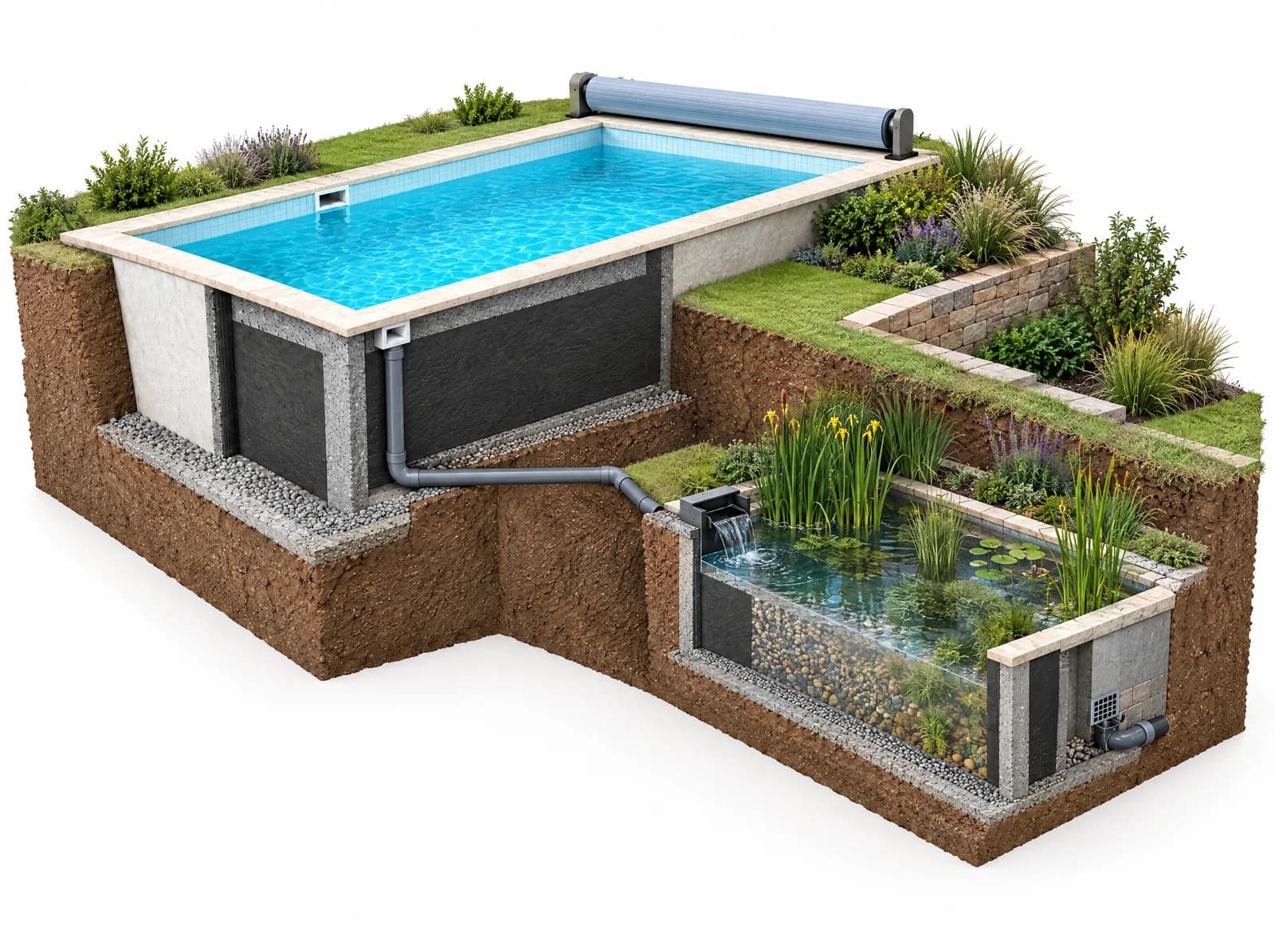
The swimming basin and the regeneration basin are built separately; water is drawn from the skimmer, passed through the planted filter basin and returned. With no plants in the swimming area, the basin can be covered, and the regeneration basin can sit in another corner of the garden.
Best suited toArchitectural garden and terrace
View in detail: Two-basin pondPond with beach entry
- Filtration
- Plants and gravel bed
- Regeneration area
- Calculated by method
- Appearance
- Gravel beach entry
- Sealing
- Liner
The swimming zone is reached from the shore along a gravel beach band, without steps, descending gradually from shallow to deep. The shallow entry band is framed with marginal plants; for families with children, the entry point and supervision area are drawn from the start.
Best suited toFamily garden and large plot
View in detail: Pond with beach entryConversion of an existing pool
- Filtration
- Planted filter basin
- Regeneration area
- Separate area beside the basin
- Appearance
- Existing basin
- Sealing
- Existing basin and liner
The existing pool remains as the swimming zone; water drawn from the skimmer passes through a planted filter basin built beside it instead of conventional treatment. The scope of the conversion is set at the site survey, according to the condition of the basin and the space available in the garden.
Best suited toExisting villa pool
View in detail: Conversion of an existing pool// 01 · Regeneration area calculation
Enter the swimming zone, and we calculate the regeneration area.
Enter the width, length and depth of the swimming zone; the calculation instantly shows the water volume, the liner area and, for three filtration methods, the required regeneration area and total water surface.
Calculation rule: regeneration area = swimming area × p ÷ (1 - p); p is the share of the regeneration area in the total water surface used in the calculation: 0.50 for plant-based flow filtration, 0.40 for a planted gravel filter (the safe end of the 30-40 percent range) and 0.25 for a biofilm filter. Liner = (width + 2 × depth + 1) × (length + 2 × depth + 1) m², with a 0.5 m overlap on each edge. Balance becomes harder when the total water surface is below 30 m²; the final proportion is set in the project according to climate and plant selection.
Get a quote with these dimensions
Send us the swimming zone size and details of your site; we confirm the filtration method, liner and plant list at the site visit and prepare an itemised quotation.
| Item | Value |
|---|---|
| Swimming zone area | 32.0 m² |
| Swimming zone water volume | 57.6 m³ |
| Swimming zone liner (including overlap) | 108.4 m² |
| Regeneration area, plant filtration | 32.0 m² |
| Total water surface, plant filtration | 64.0 m² |
| Regeneration area, planted gravel filter | 21.3 m² |
| Total water surface, planted gravel filter | 53.3 m² |
| Regeneration area, biofilm filter | 10.7 m² |
| Total water surface, biofilm filter | 42.7 m² |
// 01 · Pond layers
The pond floor has five layers, protecting the water and the liner.
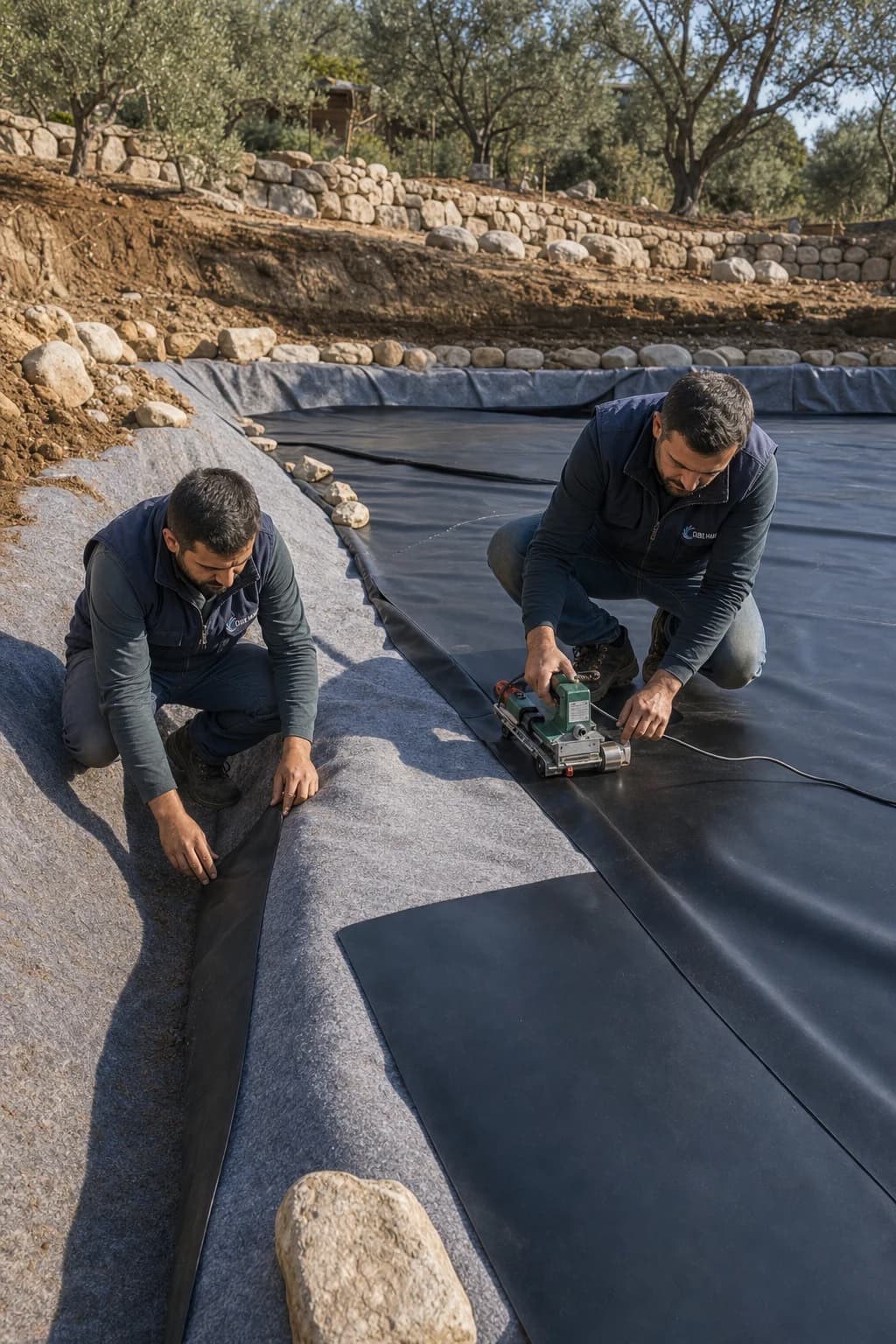
From the inside out, we build the floor with gravel and substrate, an upper protective fleece, the liner, a lower protective fleece and compacted soil. The fleeces protect the liner from stones and roots, and the gravel layer gives bacteria colonies a place to live.
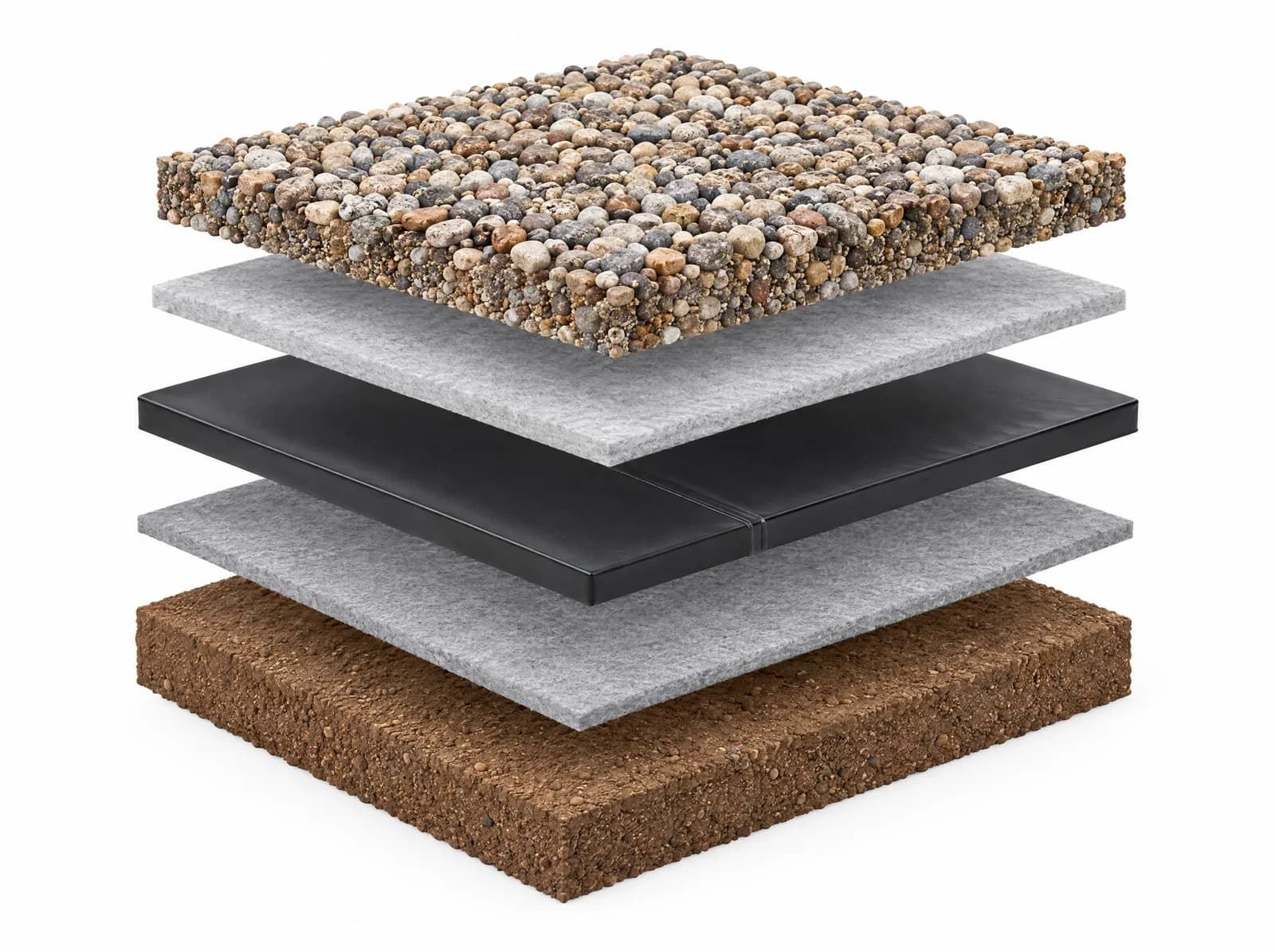
- Gravel and substrateWashed gravel; this is where bacteria colonies live.
- Upper protective fleeceProtects the liner from the pressure of gravel and stone.
- LinerFlexible pond liner; seams are welded.
- Lower protective fleeceGeotextile fleece; protects against stones and roots in the soil.
- Compacted soilLevelled base, cleared of stones and roots.
// Reading plan
Before building a natural pool, read these six short articles.
The order follows the natural course of a pond decision: first the system itself, then location, sealing, circulation, shoreline landscaping and safety.
Ponds and natural pools
How biological filtration works.5 minShort answer
Instead of chlorine, the water is cleaned by plant roots and beneficial bacteria colonies in the gravel. Water circulates constantly between the swimming zone and the planted zone, so mechanical and biological cleaning happen together.
- 01Excavation and terracingDays 7-14Stepped terraces, level control, soil compaction
- 02Liner and sealingDays 3-5Protective fleece, welded liner, penetration seals
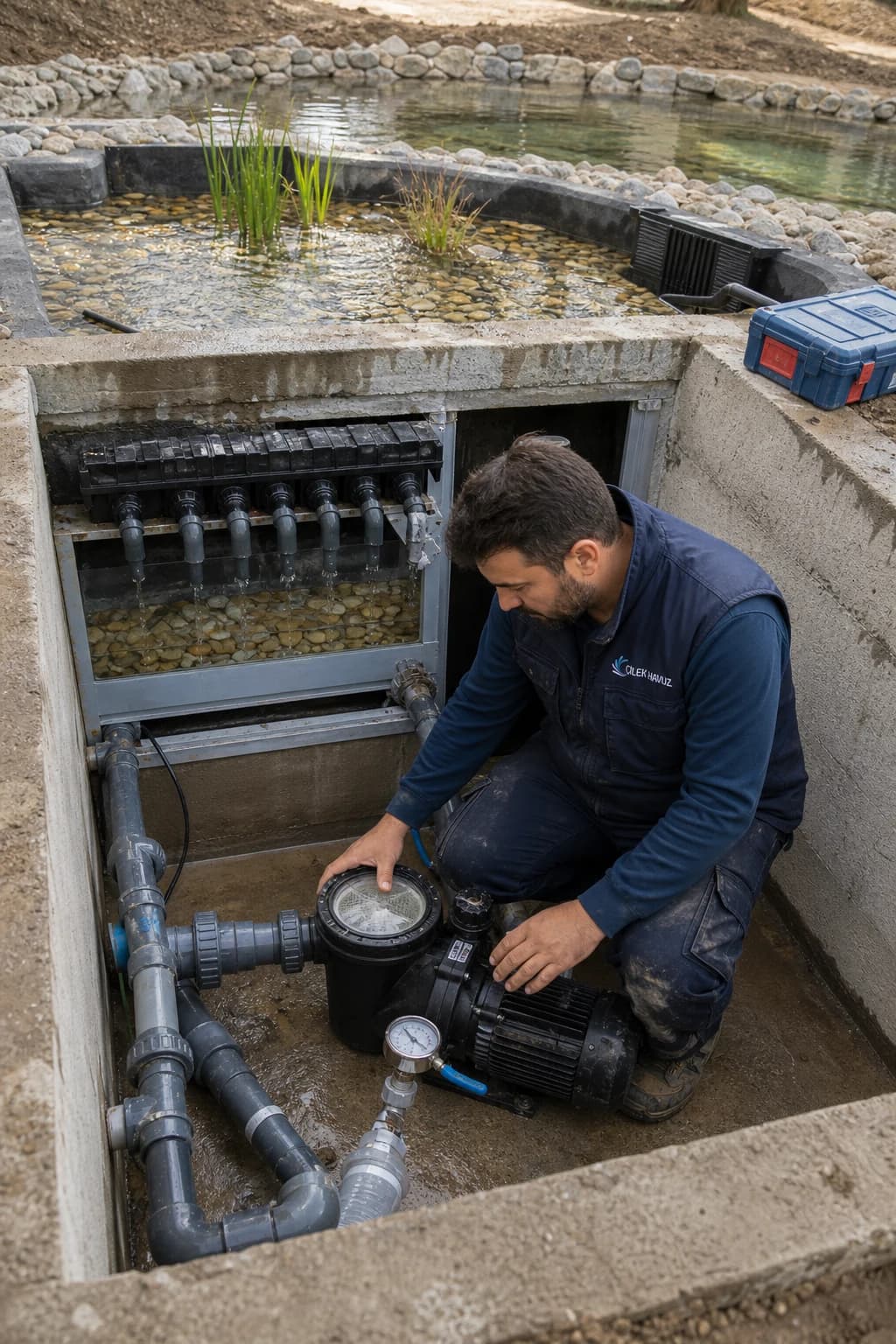
- 03Filtration and plantingDays 6-10Pump, skimmer, gravel bed and cleansing plants
- 04Filling and commissioningDays 1Staged filling, flow test, first balance check
Garden pool construction
Location, size and harmony with the garden.8 minShort answer
The real decision is where the water will sit in the garden. Tree roots, sun orientation, boundaries and machine access shape the finished garden; for a pond, leaf load is added to that list.
Pool waterproofing
Materials, layer order and water retention test.6 minShort answer
Most leaks start not on large surfaces but at pipe penetrations, drains and junction details. In a pond, too, liner seams and skimmer penetrations are the most sensitive points for sealing.
Choosing a pool pump
Flow rate, speed and energy balance.5 minShort answer
A variable-speed pump circulates the same water at low speed, with less energy and noise. In a pond the pump does not clean the water, it only moves it; that is why we choose pumps that run for long hours at low speed.
Pool surround and decking
Slip-resistant surfaces, timber and landscaping.6 minShort answer
On surfaces used wet and barefoot, slip resistance comes first. Drainage falls are directed outward so that rainwater and soil are not carried into the water.
Pool safety
Barrier, cover, alarm and safe entry.6 minShort answer
No single measure is enough; barrier, cover, alarm and supervision are layered together. In a pond the planted zone can hide the floor, so safe entry points are drawn from the start.
Showroom
Plan a showroom visit
At our showroom in Çilek Plaza, Sancaktepe, you can discuss your project with our team. We recommend booking an appointment by phone before your visit.
Working Hours
- Monday to Friday · 08:00-17:30
- Saturday · 08:00-12:30
- Closed on Sunday
// 02 · Cost
Two things drive the cost of a natural pool, surface area and sealing.
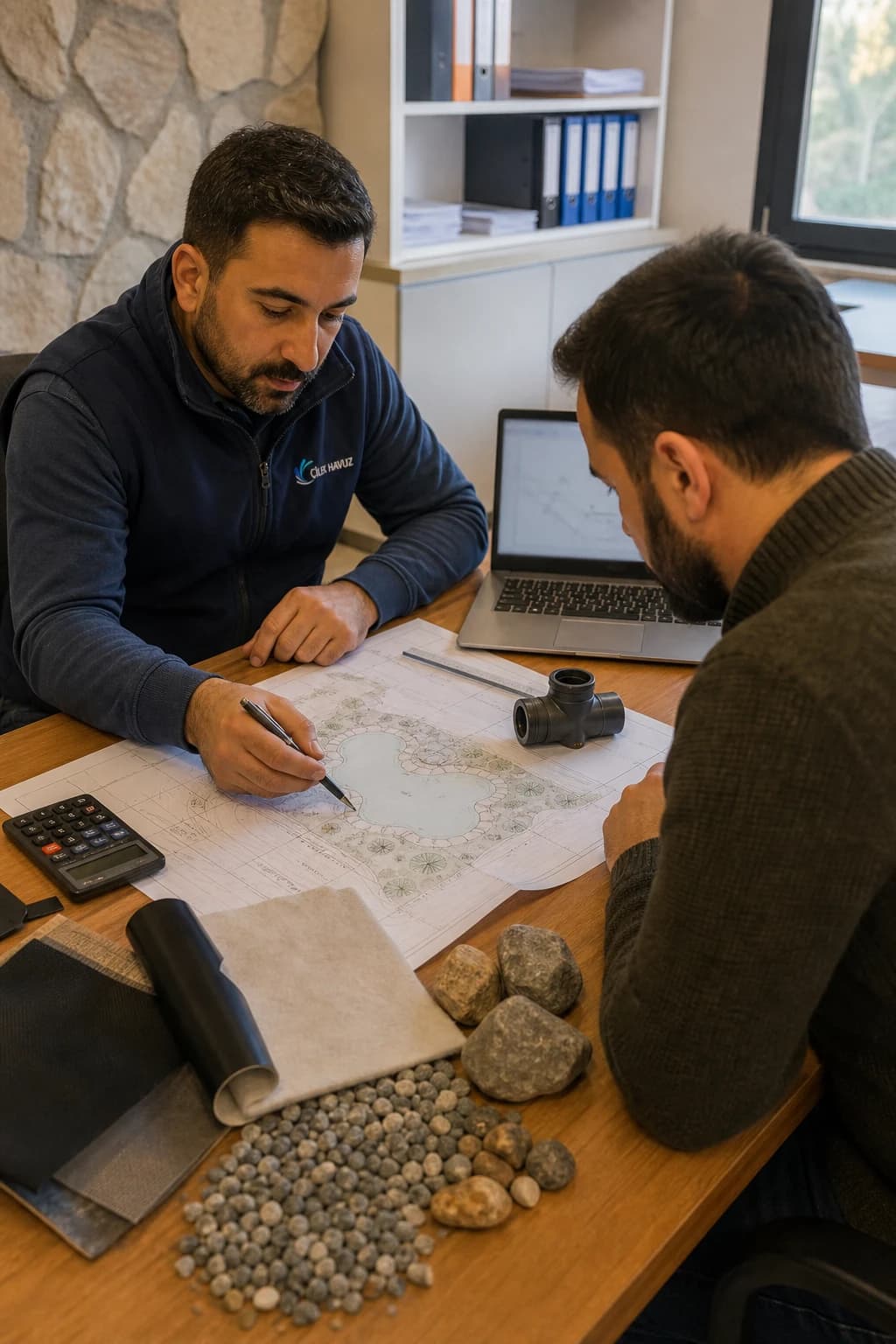
In natural pool construction the budget depends not only on the swimming area but on the total water surface including the regeneration area, the excavation volume and the liner. The six factors below explain why two natural pool prices differ; the final amount is set in an itemised quotation after the site survey.
Total water surface
The method sets the planted zone and so the total surface.
Excavation and terracing
Terraces, soil type and machine access set the duration.
Liner and protection
Liner grade and area, seams and penetration details.
Circulation and filter
Low-speed pump, skimmer, gravel or biofilm filter.
Plants and substrate
Number of plants, baskets, washed and dolomite gravel.
Shoreline and landscaping
Natural stone, beach entry, jetty and lighting scope.
// 03 · Process
A natural pool is built in eight steps, each one resting on the last.
The process begins with the survey and ecosystem design, continues with excavation and sealing, and takes shape with circulation and planting. We hand over the pond with staged filling, a flow test and maintenance training, and monitor the balance throughout the first season.
Survey and design
Site analysis, zoning, depth steps and plant list
Approved ecosystem design and itemised quotation
Excavation and sealing
Stepped terrace excavation, base preparation, fleece and liner
Tested, watertight basin
Filtration and landscaping
Pump, skimmer, gravel bed, planting and edge stone
Planted, working filtration cycle
Handover
Budget close-out, staged filling, flow test and maintenance training
Commissioned pond and first-season follow-up
The eight steps in detail
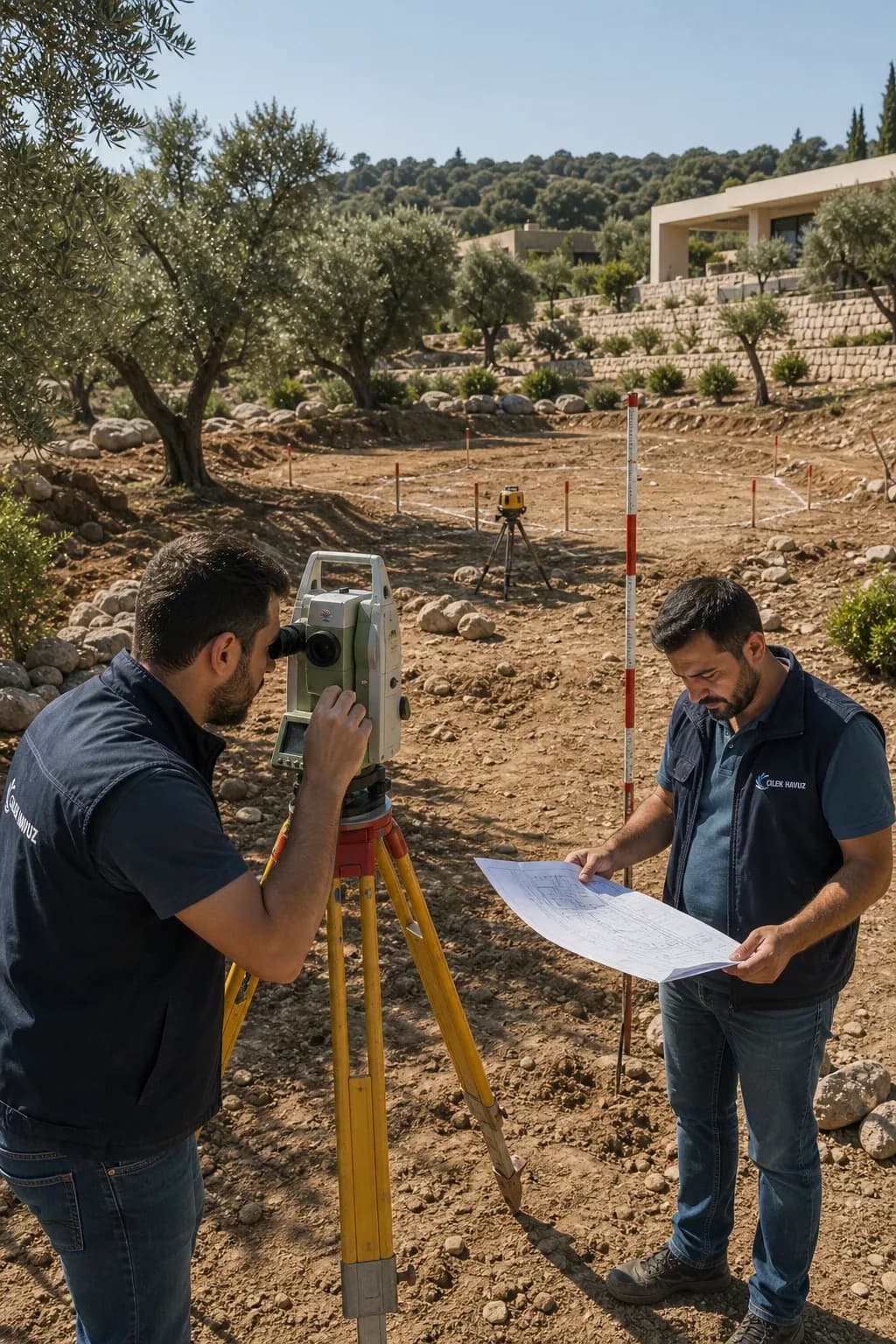
01 / 08
Site Survey and Ground Analysis
Ground, Fall and Sun
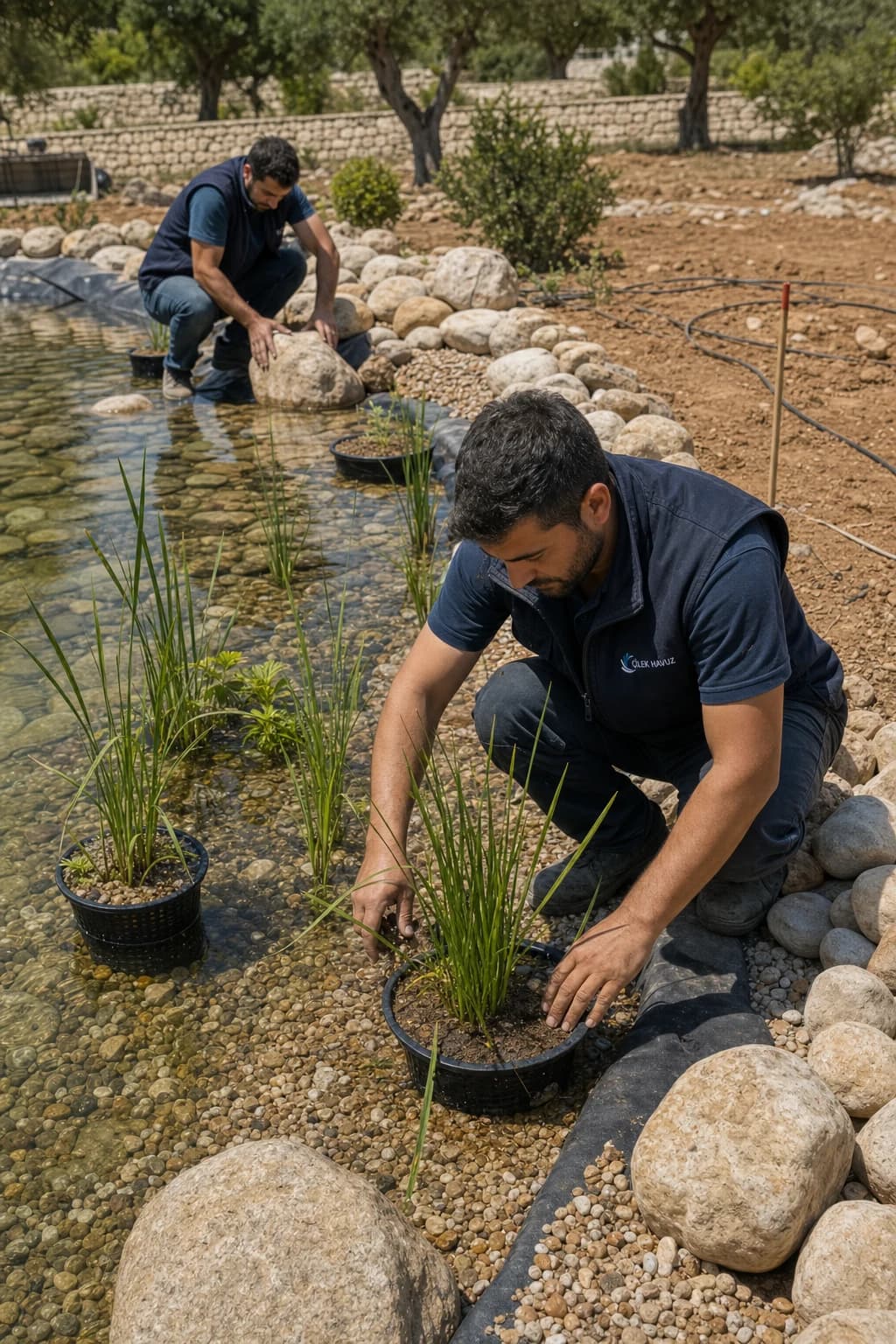
A natural pond begins with the land itself. Our technical team examines the structure of the ground, the fall, the groundwater conditions and the distribution of sun and shade through the day on site, then establishes the right position for the swimming and purification zones.
On the same visit, the water supply, the electrical connection and the leaf load from the surrounding trees are assessed; each of these has a direct bearing on how long the balance you are about to build will hold.
- Ground and groundwater survey
- Site fall and level measurement
- Sun and shade distribution
- Surrounding trees and leaf load
- Water supply source
- Access to the electrical supply
- Intended use (swimming / landscape)
- Preliminary budget frame
Do not underestimate shade
In a pond that sits in full shade all day the plants work poorly; in constant full sun the water warms and feeds algae. Choosing the right position resolves half the purification before excavation has even started.


// 04 · Plants and fill materials
We choose plants for each zone, because they clean the water.
We place marsh plants along the edge band, water lilies and submerged plants in the deep zone, and washed and dolomite gravel in the filter bed. Marginal plants grow in 0-25 cm of water and water lilies in 40-75 cm; the species list is finalised at the survey according to climate.
 01
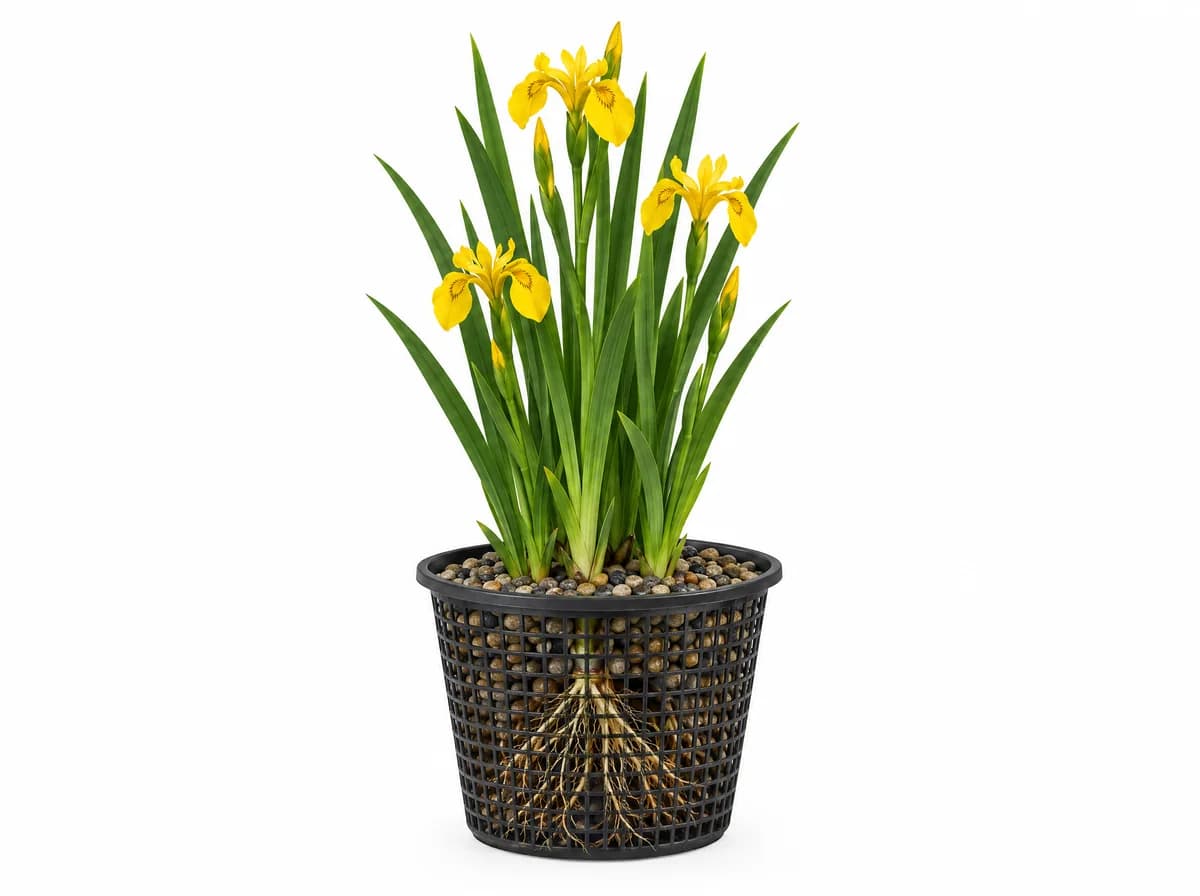
Yellow flag iris
A yellow-flowered marginal plant with strong roots. It consumes excess nutrients in shallow water and naturally hides the liner edge along the shoreline.
Where it is used
- Edge band
- Shallow zone
 02
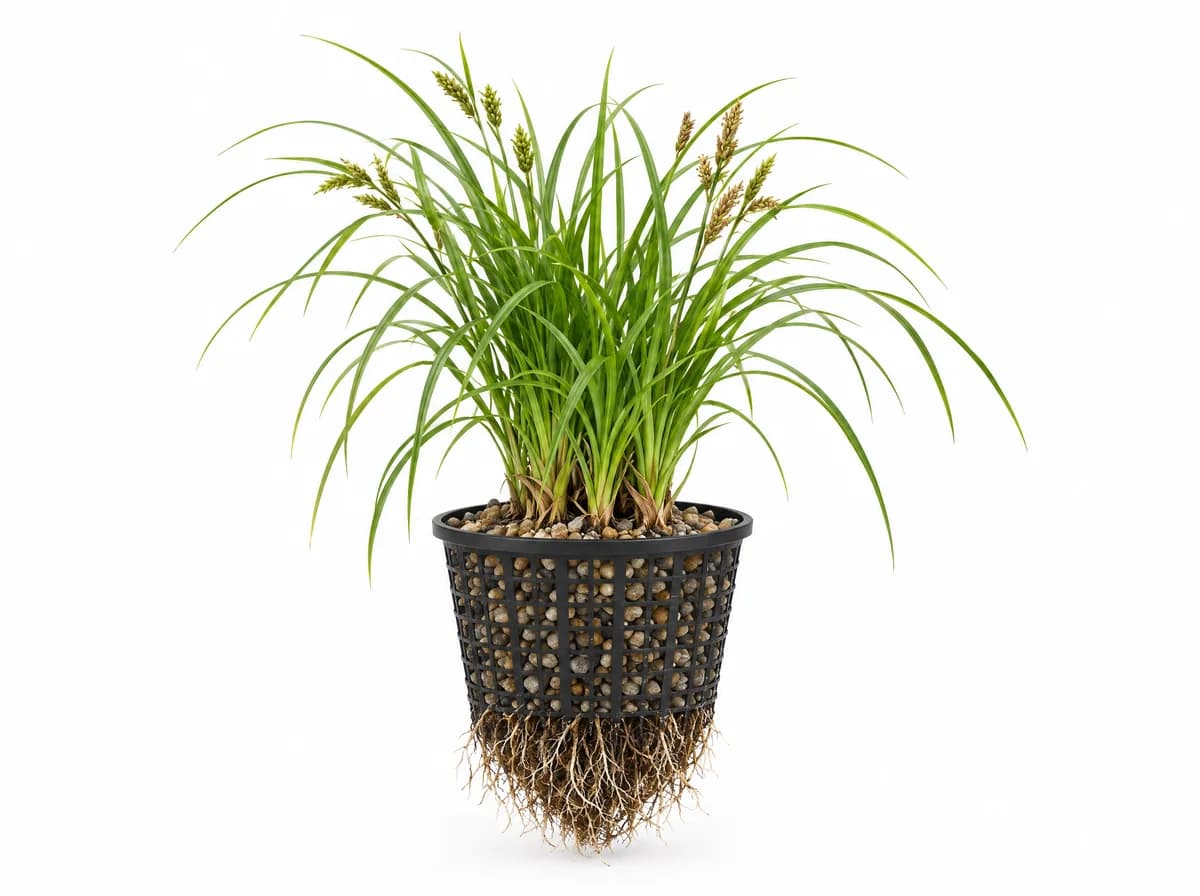
Sedge (Carex)
A clump-forming, winter-hardy marginal plant. Its roots grip the gravel bed and stabilise the bank slope.
Where it is used
- Edge band
 03
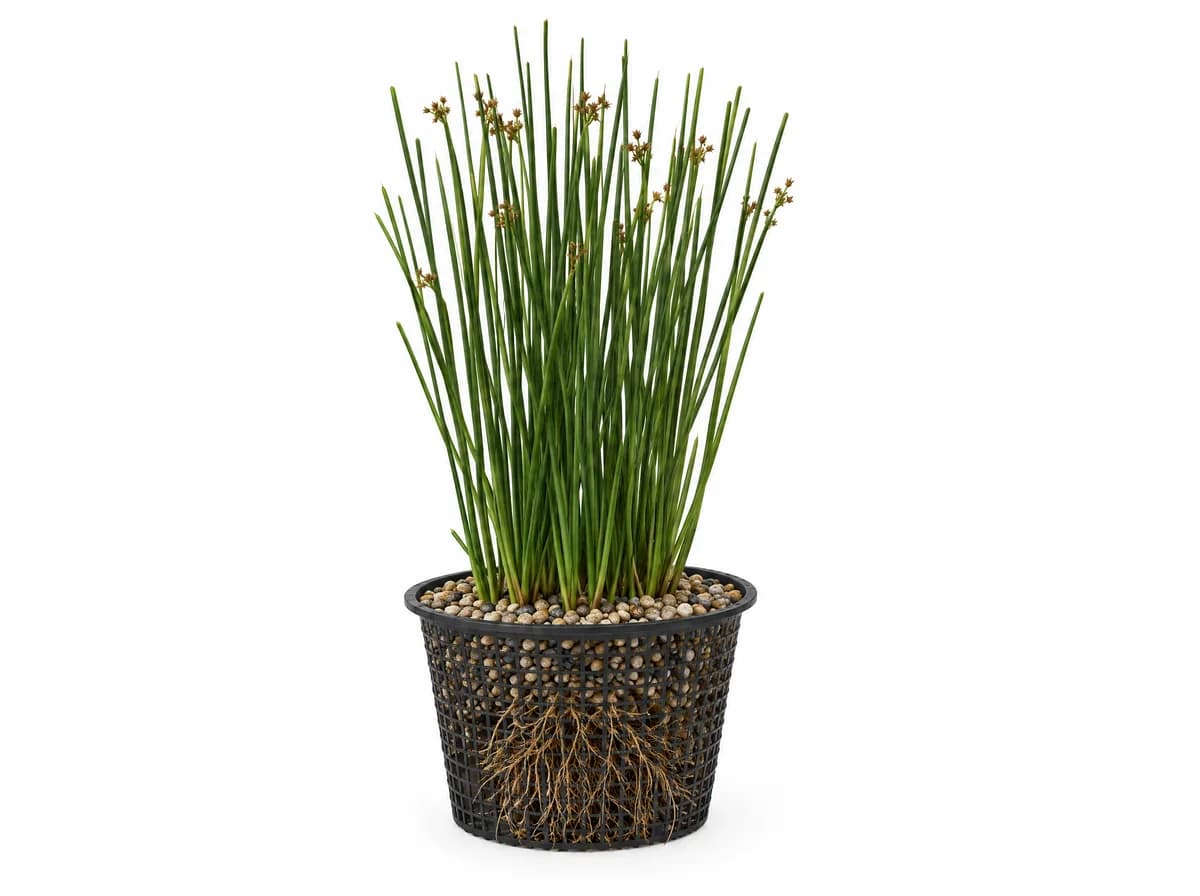
Rush (Juncus)
A slender, upright marsh plant. It stays green all year on wet banks and in shallow water.
Where it is used
- Edge band
- Shallow zone
 04
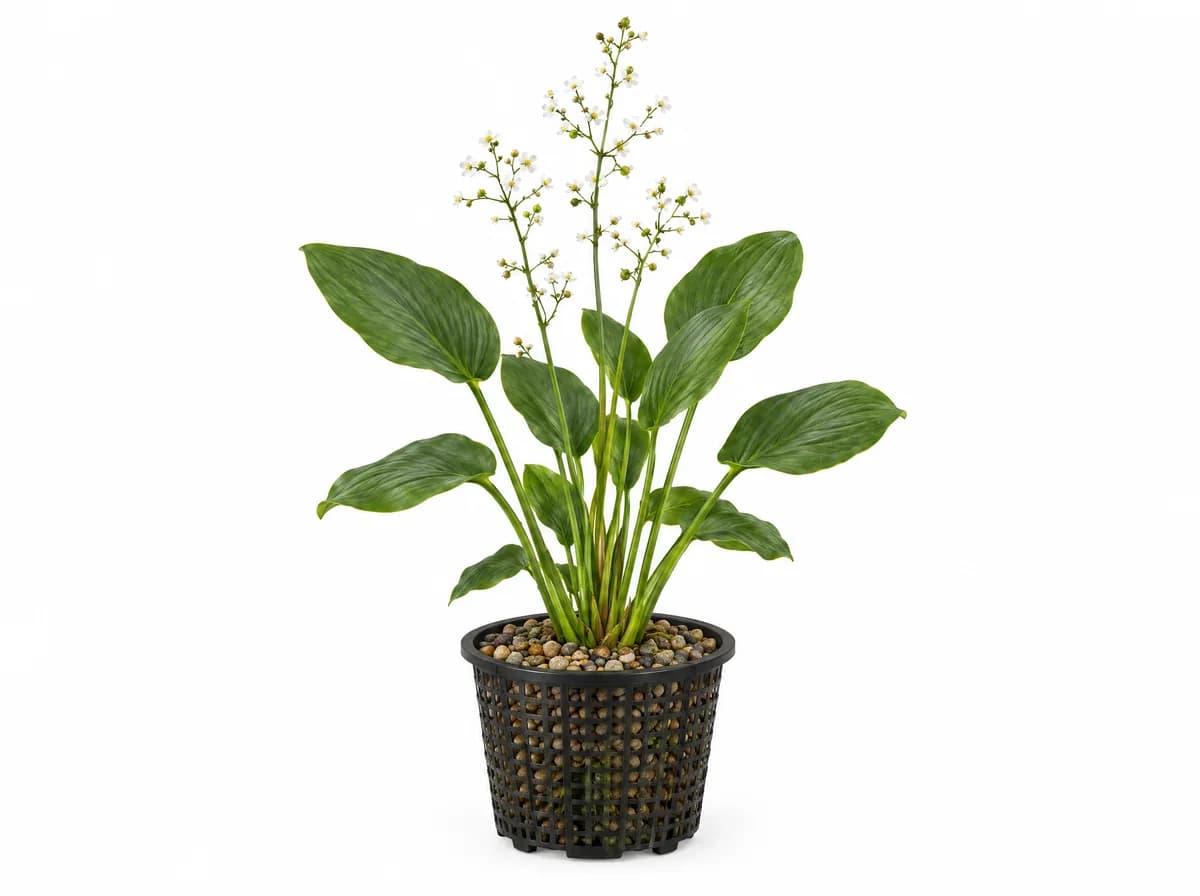
Water plantain
A broad-leaved marsh plant that grows in shallow water. The area around its roots provides a habitat for beneficial bacteria.
Where it is used
- Shallow zone
 05
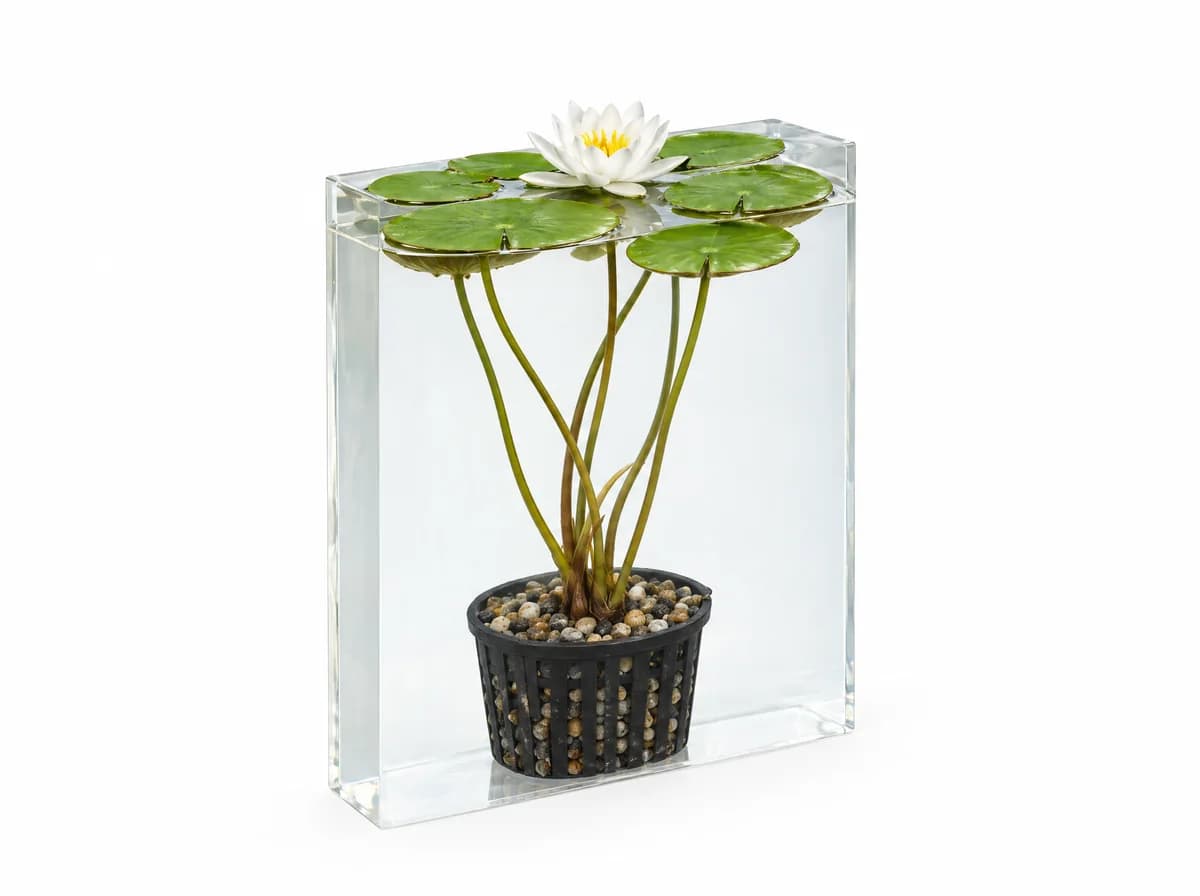
Water lily
Its leaves shade the water surface, limiting warming and algae growth. It grows on shelves 40-75 cm deep.
Where it is used
- Deep zone
 06
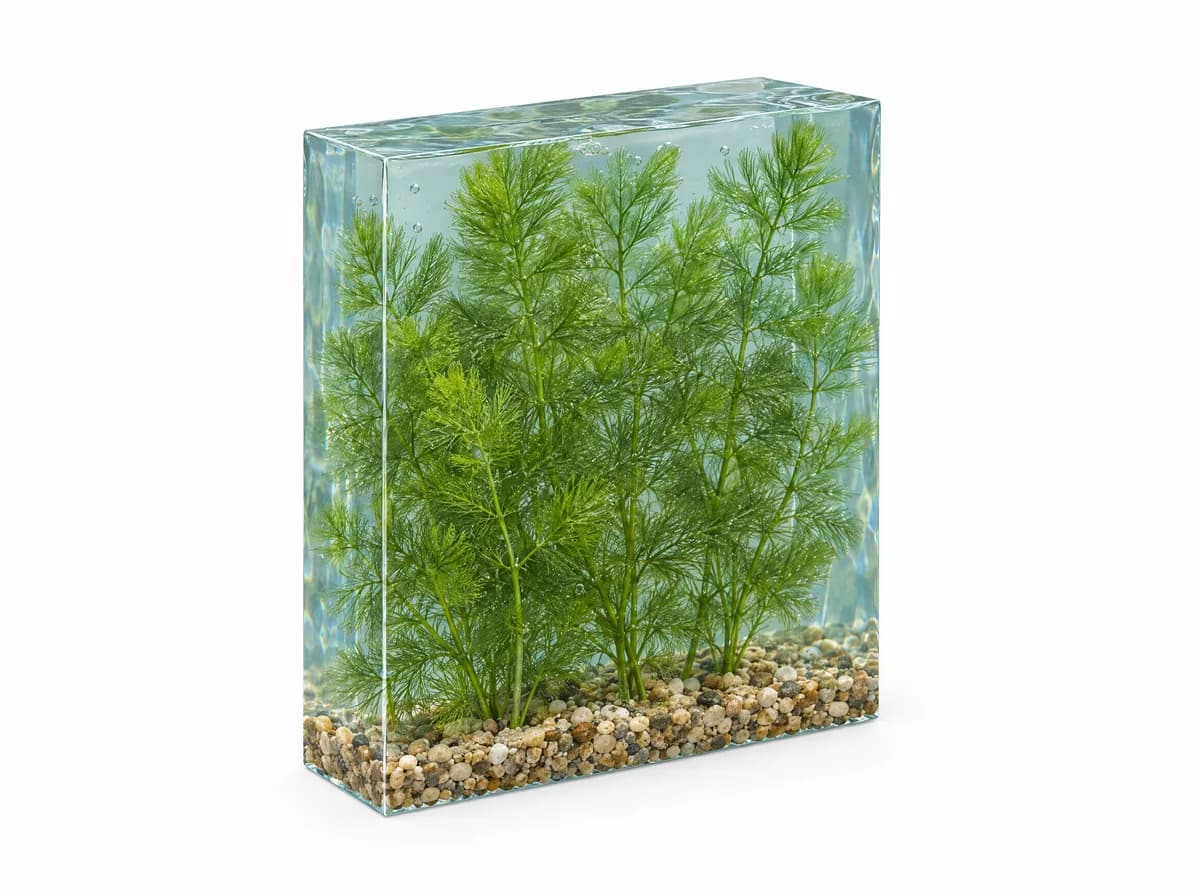
Submerged plants
Living entirely underwater, these plants oxygenate the water and consume dissolved nutrients directly; they are the most direct competitors of algae.
Where it is used
- Deep zone
- Filter bed
 07
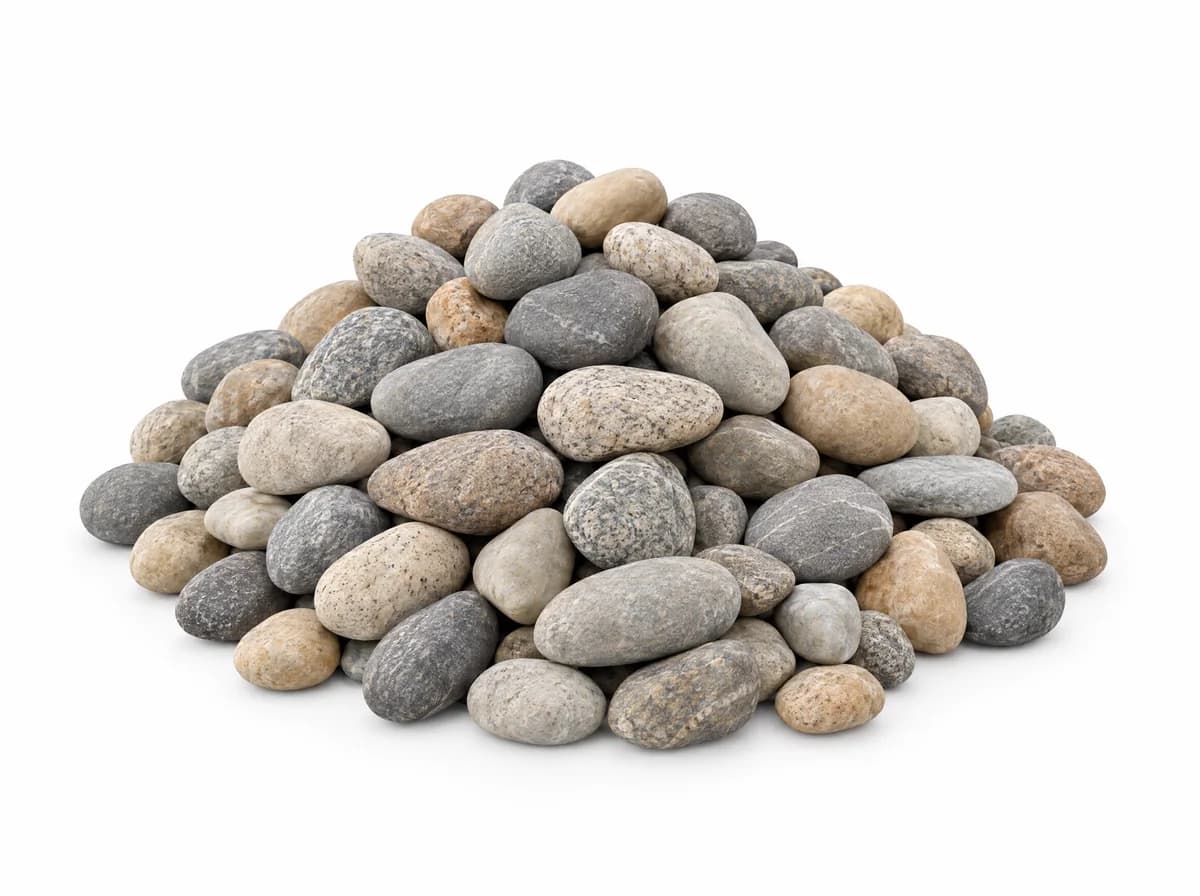
Washed gravel
The bed material that plant roots grip and bacteria colonies settle in. It is laid free of dust and clay.
Where it is used
- Filter bed
- Shallow zone
 08
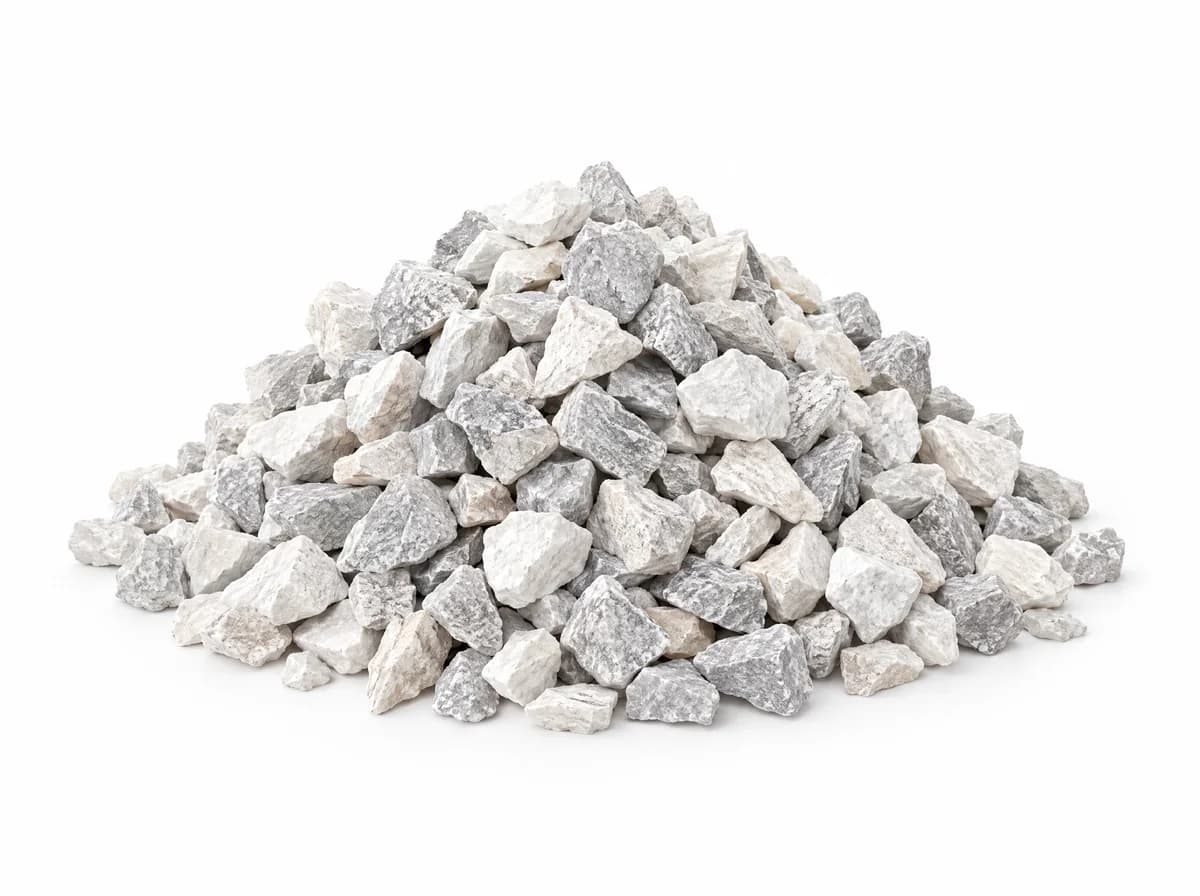
Dolomite gravel
Because it contains carbonate, it supports biofilm growth in the filter bed and helps phosphorus precipitate out of the water.
Where it is used
- Filter bed
 09
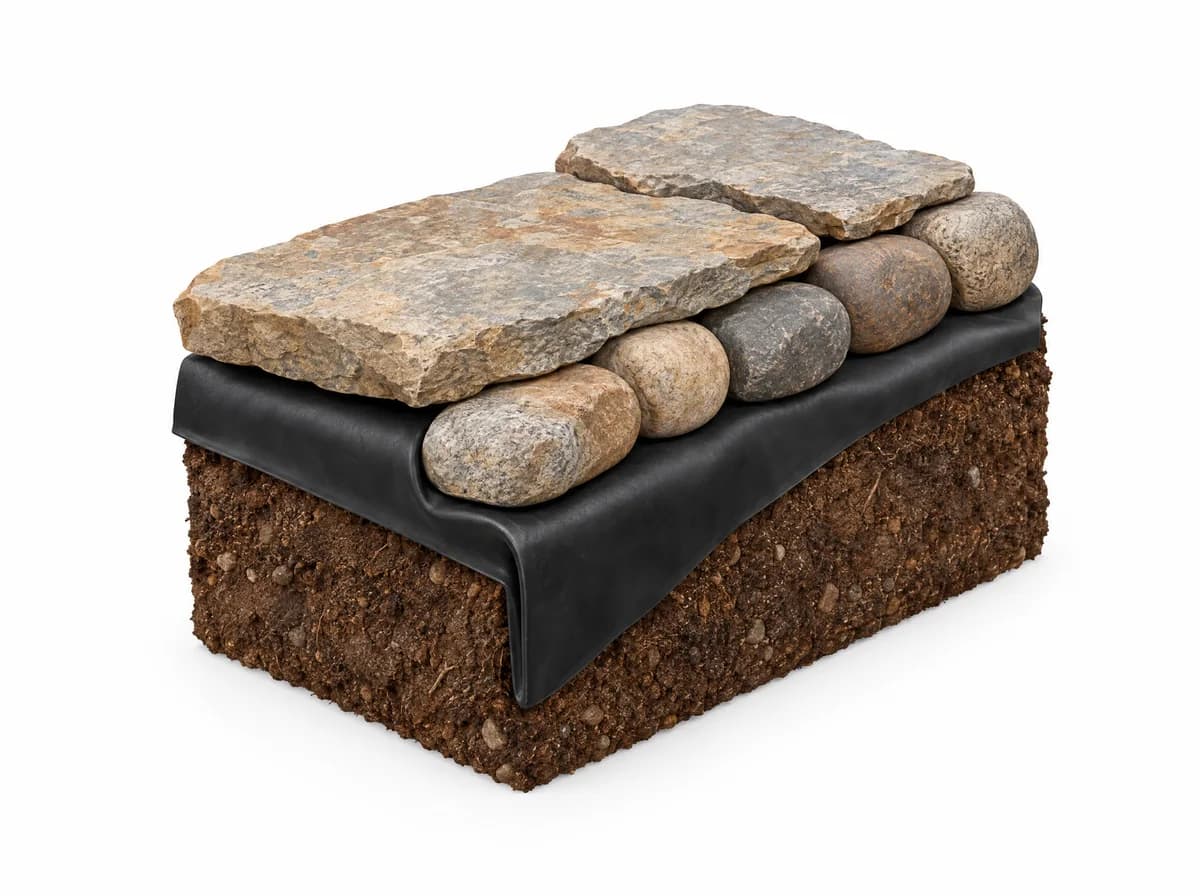
Natural stone
It covers the liner edge at the shore and forms steps and seating surfaces. Sharp-edged stone is never placed directly on the liner.
Where it is used
- Edge band
- Entry
// 04 · Natural pool materials
From pump to liner, we choose materials to suit the pond size.
Pumps, skimmers, waterproofing systems and underwater lighting are among our products. You can review the flow rate, dimensions and connection type of each product on its own page.
// 05 · Projects
From villa gardens to large plots, the water structures we have built.
Here we gather the pool and water structure projects we have carried out in villa gardens. In each project, location, levels and sealing were calculated separately for the site.
// 05 · Service regions
Across Türkiye and abroad, we build natural pools.
We build natural pools across Türkiye in villa, residential and hotel gardens; we export to 14 countries and run projects abroad on site through our branches in Kyrgyzstan, Egypt, Algeria and Iraq.
Domestic
15- Istanbul
- Mugla / Bodrum
- Antalya
- Izmir / Cesme
- Ankara
- Bursa
- Kocaeli / İzmit
- Adana
- Mersin
- Tekirdağ
- Kandıra
- Sakarya
- Samsun
- Denizli
- Elazığ
International
13- AlgeriaBranch
- EgyptBranch
- IraqBranch
- KyrgyzstanBranch
- France
- Germany
- Kazakhstan
- Libya
- Qatar
- Russia
- Saudi Arabia
- United Arab Emirates
- United Kingdom
// 06 · After handover
Our work does not end at handover, we monitor the balance together.
A pond is a living system that keeps maturing after handover. Throughout the first season we monitor the balance and plan surface cleaning, plant care and seasonal transitions together with you. Our workmanship carries a 2-year warranty.
- 012 years
Warranty
Our construction workmanship is guaranteed for 2 years from handover; warranty documents are provided at handover.
- 02First season
First-season follow-up
We monitor how the plants take hold and how the water clears; temporary cloudiness during this period is natural.
- 03Season change
Water values
Phosphate, nitrate and pH are measured; total phosphorus is kept at 0.01-0.03 mg per litre depending on pond type, and pH at 6-9.
- 04Autumn
Plants and leaves
Dead plant growth is cut back and fallen leaves are collected, so decaying organic matter does not return to the water as nutrients.
Related services
- Swimming Pool ConstructionReinforced-concrete, prefabricated and infinity swimming pools, built turnkey for villa, residential and commercial projects.
- Infinity PoolsPools that open onto the view, with water spilling over the edge into a balance tank.
- Ornamental PoolsDecorative water features with fountains, cascades and lighting.
- Pool MaintenanceWater chemistry, equipment and periodic maintenance.
- Landscape ArchitectureLandscape design that unites the pool with its garden and surroundings.
Prepared byAli SAVAŞ · Project Manager · Mechatronics Engineer
// 07 · Questions
About natural pool construction, frequently asked questions.
Çilek Havuz Corporate
Pool & Wellness Engineering
- Response Time
- Same day
- Channels
- Phone · Email · WhatsApp
If the answer you are looking for is not here, send your question directly to us and our team will reply as soon as possible.
+90 216 475 39 37On site, a medium-sized pond is completed in a few weeks. Excavation takes 1-2 weeks, and the liner, circulation and planting each take a few days; the biological balance settles in a separate maturing period that extends into the first season after handover.
Çilek Havuz Corporate
A pond takes up more room than a classic pool with the same swimming area. With plant filtration the regeneration area is at least half of the total surface; balance is easier to reach when the total water surface is 30-40 m² or more. In compact gardens, a biofilm filter reduces the regeneration area.
Çilek Havuz Corporate
No, chlorine, chemical disinfectants and UV are not used in a natural pool. The water is cleaned by plants and by beneficial bacteria colonies living in the gravel bed, so there is no chlorine smell and no drying of the skin.
Çilek Havuz Corporate
The price depends on the total water surface, excavation volume, liner area, filter type and shoreline landscaping. Chemical and energy costs are lower than for a classic pool; sealing and landscaping make up a large part of the initial investment. After the site survey we present each item in writing, with its reasoning.
Çilek Havuz Corporate
In a swimming pond the water is cleaned mainly by the planted zone; in a natural pool this work is done largely by a biofilm filter. A swimming pond is broad with a natural edge, while a natural pool has regular lines like a classic pool and is more compact; neither uses chemicals.
Çilek Havuz Corporate
In ponds meant for swimming, the swimming zone is drawn at least 2 metres deep. The deep volume helps the water stay cooler and more stable in summer; stepped terraces towards the edges serve both as plant beds and as safe exit steps.
Çilek Havuz Corporate
Yellow flag iris, sedge and rush are used along the edge band, and water lilies and submerged plants in the deep zone. Marginal plants grow in 0-25 cm of water and water lilies in 40-75 cm; the species list is finalised in the project according to climate.
Çilek Havuz Corporate
Ponds use a flexible, weldable pond liner that resists plant roots. A thickness of 1 mm is common for rubber-based EPDM liner; the liner is protected above and below by geotextile fleece, and on suitable soils compacted clay is also an option.
Çilek Havuz Corporate
No, a pond is not drained in winter; the water stays in place and the ecosystem adapts to the season. Plant activity slows and the water often becomes clearer; collecting fallen leaves and protecting the pump as the manufacturer recommends is enough.
Çilek Havuz Corporate
No, pond maintenance is different from a classic pool but a lighter routine. There is no daily chemical dosing; the routine consists of surface cleaning, plant care, monitoring the water level and measuring water values at seasonal transitions.
Çilek Havuz Corporate
A well-balanced pond does not have a mosquito problem. Because the water circulates constantly it never stands still, and moving water discourages breeding; creatures such as dragonflies also help keep them in check. We leave no stagnant corners in the circulation design.
Çilek Havuz Corporate
In most cases, yes; the existing basin is kept as the swimming zone. Water drawn from the skimmer passes through a planted filter basin built beside it instead of conventional treatment; the scope is set at the site survey according to the condition of the basin and the space available.
Çilek Havuz Corporate
The key value monitored in a pond is phosphorus, because it is the main nutrient for algae. Total phosphorus is kept at 0.01-0.03 mg per litre depending on pond type and pH at 6-9; the fill water is also tested for phosphate before use.
Çilek Havuz Corporate
Çilek Havuz builds natural pools across Türkiye in villa, residential and hotel gardens. We export to 14 countries and carry out projects abroad through our branches in Kyrgyzstan, Egypt, Algeria and Iraq.
Çilek Havuz Corporate
// Sources and regulations
Sources and regulations
The official documents behind the technical framework on this page; links open the institutions' own sites.
Next step
Let us discuss your project in the way that suits you best.
You can fill in the form for a written quote, schedule a video project presentation or ask us to survey your project site.
Get a Quote
Send us your dimensions and expectations in writing.
Online presentation
Video project presentation
On-site survey
Inspection at your project site
// 08 · Company & Contact
To talk about your project, call or write to us.
Legal Name
Çilek Havuz
Founded
1998 · Istanbul
Head Office
Çilek Plaza, Eyüp Sultan Mah. Yakacık Cd. Feshane Cd. No: 2 D:4 D:1, 34885 Sancaktepe / İstanbul
Service Area
All of Türkiye · exports to 14 countries
Branches
Kyrgyzstan · Egypt · Algeria · Iraq
Showroom
Plan a showroom visit
At our showroom in Çilek Plaza, Sancaktepe, you can discuss your project with our team. We recommend booking an appointment by phone before your visit.
Working Hours
- Monday – Friday · 08:00 – 17:30
- Saturday · 08:00 – 12:30
- Closed on Sunday