

Thermal pool construction
We design the thermal pool around the water analysis, and manage the heat of the source.
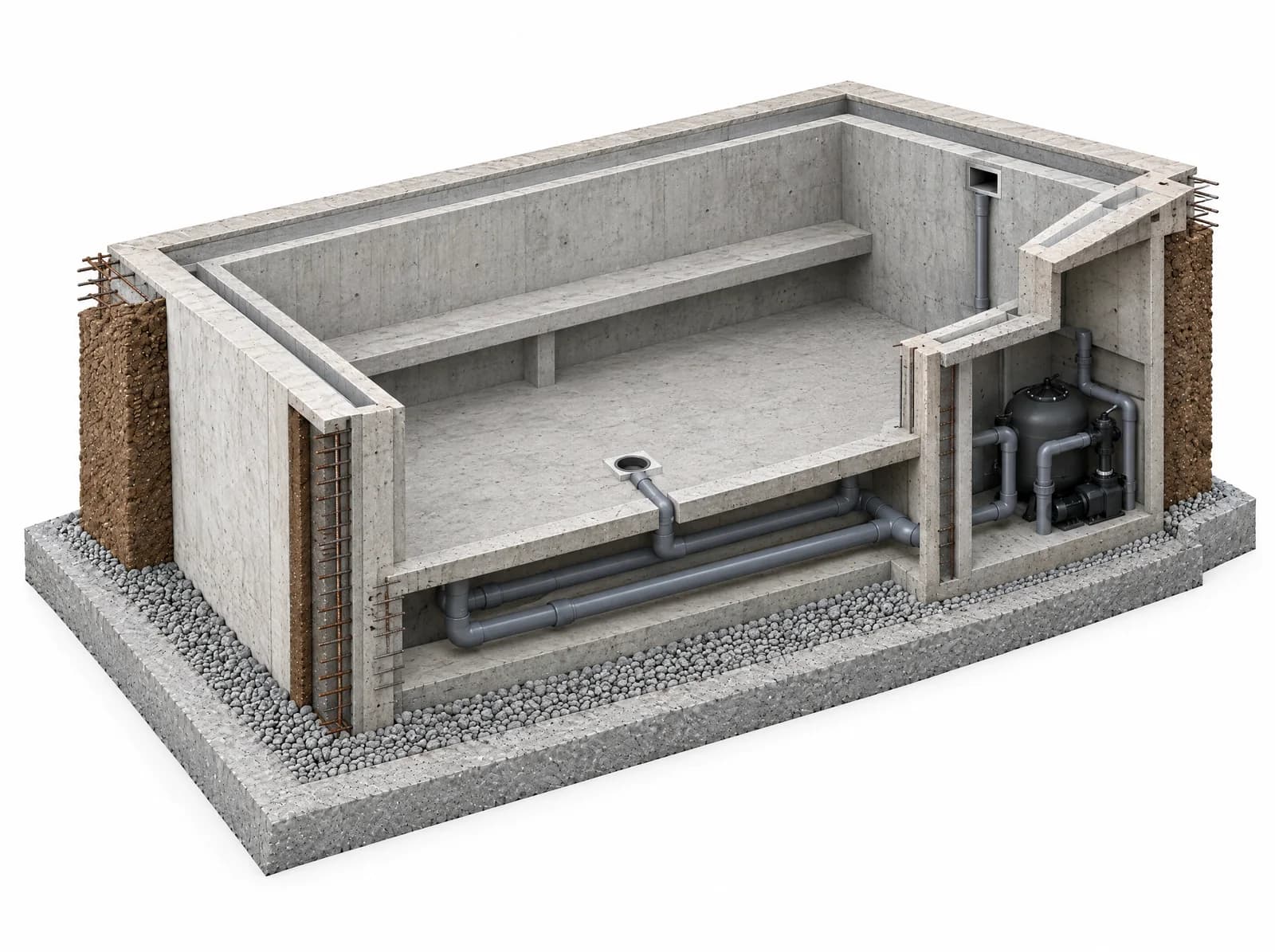
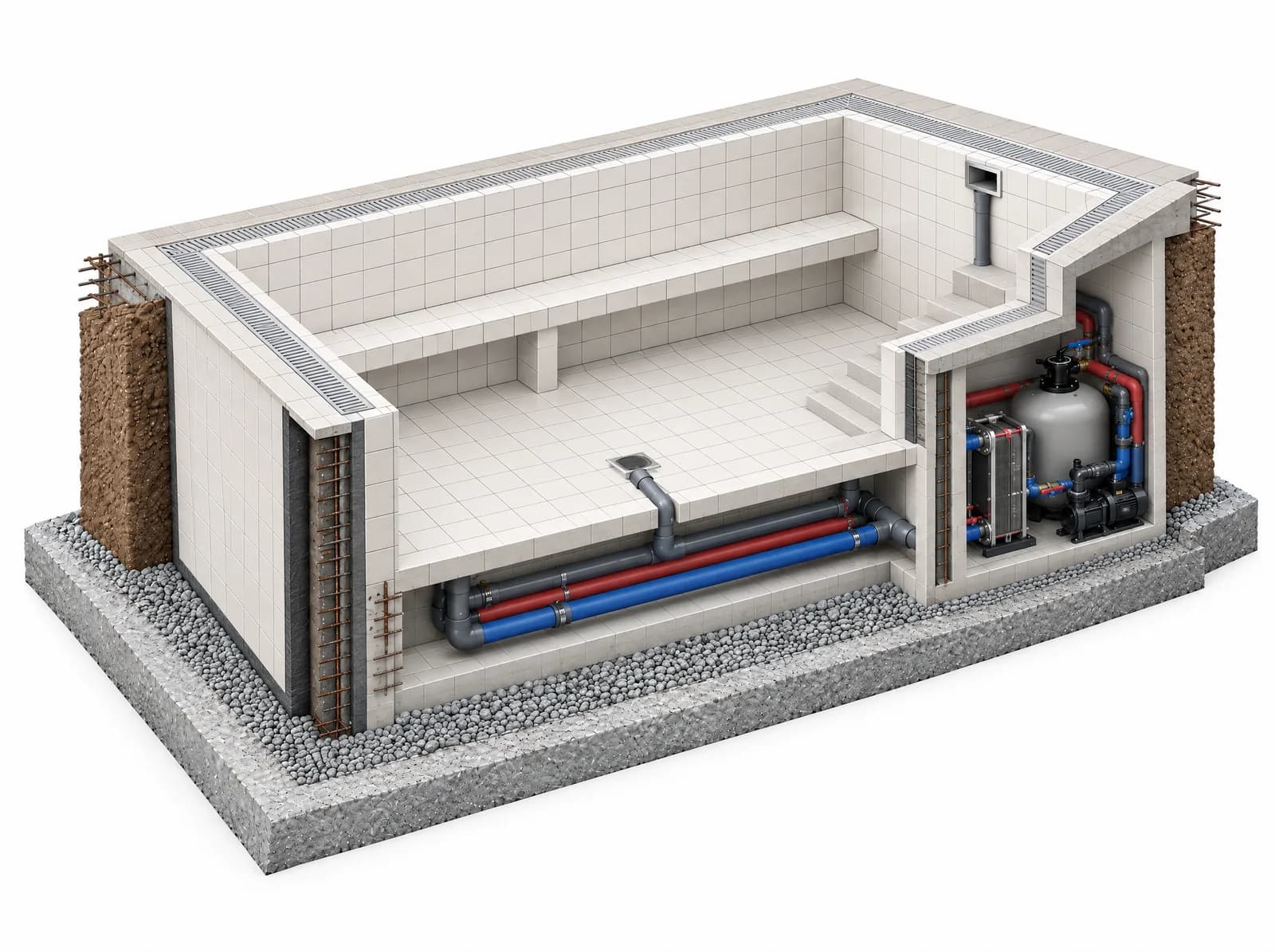
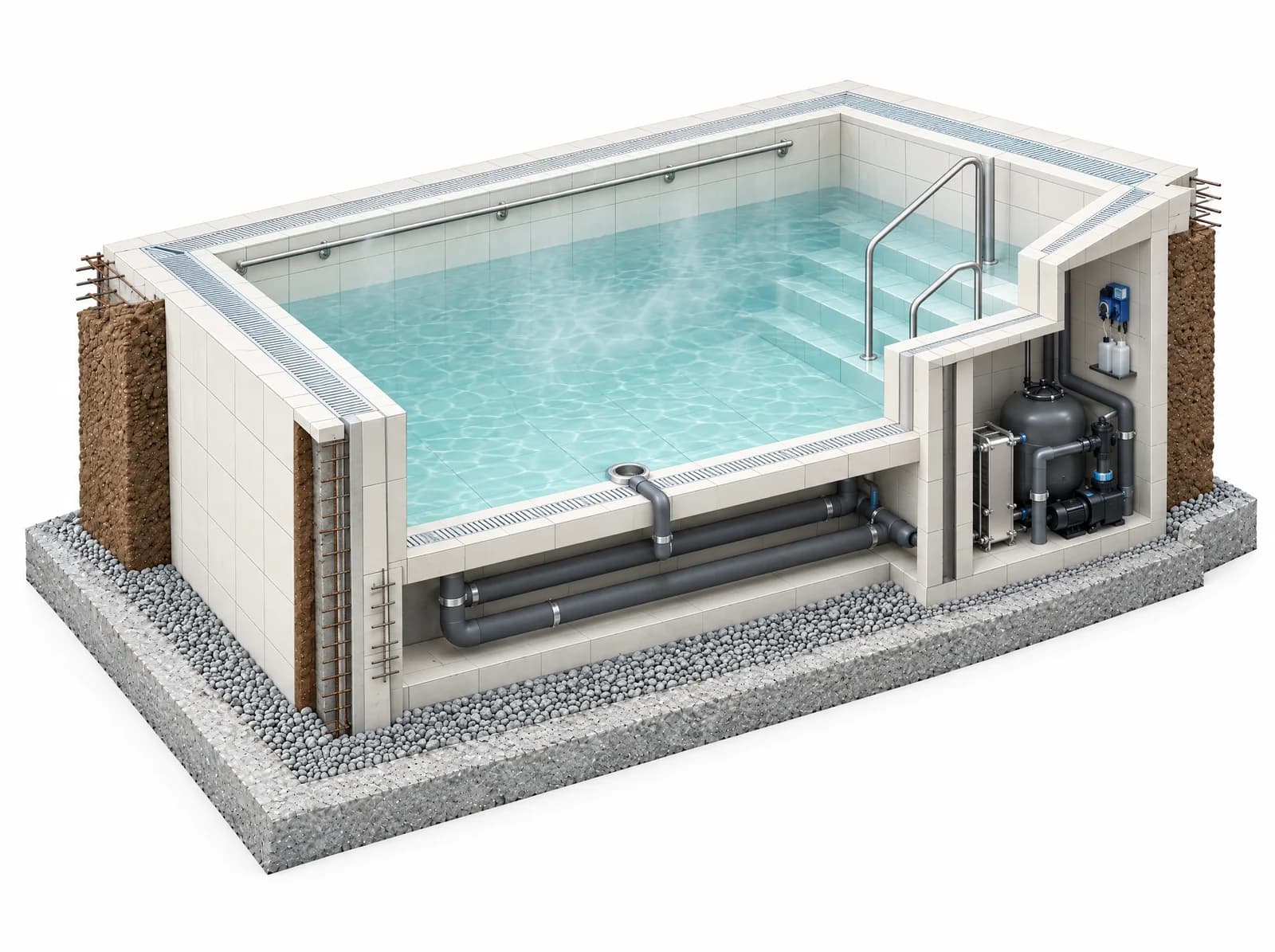
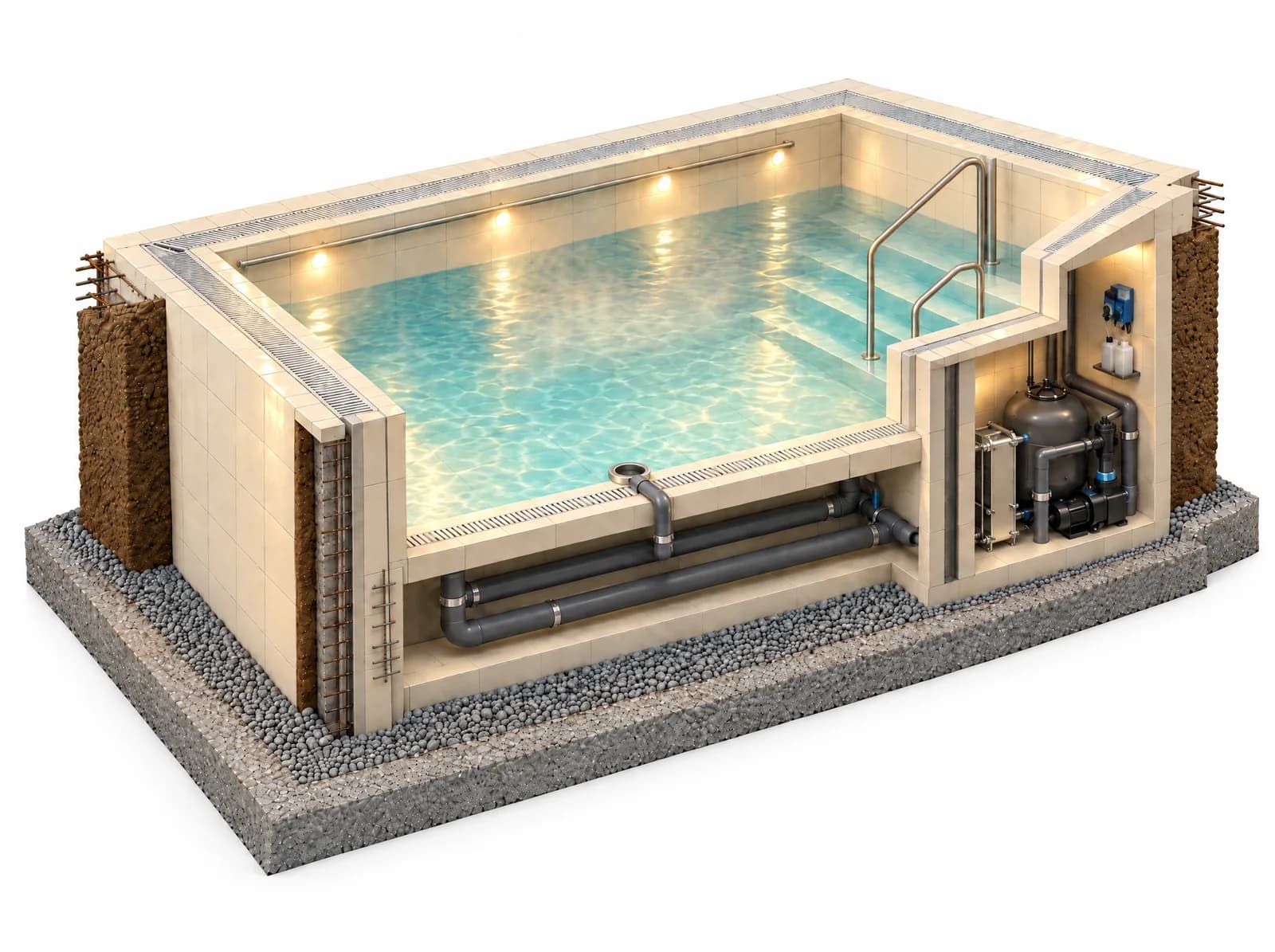
Thermal pool construction process
01 / 04
Groundwork and overflow
Weeks 1-3- 01
- 02
- 03
- 04
Çilek Havuz in thermal pool construction
We approach the thermal pool with the same engineering discipline as a swimming pool and start with the analysis of the source water.
One team handles the survey, design, construction and commissioning; the quotation is itemised line by line.
- Year founded
- 1998
- Years of industry experience
- 33+
- Export countries
- 14
- Workmanship warranty
- 2
// 01 · Decision
A thermal pool decision starts with four questions, the water analysis answers the first.
The lifespan of a thermal pool is decided in the analysis of the source water, before the first concrete is poured. We first clarify what the water carries, then who will use the pool and how many people, and finally whether the water will enter the pool or only its heat will be used.
01
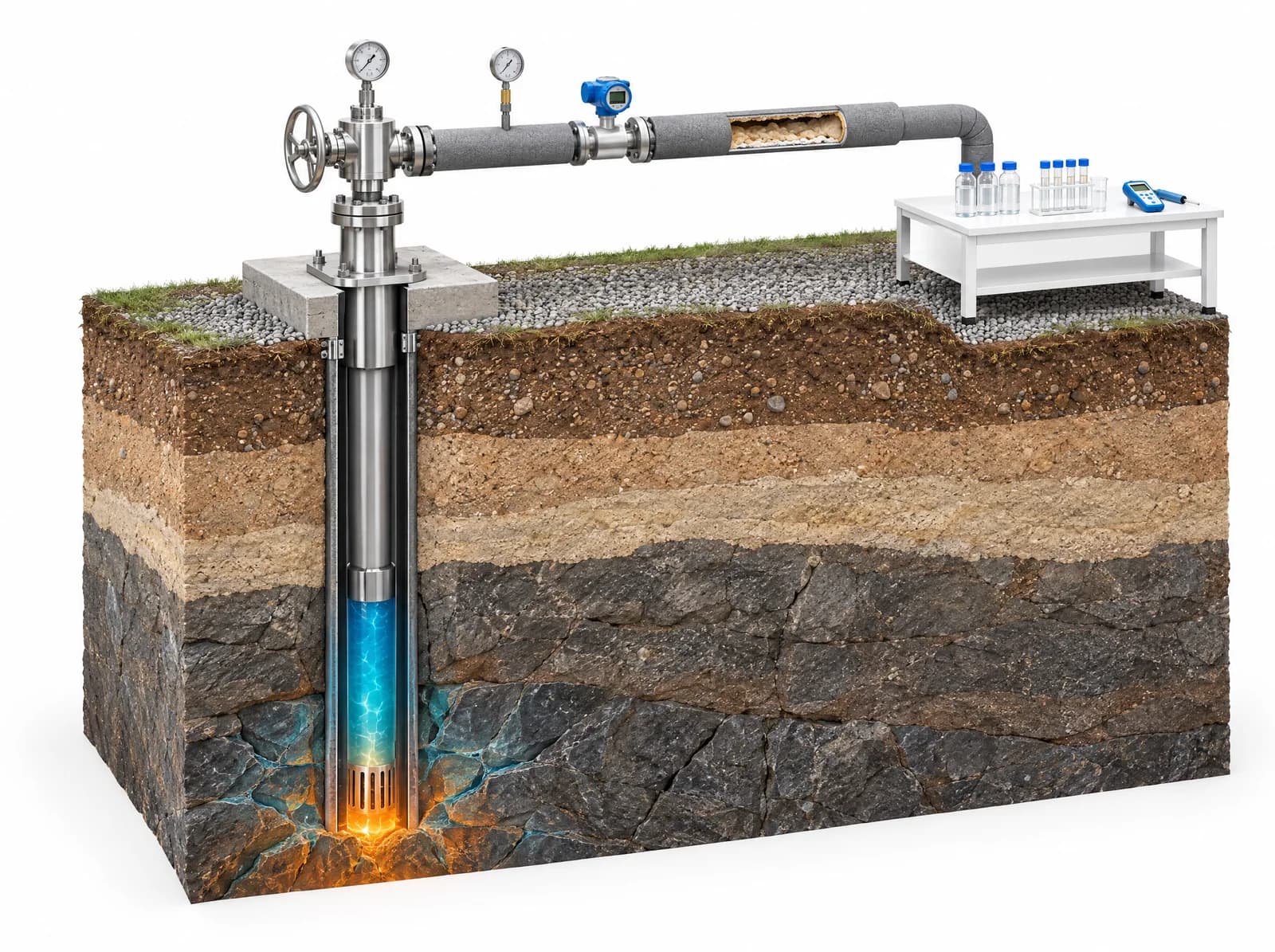
What the source water carries
Every thermal source has a different chemical fingerprint; one is dominated by lime, another by sulphate, chloride or sulphur compounds. Every decision, from materials to the heat exchanger, is based on the laboratory report.
- Source temperature and flow rate
- Mineral profile: lime, sulphate, chloride
- Sulphur and dissolved gas control
02
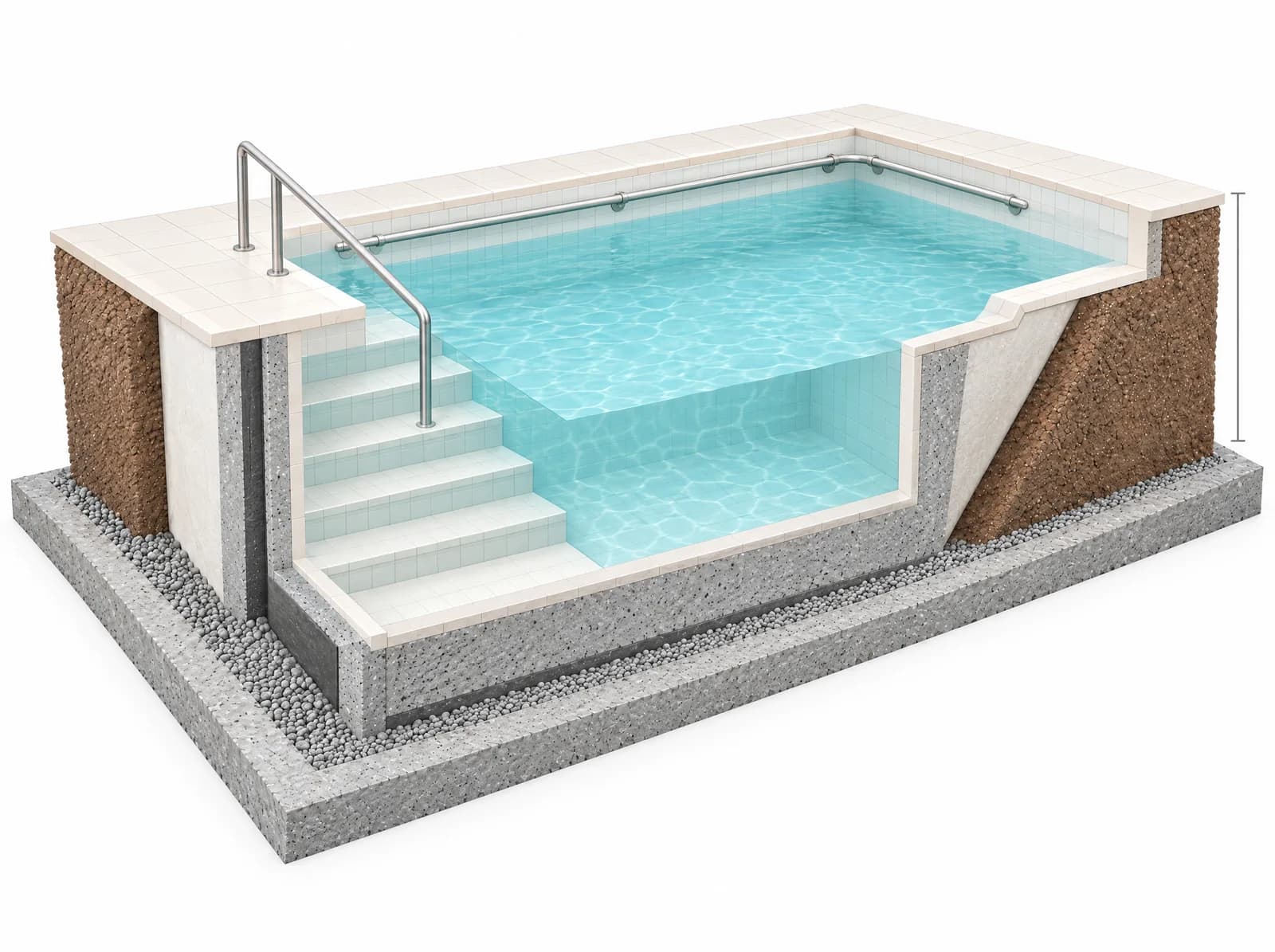
Pool users and capacity
A spa pool is sized to give at least 3 m² of water surface per person, and its depth does not exceed a net 150 cm. In hotel and residential pools, dimensions follow the number of simultaneous users and the intended use.
- At least 3 m² of water surface per person
- Maximum 150 cm depth in spa pools
- Hotel, spa or residential scenario
03
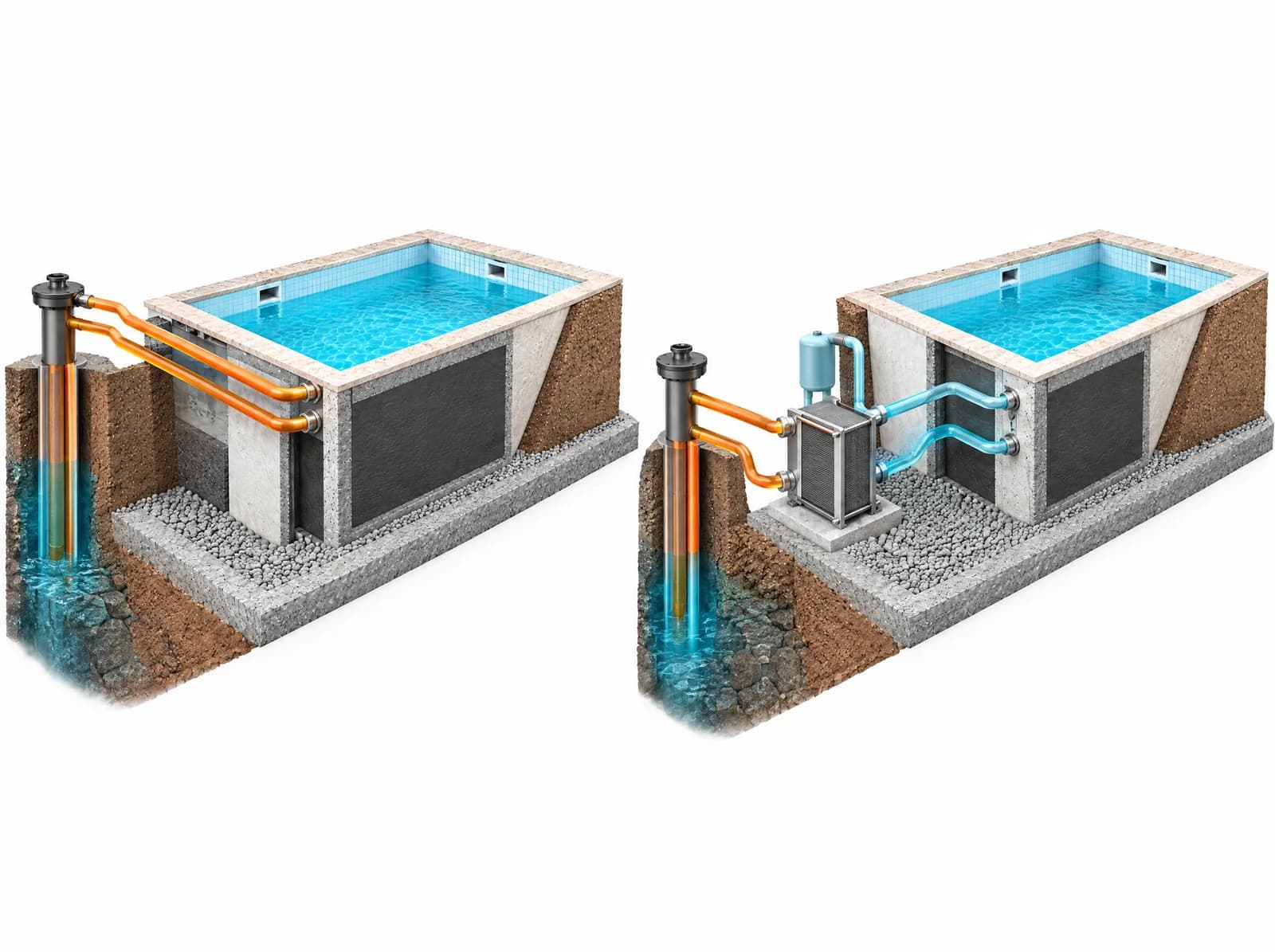
The water itself or only its heat
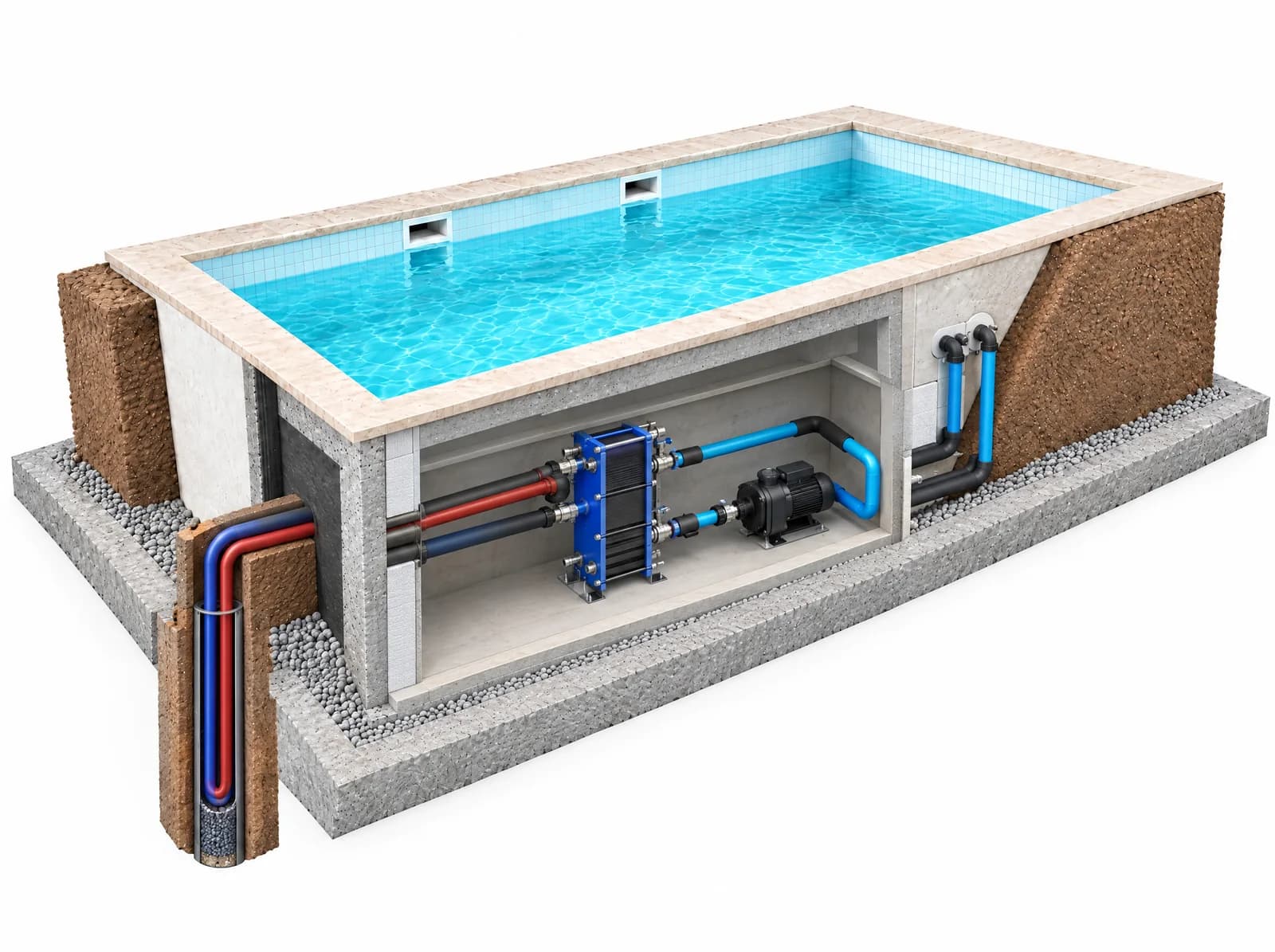
Thermal water can be fed directly into the pool, or passed through a plate heat exchanger so that only its heat is transferred to mains water. The choice depends on source temperature, mineral load and the facility's thermal water permit.
- Direct use of thermal water
- Heat transfer via exchanger
- Gap between source and target temperature
04
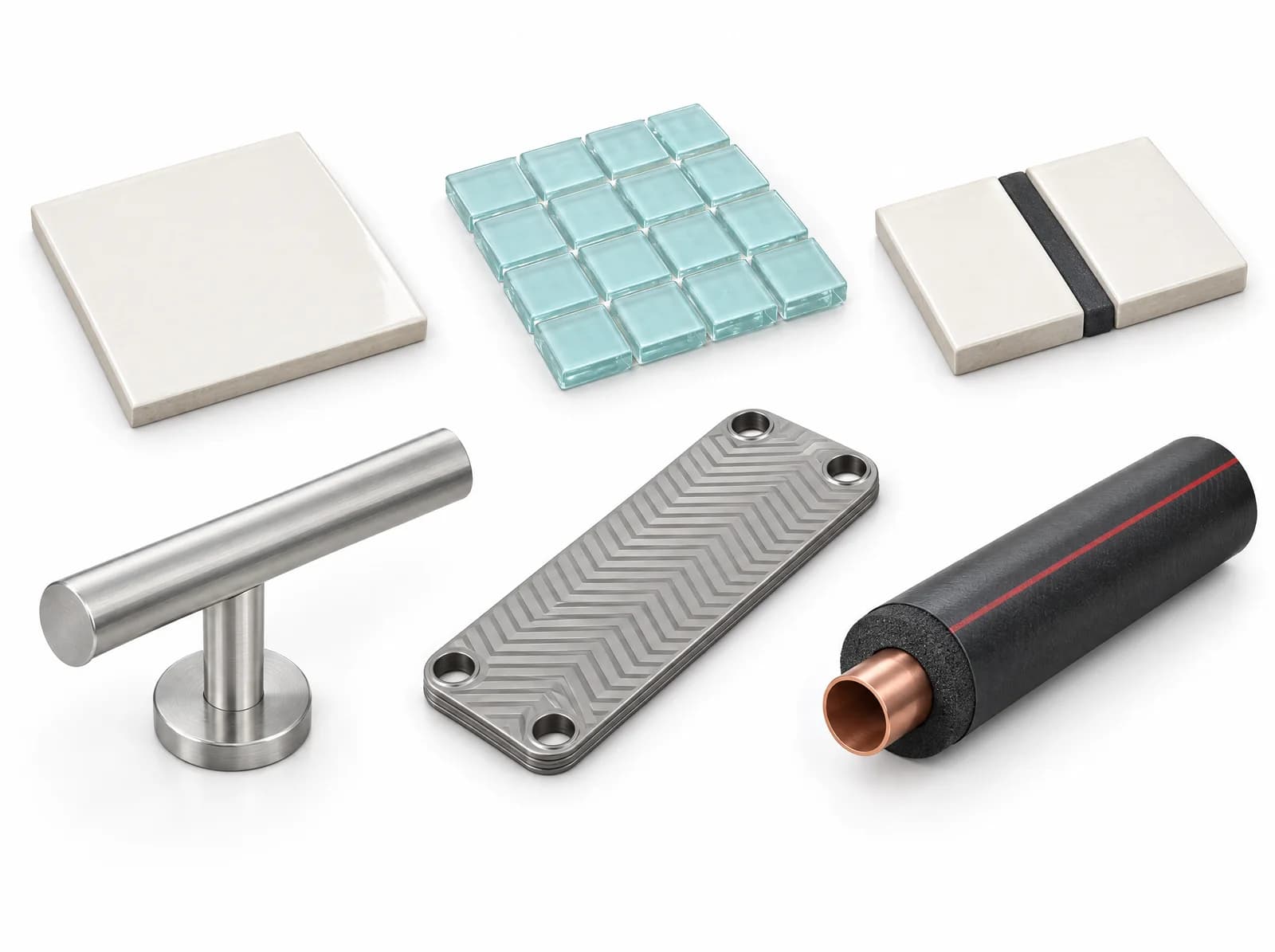
Choosing materials and equipment
Every metal in the wet area is chosen according to the analysis: high-alloy stainless steel suits most sources, while titanium-bodied equipment is used in aggressive, high-chloride waters. Grout and adhesive classes follow the same report.
- Stainless or titanium per analysis
- Epoxy grout and flexible adhesive
- Plant room with service access
// 01 · Thermal pool types
There are six thermal pool types, chosen by source and use.
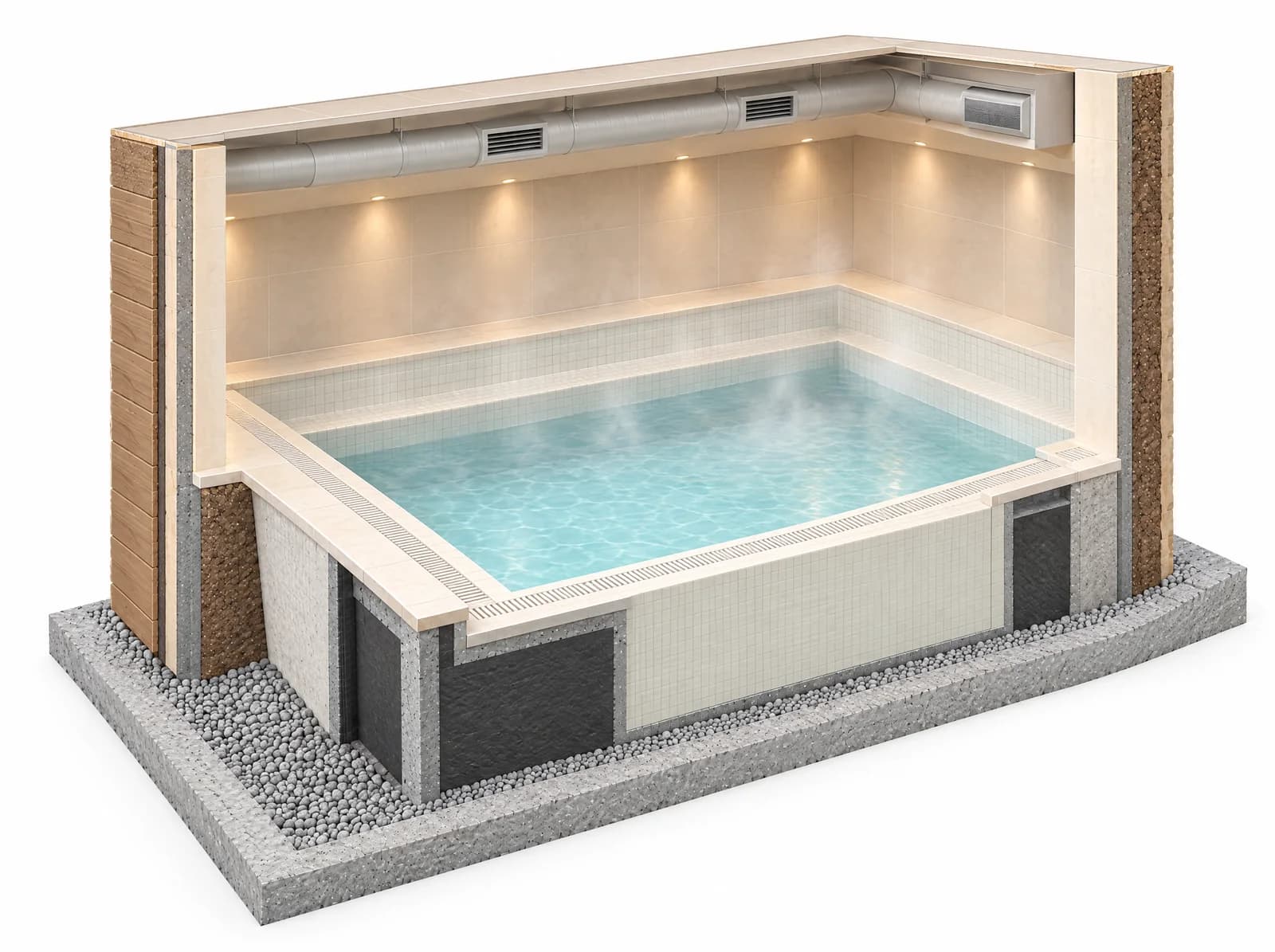
We build six types of thermal pool: indoor thermal pool, outdoor thermal pool, spa therapy pool, hydrotherapy pool, tiered pool group and geothermally heated pool. The type is selected during the survey according to source temperature, water analysis and how the facility will be used.
01 / 06
Indoor thermal pool
Thermal water in a climate-controlled hall.
- Water
- Source water
- Heat management
- Exchanger and dehumidification
- Setting
- Indoor
- Finish
- Ceramic, epoxy grout
The pool hall is designed together with dehumidification and ventilation; this system manages odour and condensation in sulphurous waters. Relative humidity in the hall is kept around 60 percent, and building materials are chosen for humid, mineral-laden air.
Best suited toThermal hotels and spas
View details: Indoor thermal poolThermal water in a climate-controlled hall.
- Water
- Source water
- Heat management
- Exchanger and dehumidification
- Setting
- Indoor
- Finish
- Ceramic, epoxy grout
The pool hall is designed together with dehumidification and ventilation; this system manages odour and condensation in sulphurous waters. Relative humidity in the hall is kept around 60 percent, and building materials are chosen for humid, mineral-laden air.
Best suited toThermal hotels and spas
View details: Indoor thermal pool01 / 06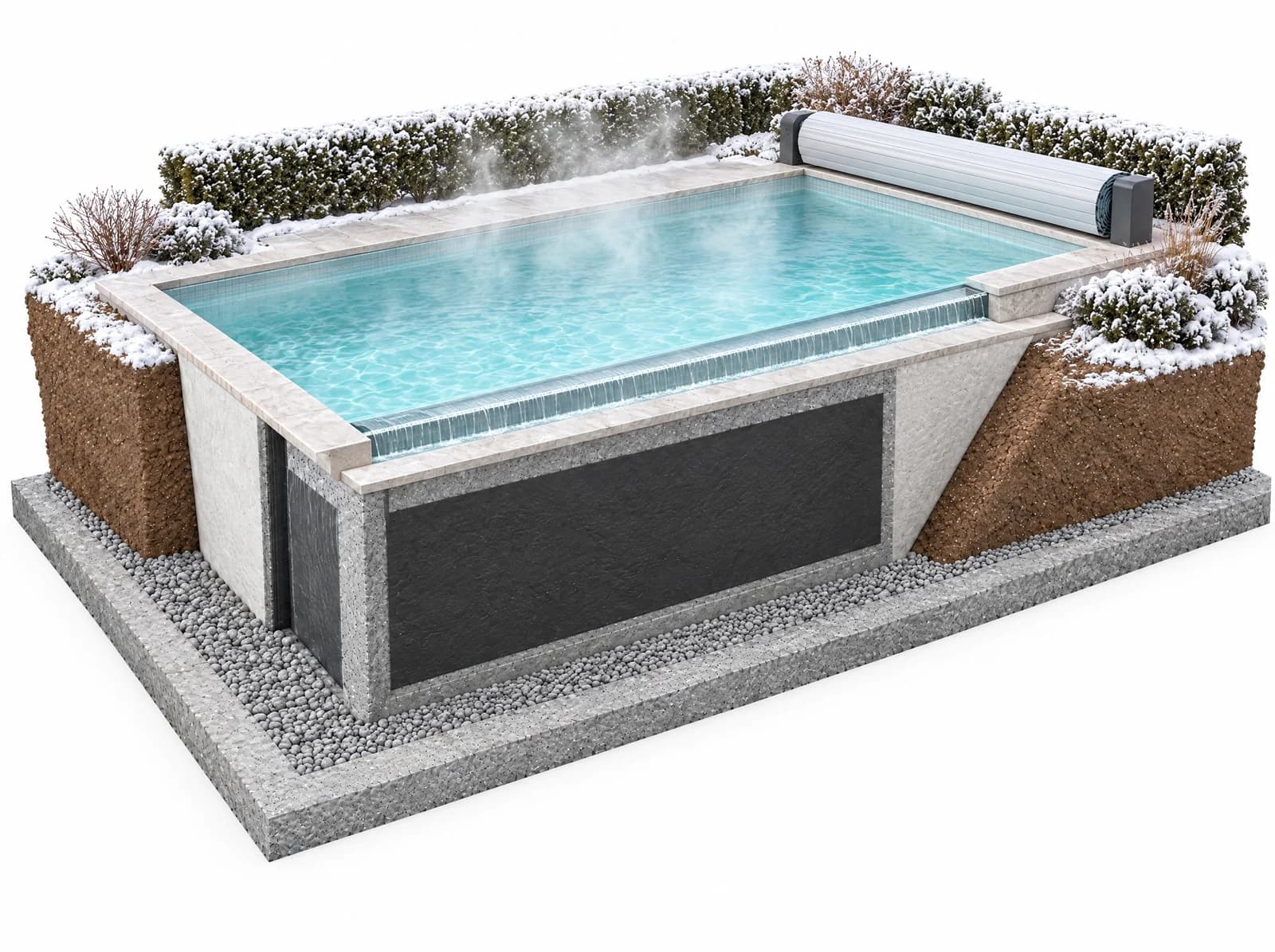
Indoor thermal pool
- Water
- Source water
- Heat management
- Exchanger and dehumidification
- Setting
- Indoor
- Finish
- Ceramic, epoxy grout
The pool hall is designed together with dehumidification and ventilation; this system manages odour and condensation in sulphurous waters. Relative humidity in the hall is kept around 60 percent, and building materials are chosen for humid, mineral-laden air.
Best suited toThermal hotels and spas
View details: Indoor thermal poolOutdoor thermal pool
- Water
- Source water
- Heat management
- Exchanger and pool cover
- Setting
- Outdoor
- Finish
- Ceramic, mosaic
The water surface is the largest source of heat loss; a pool cover, wind-sheltering landscaping and an overflow edge limit that loss. Steam forms above the water in winter, and wet walkways are finished with slip-resistant surfaces.
Best suited toThermal hotels and resorts
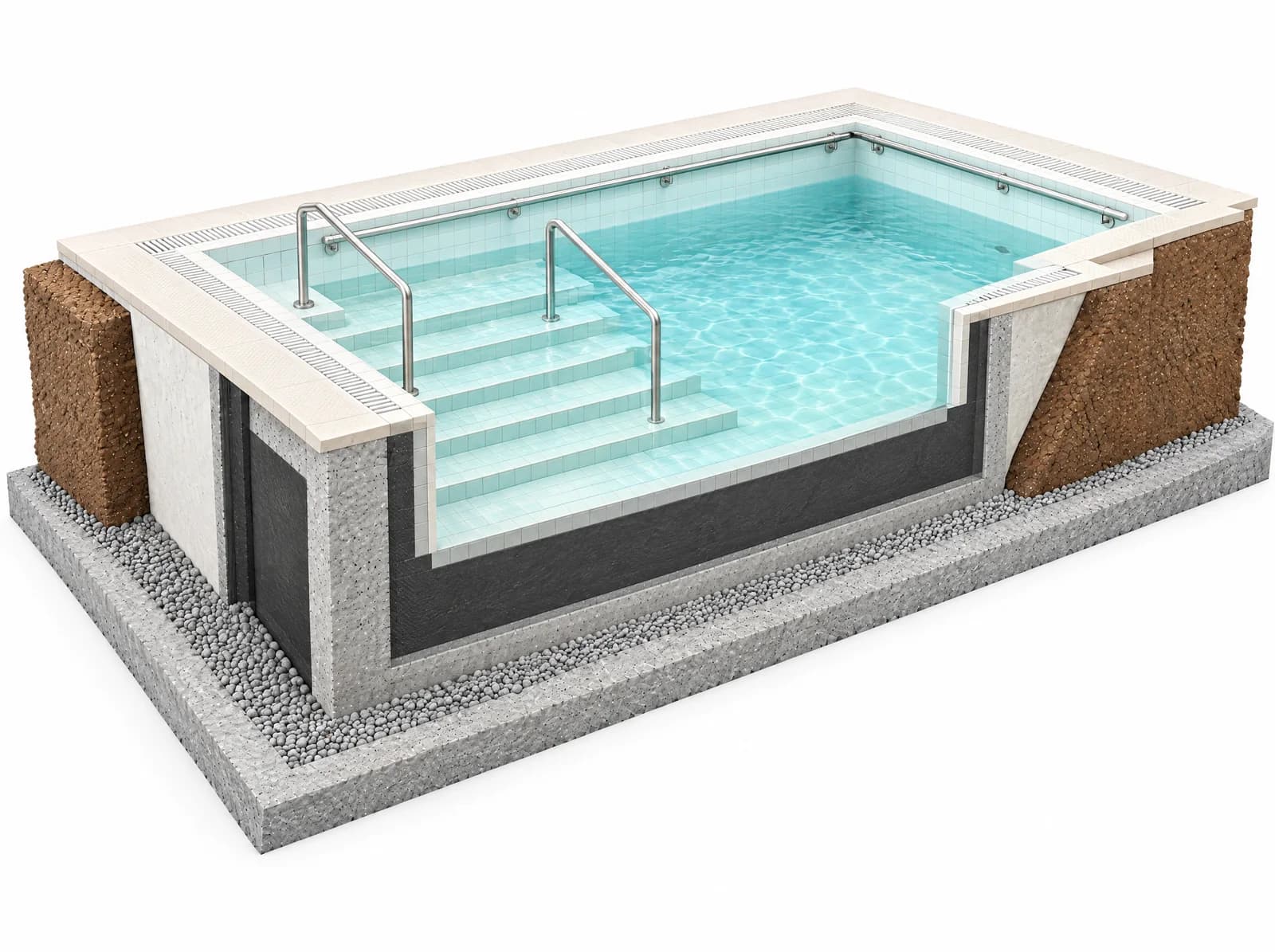
View details: Outdoor thermal poolSpa therapy pool
- Water
- Thermal or mineral water
- Heat management
- Continuous overflow
- Setting
- Indoor
- Finish
- Slip-resistant ceramic
Depth is at most a net 150 cm, and the water surface is sized to give at least 3 m² per person. Solid-step stairs, grab rails and overflow gutters that ensure continuous water renewal are installed.
Best suited toSpas and health tourism facilities
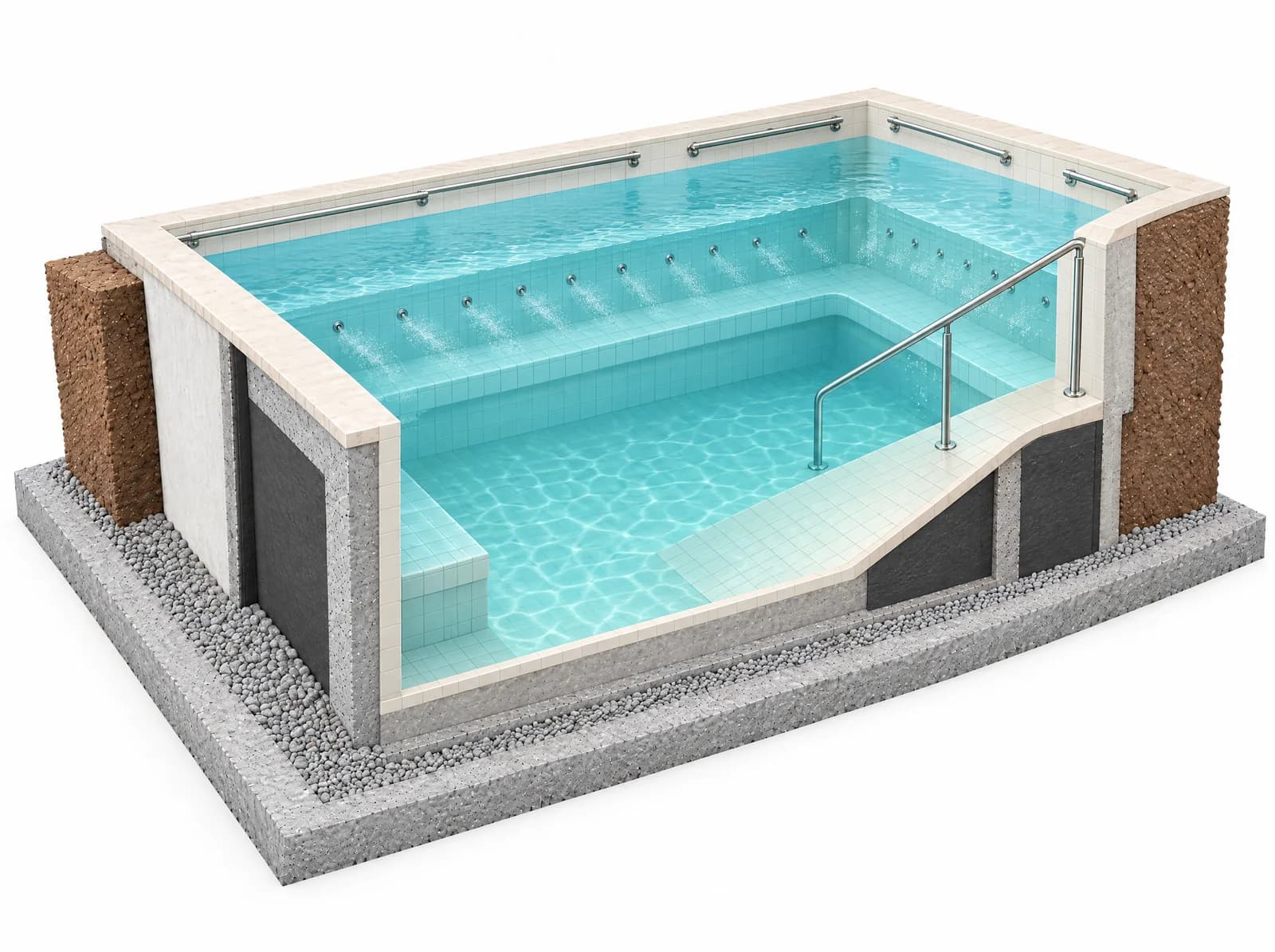
View details: Spa therapy poolHydrotherapy pool
- Water
- Thermal or heated water
- Heat management
- Exchanger, short turnover
- Setting
- Indoor
- Finish
- Ceramic, mosaic
Water is kept between 32 and 36 °C; jets, seating ledges and handrails are placed according to the intended use. Turnover time is 30-90 minutes, and filtration and dosing are sized for this short cycle.
Best suited toSpas, hotels and rehabilitation
View details: Hydrotherapy poolTiered thermal pool group
- Water
- Source and mains water
- Heat management
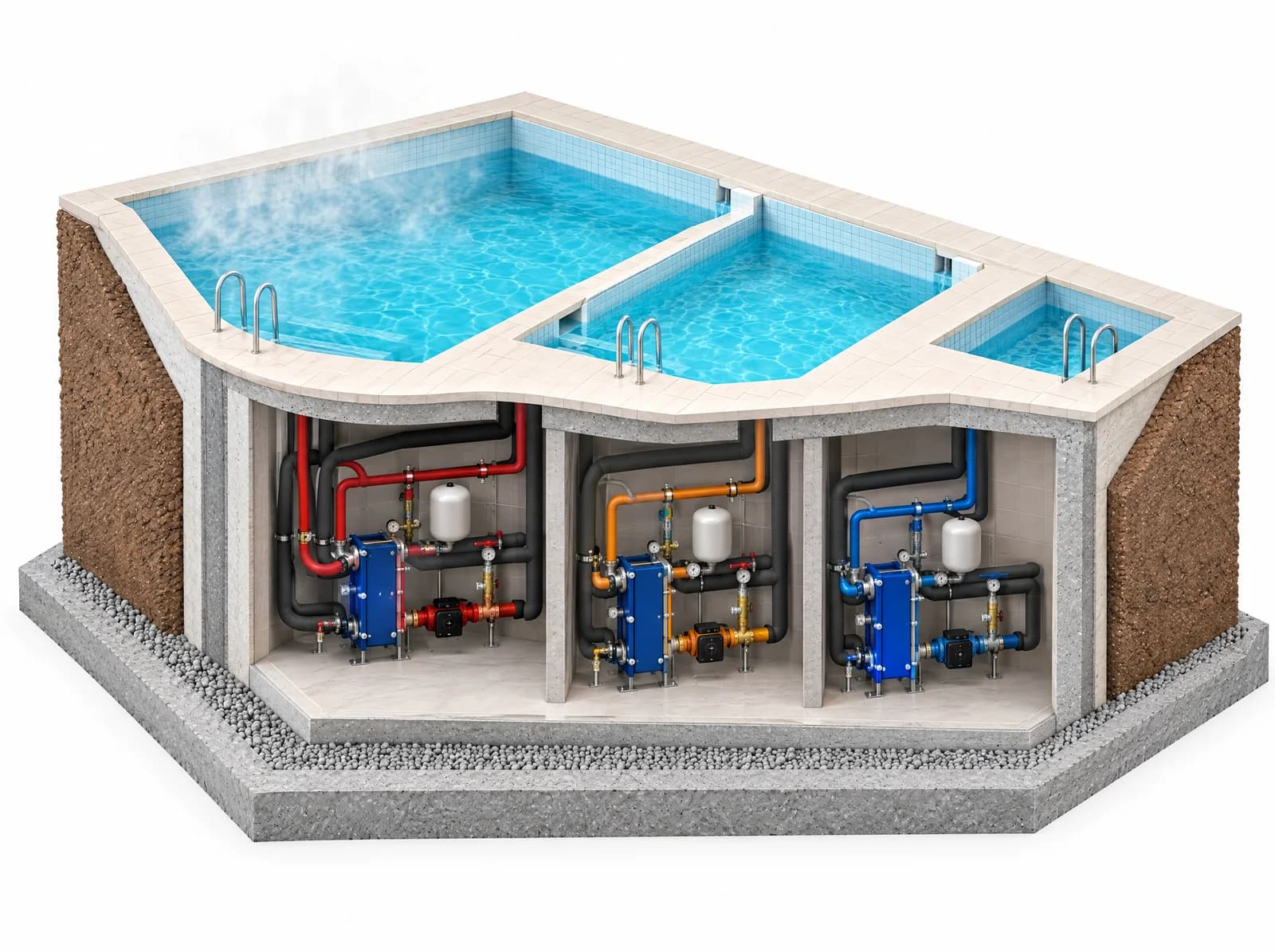
- Separate heating circuits
- Setting
- Indoor or outdoor
- Finish
- Ceramic, mosaic
Pools at different temperatures are built side by side along a route users follow in sequence. Each pool has its own circulation and heat setting; all are fed from a shared plant room.
Best suited toThermal hotels and spa centres
View details: Tiered thermal pool groupGeothermally heated pool
- Water
- Mains water
- Heat management
- Plate heat exchanger
- Setting
- Indoor or outdoor
- Finish
- Ceramic, mosaic, liner
Thermal water passes through one side of a plate heat exchanger, while the pool is filled with mains water. Since the mineral load does not reach the pool, the finish and pool equipment stay in the standard class; the exchanger material is chosen per analysis.
Best suited toVillas, residences and hotels
View details: Geothermally heated pool// 01 · Thermal pool calculation
Enter the pool size and temperatures, we calculate turnover and heat load.
Enter the width, length and average depth of the pool along with the source and target temperatures; volume, user capacity, circulation flow, filter area and the heat load of the source water are calculated instantly.
Calculation rule: volume = width × length × average depth; at least 3 m² of water surface per person. Turnover time 30-90 minutes, flow = volume ÷ turnover time; filter area = 30-minute flow ÷ 25 m/h. Fresh water 30 litres per user; changing the temperature of 1 m³ of water by 1 °C requires 1.163 kWh. Final values are set in the design according to the water analysis.
Get a quote for these dimensions
Send us the pool dimensions, the source temperature and any water analysis you have; we will finalise the material class, exchanger and filtration during the survey and prepare an itemised quotation.
| Item | Value |
|---|---|
| Water surface | 72.0 m² |
| Water volume | 86.4 m³ |
| Simultaneous users (max.) | 24 |
| Circulation flow (90 min turnover) | 57.6 m³/h |
| Circulation flow (30 min turnover) | 172.8 m³/h |
| Minimum filter area (25 m/h) | 6.91 m² |
| Fresh water (full capacity, 30 L per person) | 720 L |
| Energy to heat the pool by 1 °C | 100.5 kWh |
| Difference between source and pool | +12 °C |
| Heat load of source water per m³ | 14.0 kWh/m³ |
| Heat management | Cooling via exchanger |
// 01 · Pool wall layers
A thermal pool wall has five layers, and keeps the warm water in.
From inside out, we build the wall with ceramic tiling, adhesive and epoxy grout, brush-applied waterproofing, a reinforced concrete shell and external thermal insulation. Waterproofing provides watertightness, while the outer insulation keeps the heat of the warm water from passing into the ground; neither replaces the other.
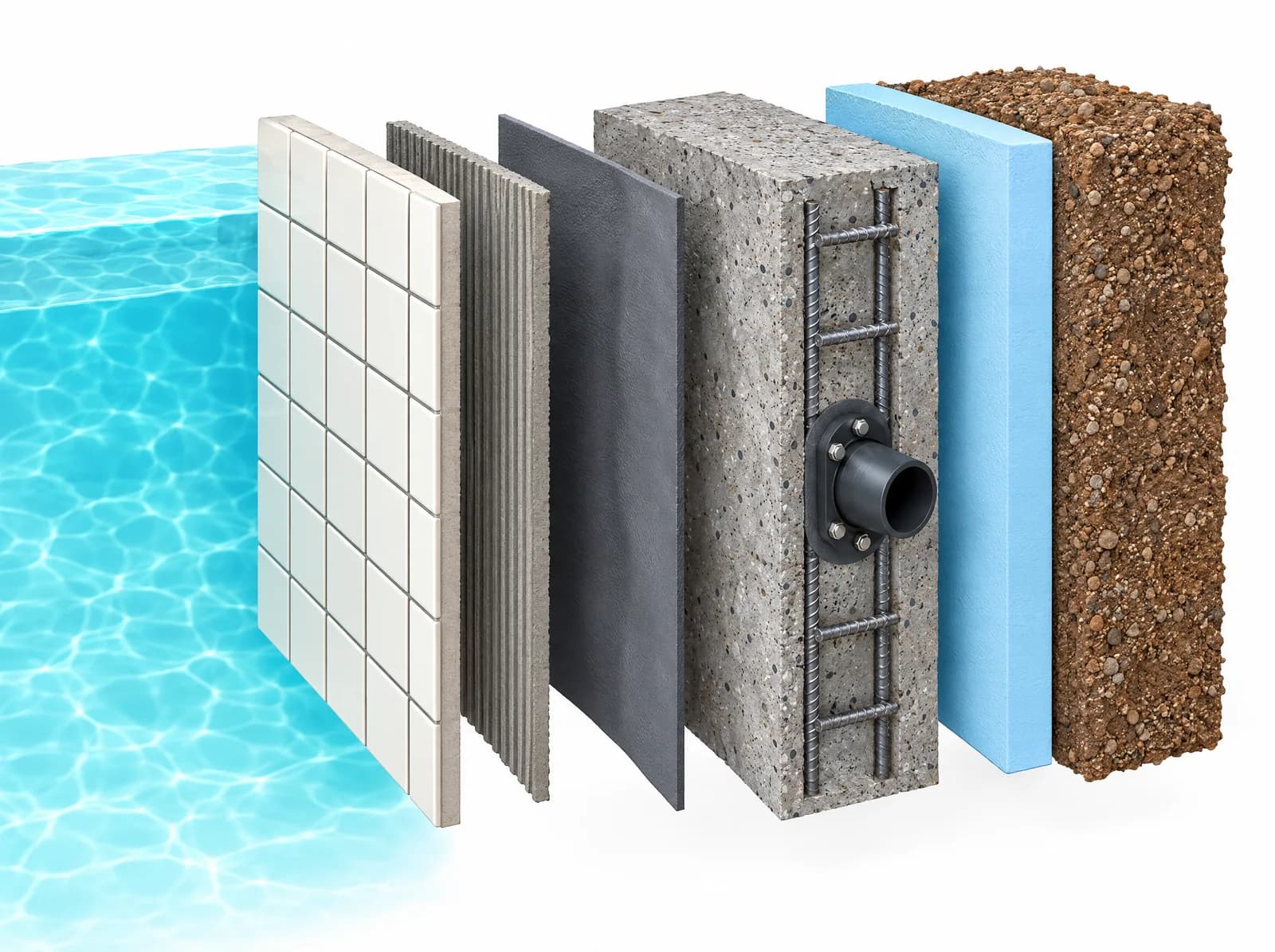
- Ceramic tilingA chemically stable surface in warm, mineral-rich water.
- Adhesive and groutFlexible adhesive and epoxy grout that resist the mineral load.
- WaterproofingTwo coats of flexible cementitious membrane, then a water test.
- Concrete shellWatertight concrete; pipe penetrations sealed with flanges.
- External insulationXPS boards keep the heat of the warm water out of the ground.
// Reading plan
Before building a thermal pool, read these six short articles.
The order follows the natural flow of a thermal pool decision: first what thermal water requires, then water balance, indoor settings, heavy use and operating costs.
Thermal pool solutions
Materials, filtration and heat management for mineral water.5 minShort answer
Warm, mineral-laden water wears standard materials quickly, which is why a thermal pool starts with a water analysis. Materials, filters and the exchanger are chosen according to the actual profile of the source.
- 01Groundwork and overflowWeeks 1-3Overflow channel, balance tank, rapid drain-down drainage
- 02Heating circuitWeeks 1-2Plate heat exchanger, temperature control, heat recovery
- 03Filtration and dosingWeeks 1-2Filters sized for mineral load, automatic dosing, continuous measurement
- 04Staged fillingWeeks 1First fill, temperature and pump tests, operator training
Water hardness and calcium balance
The balance between corrosion and scaling.5 minShort answer
Low-calcium water is corrosive and high-calcium water is scale-forming; the accepted range in residential pools is 200-400 ppm. In thermal water, this balance is read together with the source analysis.
Pool water chemistry and balance
pH, alkalinity, hardness, temperature and LSI.10 minShort answer
The Langelier index shows whether water dissolves or deposits scale; values between -0.5 and +0.5 produce no marked dissolving or precipitation. As temperature rises, water becomes more prone to leaving scale.
Indoor pool construction
Humidity, ventilation and building physics.7 minShort answer
In an indoor pool, the real issue is not the water but the air volume around it. Dehumidification and ventilation prevent condensation and return the heat drawn from the air to the space or the water.
Hotel and commercial pools
Turnover time and filtration under heavy use.7 minShort answer
The required flow is found by dividing the pool volume by the turnover time. As user density rises, turnover time shortens, and filter area and dosing grow accordingly.
Annual pool operating cost
Energy, water, chemicals and maintenance.7 minShort answer
Operating cost consists of four items: energy, water, chemicals and maintenance. In a thermal pool, when the source heat is managed well, the energy item becomes markedly smaller.
Showroom
Plan a showroom visit
At our showroom in Çilek Plaza, Sancaktepe, you can discuss your project with our team. We recommend booking an appointment by phone before your visit.
Working Hours
- Monday to Friday · 08:00-17:30
- Saturday · 08:00-12:30
- Closed on Sunday
// 02 · Cost
Thermal pool cost rests on two things, water analysis and volume.
In thermal pool construction, the budget depends as much on the source water profile as on the pool area. The six factors below explain why two quotations differ; the exact figure is finalised in an itemised quotation after the survey and water analysis.
Water analysis and source
Mineral load sets the material class, temperature the heat circuit.
Pool volume and surface
Volume sets filter and pump; surface sets capacity and heat loss.
Material class
Per analysis: 316L, high-alloy stainless steel or titanium.
Heat management
Exchanger capacity, heat recovery and pipe insulation.
Filtration and dosing
Short turnover needs larger filters, auto dosing and monitoring.
Indoor setting
Indoor halls add dehumidification and ventilation as separate items.
// 03 · Process
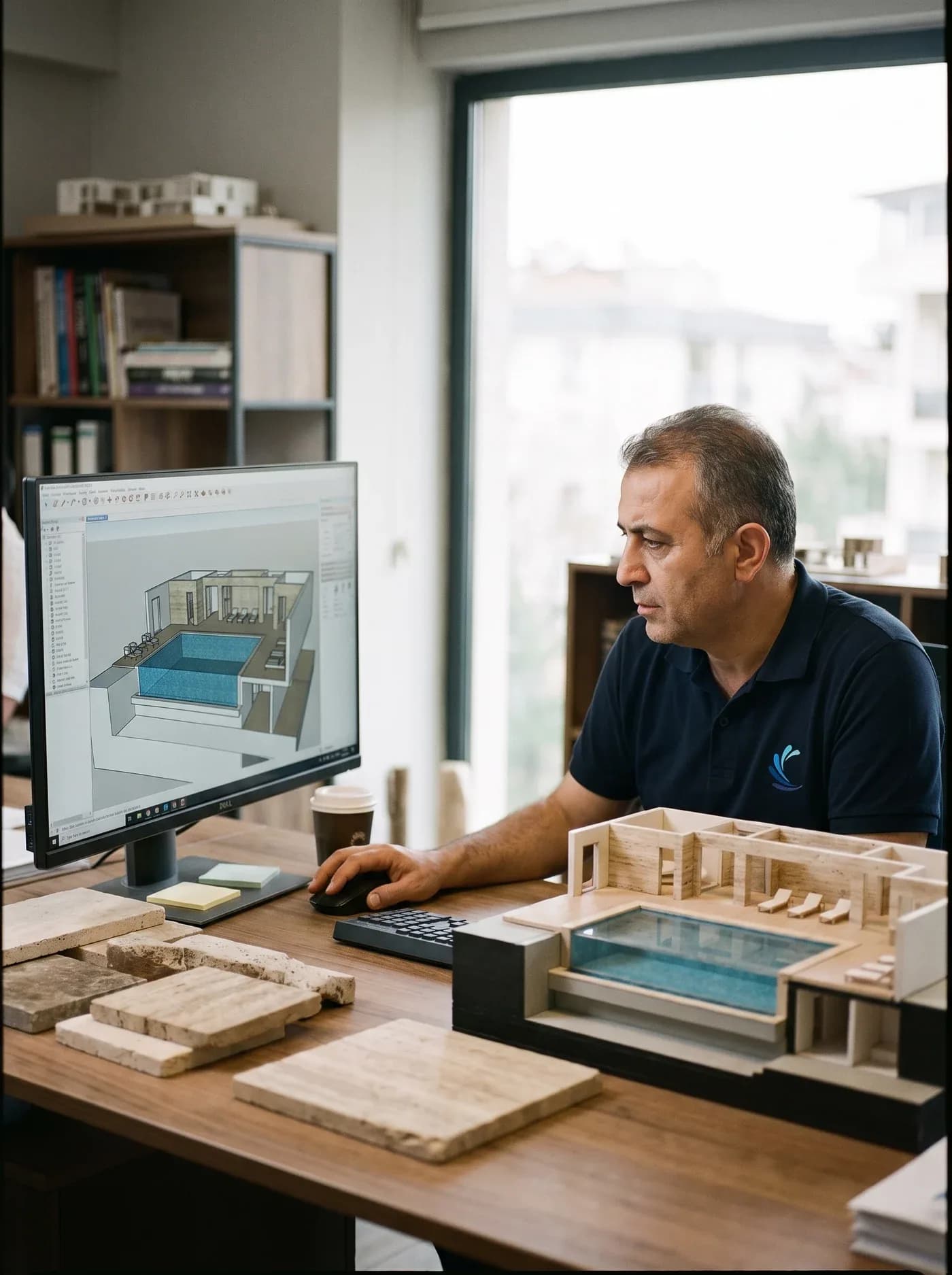
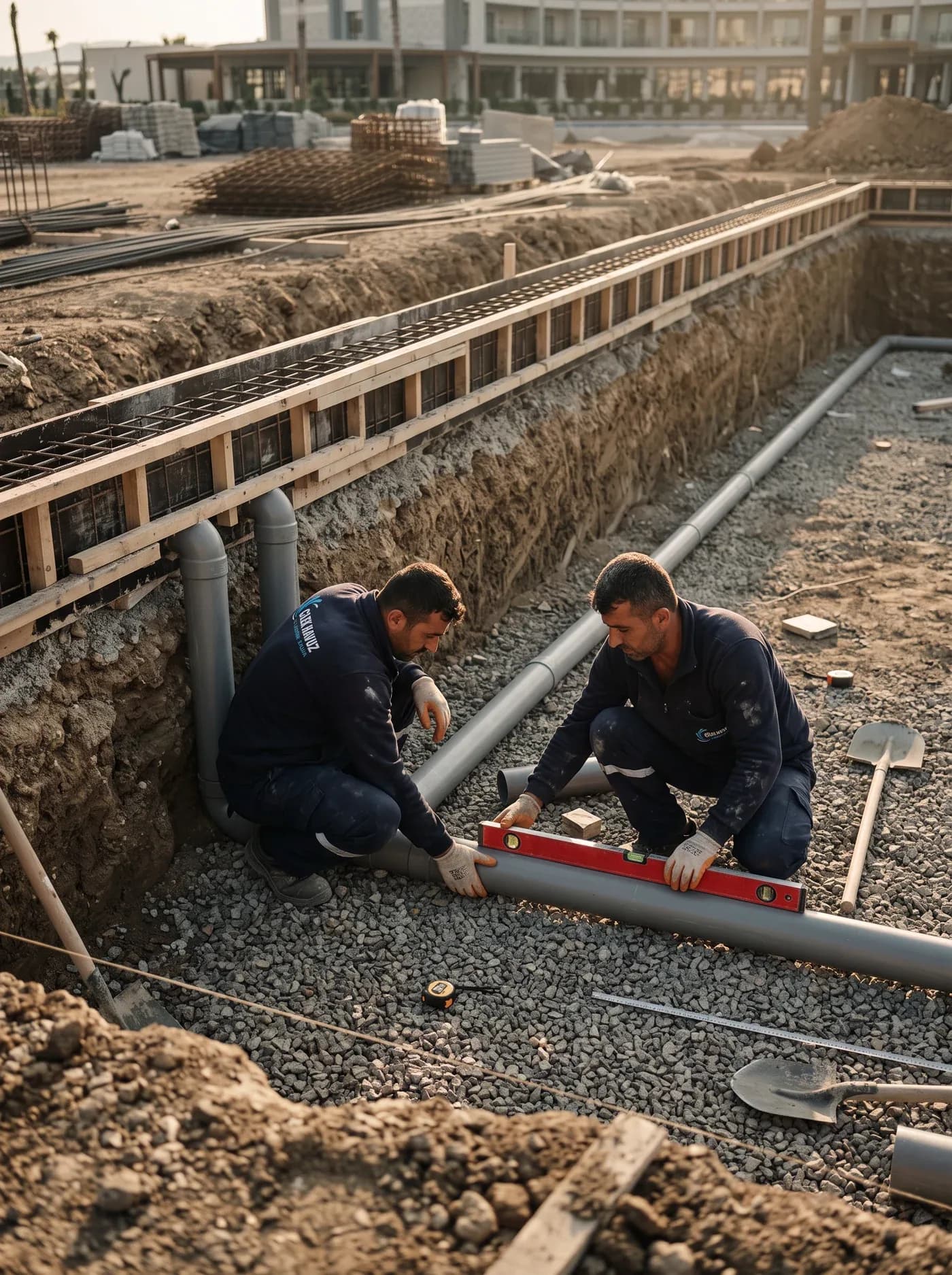
A thermal pool is built in eight steps, each based on the water analysis.
The process starts with the survey and source water analysis, continues with comfort design and groundwork, and takes shape with the materials, heating and filtration systems. We hand over the pool after staged first filling, testing and operator training.
Analysis and design
Survey, source water analysis, comfort design and construction drawings
Water analysis report and approved design
Groundwork and materials
Overflow channel, balance tank, drainage, materials and finish per analysis
Tested groundwork and watertight shell
Heating and water treatment
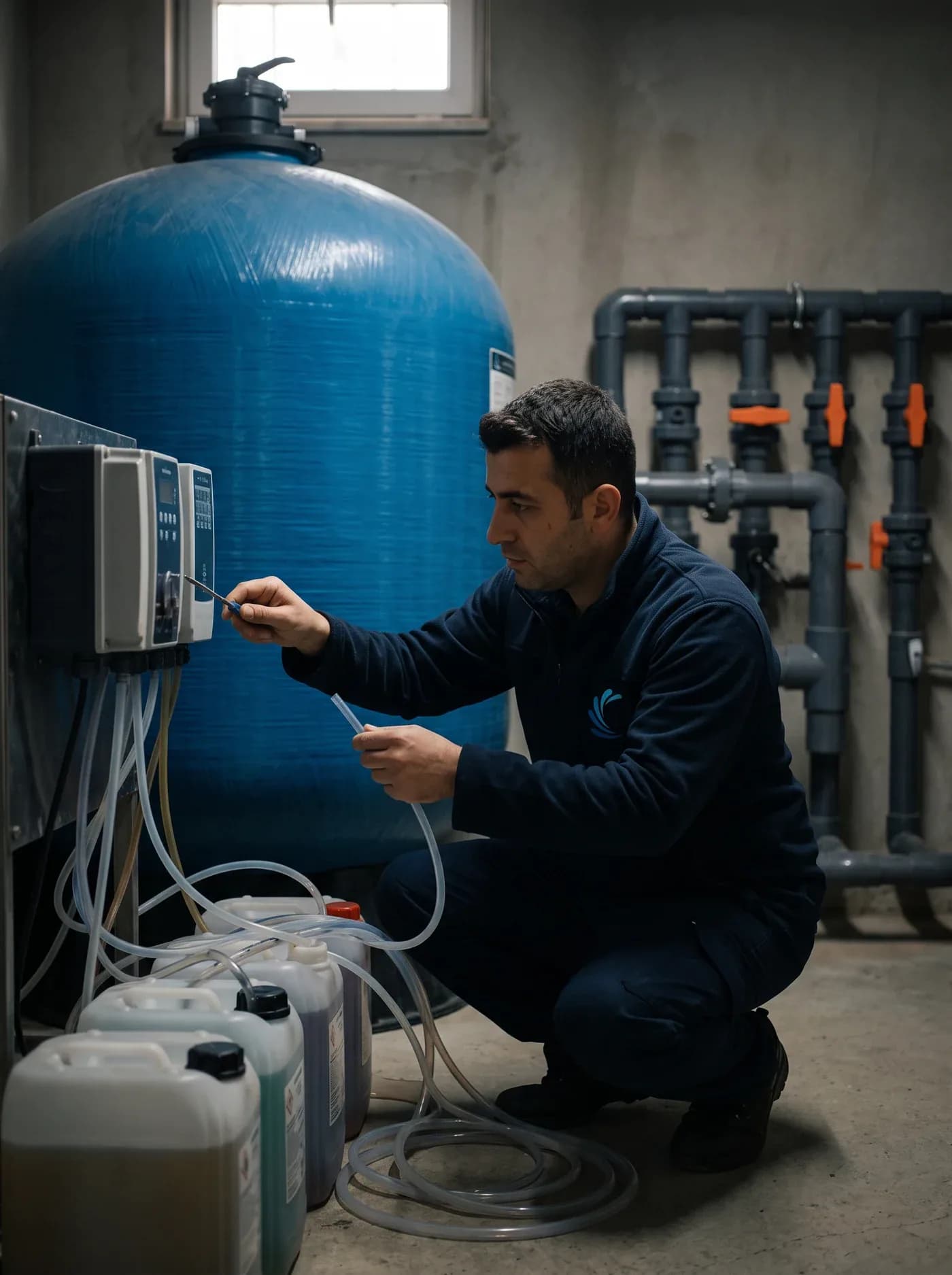
Plate heat exchanger, heat recovery, filtration, dosing and water renewal
Working heating and filtration circuit
Handover
Budget close-out, staged filling, system tests and operator training
Commissioned thermal pool
The eight steps in detail
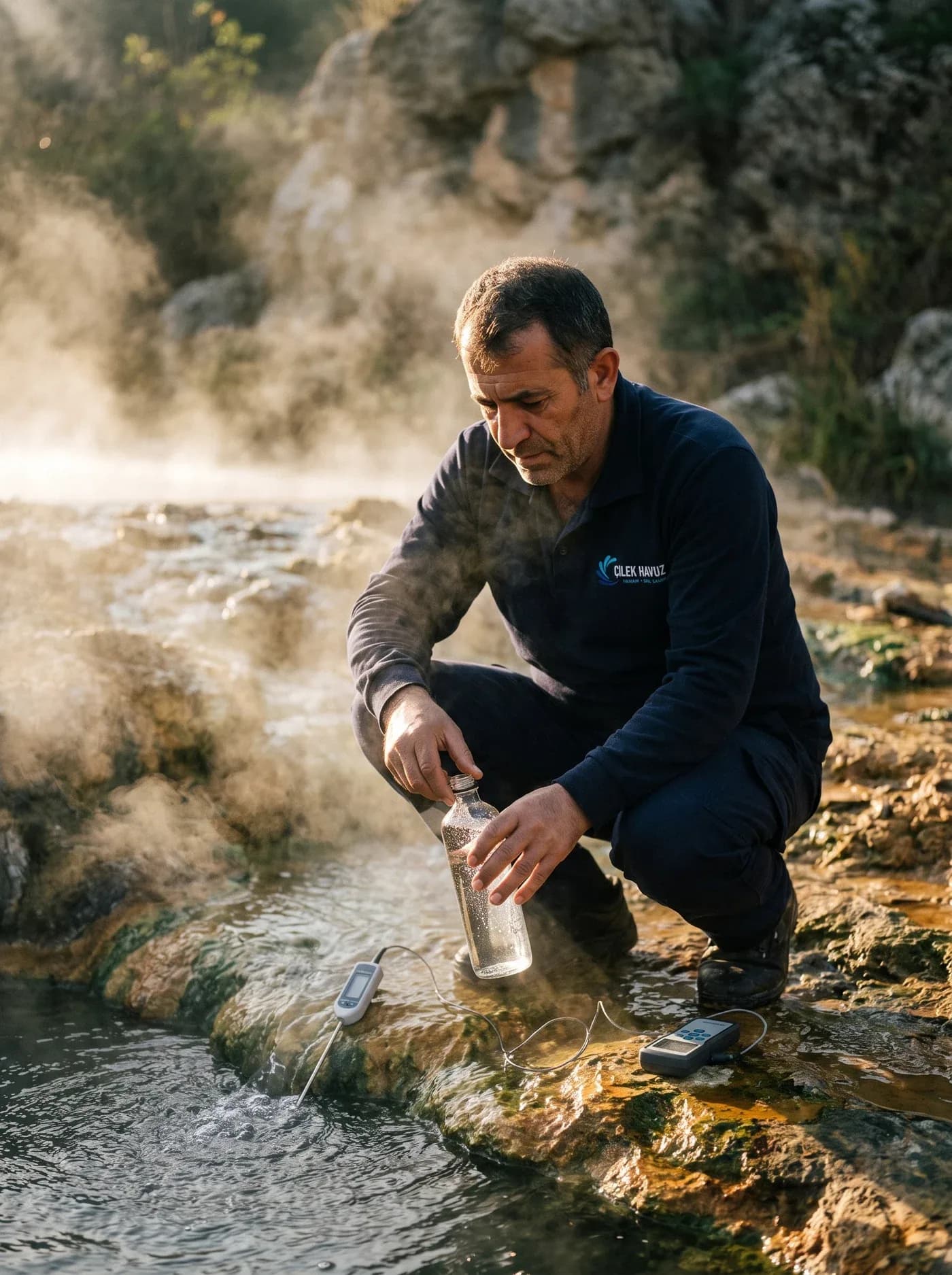
01 / 08
Site Survey and Spring Water Analysis
The Water's Identity Card
Every thermal source has its own chemical fingerprint: limescale dominates in one, sulphate or sulphur compounds in another. That is why we begin a project not with drawings but with a laboratory analysis of the spring water.
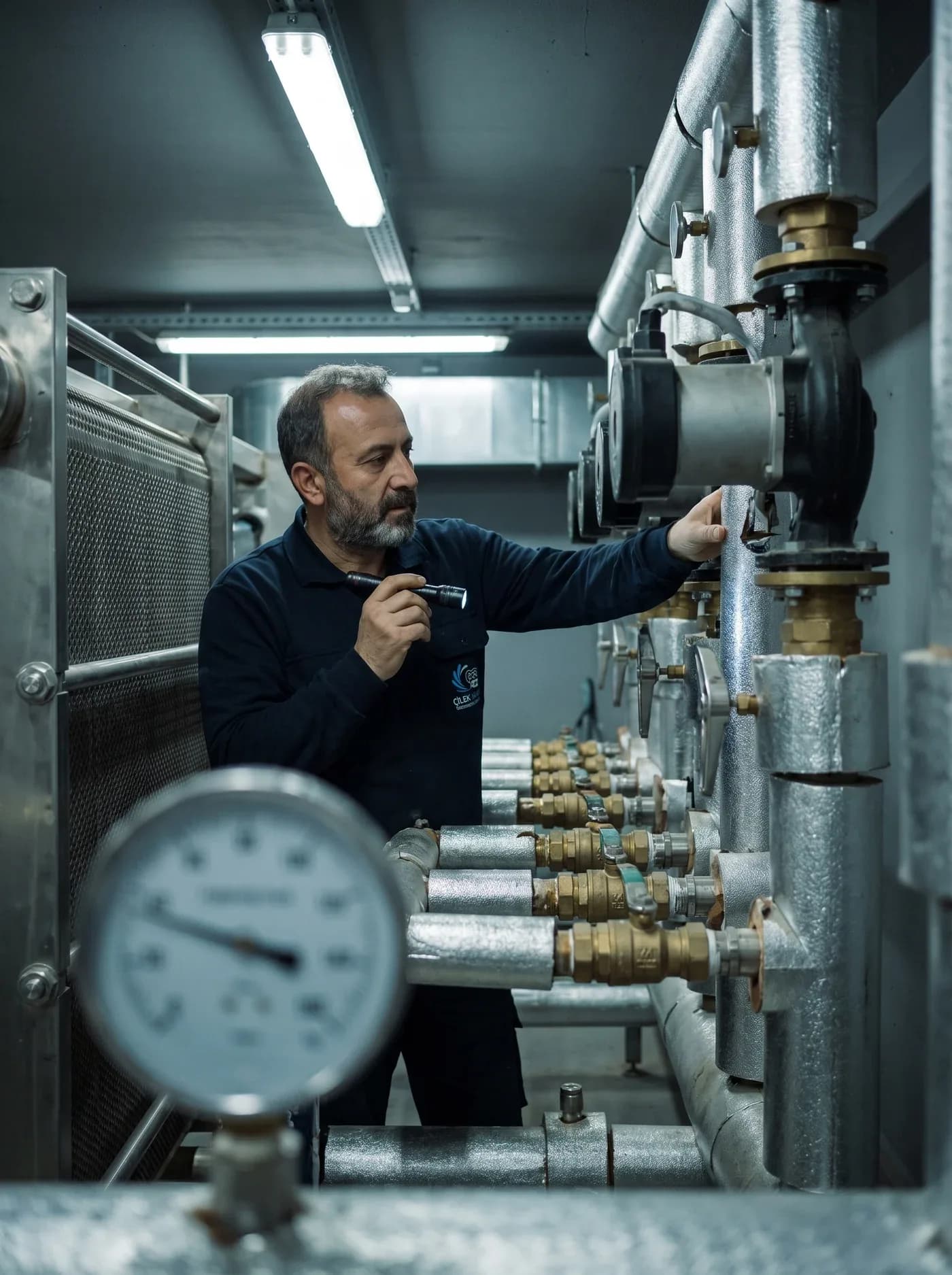
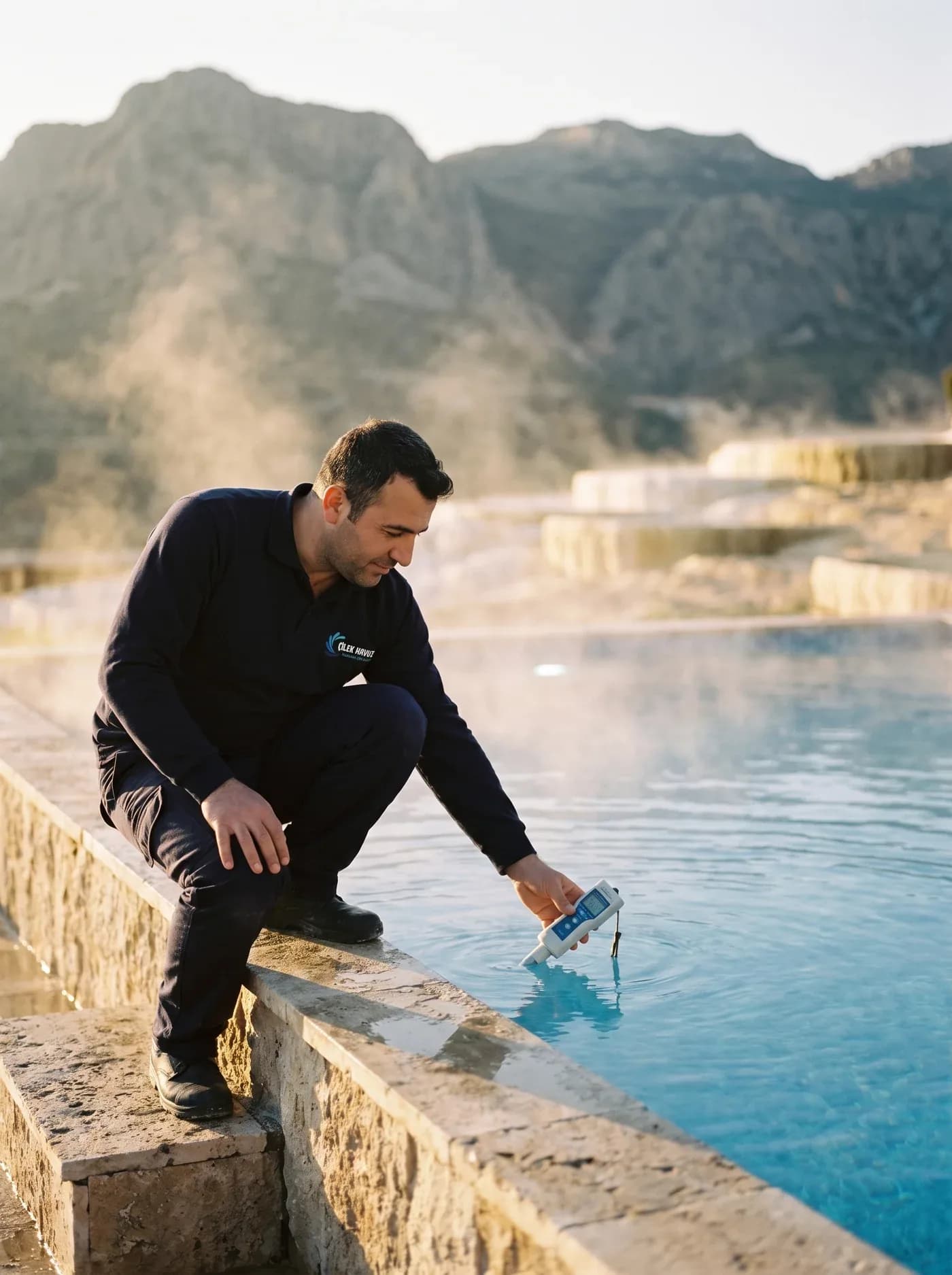
At the survey the temperature and flow rate of the source are measured, the existing installation is examined and the intended use is settled. Every decision, from materials to the heat exchanger, rests on that report.
- Laboratory water analysis
- Source temperature and flow rate
- Mineral profile (limescale, sulphate, chloride)
- Sulphur content check
- Survey of the existing installation
- Intended use (hotel / thermal spa / residential)
- Indoor / outdoor decision
- Preliminary budget frame
There is no thermal project without an analysis
A material that works without trouble for years at one source can fail within a few seasons at another. All material and equipment decisions have to rest on the real profile of the water.
// 04 · Thermal pool materials
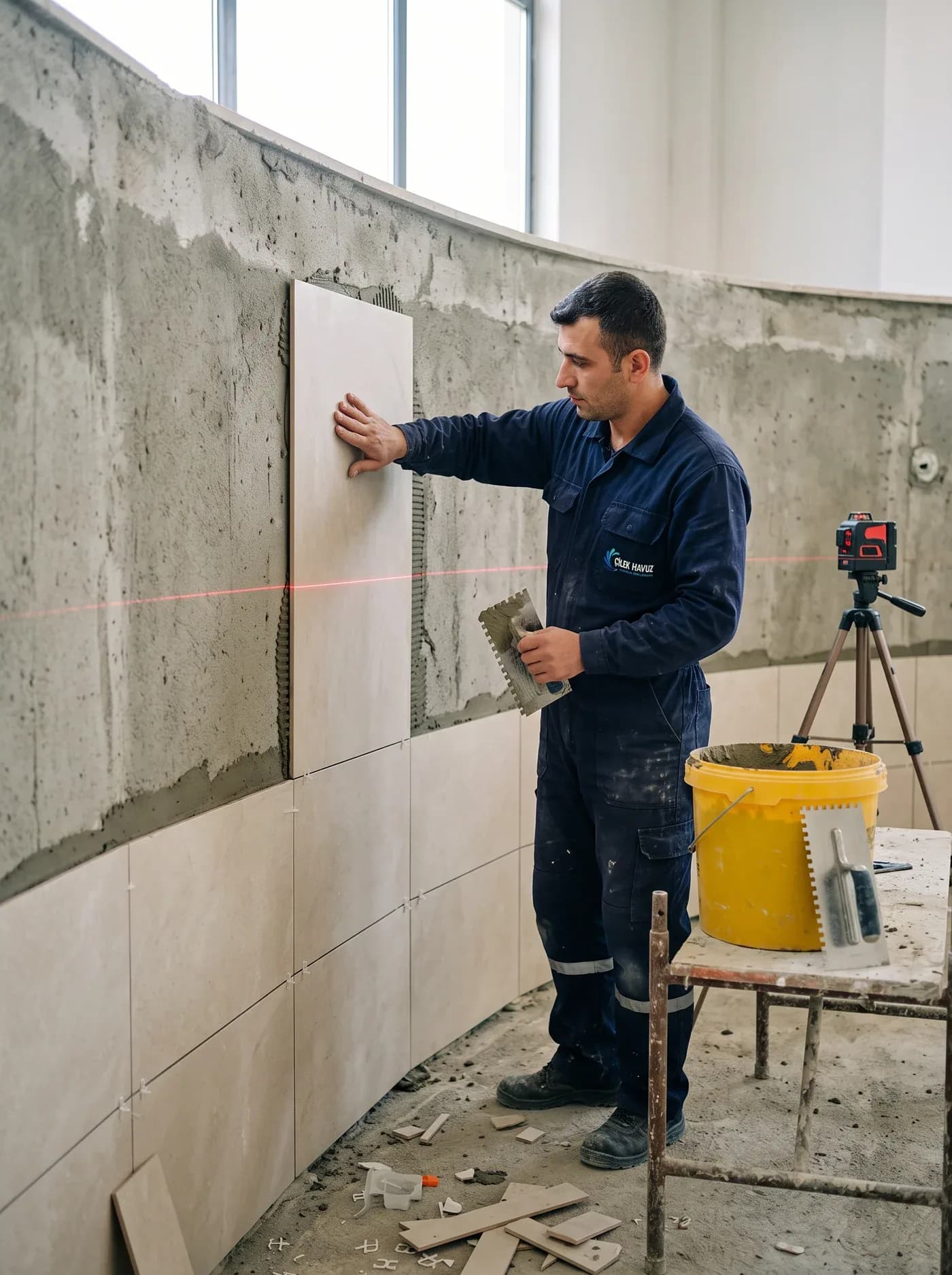
We choose a separate material for each surface, because thermal water is selective.
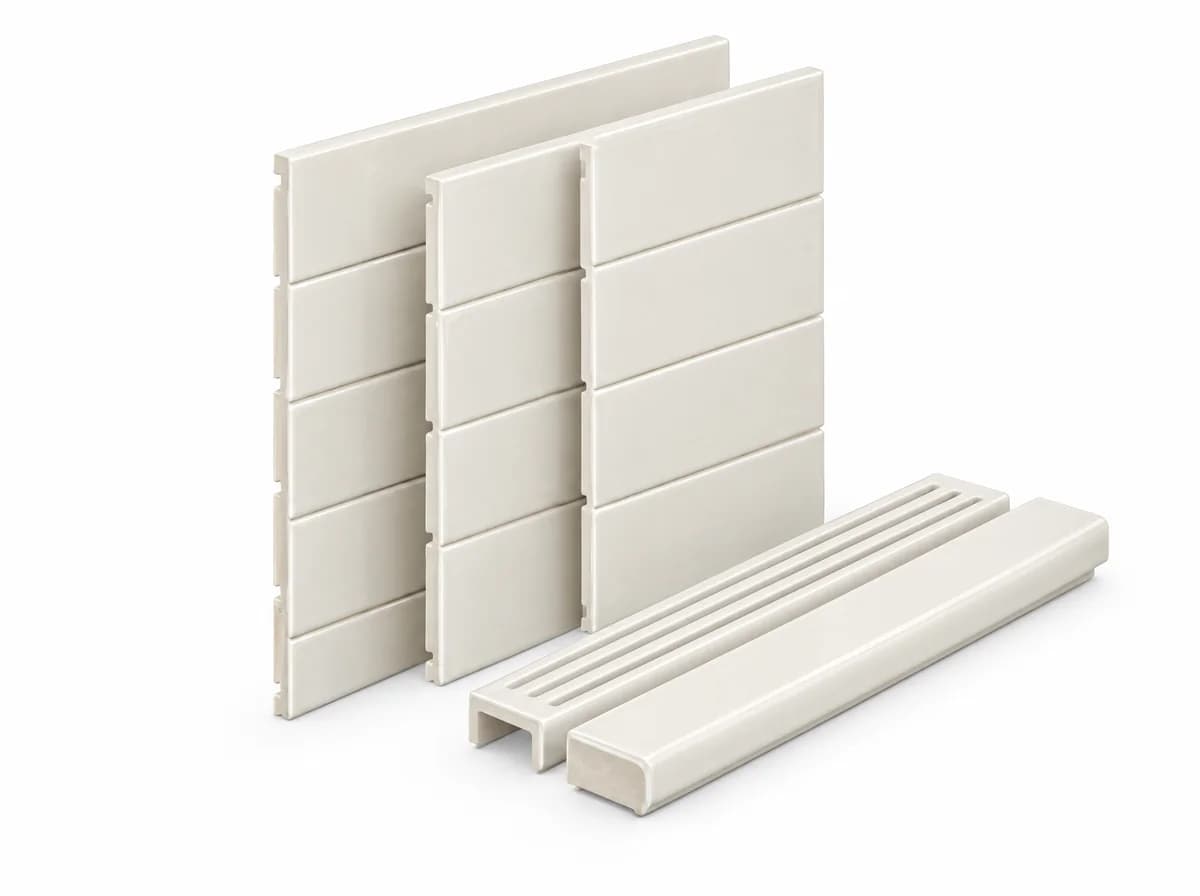
We use ceramic and glass mosaic for finishes, epoxy for grout, and the appropriate grade of stainless steel or titanium for metal in the wet area. The selection follows the laboratory analysis of the source water; a material that lasts for years at one source may wear early at another.
 01
Glazed ceramic
A surface that is chemically stable against heat and mineral load. Shaped details such as ledges and channels are laid with special pieces.
Used in
- Pool interior
- Seating ledge
- Overflow channel
 02
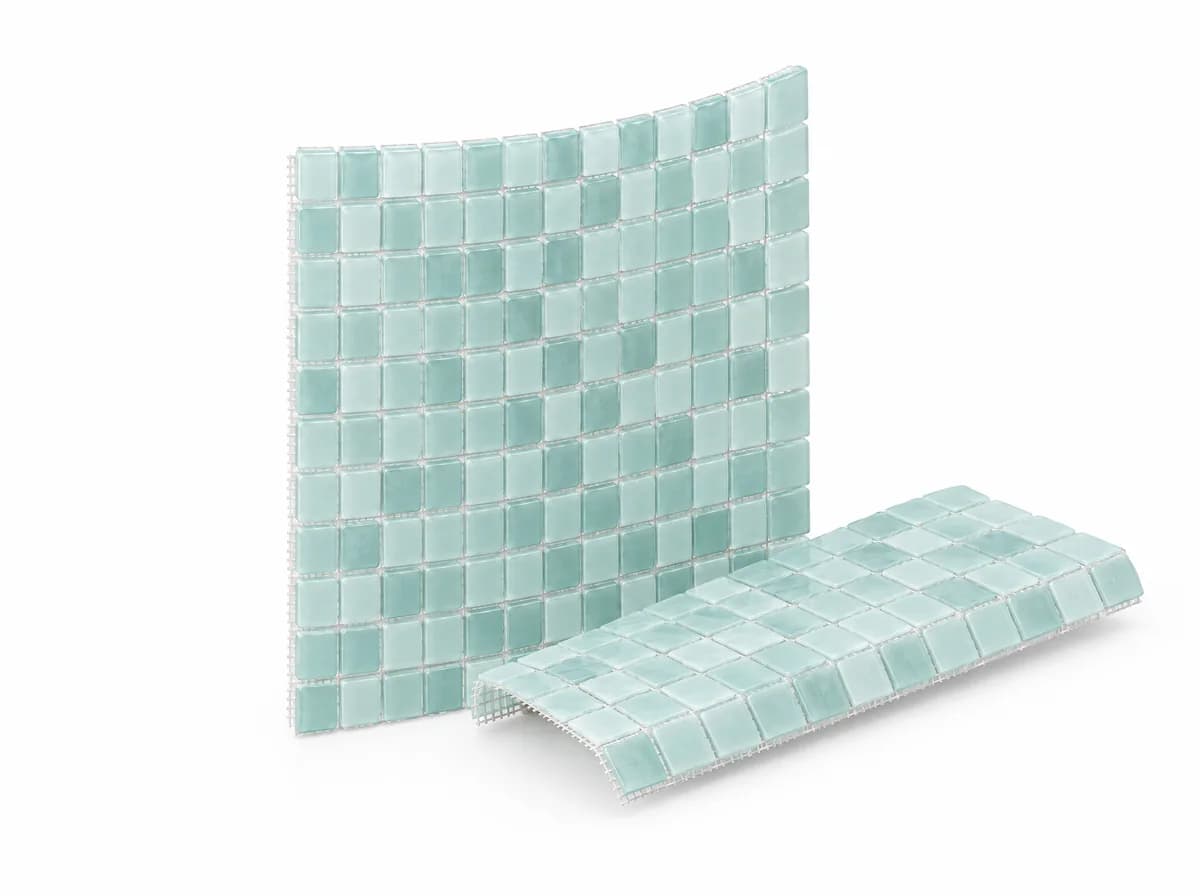
Glass mosaic
Glass does not absorb water and keeps its colour; it is used on curved walls and jet niches. It does not hold back water itself, so the waterproofing beneath is a separate layer.
Used in
- Pool interior
- Curved surfaces
 03
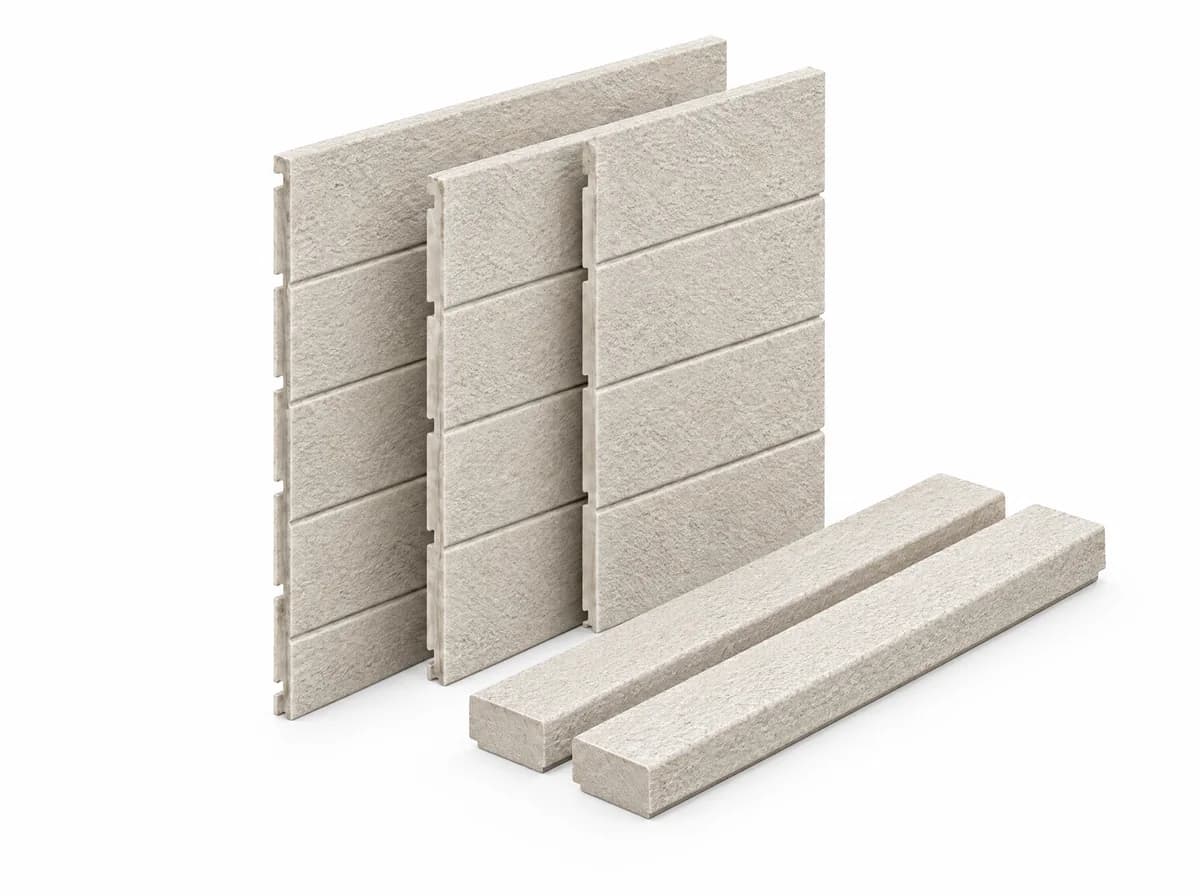
Slip-resistant ceramic
We choose textured ceramic for the edges, stairs and ramps walked on with wet feet. It gives a safe step even on steamy winter days.
Used in
- Walkway
- Stairs
- Ramp
 04
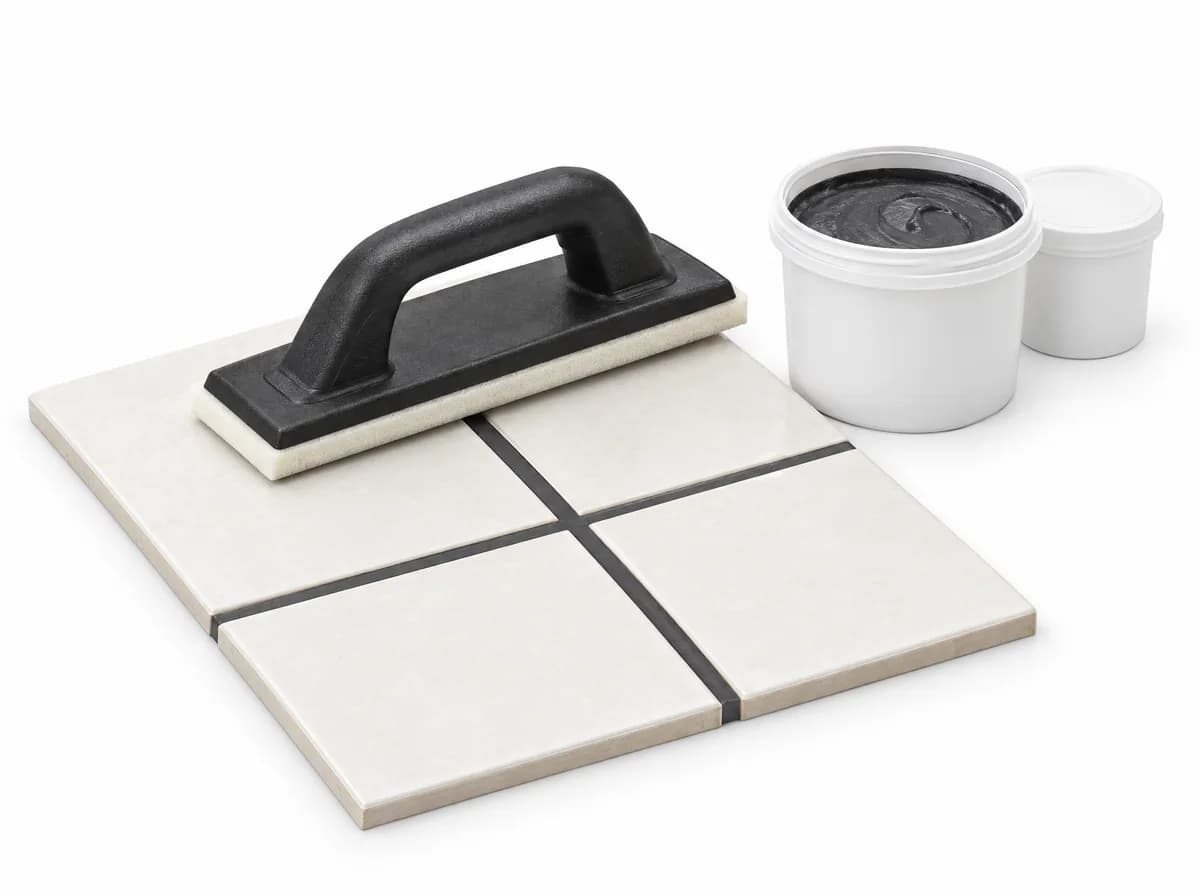
Epoxy grout
Denser than cementitious grout and resistant to wear in mineral water. Joints that stay closed also protect the waterproofing beneath.
Used in
- Joints
- Overflow channel
 05
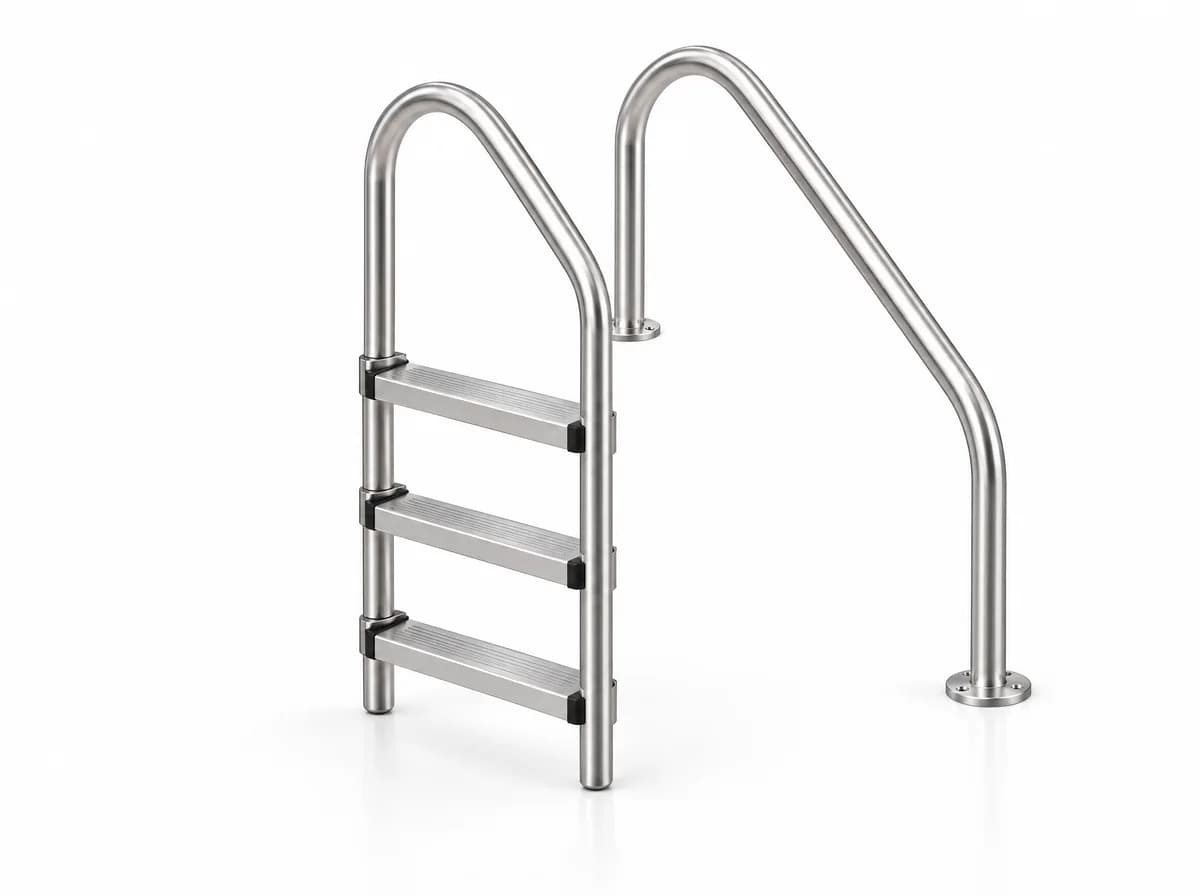
316L stainless steel
A molybdenum-bearing stainless steel used for handrails and ladders in low-chloride waters. It is the first choice when the source analysis allows.
Used in
- Handrails
- Ladders
- Fittings
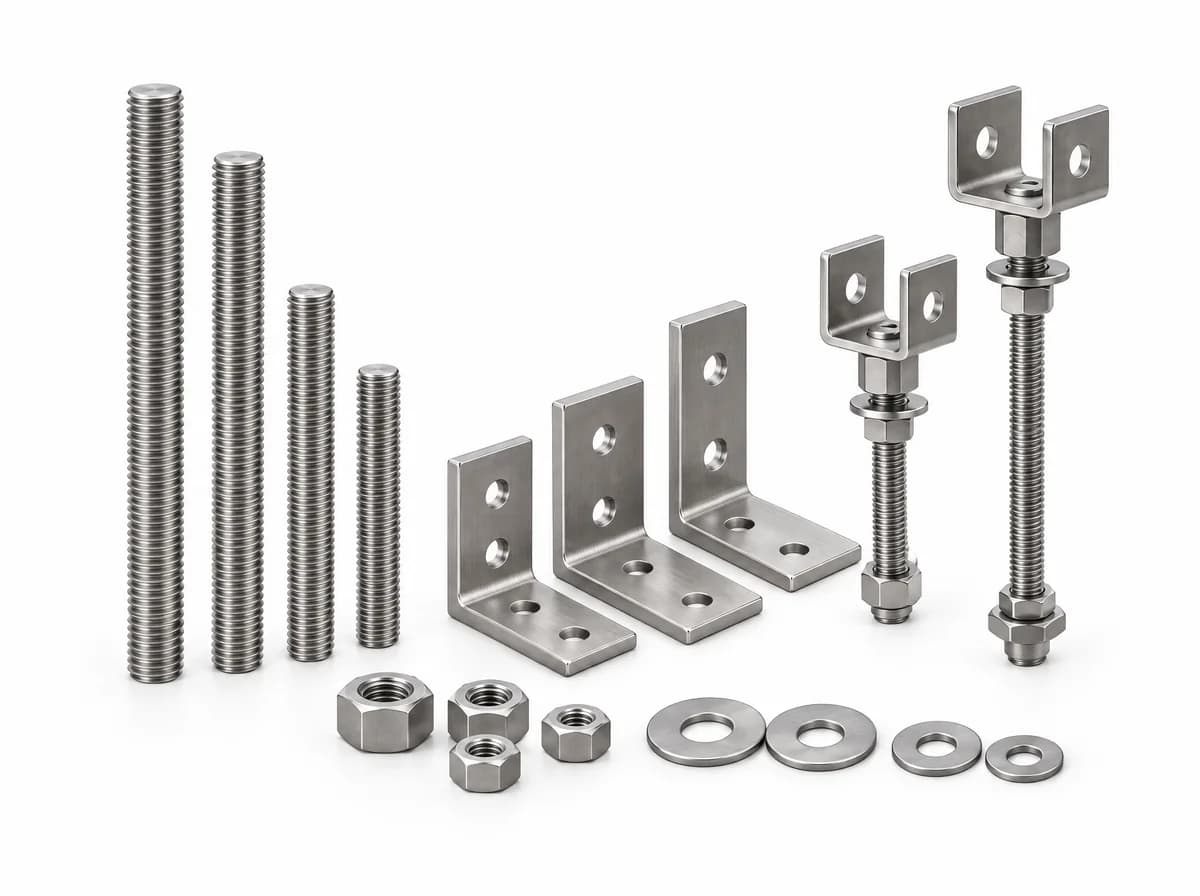 06
High-alloy stainless steel
Steel of grade 1.4529, 1.4547 or 1.4565. Used in the pool hall for supports and fixings that cannot be cleaned regularly.
Used in
- Supports
- Fixings
- Suspended ceiling
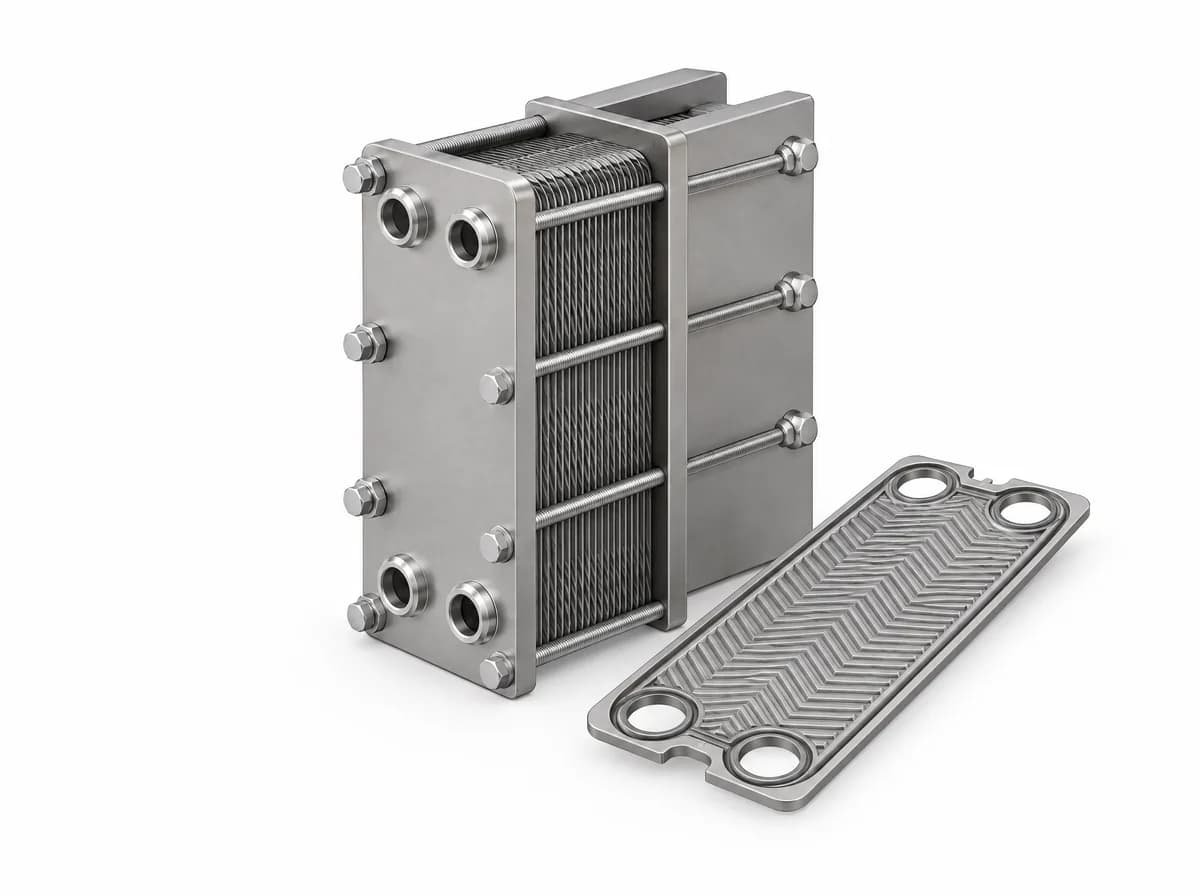 07
Titanium
More resistant than stainless steel to chloride and aggressive water. We choose it for exchanger plates and heater bodies at high-chloride sources.
Used in
- Exchanger
- Heater
- Sensor
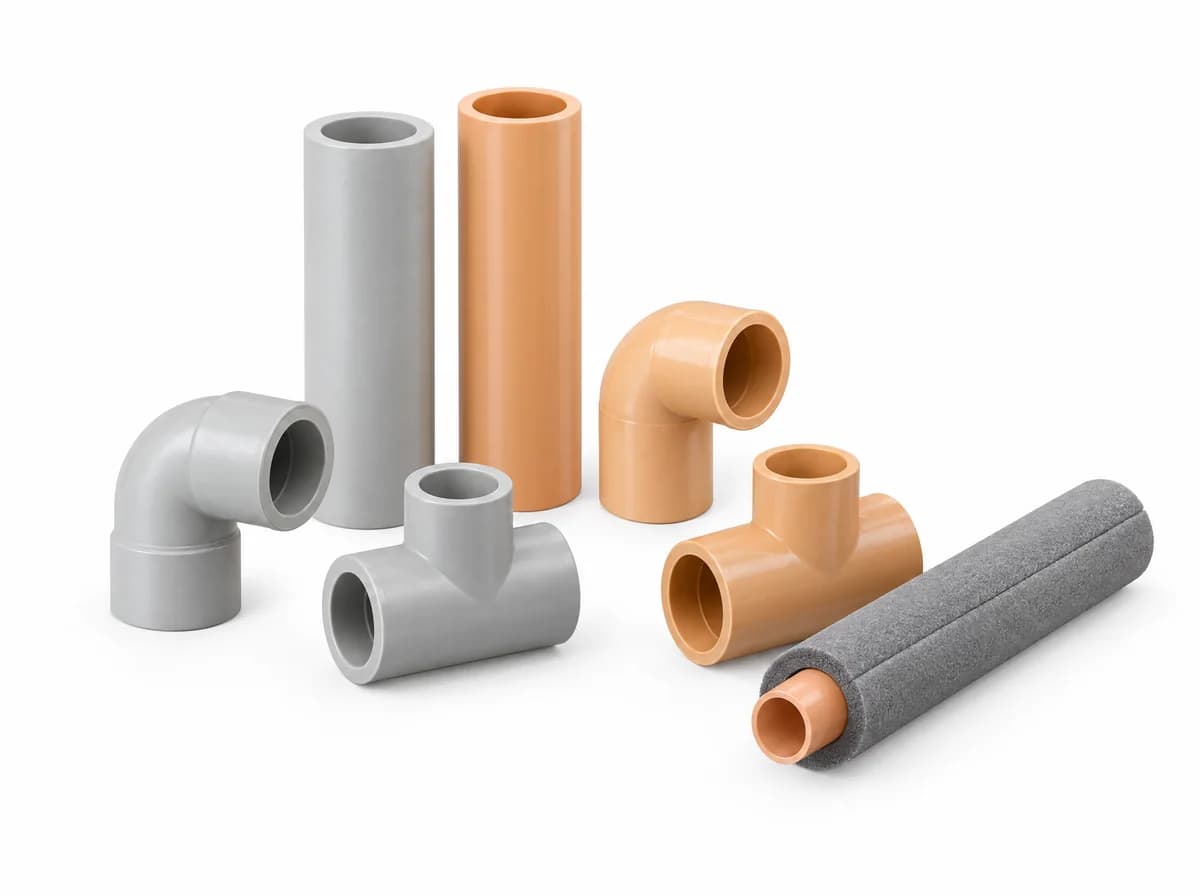 08
Heat-resistant pipe
PP-R or PVC-C pipe is used on the hot source line. Routes allow for expansion, and every critical point is left with service access.
Used in
- Source line
- Exchanger circuit
// 04 · Thermal pool equipment
From exchangers to dehumidifiers, we choose equipment by the source.
Pool heat exchangers, heat pumps, electric heaters, solar heating and dehumidifiers are among our products. You can review the capacity, material and operating conditions of each product on its own page.
// 05 · Projects
From thermal hotels to spa centres, the pools we have built.
Here we bring together the pools we have delivered in thermal hotel, hotel spa and wellness projects. In each project, materials, heating circuit and filtration were calculated separately for the facility's water and use.
// 05 · Service regions
Across Türkiye and abroad, we build thermal pools.
We carry out thermal pool construction across Türkiye for thermal hotels, spas and residential projects; we export to 14 countries and run projects abroad on site through our branches in Kyrgyzstan, Egypt, Algeria and Iraq.
Domestic
15- Istanbul
- Mugla / Bodrum
- Antalya
- Izmir / Cesme
- Ankara
- Bursa
- Kocaeli / İzmit
- Adana
- Mersin
- Tekirdağ
- Kandıra
- Sakarya
- Samsun
- Denizli
- Elazığ
International
13- AlgeriaBranch
- EgyptBranch
- IraqBranch
- KyrgyzstanBranch
- France
- Germany
- Kazakhstan
- Libya
- Qatar
- Russia
- Saudi Arabia
- United Arab Emirates
- United Kingdom
// 06 · After handover
The work does not end at handover, we keep monitoring the water together.
At handover we fill the pool in stages and train the operating team on site in water measurement, backwashing and record keeping. Thermal water can behave differently with the season and flow rate; regular measurement catches small deviations early. Our workmanship carries a 2-year warranty.
- 012 years
Warranty
Our construction workmanship is guaranteed for 2 years from handover; warranty documents are provided at handover.
- 023-5 days
Commissioning and training
We fill the pool in stages, test the exchanger, pumps and dosing, and train the operating team in measurement and record keeping.
- 03Continuous
Water measurement
Sensors measure pH and disinfectant continuously; automatic dosing keeps the water balanced between corrosion and scaling.
- 04At least monthly
Microbiological testing
Microbiological parameters are tested in an accredited laboratory at least once a month; the source analysis is renewed periodically.
Related services
- Swimming Pool ConstructionReinforced-concrete, prefabricated and infinity swimming pools, built turnkey for villa, residential and commercial projects.
- Prefabricated PoolsFast-install modular prefabricated pool systems.
- Infinity PoolsPools that open onto the view, with water spilling over the edge into a balance tank.
- Sauna ConstructionFinnish, bio and infrared saunas; timber cabins built to measure.
- Turkish Hamam ConstructionTurkish hammams with a heated navel stone and marble craftsmanship.
- Natural PondsNatural-look pond and bio-pool designs.
Prepared byAli SAVAŞ · Project Manager · Mechatronics Engineer
// 07 · Questions
About thermal pool construction, frequently asked questions.
Çilek Havuz Corporate
Pool & Wellness Engineering
- Response Time
- Same day
- Channels
- Phone · Email · WhatsApp
If the answer you are looking for is not here, send your question directly to us and our team will reply as soon as possible.
+90 216 475 39 37The timeline depends on pool size and the condition of the source. Groundwork takes 1-3 weeks, the heating circuit and filtration 1-2 weeks each, and commissioning 3-5 days. The process runs in four phases: analysis and design, groundwork and materials, heating and water treatment, and handover; the schedule is given in writing at the survey.
Çilek Havuz Corporate
The first step is a laboratory analysis of the source water. Every thermal source has a different chemical fingerprint; every decision, from materials to the heat exchanger, is based on this report. During the survey we also measure the source temperature and flow rate on site.
Çilek Havuz Corporate
Under Türkiye's Spa Regulation, water with a temperature of 20 °C or above at the point of emergence is thermal water. If it also carries minerals, it is called thermomineral water. The pool is designed according to this temperature and mineral profile.
Çilek Havuz Corporate
In hydrotherapy and rehabilitation pools, water is kept between 32 and 36 °C. If the source water is above this range it is cooled with a plate heat exchanger, and if below, additional heating is provided; the target temperature is held steady throughout the day by sensors and automation.
Çilek Havuz Corporate
Under Türkiye's Spa Regulation, a therapy pool is sized to give at least 3 m² of water surface per person, and its depth does not exceed a net 150 cm. Solid-step stairs, grab rails along the walls and overflow gutters are mandatory.
Çilek Havuz Corporate
Glazed ceramic and glass mosaic are used for finishes, and epoxy for grout. Metal in the wet area is 316L or high-alloy stainless steel, depending on the analysis. In aggressive, high-chloride waters we switch to titanium for equipment such as exchangers and heaters.
Çilek Havuz Corporate
Both can be right; the decision depends on source temperature, mineral load and the purpose of the facility. If only heat is taken via an exchanger, the pool is filled with mains water and the mineral load does not reach the pool; with direct use, the material class goes up.
Çilek Havuz Corporate
Circulation flow is found by dividing the pool volume by the turnover time. In warm, heavily used pools the turnover time is kept between 30 and 90 minutes. Filter area is found by dividing the flow by the filtration velocity; commercial pools are based on a medium rate of 10-25 m/h.
Çilek Havuz Corporate
Hygiene is ensured through filtration, continuous overflow, planned fresh water and continuous measurement of the water. Fresh water is planned at about 30 litres per user, with filter backwash water contributing to this amount. Automatic dosing minimises human error.
Çilek Havuz Corporate
Because sulphur odour concentrates in enclosed spaces, ventilation is planned at the start of the design. Where sulphurous or carbonated water is used, adequate ventilation is installed to remove the gas; the same system also stops humid air from damaging the building.
Çilek Havuz Corporate
Cost depends on the water analysis, pool volume, material class and the heat exchanger with heat recovery. The level of filtration and dosing, and the dehumidification system in indoor settings, also affect it. When the source heat is managed well, heating costs largely disappear.
Çilek Havuz Corporate
A direct connection is not recommended; the finish, pipework and equipment of a standard pool are not designed for warm, mineral-laden water. We inspect the existing structure on site and, together with the water analysis, report what can stay and what needs to change.
Çilek Havuz Corporate
Yes, maintenance is more frequent. More frequent filter backwashing, scale monitoring on surfaces, corrosion checks on metal parts and regular water measurement are part of the routine; a plant room with easy service access lightens this load.
Çilek Havuz Corporate
Çilek Havuz builds thermal pools across Türkiye for thermal hotels, spas and residential projects. We export to 14 countries and run projects abroad through our branches in Kyrgyzstan, Egypt, Algeria and Iraq.
Çilek Havuz Corporate
// Sources and regulations
Sources and regulations
The official documents behind the technical framework on this page; links open the institutions' own sites.
- Regulation on the Health Principles and Conditions for Swimming Pools (Official Gazette No. 27866, 6 March 2011)Official Gazette of Türkiye
- Regulation Amending the Swimming Pools Regulation (Official Gazette, 15 December 2011)Official Gazette of Türkiye
- Guidelines for safe recreational water environments, Volume 2: Swimming pools and similar environments
Next step
Let us discuss your project in the way that suits you best.
You can fill in the form for a written quote, schedule a video project presentation or ask us to survey your project site.
Get a Quote
Send us your dimensions and expectations in writing.
Online presentation
Video project presentation
On-site survey
Inspection at your project site
// 08 · Company & Contact
To talk about your project, call or write to us.
Legal Name
Çilek Havuz
Founded
1998 · Istanbul
Head Office
Çilek Plaza, Eyüp Sultan Mah. Yakacık Cd. Feshane Cd. No: 2 D:4 D:1, 34885 Sancaktepe / İstanbul
Service Area
All of Türkiye · exports to 14 countries
Branches
Kyrgyzstan · Egypt · Algeria · Iraq
Showroom
Plan a showroom visit
At our showroom in Çilek Plaza, Sancaktepe, you can discuss your project with our team. We recommend booking an appointment by phone before your visit.
Working Hours
- Monday – Friday · 08:00 – 17:30
- Saturday · 08:00 – 12:30
- Closed on Sunday