

Garden hot tub prices: which item total sets the figure?
Garden hot tub prices are the total of shell material, jet and pump group, heater power, cabinet insulation, concrete slab and electrical line items.
Garden hot tub prices are the total of shell material, jet and pump group, heater power, cabinet insulation, concrete slab and electrical line items.
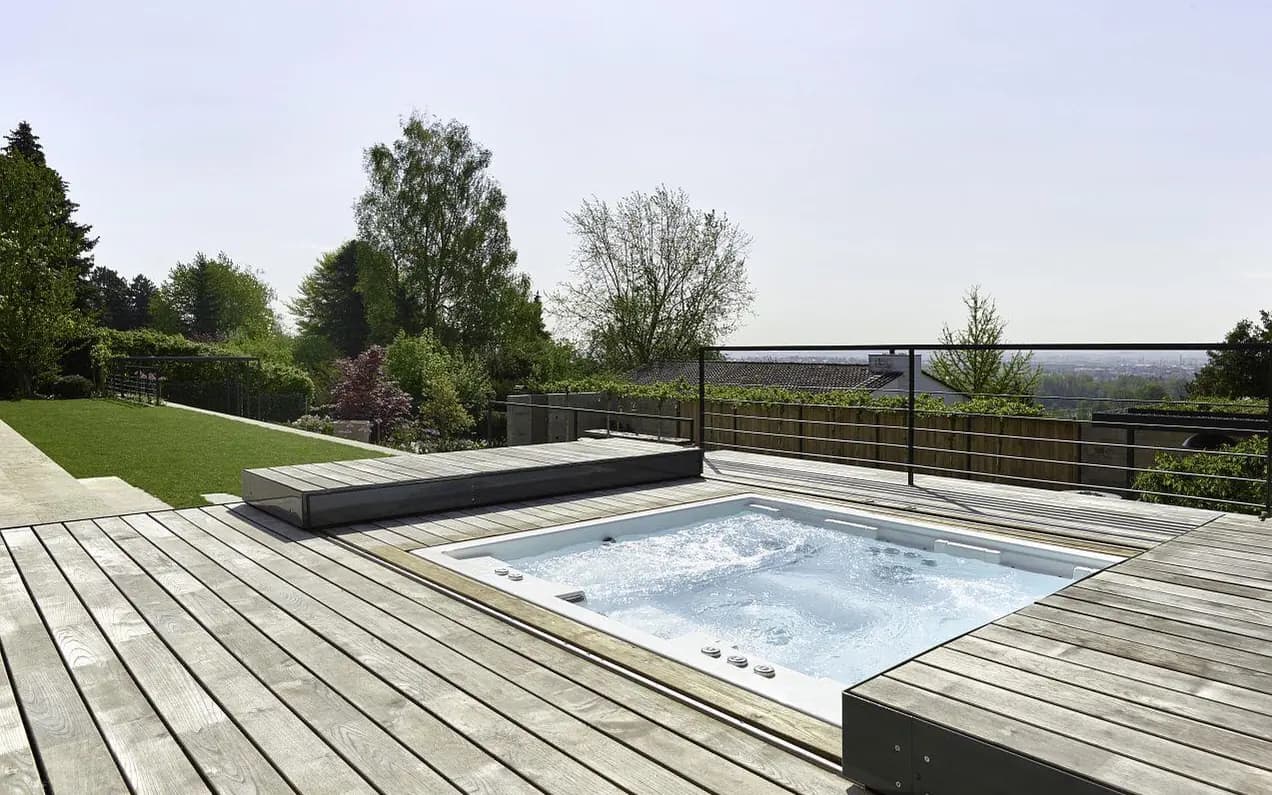
Garden hot tub prices are the total of the shell, mechanical group, heating, insulation, infrastructure and commissioning items for a spa unit installed outdoors. Unlike an indoor unit, a garden hot tub is exposed to outdoor air temperature, precipitation and direct sun; for this reason, within outdoor hot tub prices, insulation, thermal cover and heater power items take up a larger share than in an indoor unit. Items fall into three groups: the unit itself, the infrastructure that supports and feeds the unit, and the operating expense that runs through the year.
This article is not a product comparison or a budget list, and it contains no figure in any currency. Hot tub selection by model, seating count and usage scenario is a separate topic; there is only one question here. In a garden hot tub's total cost, how much share does each item take, and what technical decision is it that enlarges that item. The second question is which items are not included in the unit price: concrete slab, drainage, electrical line, transport and crane work usually stay outside the unit price and can approach a fifth of the total.
There are three common shell types, and their cost behaviour is not alike. A cast acrylic shell is made by thermoforming a poly(methyl methacrylate) (PMMA) sheet and backing it with fibreglass-reinforced polyester. PMMA's density is between 1.17 and 1.20 g/cm3, roughly half that of glass; it filters ultraviolet light below 300 nm and is more weather-resistant than polystyrene and polyethylene. On the other hand, it scratches more easily than glass, and atactic PMMA's glass transition temperature is around 105 °C. The fibreglass reinforcement (GRP) behind it, when made with chopped strand mat consisting of randomly arranged fibre bundles, gives isotropic behaviour in-plane; it is applied by either hand lay-up or spray lay-up. The number of reinforcement layers and the resin type are the main reason two different prices come out of the same acrylic sheet. Polyester resin shrinks 5 to 6 percent while curing, epoxy about 2 percent; this shrinkage difference leaves shape deviation at edge areas in thinly reinforced shells.
A polyethylene shell made by rotational moulding is a single-piece, hollow shell. More than 80 percent of the material used in this method belongs to the polyethylene family (PEX, LDPE, LLDPE, HDPE). Mould cost is noticeably lower than other moulding methods, but only one or two cycles can be run per hour. The result is low mould investment and low part variety: a rotationally moulded shell is cheap at the entry level but does not offer the variety in seating geometry, number of jet fittings and surface quality that an acrylic shell offers. A wooden barrel-type unit, on the other hand, is made by binding cedar or redwood staves with metal hoops; it is material- and labour-heavy, its mechanical group stays simple, and its maintenance share is high over its lifetime.
How cost behaves by shell type
- Acrylic + GRP reinforcement: cost depends on acrylic sheet thickness and the number of reinforcement layers behind it. Most of the difference between two units of the same outer size is hidden here and is not visible from outside.
- Rotationally moulded polyethylene: mould investment is low, the shell is single-piece. Pulls the price down; on the other hand, jet and seating layout are fixed by the mould and cannot be changed afterward.
- Wooden barrel: material and labour share is high, mechanical group share is low. Keeps initial cost at a moderate level but raises annual maintenance share.
- Stainless steel shell: offers custom sizing and long life, the highest unit cost group; usually chosen for hotel and project work.
- Inflatable PVC unit: has no technical claim beyond portability; for a permanent garden installation it does not remove infrastructure items, only postpones them.
Acrylic-shell units typically range from 2 to 7 seats. As capacity rises, water volume, jet count and required flow rate all rise together; all three touch separate items. Jets work on the principle that pressurised water flow draws in air through the Venturi effect; a separate air blower sets up a second line for floor bubbles. A jet needs a certain flow rate and pressure to do its job, so once jet count passes a certain threshold, a single pump is not enough, and a second pump with a larger-diameter pipe group comes into play. The price increase does not come from jet count itself but from the second pump feeding those jets and the expanding plumbing.
Water volume is the second multiplier. Volume directly determines heating energy, chemical consumption, and the amount to be drained at water change. The volume difference between a four-person unit and a six-person unit looks small in the initial investment, but it repeats in every heating cycle on the operating side. Filter surface area is also sized to volume: insufficient filter area raises chemical consumption, shifting cost from mechanical to operating.
For an electric heater, the choice is mostly between 3 kW and 6 kW, and this choice changes the electrical infrastructure item far more than the unit price. A 3 kW heater draws roughly 13 A on 230 V single phase; it can be supplied by a dedicated 16 A circuit. A 6 kW heater approaches 26 A at the same voltage, which means either a larger single-phase cable section or a 400 V three-phase supply. The heating-time calculation is simple: the energy needed to heat 1,500 L of water by 10 K is roughly 17.4 kWh. Assuming no losses, a 3 kW heater delivers this in roughly 6 hours, a 6 kW heater in roughly 3 hours. In practice, cabinet losses and outdoor air temperature add to this time. The decision depends on whether the unit will be kept hot continuously or heated before each use; 3 kW is enough for a unit kept continuously hot, while if occasional, fast heating is wanted, the 6 kW heater brings the line cost into the budget along with it.
Cabinet insulation and the thermal cover are cheaper items than the heater but have a bigger effect on operating expense. A cover over the open water surface can cut heating expense by up to 75 percent. Insulation is done in two ways: filling the space behind the shell completely with foam (full fill) or cladding only the cabinet's interior surface (perimeter insulation). Full fill reduces heat loss more, but makes access harder in case of a plumbing fault and lengthens service time. Perimeter insulation preserves service access but leaves loss slightly higher. The control panel item also appears here: the difference between a simple thermostat panel and a programmable, remotely accessible panel comes back through the operating item to the extent it can shift heating to an off-peak tariff.
A garden hot tub requires a set of preparation items that fall outside the unit price. Ground is the first of these. A filled unit's weight transfers straight to the ground, in tonnes, matching its water volume: 1,500 L of water alone is 1.5 tonnes, and shell, cabinet, mechanical group and user weight are added to this. This load requires a reinforced, level-checked concrete slab 10 to 15 cm thick. The slab needs to extend beyond the unit's base on every side and carry a slight slope in the direction surface water should drain away. Where no drainage is done around the slab, rain and overflow water collect under the cabinet; if the cabinet is wood or clad, its life shortens.
The second item is the electrical line. The supply must be a dedicated line run from the panel and must include residual-current protection. A residual-current device measures the current difference between phase and neutral with a differential current transformer and opens the circuit when the difference exceeds a set threshold; overcurrent protection does not do this job, it only limits total current. The typical value for wet areas and outdoor sockets is 30 mA, and the device is expected to trip within 25 to 40 milliseconds for leakages above 30 mA. The third item is transport and placement: if a vehicle cannot reach the garden, or the unit has to be brought over a wall, a crane is needed, and this creates a one-off but not-to-be-underestimated expense.
The table below shows the typical share of each item within the total for a completed garden hot tub installation, and the technical decision that enlarges that share. Percentages are given as ranges, because shell type and ground condition noticeably shift the distribution: an installation with a rotationally moulded shell that can use existing concrete drops to the lower end of the infrastructure share, while an acrylic-shell installation with a slab poured from scratch rises to the upper end.
| Item | Typical share of total (%) | What changes it |
|---|---|---|
| Shell and cabinet | 30 to 45 | Acrylic sheet thickness and number of GRP reinforcement layers; rotationally moulded polyethylene pulls this share down, stainless steel pulls it up |
| Mechanical group (pump, jets, filter, piping) | 12 to 20 | Once jet count passes a certain threshold, a second pump and a larger-diameter pipe group are required |
| Heater and control panel | 8 to 15 | The choice between 3 kW and 6 kW; a programmable panel can shift heating to an off-peak tariff |
| Insulation and thermal cover | 4 to 8 | Full foam fill makes service access harder, perimeter insulation leaves loss slightly higher; a cover can cut heating expense by up to 75 percent |
| Concrete slab and ground preparation | 6 to 12 | Lower end if existing concrete is adequate; upper end if a reinforced 10 to 15 cm slab is poured from scratch |
| Electrical line and residual-current protection | 4 to 9 | Distance from the panel, cable section, and the choice between 230 V single phase and 400 V three phase |
| Transport, placement and crane work | 3 to 8 | Vehicle access distance and whether the unit must be brought over a wall, terrace or roof |
| Initial fill, chemicals and commissioning | 2 to 5 | Water volume and the chosen disinfection method (chlorine, bromine or salt chlorination) |
Glossary of terms
- Cast acrylic shell
- A shell made by thermoforming a PMMA sheet and backing it with fibreglass-reinforced polyester. Its price is set by sheet thickness and the number of reinforcement layers.
- Rotational moulding
- Heating a powdered polymer in a rotating mould to form it into a single-piece, hollow shell. More than 80 percent of the material used belongs to the polyethylene family; mould cost is low, cycle time is long.
- Venturi jet
- A nozzle that works on the principle of pressurised water flow gaining speed through a narrowing section and drawing in air from a side channel. As jet count rises, required flow rate, and therefore pump capacity, rises with it.
- Thermal cover
- An insulated cover over the water surface. Because it can cut heating expense by up to 75 percent, it is the highest-payback component on the operating side.
- Full foam fill
- Filling the space between the shell and the cabinet completely with polyurethane foam. Reduces heat loss but lengthens access and service time in case of a plumbing fault.
- Residual-current device
- A device that measures the current difference between phase and neutral with a differential current transformer and opens the circuit once a threshold is exceeded. The typical threshold in wet areas is 30 mA, with a trip time of 25 to 40 ms.
Once the initial investment is done, three items repeat every year. The first is heating energy, and its share usually exceeds the sum of the other two. An electric resistance heater's coefficient of performance is 1.0, meaning every unit of electricity spent gives one unit of heat. An air-source heat pump reaches a coefficient between 2 and 5 in mild conditions; once temperature drops below roughly -8 °C, this value falls to the 1 to 4 band. If the garden hot tub is to be kept hot year-round, a heat pump raises the initial investment but pulls the energy item down; if it will be used only in summer months, a resistance heater combined with a thermal cover stays adequate in most installations.
The second item is chemicals. Chlorine or bromine is used as disinfectant; salt chlorination is an increasingly common method, and ozone units are added as a supplement. The third item is water change. In a small-volume spa unit operating at high temperature, dissolved solids build up over time until chemical balance can no longer be held; fully changing the water every 3 to 4 months is common practice. A water change means both water and re-heating energy, so volume choice is a longer-lived decision than it appears in the initial investment. On temperature, the established limit is 40 °C; 37 °C is the recommended value for most use, and a higher setting raises both energy and chemical consumption.
Today's item distribution follows from the product's history. Wooden barrel-type units had their most common period in the 1970s; in this construction, where redwood and cedar staves were bound with metal hoops, cost was weighted toward carpentry and the mechanical group stayed simple. Backing an acrylic sheet with fibreglass-reinforced polyester gave a single-piece, watertight shell; cost weight shifted from carpentry to material and mould. Rotational moulding, in turn, pulled the entry level down with low mould investment. The same three generations left their mark on the infrastructure side too: as the shell got lighter, ground preparation did not get simpler, because the decisive load is not the shell's weight but the water's. For a user also planning a pool construction in the same garden, designing the slab, drainage and electrical line together in one pass combines the infrastructure items of both jobs. In hotel and residential projects, unit selection is not handled alone but together with a sauna and steam room; spa and wellness consultancy, at this point, discusses not the equipment list but the volume and infrastructure plan.
Solutions for your project
Explore services and product categories related to this topic.
Company & Contact
To talk about your project, we are one call away.
Legal Name
Çilek Havuz
Founded
1998 · Istanbul
Head Office
Çilek Plaza, Eyüp Sultan Mah. Yakacık Cd. Feshane Cd. No: 2 D:4 D:1, 34885 Sancaktepe / İstanbul
Service Area
All of Türkiye · exports to 14 countries
Related articles
Keep reading.
References
- 1.Hot tub — Wikipedia, 2026
- 2.Poly(methyl methacrylate) — Wikipedia, 2026
- 3.Rotational molding — Wikipedia, 2026
- 4.Fiberglass — Wikipedia, 2026
- 5.Residual-current device — Wikipedia, 2026
- 6.Heat pump — Wikipedia, 2026
Frequently Asked Questions
Our readers' most asked; with expert answers.
Çilek Havuz Content & Technical Team
Guides & Technical Content
- Response Time
- Same day
- Channels
- Phone · E-mail · WhatsApp
If the answer you are looking for is not here, send your question directly to us and our team will reply as soon as possible.
Book a free site surveyIn a completed installation, the shell and cabinet usually make up 30 to 45 percent of the total. What sets this share is not outer size but acrylic sheet thickness and the number of fibreglass reinforcement layers behind it. Most of the difference between two units of the same size is not visible from outside.
Çilek Havuz Content & Technical Team
The difference shows up in the electrical infrastructure far more than in the heater's own price. A 3 kW heater draws roughly 13 A on 230 V single phase and can be supplied by a dedicated 16 A circuit; a 6 kW heater approaches 26 A, requiring a larger cable section or a 400 V three-phase supply. Heating 1,500 L of water by 10 K takes roughly 17.4 kWh; 3 kW delivers this in roughly 6 hours, 6 kW in roughly 3 hours.
Çilek Havuz Content & Technical Team
In a filled unit, most of the load is water; 1,500 L of water alone is 1.5 tonnes, and shell, mechanical group and user weight are added to this. This load requires a reinforced, level-checked slab 10 to 15 cm thick. If an existing terrace slab is already at adequate thickness and level, this item drops to the low end; otherwise the slab is poured from scratch.
Çilek Havuz Content & Technical Team
A cover over the open water surface can cut heating expense by up to 75 percent. Because it is part of the insulation item, which takes 4 to 8 percent of total investment, it is the fastest-payback component on the operating side. Raising heater power on a unit where the cover is not used does not give the same result, it only increases energy consumption.
Çilek Havuz Content & Technical Team
Because a spa unit operates at small volume and high temperature, dissolved solids build up quickly, and past a certain point chemical balance can no longer be held. Common practice is to fully change the water every 3 to 4 months. Because a change means both water and re-heating energy, volume choice affects the operating item for years.
Çilek Havuz Content & Technical Team