

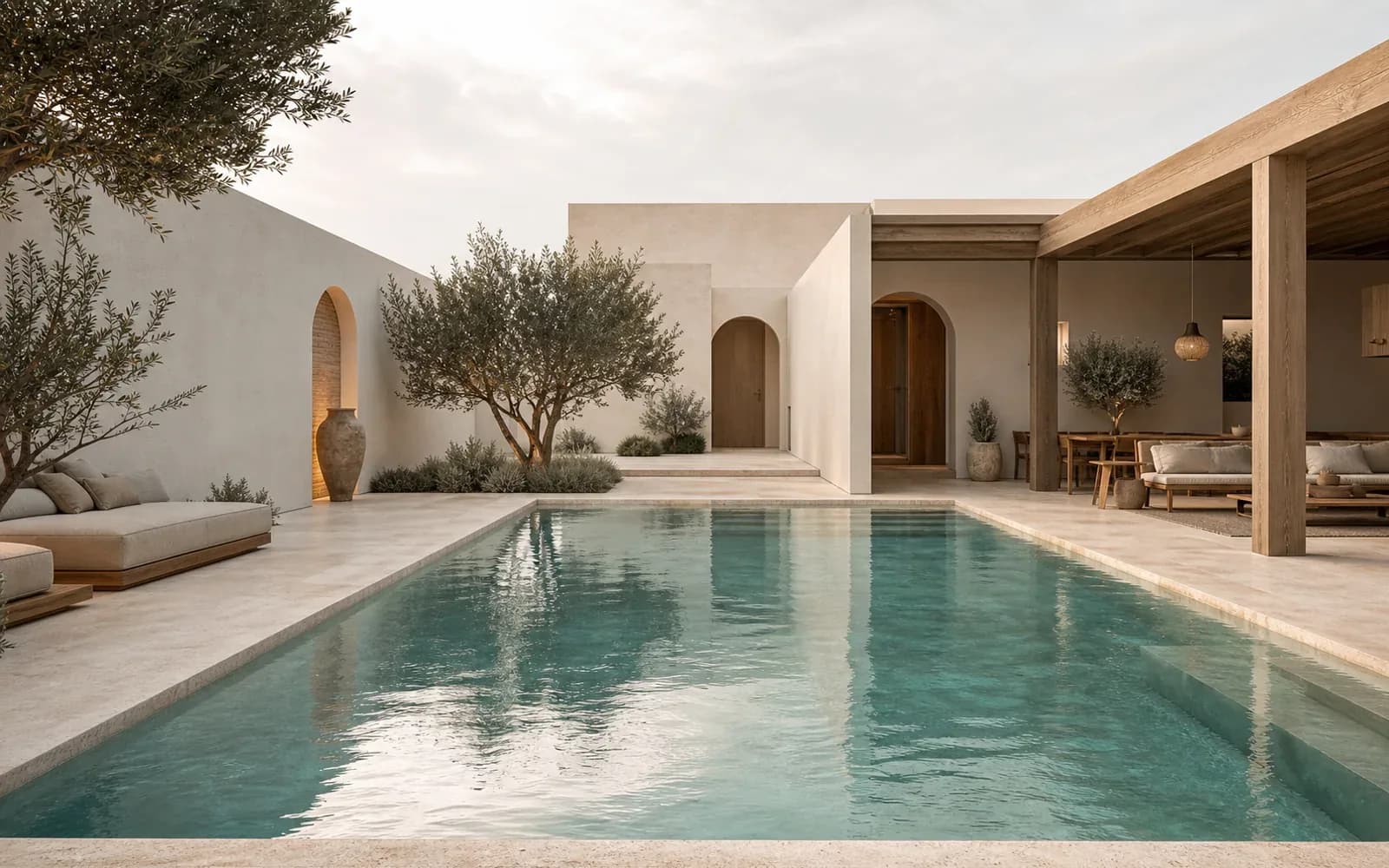
2026 Pool Construction Cost: Per m² and Itemized Budget
How is 2026 pool construction cost calculated? We explain what a per-square-meter price really includes, the hidden items, and the total cost of ownership from an engineer's view.
How is 2026 pool construction cost calculated? We explain what a per-square-meter price really includes, the hidden items, and the total cost of ownership from an engineer's view.
A pool's cost is a multi-item budget that varies with size, type, ground conditions, equipment class and the waterproofing system. When one of two pools with the same surface area is built on flat ground and the other on sloping land, their budgets diverge markedly.
So be careful with a price given as 'so much per square metre'. Split the job into items; two quotes cannot be compared without seeing what each item includes and what it leaves out. We have written our quotes with this clarity since 1993.
A pool budget generally breaks down into these headings: excavation and earthmoving, reinforced concrete structure and rebar, waterproofing, finishes (ceramic tiles, glass mosaic or membrane), plumbing and hydraulic lines, the filtration and pump set, electrics and automation, lighting, landscaping and commissioning. The price of each item moves within its own range depending on the quality chosen.
In equipment, the pump, filter and disinfection system are the decisive part of the budget. A long-lived filter, pump and salt chlorinator whose spare parts remain available for years raise the initial price a little but bring the total cost down.
Low m² prices on the market often cover only the structural shell; waterproofing, automation, heating, lighting and landscaping are billed separately. When you put quotes side by side, ask item by item whether these are included in the price.
Ground improvement, drainage and groundwater removal are also frequently omitted. On land with a high water table, if this work is not done the pool's service life is shortened directly; this is the real cost that does not appear in the quote.
A pool's cost does not end at handover. Electricity, chemicals, top-up water, filter maintenance and seasonal opening and closing make up an operating budget that recurs every year.
An efficient pump, a well-insulated shell and automatic dosing raise the initial investment somewhat but lower the annual expense. Make your decision on the total cost over several years, not on the construction price alone.
Reinforced concrete pools offer freedom of custom size and form, but the labour and time items are higher. Prefabricated and panel systems shorten installation time, but flexibility in size and design is limited. Compared with skimmer systems, overflow and infinity pools raise the cost because they require an additional balance tank and stronger hydraulics.
Choosing the right type is not about cutting the budget but about putting the money in the right place. A cheap solution that does not fit the need comes back in the medium term as a renovation bill.
For a comparable quote, the same scope has to be priced at the same quality class. Prices obtained before the size, type of finish, equipment brand and waterproofing system are settled cannot be compared with each other.
We run the work from site survey to handover from a single source and with written documentation. Our experience of projects in 14 countries lets us see the hidden items from the start and reduce the extra invoices that arise later.
A sound picture can be drawn without giving a figure in Turkish lira. In a typical reinforced concrete residential pool, structural and concrete work takes about a third of the budget, waterproofing and finishes a fifth, and plant room equipment around 15 percent; the remaining share is divided among plumbing, heating, landscaping, and transport and labour. With prefabricated panels the structural share shrinks and the shell and installation share grows.
To see this breakdown with your own dimensions, you can use the pool cost calculator on the site: it shows on a single screen how item shares shift with your choices of size, type and equipment, along with the water volume and annual operating figures. This breakdown is also useful when comparing quotes: a quote that looks far below the market on one item is recovering the difference on another.
The most honest answer to the pool cost calculation question starts by converting the dimensions into surface area and volume. An 8x4 pool means 32 m² of water surface and, at an average depth of 1.5 m, 48 m³ of water; a 5x10 pool has 50 m² of surface and, at the same depth, holds 75 m³ of water. Excavation, reinforced-concrete and cladding items scale with surface area and perimeter length (24 m for 8x4, 30 m for 5x10), while filtration and heating items scale with water volume.
This is why the cost of a 5x10 pool grows by about 56 percent in surface area compared with an 8x4 pool, while the total budget generally increases by less than that: fixed items such as the plant room, electrical panel, automation and design fee remain the same at both sizes. The rough rule is: when surface area doubles, total cost increases by a factor of about 1.5 to 1.7. If you want to see the item-by-item breakdown for your own dimensions, the pool cost calculator on the site works with the same ratios.
The table below calculates the hydraulic and mechanical quantities of four common pool sizes with the same method. These are quantities, not prices: water volume, filtration flow, filter area and filter sand are the basis of equipment selection and therefore of the mechanical budget. The average depth is assumed to be 1.5 m for every size (the mean of the shallow and deep ends); if your pool is deeper or shallower, volume and flow change in the same proportion.
| Size (m) | Water surface (m²) | Water volume (m³) | Flow, 6 h turnover (m³/h) | Flow, 4 h turnover (m³/h) | Filter area (m²) | Filter sand (kg) |
|---|---|---|---|---|---|---|
| 5x3 | 15 | 22.5 | 3.75 | 5.6 | 0.08-0.13 | 45-113 |
| 8x4 | 32 | 48 | 8 | 12 | 0.16-0.27 | 96-240 |
| 5x10 | 50 | 75 | 12.5 | 18.8 | 0.25-0.42 | 150-375 |
| 10x20 | 200 | 300 | 50 | 75 | 1.00-1.67 | 600-1,500 |
Formulas and assumptions
- Water volume V = length × width × average depth. Average depth assumed at 1.5 m.
- Filtration flow Q = V ÷ turnover time. Six hours is the minimum design assumption for a residential pool; the calculator on this site uses a stricter 4-hour turnover, so both values are shown. Public pools (hotels, residential complexes) are designed to the rules for public pools and local regulations, taking bather load into account; the 6-hour assumption here applies to residential pools only.
- Filter area F = Q ÷ filtration velocity. The 30-50 m³/h·m² range commonly used for sand filters was applied; the smaller area corresponds to 50 and the larger to 30 m³/h·m². The filter chosen is the standard diameter that covers this area.
- Filter sand = F × sand bed height (0.4-0.6 m) × bulk density (about 1.5 t/m³). The exact quantity is read from the filling table of the selected filter.
To see your own size, pick one of the size links at the end of this article: the calculator opens with that size and shows the budget breakdown.
There are three equipment items where cheap turns out expensive. The first is the pump: a variable-speed pump starts out more expensive than a fixed-speed one, but cuts annual electricity consumption by close to half and runs quietly. The second is the filter: a filter chosen one size larger in body diameter filters the same water at a lower velocity and does it better. The third is dosing automation: a system that measures and doses cuts both chemical waste and human error.
On the other hand, there are items you do not have to buy on day one: a robotic cleaner, a salt chlorination system and accessories such as waterfalls and massage jets can be added later. Provided the infrastructure (pipework and power line) is left in place from the outset, deferring these items to the second season is a sensible way to concentrate the budget on the main structure and the waterproofing.
In a sound project, payment is tied to the progress of the work, not to the calendar: the contract defines interim deliverables such as excavation, reinforced concrete, the waterproofing test, finishes and commissioning, and each payment is made after the relevant stage is completed and checked together. This arrangement protects both parties and minimises the risk of the work being abandoned or dragging on.
A promise of a large discount for payment up front, on the other hand, is the best-known warning sign. A reasonable initial advance requested by the contractor (for materials and site mobilisation) is normal; but a request for more than half of the total price before work begins should not be accepted unless the contract and the guarantees are strengthened. We explain the contract clauses in detail in our pool contract guide.
Solutions for your project
Explore services and product categories related to this topic.
Image gallery
04 görsel
 01
01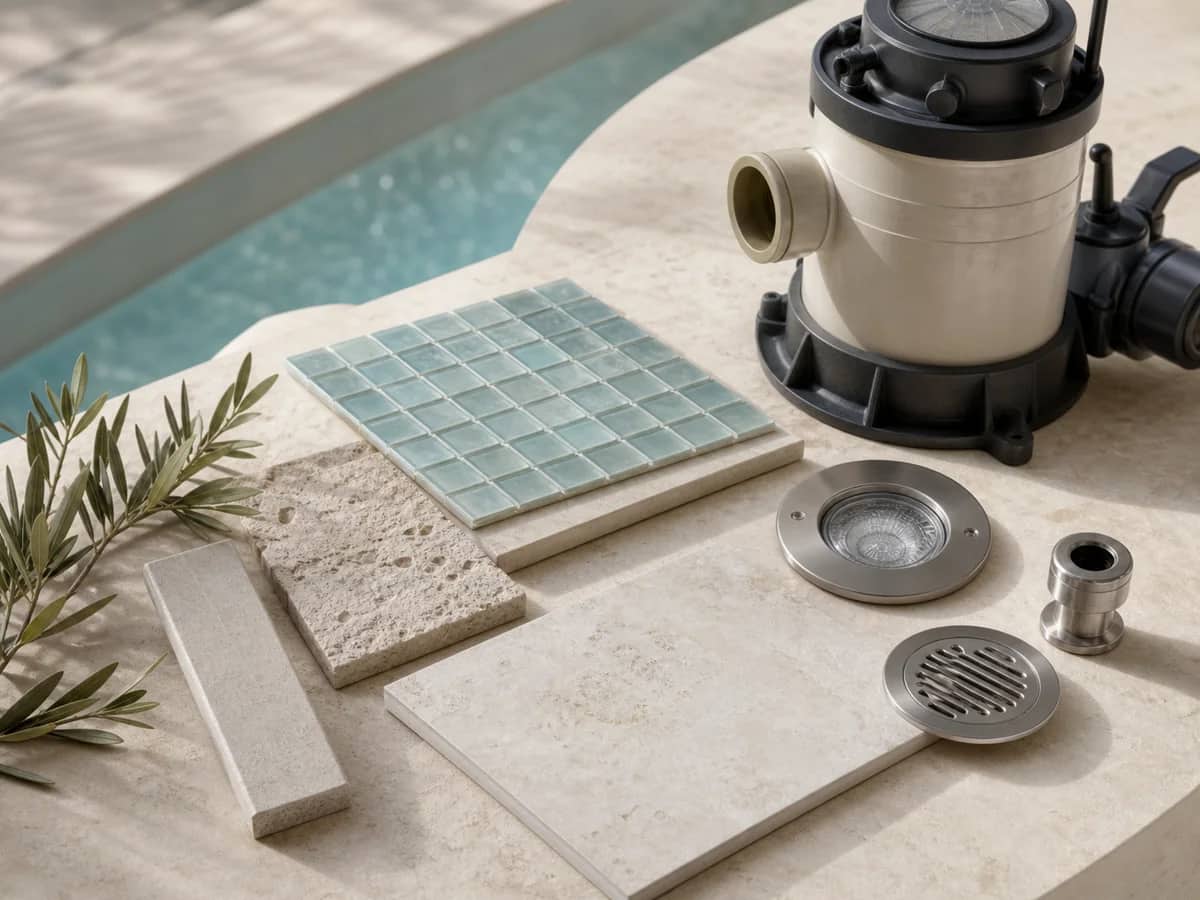 02
02 03
03 04
04Company & Contact
To talk about your project, call or write to us.
Related articles
Keep reading.
Frequently Asked Questions
Our readers' most asked; with expert answers.
Çilek Havuz Content & Technical Team
Guides & Technical Content
- Response Time
- Same day
- Channels
- Phone · Email · WhatsApp
If the answer you are looking for is not here, send your question directly to us and our team will reply as soon as possible.
Book a free site surveyPayment is generally planned as progress payments tied to the stages of the work, so the budget is spread over the construction period. A bank loan is a separate process that you run with your bank. Settle the payment plan clearly and in writing in the contract; that way no dispute arises later.
Çilek Havuz Content & Technical Team
The riskiest saving is cutting back on items that are not visible but determine the pool's life. Waterproofing, the structure, pump and filter capacity and reinforcement are such items. A mistake here turns into a major repair a few seasons later. On items such as the finish class, lighting details or landscaping, safer adjustments that remain open to later upgrades can be made. The right priority is to invest in what cannot be seen.
Çilek Havuz Content & Technical Team
A significant part of a pool's cost consists of fixed items that do not depend on size. These are the plant room, the pump and filter set, plumbing, automation and commissioning. Because these fixed costs are divided over fewer square metres in a small pool, the unit price rises. This is why the price per square metre of a small pool can look misleadingly high compared with a large pool.
Çilek Havuz Content & Technical Team
A quote that is too low is usually a sign that some items have not been included in the price. Waterproofing, automation, heating or ground improvement are typical examples. When assessing the quote, ask item by item what is included and what is excluded, and compare the same scope at the same quality class. A transparent, documented quote keeps later extra costs to a minimum.
Çilek Havuz Content & Technical Team
A well-designed and properly built pool can increase the appeal and sale value of a property, especially villas and detached houses. A badly executed pool that leaks or is expensive to run, however, becomes a burden instead. For it to add value, what decides is that the pool is built to engineering standards, with documentation and in harmony with the architecture.
Çilek Havuz Content & Technical Team
Yes; components such as a heat pump, automation, lighting or water features can be planned so that they can be added later. For this, pipe penetrations, the power line and connection points must be left ready from the outset. If your budget is limited, tell us at the site survey which items you are thinking of adding later; if the pipes and cables are laid that day, nothing has to be broken open afterwards.
Çilek Havuz Content & Technical Team
The site survey is free of charge and does not commit you to anything. Any figure given without on-site measurement and observation of the ground is an estimate; instead of an estimate, we give a written, itemised quote after the survey.
Çilek Havuz Content & Technical Team
In spring and summer demand piles up, so team schedules tighten and supply times lengthen. Work started in autumn or winter finishes ready for the season and proceeds without calendar pressure. On the materials side, exchange rate and commodity movements affect the price; settling the validity period of the written quote in the contract is the way to manage this uncertainty.
Çilek Havuz Content & Technical Team
At least these items should be itemised. Excavation and ground work, reinforced concrete (including rebar and concrete), the waterproofing system and its brand, and the type and quantity of finish come first. The plant room equipment list (brand and model), plumbing, heating, electrics and lighting, landscaping, and transport should follow. A quote that says 'turnkey pool' on a single line can be neither compared nor checked.
Çilek Havuz Content & Technical Team