

Why Do Pool Quotes Differ So Much? The Choices That Change Your Budget
Two pools of the same size can come in at quotes where one is double the other. We explain the choices behind the gap and how to compare quotes line by line; quantities and cost items by pool size are covered in a separate guide.
Project Manager · Mechatronics Engineer · Çilek Havuz
- Published
- Updated
- Reading
- 10 min read
- Category
- Pool Construction
Two pools of the same size can come in at quotes where one is double the other. We explain the choices behind the gap and how to compare quotes line by line; quantities and cost items by pool size are covered in a separate guide.
Most of the per-square-metre prices you see online hide one thing: what is included.
The same 5x10 pool ends up at two completely different budgets depending on the answers to a few questions: glass mosaic or ceramic finish, skimmer or overflow circulation, heating or no heating. A single figure published without saying what it includes does not inform the customer.
That is why we give our reference price together with its size and scope, and we do not quote a firm price for your own pool before a site survey, because a figure given without seeing the ground misleads either you or us. The difference between excavating rocky ground and excavating clay is on its own the most volatile item in the project, and you cannot tell it from a satellite image.
This page is not a price list. It shows which decisions change your budget and how. After reading it, you will be able to compare the quotes you receive properly, and that is its real value.
The first uncertainty in a pool budget lies under the soil.
On soft ground, excavating a 5x10 pool takes one working day; the same size on rocky ground stretches over days with a breaker, and the volume of spoil to be hauled away grows. The dig goes 30 to 40 cm deeper than the pool itself, because a blinding concrete layer and a drainage layer go underneath.
The second uncertainty is groundwater. If water seeps into the pit, the pool shell takes pressure from outside. In that case you need a drainage line, a sump and a buoyancy (uplift) calculation, and the shell's thickness and reinforcement increase. An empty pool being shifted by groundwater is a real occurrence, seen in pools drained for the winter.
The third is access. If an excavator cannot get into the garden, the dig is done with a mini machine or by hand, which multiplies labour time several times over. If there is nowhere to set up a concrete pump, the concrete is moved by wheelbarrow. In the city, on narrow streets and at homes with finished gardens, the item that inflates the budget most is often not the pool itself but getting to it.
A pool shell is not an ordinary retaining wall: it takes water pressure from inside and earth pressure from outside, and the balance between them flips depending on whether the pool is full or empty.
That is why wall thickness, rebar diameter and spacing are set by structural calculation. Using watertight concrete and pouring without interruption gives an advantage that no waterproofing applied later can make up for.
Cutting corners on waterproofing is paid for two or three seasons later. The difference between brush-on membrane, cement-based crystalline waterproofing and polyurethane systems looks small on the first invoice; once a leak starts, the pool finish has to be stripped, and then the difference becomes large. Calling in a leak detection team costs more than getting the waterproofing right from the start.
The deeper the pool, the thicker the shell. There is a difference in concrete and steel between a pool with a constant depth of 1.50 m and one that slopes from 1.20 to 1.80 m; in a diving pool that goes down to 3 m, the difference grows considerably. Depth is not only a comfort decision but a budget decision.
On the same pool shell, the finish is the item with the widest price range.
Liner (PVC membrane) sits at the economical end and goes in quickly; its lifespan is limited and it is replaced over the years. Ceramic and porcelain tiles sit in the middle band and offer a wide choice of colours. Glass mosaic sits at the top end and noticeably changes the colour of the water.
The difference is not only in the material but in the labour. Laying glass mosaic takes many times longer per square metre and needs an experienced installer; the grout and render substrate has to be accurate to the millimetre. So choosing mosaic pushes the budget up on two fronts at once.
When deciding, think about how the water will look. Light blue mosaic makes the pool look turquoise, while a dark grey or black finish turns the pool into a mirror and warms the water faster. Your colour choice affects your heating budget too; nobody mentions it, but it does.
In a skimmer system the water sits 10 to 15 cm below the coping and is drawn off the surface through skimmer mouths.
It needs no extra tank, the plant room stays small and the pipe runs are short. That is why it is the most common choice for residential pools.
In an overflow system the water is level with the coping, spills into a grating on all four sides and collects in a balance tank. This system adds the following: a balance tank of 60 to 80 litres for every square metre of pool surface, an overflow channel and grating along the perimeter, level control automation, longer pipe runs and a larger pump. All five of these items add to the budget.
What do you get in return? An unbroken waterline and a surface that cleans itself. In hotels, villas and projects with a view, the difference is worth paying. For a homeowner who will swim with the family in the back garden, a skimmer system is enough; don't let anyone tell you otherwise.
This item is not guesswork but calculation.
Work out the pool volume, divide it by the 6-hour turnover time targeted for residential pools, and you have the hourly flow rate. A 5x10 pool with an average depth of 1.50 m holds 75 m³; a 6-hour turnover means a pump of 12 to 13 m³/h.
The filter is chosen for that flow rate. For 12 m³/h, a sand filter with a Ø600 mm vessel is the typical solution. When glass media is used instead of sand, filtration becomes finer and backwash water decreases; the initial outlay is a little higher and it pays back in operation. The pipe diameter follows from this as well: Ø50 is borderline, Ø63 runs comfortably.
If a quote does not state the pump power and filter diameter, it is incomplete. An undersized filter makes the pool cloudy, and an oversized pump burns electricity. The quickest way to see where the gap between two companies' quotes comes from is to compare these two numbers.
The heating decision affects two separate budgets at once.
On the installation side, there is a serious difference between a heat pump, solar collectors and a boiler connection. On the operating side, the difference repeats every month throughout the year; that is why you need to look at seasonal consumption, not the initial price.
Most heat loss happens through evaporation from the water surface. So what determines the heating load is not the pool's volume but its surface area. A pool with a 50 m² surface needs a noticeably more powerful unit than one with a 32 m² surface.
A pool cover is the investment with the highest return in this item. A pool covered overnight loses far less heat by morning, and the heat pump does not have to go up a model. If you are having heating installed, get the cover included in the same quote; a cover bought later costs more and tends not to fit properly.
5x10 m, 1.50 m deep: 50 m² of surface, 75 m³ of water.
This pool needs two skimmers, a 12 to 13 m³/h pump, a Ø600 sand filter and a mid-range heat pump. It is the most balanced size for residential pools; all the equipment comes from standard production ranges and no custom manufacturing is needed.
8x4 m, 1.50 m deep: 32 m² of surface, 48 m³ of water. The water volume drops by a third, and the heating load and chemical consumption fall in step. The 8-metre length allows short-distance swimming; whether this size suits you depends on how you expect to swim.
The budget difference between the two sizes is not linear. Excavation, formwork, the plant room and design fees exist in much the same way for both pools; only the items proportional to concrete, finish and water volume get smaller. In other words, making the pool smaller does not make the budget smaller by the same ratio; decide with that in mind.
10 × 5 m concrete pool costs 1,850,000 TL in October 2026 (excluding VAT). This price rests on a calculation that scales with size: the reference pool is 1.5 m deep, with a 95 m² shell area and 75 m³ of water. The shell area is the floor area plus the perimeter multiplied by the depth; structural and finishing work grow with that area, the mechanical installation with the water volume. Ground conditions, lining type and access are added at the site survey.
Most people getting pool quotes do not account for the items that come up after the pool is finished.
Surrounding paving and decking: the 1.20 to 2.50 m strip around the pool adds up to a lot of square metres, and if natural stone is chosen it rivals the pool finish in cost. Landscaping and lighting: the garden needs repairing after the dig.
The electrical infrastructure is a separate item. The plant room needs its own circuit, residual current protection and earthing, and pool lighting requires a safety extra-low voltage transformer. Whether the existing household distribution board can handle this is checked during the site survey.
Permit and design fees and the water for the first fill are also part of the budget. 75 m³ of water is supplied from the mains or by tanker, depending on where you are; it is a one-off but real item. If the quote does not mention these three, ask, so they do not surface later.
When you put quotes from different companies side by side, do not look at the total first.
Check whether all of these eight lines are written down: shell thickness and reinforcement, waterproofing system and brand, type of finish, circulation type, pump flow rate, filter diameter, heating unit capacity, and warranty period and coverage.
A quote with all eight lines written out may come in higher than one without them. It usually does. An incomplete quote looks cheap because its gaps are filled later with extra payments; plenty of customers who have been through this come to us.
You can use our calculator for a scope list and quote prepared for your pool's size. It shows which items come into play based on the size and preferences you enter, and you can continue from the same form for a firm quote after the site survey.
The itemised budget, size examples from 5x3 to 10x20 and the engineering quantities are in a separate guide: Pool construction cost guide
Pool Cost CalculatorNext step
Let us discuss your project in the way that suits you best.
You can fill in the form for a written quote, schedule a video project presentation or ask us to survey your project site.
Get a Quote
Send us your dimensions and expectations in writing.
Online presentation
Video project presentation
On-site survey
Inspection at your project site
// 01 · Product groups
Compare the products on this topic on their category pages.
Each card leads to a product category; models, technical sheets and list prices are there.
 Product category
Pool Mosaic Tile Models
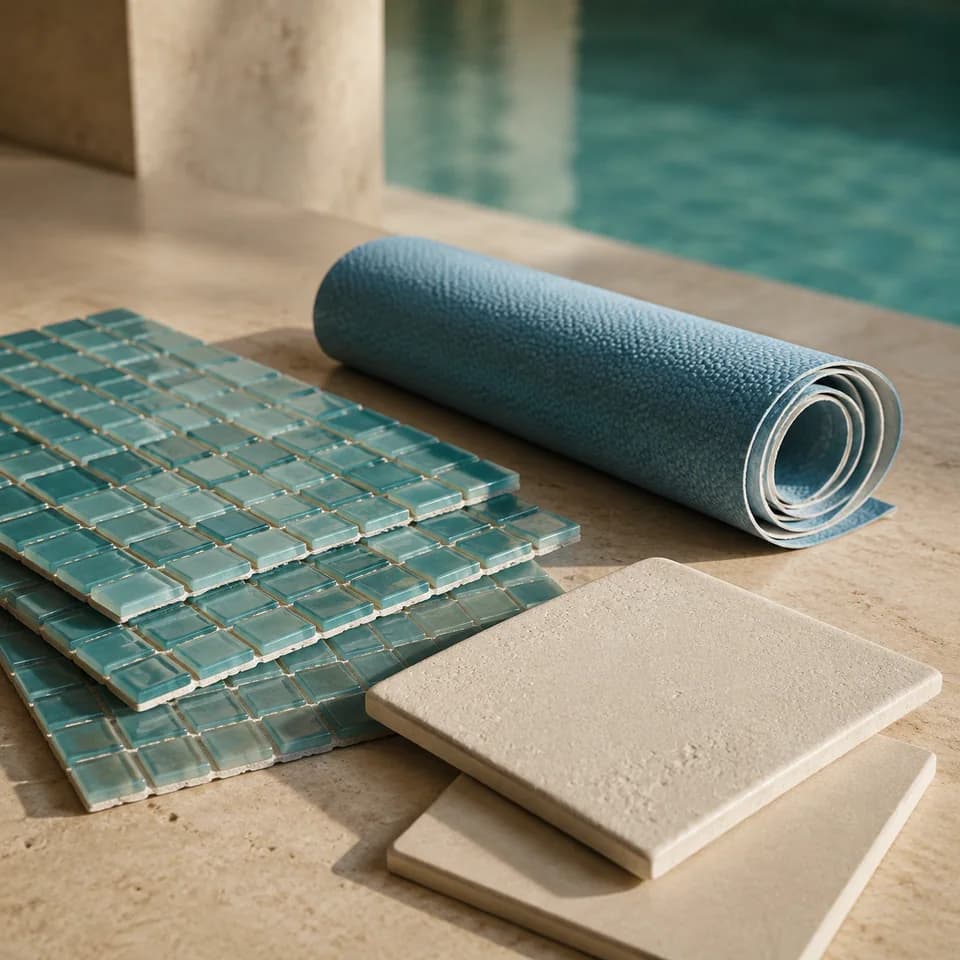
2.5 x 2.5 cm glass mosaic tiles, Niebla and Premium Pearl Mix glass mosaic sheets, and patterned, hexagonal and glow-in-the-dark special series. Every model is made of glass; the choice is based on tile size, sheet size and finish.
View- 10 products
 Product category
Pool Mechanical Equipment
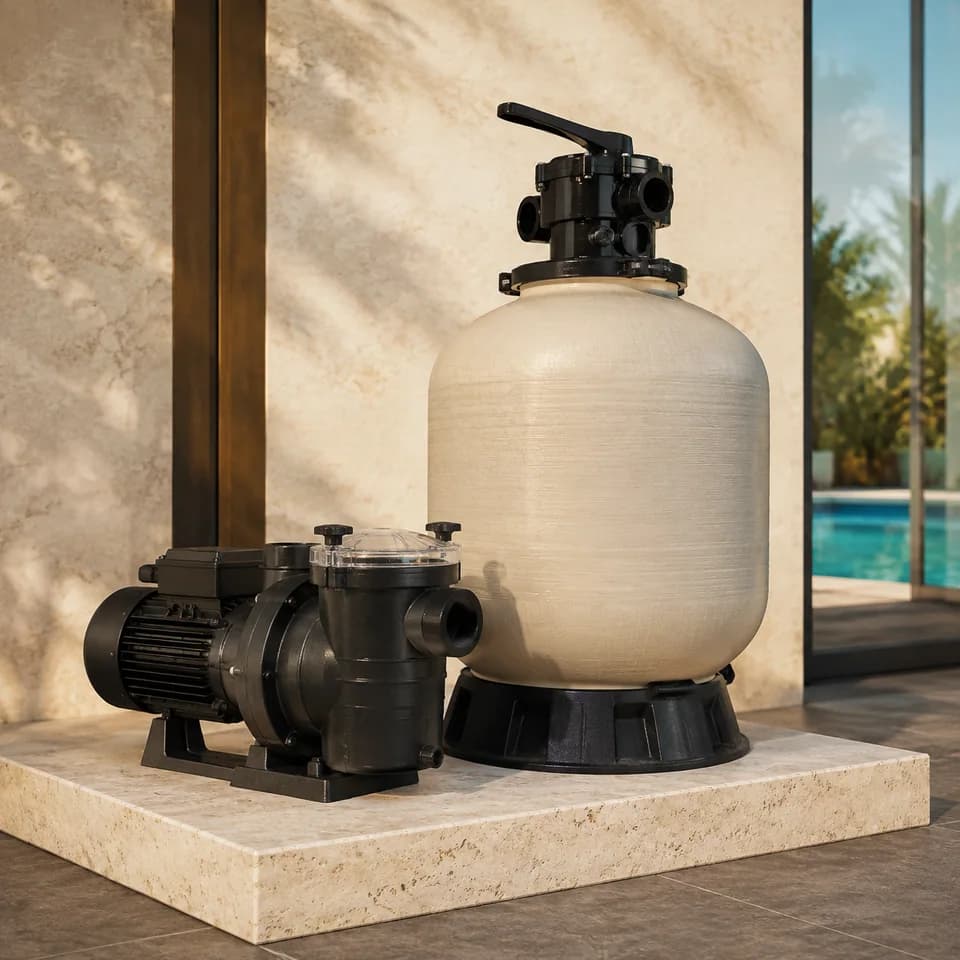
Circulation pumps, filters, valves and automation: the mechanical infrastructure that forms the heart of the pool.
View- 65 products
- Product category
Pool Lining Systems
PVC liner, membrane, ceramic tile and glass mosaic: lining materials that make the pool watertight and form its finished surface.
View- 20 products
Product category
Pool Mosaic Tile Models
2.5 x 2.5 cm glass mosaic tiles, Niebla and Premium Pearl Mix glass mosaic sheets, and patterned, hexagonal and glow-in-the-dark special series. Every model is made of glass; the choice is based on tile size, sheet size and finish.
10 productsProduct category
Pool Mechanical Equipment
Circulation pumps, filters, valves and automation: the mechanical infrastructure that forms the heart of the pool.
65 productsProduct category
Pool Lining Systems
PVC liner, membrane, ceramic tile and glass mosaic: lining materials that make the pool watertight and form its finished surface.
20 products
// 02 · Related service
The work in this article, we deliver from design to handover.
Çilek Havuz service
Swimming Pool Construction
Reinforced-concrete, prefabricated and infinity swimming pools, built turnkey for villa, residential and commercial projects.
Swimming pool construction is a turnkey build in which the site survey, structural and mechanical design, excavation, reinforced-concrete shell, waterproofing, finish, filtration plumbing and commissioning run under a single contract. The written project schedule follows the site survey.
How we work
- 01Initial meeting and site surveyWe inspect the site and listen to the brief.
- 02Design and quotationWe give the cost item by item, in writing.
- 03ExecutionThe same team builds to a written schedule.
- 04Handover and commissioningWe start the systems and explain their use.
- 05Maintenance and technical supportWe provide periodic maintenance and support.
// 03 · Guides
On Pool Construction, more articles to read.
First the articles directly related to this one, then the newest articles on the topic.
 Pool Construction
2026 Pool Construction Cost: Per m² and Itemized Budget
How is 2026 pool construction cost calculated? We explain what a per-square-meter price really includes, the hidden items, and the total cost of ownership from an engineer's view.
View- 22 July 2026
- 9 min read
 Pool Construction
Building a pool or spa abroad: what drives the cost of an international project?
A pool, hammam or spa project delivered abroad from Turkey has no single price per square metre. We cover design, equipment, shipping, customs and schedule.
View- 29 September 2026
- 8 min read
 Spa & Wellness
Garden hot tub prices: which item total sets the figure?
Garden hot tub prices are the total of shell material, jet and pump group, heater power, cabinet insulation, concrete slab and electrical line items.
View- 9 September 2026
- 10 min read
 Pool Construction
Choosing Pool Showers and Waterfalls: Shower Types, Water Curtains and Plumbing Needs
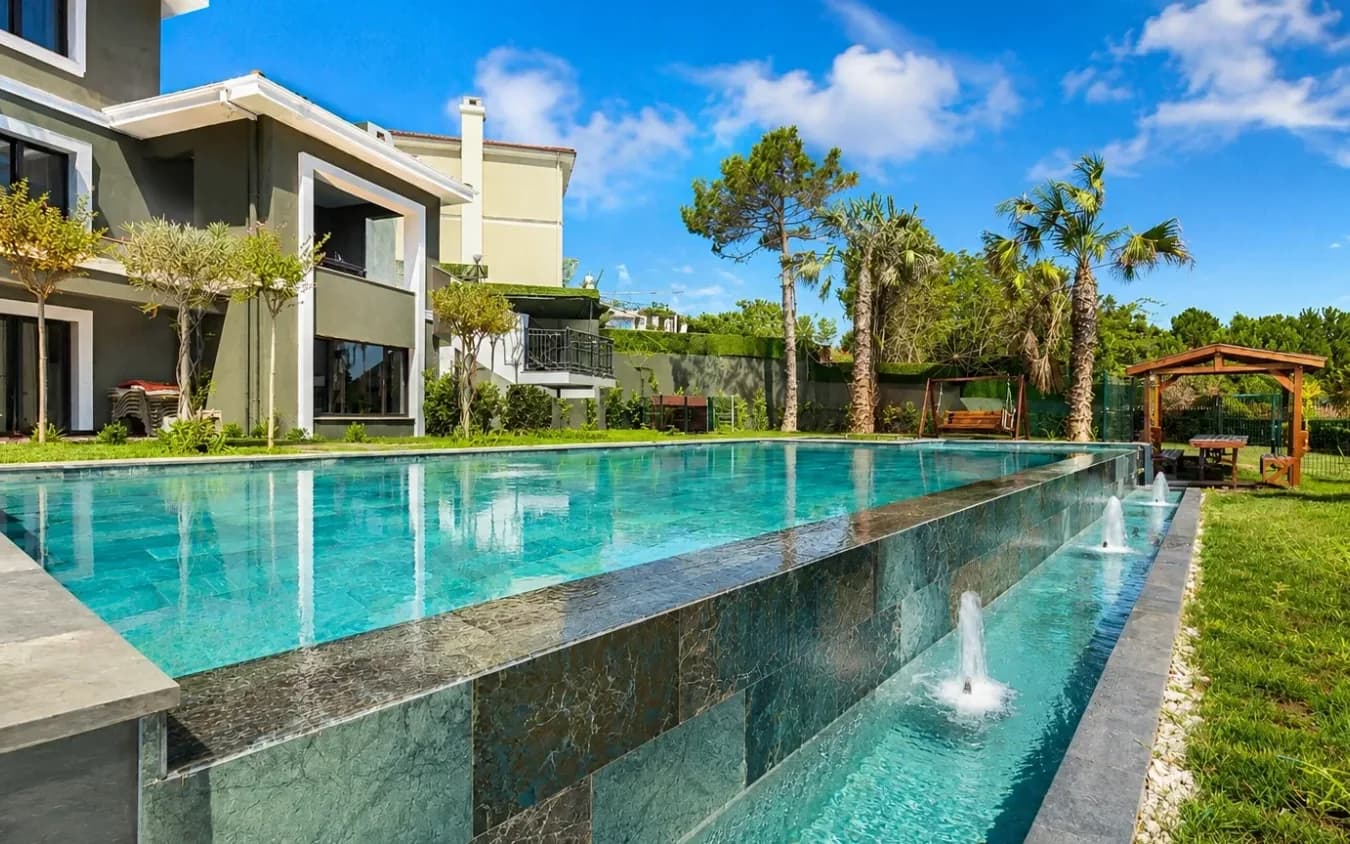
Choosing a pool shower, waterfall or water curtain depends on the material, where the water comes from and where it is mounted. We compare solar and stainless steel shower types and their pump and plumbing needs.
View- 2 October 2026
- 8 min read
 Pool Construction
Competition Pool Equipment: Which Pool Needs Which Equipment?
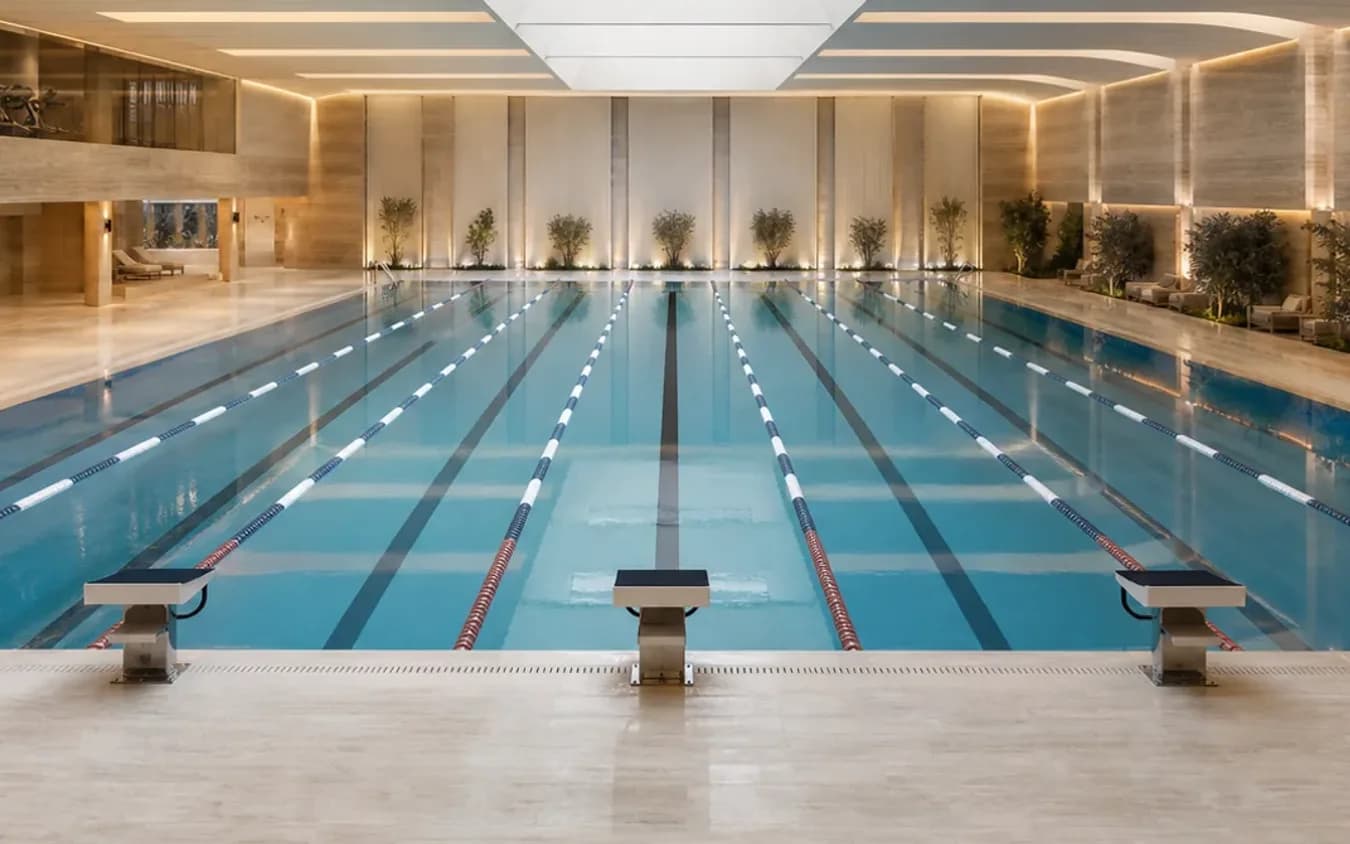
Starting blocks, lane ropes, warning and turn systems, underwater speakers and water polo goals are chosen according to how the pool is used. We explain which dimensions we check for each item.
View- 2 October 2026
- 7 min read
 Pool Construction
Can the Depth of a Prefabricated Pool Be Changed?
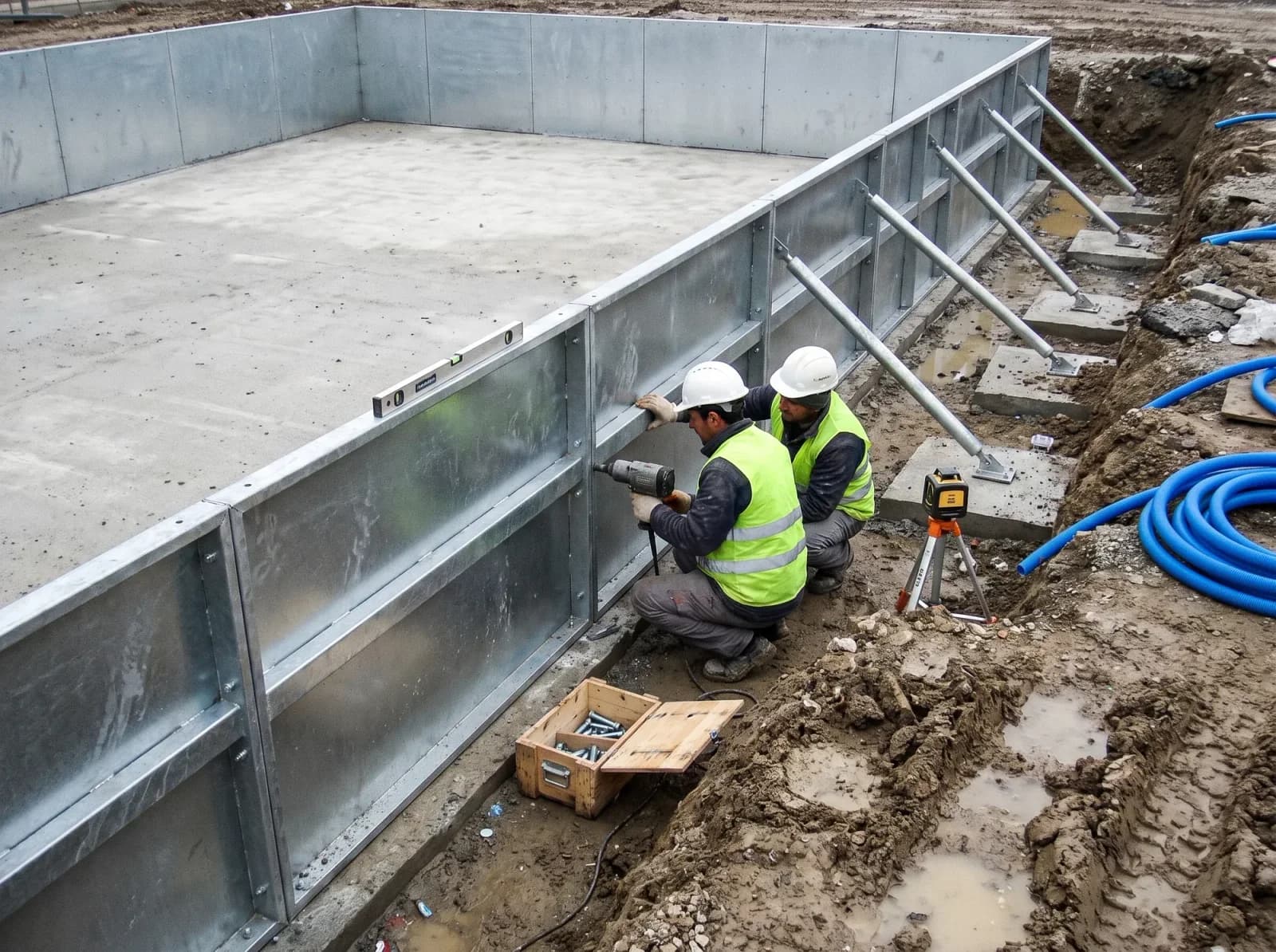
How much can depth change in one-piece fiberglass, polyester and panel prefab pools? Options before and after installation, water volume and safety.
View- 17 September 2026
- 8 min read
- Pool Construction · 22 July 20262026 Pool Construction Cost: Per m² and Itemized BudgetHow is 2026 pool construction cost calculated? We explain what a per-square-meter price really includes, the hidden items, and the total cost of ownership from an engineer's view.9 min read
- Pool Construction · 29 September 2026Building a pool or spa abroad: what drives the cost of an international project?A pool, hammam or spa project delivered abroad from Turkey has no single price per square metre. We cover design, equipment, shipping, customs and schedule.8 min read
- Spa & Wellness · 9 September 2026Garden hot tub prices: which item total sets the figure?Garden hot tub prices are the total of shell material, jet and pump group, heater power, cabinet insulation, concrete slab and electrical line items.10 min read
- Pool Construction · 2 October 2026Choosing Pool Showers and Waterfalls: Shower Types, Water Curtains and Plumbing NeedsChoosing a pool shower, waterfall or water curtain depends on the material, where the water comes from and where it is mounted. We compare solar and stainless steel shower types and their pump and plumbing needs.8 min read
- Pool Construction · 2 October 2026Competition Pool Equipment: Which Pool Needs Which Equipment?Starting blocks, lane ropes, warning and turn systems, underwater speakers and water polo goals are chosen according to how the pool is used. We explain which dimensions we check for each item.7 min read
- Pool Construction · 17 September 2026Can the Depth of a Prefabricated Pool Be Changed?How much can depth change in one-piece fiberglass, polyester and panel prefab pools? Options before and after installation, water volume and safety.8 min read
// 04 · Company & Contact
To talk about your project, call or write to us.
Legal Name
Çilek Havuz
Founded
1998 · Istanbul
Head Office
Çilek Plaza, Eyüp Sultan Mah. Yakacık Cd. Feshane Cd. No: 2 D:4 D:1, 34885 Sancaktepe / İstanbul
Service Area
All of Türkiye · exports to 14 countries
Branches
Kyrgyzstan · Egypt · Algeria · Iraq
Showroom
Plan a showroom visit
At our showroom in Çilek Plaza, Sancaktepe, you can discuss your project with our team. We recommend booking an appointment by phone before your visit.
Working Hours
- Monday – Friday · 08:00 – 17:30
- Saturday · 08:00 – 12:30
- Closed on Sunday
Frequently Asked Questions
About Why Do Pool Quotes Differ So Much? The Choices That Change Your Budget, frequently asked questions.
Çilek Havuz Corporate
Pool and Wellness Engineering
- Response Time
- Same day
- Channels
- Phone · Email · WhatsApp
If the answer you are looking for is not here, send your question directly to us and our team will reply as soon as possible.
+90 216 475 39 37For a residential-scale reinforced concrete pool, the time from excavation to filling is given in the written project schedule after the site survey. Rocky ground, groundwater, an overflow system and a glass mosaic finish are the four main factors that extend this. With prefabricated systems, time on site is noticeably shorter.
Çilek Havuz Corporate
Six items create the difference. They are ground and access conditions, type of finish, circulation type (skimmer or overflow), waterproofing system, heating unit and surrounding paving. Before comparing two quotes, check whether these six are the same in both.
Çilek Havuz Corporate
An overflow system adds five items: a balance tank, an overflow channel and grating, level automation, longer pipe runs and a larger pump. The difference cannot be reduced to a single percentage; it varies with the pool's perimeter length and the type of grating chosen.
Çilek Havuz Corporate
The type of finish and the circulation type are the two decisions with the widest range; a measured choice in both brings the budget down noticeably. Do not save on waterproofing or reinforcement; every corner cut there comes back bigger within a few seasons.
Çilek Havuz Corporate
There are four running cost items: electricity (the pump and, if fitted, the heat pump), chemicals, top-up water and annual maintenance. All of them are proportional to water volume and surface area. Using a pool cover reduces both heating costs and water lost to evaporation, which makes it the investment that pays back fastest on running costs.
Çilek Havuz Corporate
Whether a building permit is required in Turkey depends on the municipality and the status of the plot. For detached houses, most municipalities treat the pool as an annex to the building and require a design. Confirm with your local municipality before excavation starts. A pool built without a permit causes problems at the sale and occupancy permit stages.
Çilek Havuz Corporate