

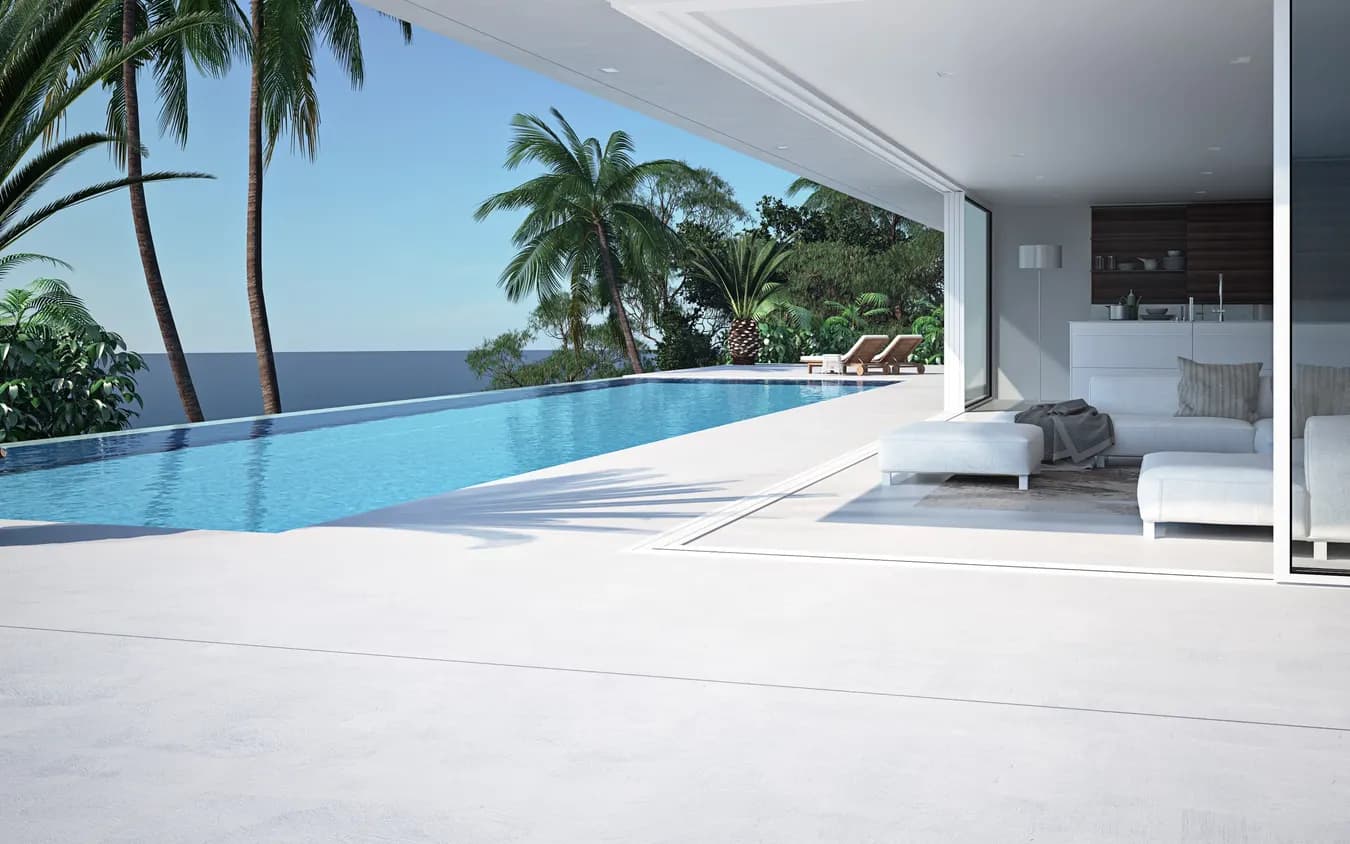
Pool construction in Antalya: winter downpours, 46 °C and karst ground
In Antalya, a pool is built with overflow, cooling and a ground investigation sized for 262 mm of rain in December, 46.1 °C in July and karst ground.
Project Manager · Mechatronics Engineer · Çilek Havuz
- Published
- Updated
- Reading
- 11 min read
- Category
- Pool Construction
In Antalya, a pool is built with overflow, cooling and a ground investigation sized for 262 mm of rain in December, 46.1 °C in July and karst ground.
Pool construction in Antalya is the delivery of a reinforced concrete pool project at the foot of the Taurus Mountains, at 30 m altitude, in a hot-summer Mediterranean climate (Köppen: Csa).
It differs from a pool project on another Turkish coast in three ways: precipitation is high at 1,050 mm a year but concentrated between November and February, summer temperatures reach a record 46.1 °C, and the ground is limestone and travertine with a karst structure full of voids.
This article is not about budget items; it explains how climate and ground data determine the overflow system, water cooling, chlorine stabilisation and the ground investigation. Year-round use in hotel pools and the rental season in villa pools are derived from the same data.
Antalya's annual mean temperature is 19.0 °C, the warmest month average (August) is 29.0 °C and the coldest month average (January) is 9.8 °C.
In July and August the average high is 34.9 °C; the highest value measured is 46.1 °C (July) and the lowest -4.6 °C (February 1950). The annual 1,050 mm of precipitation falls on only 67.4 days; December, with 262.2 mm, and January, with 210.6 mm, are the wettest months, while July has 4.0 mm. Annual sunshine is 2,864.6 hours, and sea temperature ranges from 16 °C in winter to 28.8 °C in August.
| Month | Avg. temperature (°C) | Avg. high (°C) | Precipitation (mm) | Rainy days | Sunshine (hours) |
|---|---|---|---|---|---|
| January | 9.8 | 15.0 | 210.6 | 11.5 | 151.9 |
| February | 10.8 | 15.9 | 112.7 | 9.6 | 161.0 |
| March | 13.1 | 18.4 | 94.5 | 7.6 | 201.5 |
| April | 16.4 | 21.8 | 63.1 | 6.4 | 231.0 |
| May | 20.9 | 26.4 | 37.0 | 5.0 | 291.4 |
| June | 25.7 | 31.6 | 10.1 | 2.1 | 330.0 |
| July | 28.9 | 34.9 | 4.0 | 0.7 | 344.1 |
| August | 29.0 | 34.9 | 5.0 | 0.6 | 325.5 |
| September | 25.6 | 31.7 | 22.0 | 1.9 | 273.0 |
| October | 20.9 | 27.3 | 76.6 | 4.9 | 232.5 |
| November | 15.3 | 21.6 | 152.2 | 7.1 | 177.0 |
| December | 11.4 | 16.7 | 262.2 | 10.0 | 145.7 |
| Year | 19.0 | 24.7 | 1,050 | 67.4 | 2,864.6 |
From a pool engineering point of view, the two decisive rows of the table are December and July. In December, 262.2 mm of rain falls on only 10 days; tens of millimetres in a single day are normal, and surface water from the paving around the pool strains the overflow channel and the balance tank. In July, an average high of 34.9 °C, 344.1 hours of sunshine and 4.0 mm of rain come together; the water rises above 30 °C, free chlorine is used up by the sun, and evaporation is at its highest level of the year.
In Antalya, rain is not fine and continuous as on the Black Sea, but short and intense.
Surface water and pool water are two separate systems: rain running off the surround paving into the pool carries soil, leaves and fertiliser with it; if the capacity of the overflow channel is exceeded, the balance tank fills and overflows into the garden. The pool design keeps this load away from the pool through paving that falls away from the pool, a rain gutter at the edge of the paving and garden drainage.
In an overflow pool, the balance tank holds three volumes: water displaced when bathers enter, water returning from the channel when the pump stops, and rain falling on the pool surface in a downpour. In Antalya the third item is written separately into the design; the overflow line of the balance tank is connected directly to the rainwater line. In a skimmer pool, the pool level rises above the skimmer mouth in a downpour and surface skimming stops; the design should include a level-lowering drain.
In summer, two problems come together.
The first is water temperature: an August average of 29.0 °C and an average daytime high of 34.9 °C push outdoor pool water above 30 °C. This water does not cool swimmers, and in the Langelier calculation the temperature factor moves towards scaling; in heated hotel pools the heater is switched off from June to September, and the water is cooled with shading and night circulation. If a reversible heat pump is chosen in the pool design, it runs in cooling mode in summer.
The second is chlorine loss. Cyanuric acid exists in equilibrium with free chlorine, releases the chlorine slowly and extends the half-life of the active chlorine residual by 4 to 6 times; sunlight quickly consumes unstabilised chlorine. Under Antalya's 344 hours of July sunshine, an unstabilised outdoor pool loses by the afternoon the chlorine dosed in the morning. On the other hand, cyanuric acid does not evaporate or break down; its concentration rises as evaporated water is topped up. In the pool maintenance programme, cyanuric acid testing and the partial water replacement rate for the summer months are written into the specification.
Design decisions for summer operation in Antalya
- Water cooling with a reversible heat pump or night circulation; a heater lockout in summer months for hotel pools.
- Chlorine dosing split through the day with automatic dosing; a single morning dose is not enough under the July sun.
- An upper limit for cyanuric acid and a partial water replacement rate; topping up evaporation raises TDS and hardness, and this is taken into account.
- The balance tank and plant room placed in shade, ventilated, and not positioned where air above 40 °C would leave the equipment unprotected; ventilation airflow for pump motors.
- For villa pools, a weekly test log and remotely monitored automation throughout the rental season (May to October).
Antalya's water comes from a karst system.
The water of the Upper Düden Waterfall disappears into the Bıyıklı sinkhole 18 km away and then returns to the surface from a karst spring; the Lower Düden Waterfall falls directly into the Mediterranean from a height of 40 m at Lara. The same system works beneath the city: in limestone and travertine, rainwater dissolves fissures and opens voids and channels underground. For a pool shell, the problem is that bearing capacity can change from one corner of the plot to the other.
| Case | Ground | Water table (relative to pool floor) | Specification clause |
|---|---|---|---|
| A: City centre and the Lara and Konyaaltı ridges | Travertine and limestone with karst voids | Usually below floor level; local water in fissures | Void and fissure scanning in the ground investigation, a thick raft or ground improvement over voids, rock excavation allowance, C30/37 concrete |
| B: Coastal plain and delta (Belek, Serik, Manavgat, Alanya coast) | Sand, alluvium; saline groundwater | Close to floor level, tied to sea level | Perimeter drainage, hydrostatic relief valve, toe-extended base, AISI 316L stainless steel, waterproofing admixture against saline water |
| C: Taurus foothills and slopes (Kemer, Kaş, Kalkan) | Rock, scree, sloping plot | Below floor level; slope water behind the shell | Rock excavation, a raft anchored to rock, retaining calculation for the uphill wall, slope drainage, balance tank level for a sea-view overflow system |
On karst ground, the shell is calculated on the assumption that part of the ground beneath it sits over a void; the raft is continuous and its reinforcement is increased. On the coastal plain, as in Samsun, an uplift calculation and a hydrostatic valve are mandatory. On the hillside plots of Kemer and Kaş, the balance tank of a sea-view overflow pool is planned together with the rock excavation beneath the shell.
Glossary
- Karst
- Ground formed by limestone and travertine dissolving in water, containing sinkholes, caves and underground channels; bearing capacity varies within the plot.
- Travertine
- Porous rock formed by calcium carbonate precipitating from spring water; the ground of Antalya city, which may contain voids.
- Balance tank
- The tank that collects water coming from the channel in an overflow pool; in Antalya the rainfall load is added to its volume separately.
- Reversible heat pump
- A unit that heats the water in winter and cools it in summer by reversing its cycle; a design option for pool water above 30 °C.
- Cyanuric acid
- A stabiliser that protects free chlorine from sunlight; it extends half-life 4 to 6 times and builds up through evaporation.
- Turnover
- The time needed for the whole pool volume to pass through the filter once; shortened in hotel pools according to bather load.
In Antalya, a pool project is sized for one of two operating models.
A hotel pool aims for year-round occupancy: a January average of 9.8 °C and sea water falling to 16 °C call for a heated outdoor pool or an indoor pool in the winter months. Bather load is high; turnover is kept short, filter area and the balance tank grow accordingly, and automatic dosing and record keeping are mandatory. Pool construction is tied to the hotel calendar: structural work and commissioning are squeezed between rainy days from November to April.
In a rental villa pool, the season runs from May to October and a different guest uses the pool every week. The design decision is automation that keeps the pool running while the owner is away: automatic level top-up, automatic dosing, a remotely monitored pump and heat pump, and a weekly test log. An overflow pipe connected to the rainwater line ensures that the balance tank does not overflow in a December downpour while the villa is empty.
In Antalya, pool engineering starts with knowledge of the karst system that shapes the city's water and ground.
The 18 km the Düden water travels underground is a reminder that the same rock can be full of voids beneath a pool shell too; that is why the ground investigation is not skipped, even on rock. Sand and alluvium on the coast carry the uplift calculation used in Samsun and Izmir over to Antalya's deltas. The climate table, meanwhile, gives an inverted list of problems: keeping water out in winter, cooling the water and protecting the chlorine in summer.
The short rule follows from this: pool construction in Antalya starts with a ground investigation, the surround paving and balance tank are sized for the December downpour, summer operation is set up with split dosing and a cyanuric acid limit, the water is cooled when it exceeds 30 °C, and metal in contact with water on the coast is AISI 316L. Winter heating and a short turnover go into the design of a hotel pool, and automation built for operation without the owner into that of a villa pool.
Next step
Let us discuss your project in the way that suits you best.
You can fill in the form for a written quote, schedule a video project presentation or ask us to survey your project site.
Get a Quote
Send us your dimensions and expectations in writing.
Online presentation
Video project presentation
On-site survey
Inspection at your project site
// 01 · Product groups
Compare the products on this topic on their category pages.
Each card leads to a product category; models, technical sheets and list prices are there.
 Product category
Pool Mechanical Equipment
Circulation pumps, filters, valves and automation: the mechanical infrastructure that forms the heart of the pool.
View- 65 products
 Product category
Pool Lining Systems
PVC liner, membrane, ceramic tile and glass mosaic: lining materials that make the pool watertight and form its finished surface.
View- 20 products
 Product category
Pool Disinfection Systems
Fully automatic pool water disinfection that reduces chemical use with salt electrolysis, UV disinfection and smart dosing systems.
View- 52 products
Product category
Pool Mechanical Equipment
Circulation pumps, filters, valves and automation: the mechanical infrastructure that forms the heart of the pool.
65 productsProduct category
Pool Lining Systems
PVC liner, membrane, ceramic tile and glass mosaic: lining materials that make the pool watertight and form its finished surface.
20 productsProduct category
Pool Disinfection Systems
Fully automatic pool water disinfection that reduces chemical use with salt electrolysis, UV disinfection and smart dosing systems.
52 products
// 02 · Related service
The work in this article, we deliver from design to handover.
Çilek Havuz service
Swimming Pool Construction
Reinforced-concrete, prefabricated and infinity swimming pools, built turnkey for villa, residential and commercial projects.
Swimming pool construction is a turnkey build in which the site survey, structural and mechanical design, excavation, reinforced-concrete shell, waterproofing, finish, filtration plumbing and commissioning run under a single contract. The written project schedule follows the site survey.
How we work
- 01Initial meeting and site surveyWe inspect the site and listen to the brief.
- 02Design and quotationWe give the cost item by item, in writing.
- 03ExecutionThe same team builds to a written schedule.
- 04Handover and commissioningWe start the systems and explain their use.
- 05Maintenance and technical supportWe provide periodic maintenance and support.
// 03 · Guides
On Pool Construction, more articles to read.
First the articles directly related to this one, then the newest articles on the topic.
 Pool Construction
Pool construction in Izmir: evaporation, alluvial ground and the seismic joint
In Izmir, a pool is designed together with 2,938 hours of sunshine a year, 48 percent summer humidity, evaporation, Gediz alluvium and earthquake load.
View- 9 September 2026
- 10 min read
 Pool Construction
Concrete swimming pool construction: shotcrete or formwork?
Shotcrete or double-sided formwork for the shell, C30/37 concrete, a water/cement ratio below 0.45 and the waterproofing details of a concrete pool.
View- 9 September 2026
- 10 min read
 Pool Construction
Building a Garden Pool: Location, Size and Fitting It to Your Garden
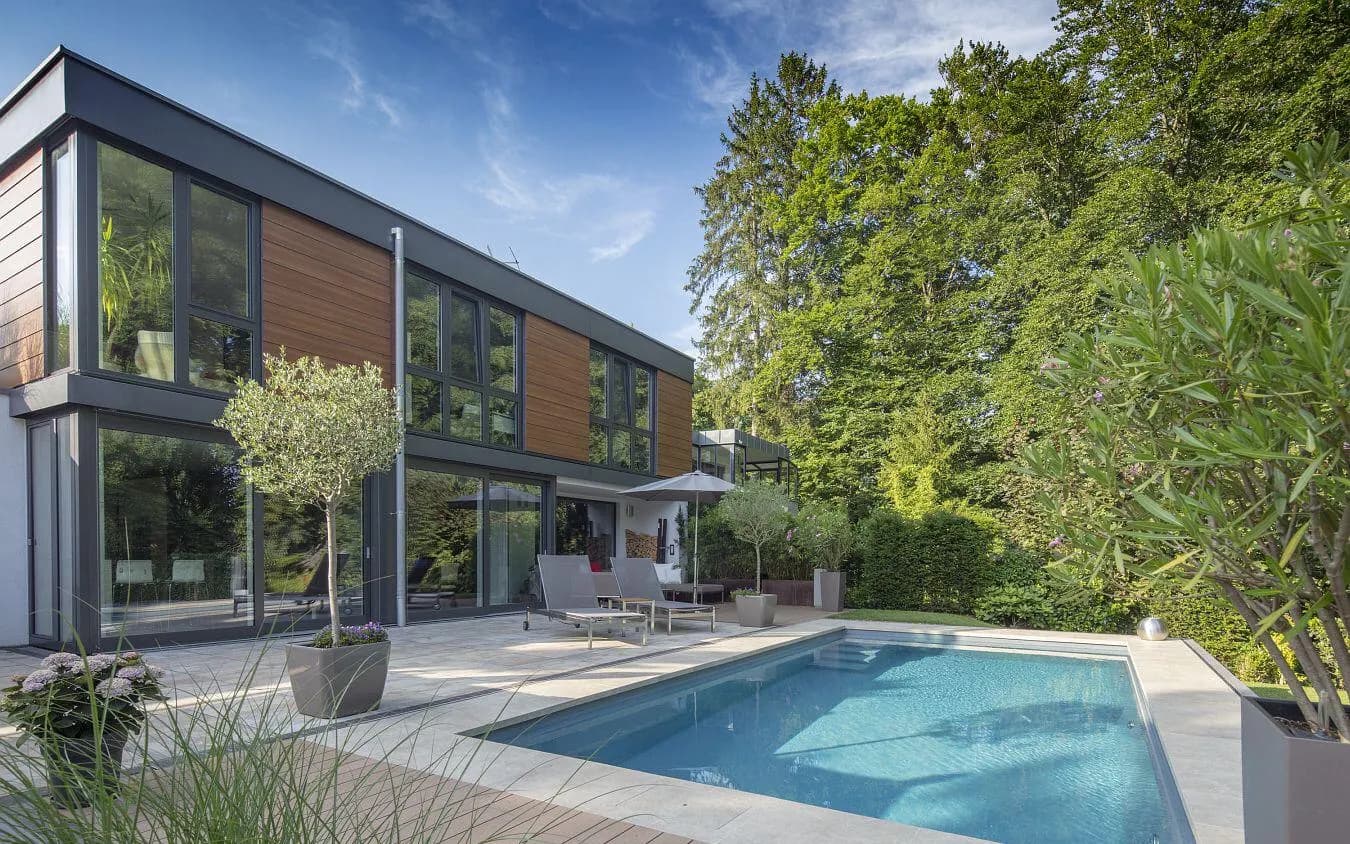
With a garden pool, the real decision is not the pool itself but where it sits. Tree roots, sun direction, the neighbour's boundary, machine access and the space left after the pool: these five shape the finished garden.
View- 4 September 2026
- 8 min read
 Pool Construction
Choosing Pool Showers and Waterfalls: Shower Types, Water Curtains and Plumbing Needs
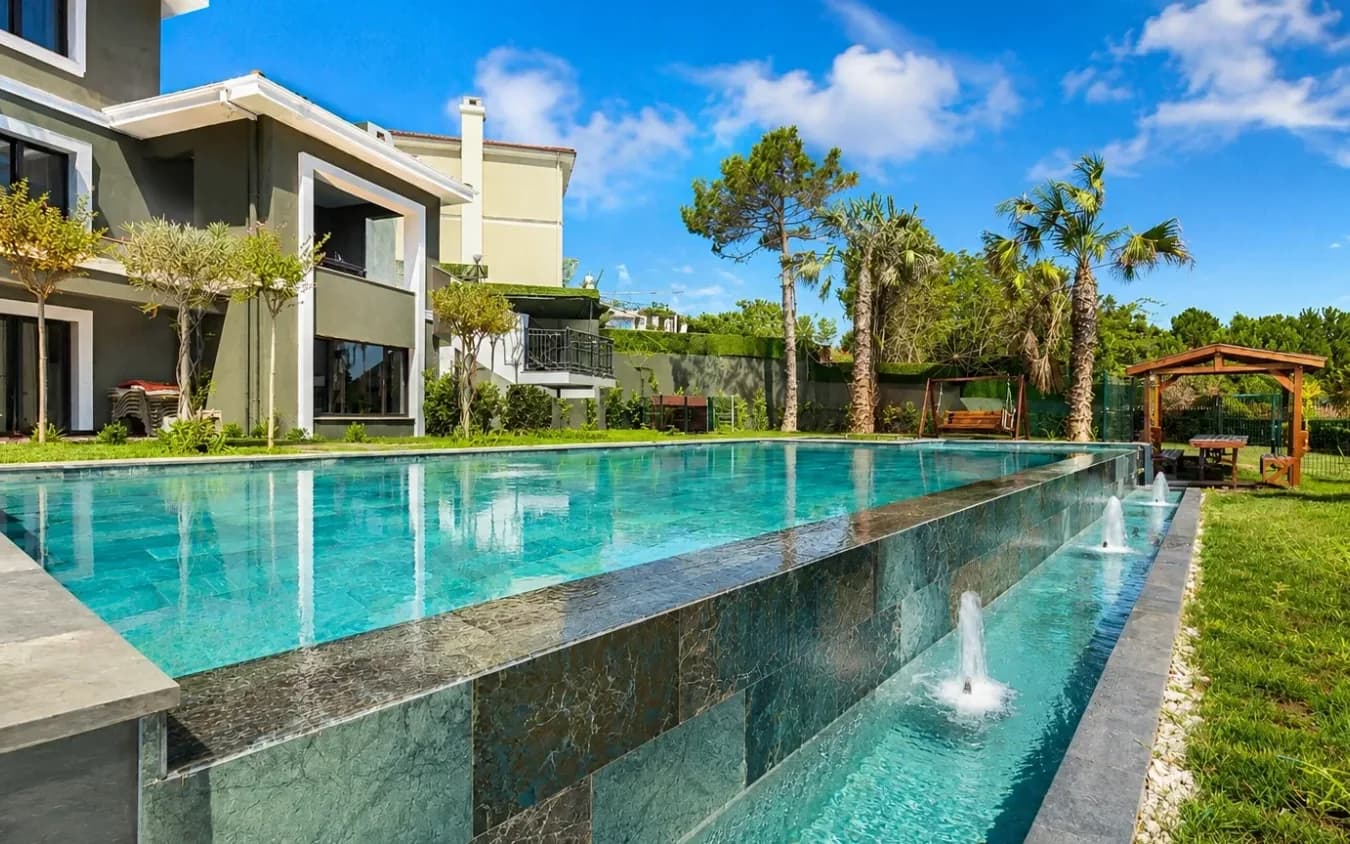
Choosing a pool shower, waterfall or water curtain depends on the material, where the water comes from and where it is mounted. We compare solar and stainless steel shower types and their pump and plumbing needs.
View- 2 October 2026
- 8 min read
 Pool Construction
Competition Pool Equipment: Which Pool Needs Which Equipment?
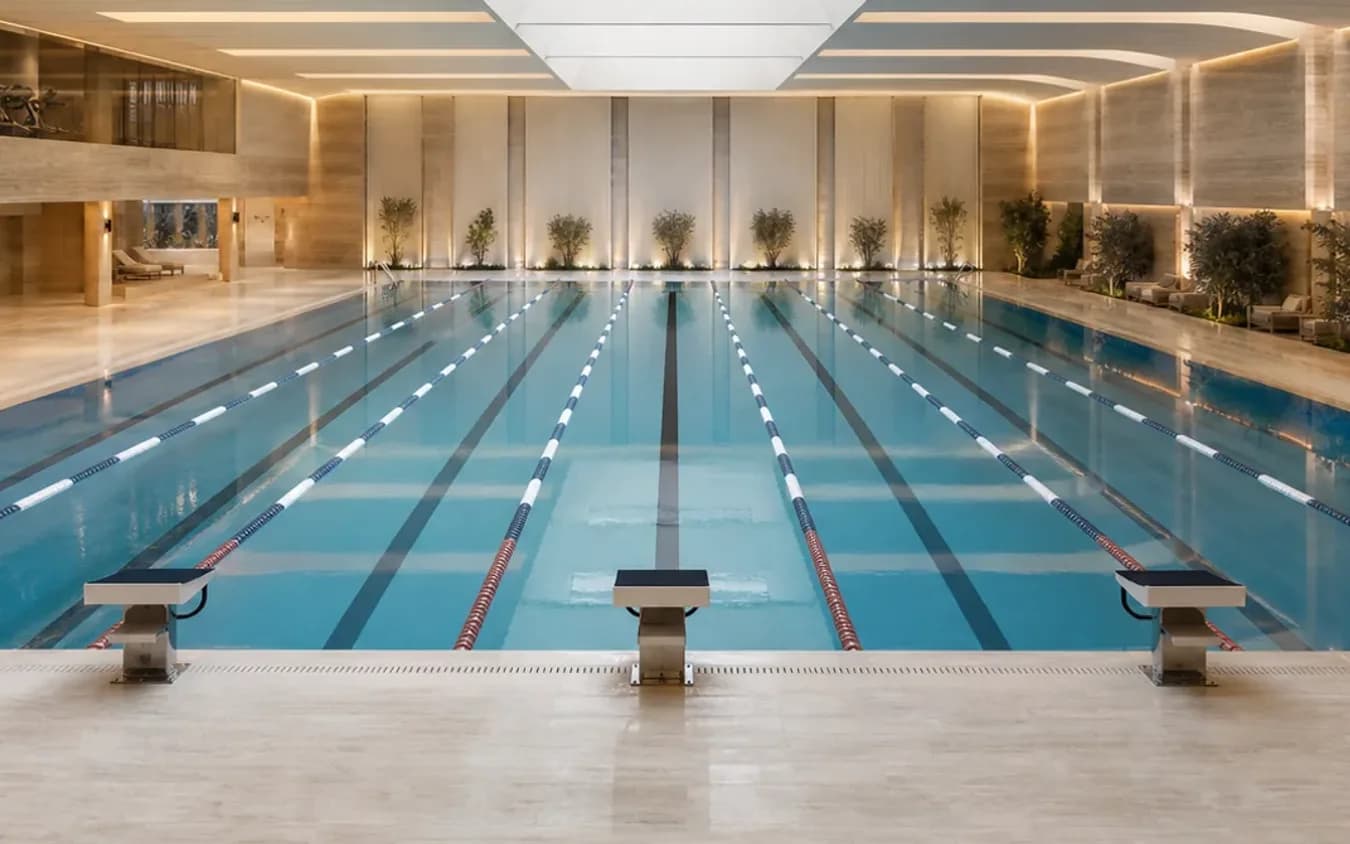
Starting blocks, lane ropes, warning and turn systems, underwater speakers and water polo goals are chosen according to how the pool is used. We explain which dimensions we check for each item.
View- 2 October 2026
- 7 min read
 Pool Construction
Building a pool or spa abroad: what drives the cost of an international project?
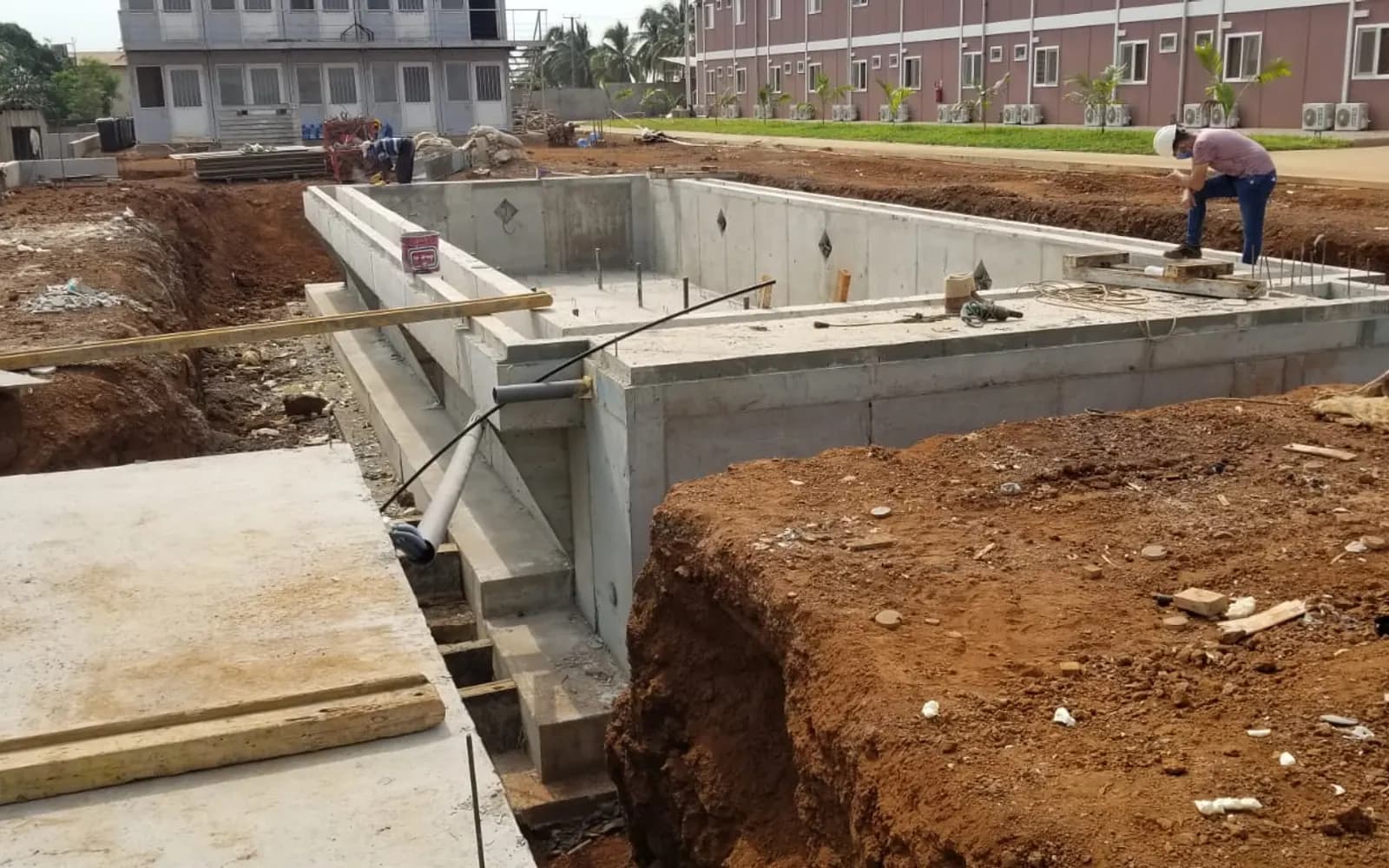
A pool, hammam or spa project delivered abroad from Turkey has no single price per square metre. We cover design, equipment, shipping, customs and schedule.
View- 29 September 2026
- 8 min read
- Pool Construction · 9 September 2026Pool construction in Izmir: evaporation, alluvial ground and the seismic jointIn Izmir, a pool is designed together with 2,938 hours of sunshine a year, 48 percent summer humidity, evaporation, Gediz alluvium and earthquake load.10 min read
- Pool Construction · 9 September 2026Concrete swimming pool construction: shotcrete or formwork?Shotcrete or double-sided formwork for the shell, C30/37 concrete, a water/cement ratio below 0.45 and the waterproofing details of a concrete pool.10 min read
- Pool Construction · 4 September 2026Building a Garden Pool: Location, Size and Fitting It to Your GardenWith a garden pool, the real decision is not the pool itself but where it sits. Tree roots, sun direction, the neighbour's boundary, machine access and the space left after the pool: these five shape the finished garden.8 min read
- Pool Construction · 2 October 2026Choosing Pool Showers and Waterfalls: Shower Types, Water Curtains and Plumbing NeedsChoosing a pool shower, waterfall or water curtain depends on the material, where the water comes from and where it is mounted. We compare solar and stainless steel shower types and their pump and plumbing needs.8 min read
- Pool Construction · 2 October 2026Competition Pool Equipment: Which Pool Needs Which Equipment?Starting blocks, lane ropes, warning and turn systems, underwater speakers and water polo goals are chosen according to how the pool is used. We explain which dimensions we check for each item.7 min read
- Pool Construction · 29 September 2026Building a pool or spa abroad: what drives the cost of an international project?A pool, hammam or spa project delivered abroad from Turkey has no single price per square metre. We cover design, equipment, shipping, customs and schedule.8 min read
// Sources and regulations
Sources and regulations
The official documents behind the technical framework on this page; links open the institutions' own sites.
- Regulation on the Health Principles and Conditions for Swimming Pools (Official Gazette No. 27866, 6 March 2011)Official Gazette of Türkiye
- Regulation Amending the Swimming Pools Regulation (Official Gazette, 15 December 2011)Official Gazette of Türkiye
- Guidelines for safe recreational water environments, Volume 2: Swimming pools and similar environments
// 04 · Company & Contact
To talk about your project, call or write to us.
Legal Name
Çilek Havuz
Founded
1998 · Istanbul
Head Office
Çilek Plaza, Eyüp Sultan Mah. Yakacık Cd. Feshane Cd. No: 2 D:4 D:1, 34885 Sancaktepe / İstanbul
Service Area
All of Türkiye · exports to 14 countries
Branches
Kyrgyzstan · Egypt · Algeria · Iraq
Showroom
Plan a showroom visit
At our showroom in Çilek Plaza, Sancaktepe, you can discuss your project with our team. We recommend booking an appointment by phone before your visit.
Working Hours
- Monday – Friday · 08:00 – 17:30
- Saturday · 08:00 – 12:30
- Closed on Sunday
Frequently Asked Questions
About Pool construction in Antalya, frequently asked questions.
Çilek Havuz Corporate
Pool and Wellness Engineering
- Response Time
- Same day
- Channels
- Phone · Email · WhatsApp
If the answer you are looking for is not here, send your question directly to us and our team will reply as soon as possible.
+90 216 475 39 37March to June and September to October suit excavation and shell concrete. In July and August, an average high of 34.9 °C makes concrete curing difficult; if a pour is needed, night pouring and wet curing are planned. In December and January, downpours of tens of millimetres a day stop excavation.
Çilek Havuz Corporate
An August average of 29.0 °C, an average daytime high of 34.9 °C and 344 hours of sunshine in July push the water above 30 °C. In heated pools the heater is switched off in summer; cooling is done with shading, night circulation or a reversible heat pump.
Çilek Havuz Corporate
In December, 262.2 mm of rain falls on only 10 days. If the surround paving falls towards the pool, soil and fertiliser wash into it and the balance tank overflows. The paving is laid falling away from the pool, a gutter and garden drainage are installed, and the overflow line of the balance tank is connected to the rainwater line.
Çilek Havuz Corporate
The city's ground is travertine and limestone. The karst structure can contain fissures and voids, and bearing capacity changes from one corner of the plot to the other. The investigation includes void scanning; the result sets the raft thickness and the need for ground improvement. On the coastal plain, groundwater and uplift are measured instead.
Çilek Havuz Corporate
The January average is 9.8 °C and, with a record low of -4.6 °C, frost is rare. Unheated water falls below 15 °C in winter; hotel pools use an outdoor pool heated by a heat pump or an indoor pool. Villa pools usually spend the winter at winterising level with the pipework still running.
Çilek Havuz Corporate