

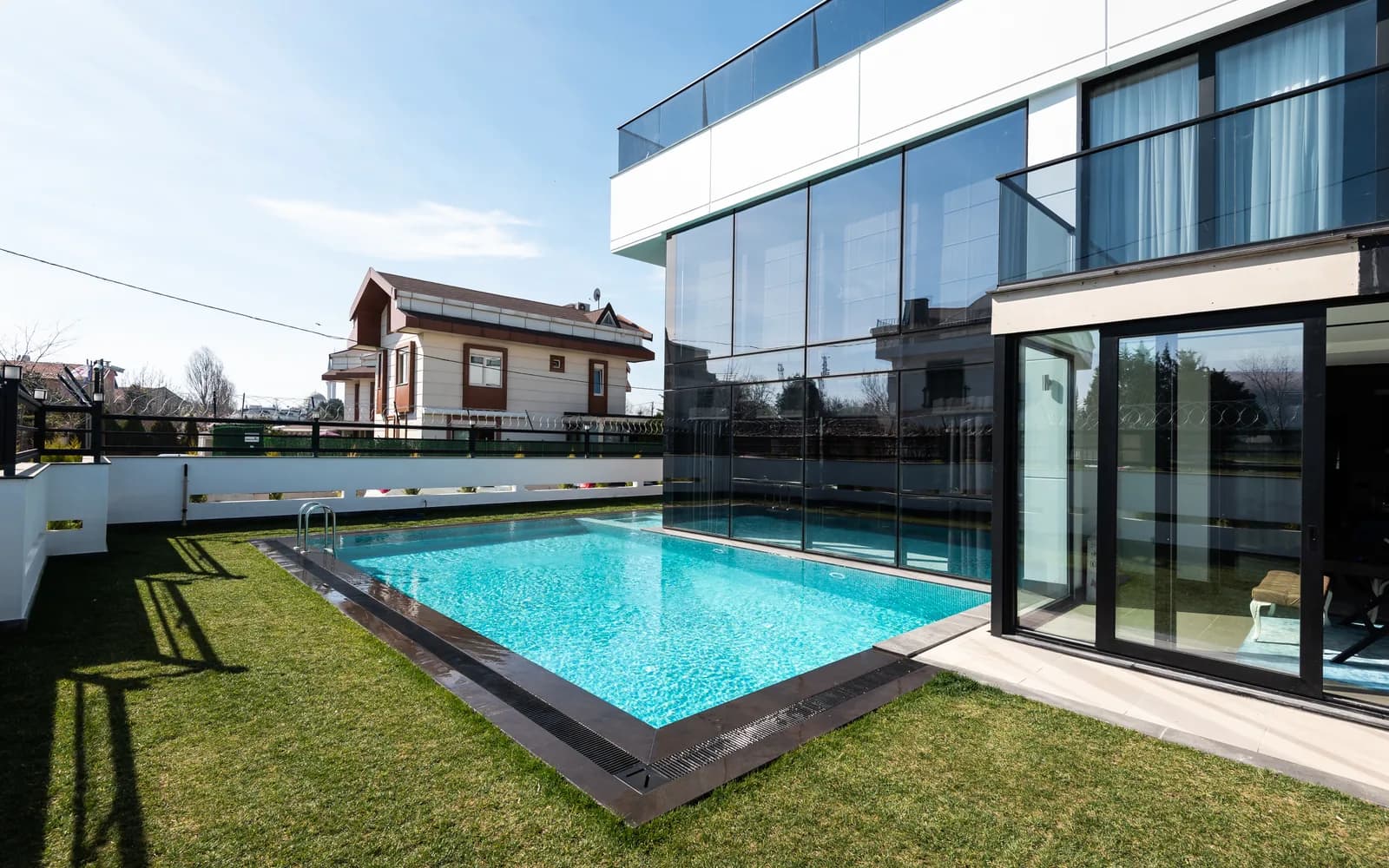
Pool construction in Ankara: what are the frost and heating loads in a continental climate?
Pool construction in Ankara means a reinforced concrete pool designed for freeze-thaw, winterising and heating load in a continental climate at 938 m altitude, with a January average of 0.9 °C.
Project Manager · Mechatronics Engineer · Çilek Havuz
- Published
- Updated
- Reading
- 12 min read
- Category
- Pool Construction
Pool construction in Ankara means a reinforced concrete pool designed for freeze-thaw, winterising and heating load in a continental climate at 938 m altitude, with a January average of 0.9 °C.
Pool construction in Ankara is the practice of designing a reinforced concrete pool so that its concrete and finish withstand the freeze-thaw cycle that repeats every winter, in a climate classed as cold semi-arid (BSk) under the Köppen classification, at an altitude of 938 m, with an annual mean temperature of 12.6 °C and annual precipitation of 413.6 mm.
The core of the definition is the climate: the same reinforced concrete pool section, in a city where the average night temperature in January is -2.2 °C, needs different joint, concrete mix, water level and heating decisions from those in a coastal climate.
This does not mean copying a pool project from the Mediterranean or Aegean coast to Ankara. On the coast, salt, humidity and a long season are decisive; in Ankara, the decisive factors are the day-night temperature range, low humidity, a record low of -24.9 °C measured since 1927 and an outdoor pool season of about five months. A pool built with coastal details survives its first winter in Ankara, then starts to show damage at the joints and under the finish in the second or third winter.
The numerical backbone of a pool design is the monthly temperature and precipitation series.
The table below gives the 1991-2020 averages for Ankara. Three columns are decisive for the pool designer: the average monthly low (how many months frost lasts), the average monthly temperature (the heating deficit) and precipitation (the months in which the pool does not fill itself but loses water to evaporation).
| Month | Avg. temperature (°C) | Avg. high (°C) | Avg. low (°C) | Precipitation (mm) | Rainy days |
|---|---|---|---|---|---|
| January | 0.9 | 4.7 | -2.2 | 38.6 | 11.7 |
| February | 2.7 | 7.4 | -1.2 | 36.6 | 10.9 |
| March | 6.7 | 12.2 | 1.9 | 46.9 | 10.5 |
| April | 11.5 | 17.5 | 6.0 | 44.5 | 11.6 |
| May | 16.5 | 22.8 | 10.5 | 51.0 | 12.0 |
| June | 20.6 | 27.3 | 14.1 | 40.2 | 9.3 |
| July | 24.2 | 31.0 | 17.2 | 14.8 | 3.4 |
| August | 24.3 | 31.0 | 17.4 | 14.6 | 3.7 |
| September | 19.6 | 26.5 | 13.1 | 17.9 | 4.2 |
| October | 13.9 | 20.3 | 8.4 | 33.4 | 7.6 |
| November | 7.3 | 13.0 | 2.7 | 31.9 | 7.7 |
| December | 2.8 | 6.7 | -0.3 | 43.2 | 11.3 |
| Year | 12.6 | - | - | 413.6 | 103.7 |
Three conclusions follow from the table. First, in December, January and February the average night temperature is below zero; in other words, the pool shell and joints freeze almost every night and thaw during the day for three months. Second, in July and August the day-night range is between 13.6 and 13.8 °C; the pool water warms during the day and loses heat at night to the cloudless dry air through radiation and evaporation. Third, while total precipitation for July to September is 47.3 mm, evaporation is far above this; the pool's water level is kept up by the mains, not by rain.
On site, two phenomena are often confused.
A one-off frost fracture is when water freezes in an undrained pipe or a water-filled overflow channel, its volume increases by about nine percent and it cracks the part; it happens in a single night and its cause is clear. Freeze-thaw fatigue, by contrast, is the flaking of the surface, the opening of joints and the hollowing out under ceramic tiles after dozens of cycles, as water in the capillary pores of the concrete and the mortar under the finish freezes every night and thaws every day. At -22 °C, ice growth can produce pressures of up to 207 MPa, and the process is active between -3 and -8 °C when water is present; most winter nights in Ankara fall exactly within this range.
The modern explanation is less about volume expansion than about ice segregation: water migrates by capillary action to the freezing front, ice grows in lens shapes and cracks the material from within. The practical consequence for a pool is this: the problem is the concrete and mortar staying saturated, as well as the water in the pool freezing. A pool shell left open, saturated and without drainage through the winter is exposed to this mechanism every night.
| Element affected | Damage observed | Measure |
|---|---|---|
| Reinforced concrete pool shell | Surface scaling, seepage through hairline cracks | Air-entrained concrete, low water/cement ratio, adherence to curing time |
| Expansion and construction joints | Joint sealant tearing, water ingress, opening under ice pressure | Elastic joint sealant, joint spacing calculated for winter temperatures |
| Ceramic or mosaic finish | Blistering, detachment, voids under the mortar | Freeze-thaw class adhesive and grout, full-bed bonding |
| Overflow channel and grating | Water left in the channel freezing and cracking it | Draining the channel completely in winter, falls towards the drain |
| Pipes and equipment | Frozen pipe, cracked pump housing | Draining the lines, blowing them out with compressed air, winterising the balance tank |
| Surround paving | Slabs lifting, movement joints opening | Foundation taken below frost depth, drained sub-base |
Glossary
- Air-entrained concrete
- Concrete in which closed air bubbles 10 to 500 micrometres in diameter are formed by adding an air-entraining admixture to the mix. The bubbles provide pressure relief space for water expanding as it freezes and raise the freeze-thaw resistance of the shell.
- Freeze-thaw cycle
- Water within a material freezing and thawing within a single day. In Ankara, because the average night temperature is below zero from December to February, dozens of cycles are counted in one winter.
- Frost depth
- The greatest depth that frost reaches in the ground. Foundations and the sub-base of surround paving are taken below this depth; the value is set from the local ground investigation and meteorological data, and there is no single national figure.
- Winterising
- Preparing an outdoor pool for winter: lowering the water level below the skimmer, draining the lines, adjusting the chemical balance and laying the cover. Draining the pool completely is not winterising; an empty pool can be moved by groundwater pressure and frost heave.
- Heating degree day
- The sum over days of the number of degrees by which the daily mean temperature falls below a base temperature. For buildings the base is taken as 15.5 °C in the EU and 18.3 °C in the US; for a pool the base is the target water temperature.
- Evaporation loss
- Loss of water and latent heat from the pool surface. It increases in dry air and wind; Ankara's 327.8 hours of sunshine and 14.8 mm of rain in July show that rain does not make up this loss.
The decision criteria are set on two axes: the shell getting through winter undamaged, and the short season being extended by heating.
On the first axis, the mix, joint and drainage decisions for the reinforced concrete pool are written; on the second, the heat pump capacity and cover decision. The list below gathers clauses that can be transferred directly into the technical specification of a pool project.
Specification clauses for a pool project in Ankara
- 01The concrete of the pool shell and overflow channel is chosen in an air-entrained, low-permeability class with a limited water/cement ratio; for October and November pours, curing time is extended with protection against night frost.
- 02Expansion joints are calculated for the 23.4 °C temperature difference between the winter average of 0.9 °C and the summer average of 24.3 °C; the joint sealant is an elastic material of freeze-thaw class.
- 03The finish adhesive and grout are chosen in a class with declared freeze-thaw resistance; bonding with voids is not accepted.
- 04Foundations for surround paving and the plant room are taken below frost depth; drainage is placed in the sub-base, and surface water is sloped away from the pool.
- 05The winterising procedure is written into the design: the water level is lowered below the skimmer mouth, the pool is not drained, all lines are drained and blanked off, and the balance tank and pump housing are dried.
- 06The heat pump is sized according to the degree-day total obtained by multiplying the difference between the target pool water temperature and the average monthly air temperature by the number of days; in a project that wants to extend the season from May to September, capacity is chosen for the May and September deficit, not for the June to August average.
- 07A pool cover (solar or automatic slatted) is written in as a mandatory item for every heated outdoor pool; the cover reduces night-time radiation loss and evaporation and lowers heat pump running hours.
The degree-day logic is clearer with an example. If the target water temperature is taken as 26 °C, the deficit with the monthly averages in the table is: in May, 26 minus 16.5 equals 9.5 K, which multiplied by 31 days gives about 295 degree days; in June, 5.4 K gives 162; in July, 1.8 K gives 56; in August, 1.7 K gives 53; in September, 6.4 K gives 192. May and September together carry a larger heating deficit than the three summer months combined. This calculation shows only the deficit from the air; evaporation, wind and night-time radiation are added separately. That is why in Ankara heat pump capacity is always chosen for the ends of the season, taking into account that the COP also falls when the air temperature is low.
The heating degree day concept comes from building engineering: the base temperature is subtracted from the daily mean temperature, and if the result is positive it is that day's degree days; a building's heating energy is estimated as the product of its specific heat loss and the degree-day total for the period. In a pool, the same logic is applied with the water temperature as the base.
Demand for villa pools in Ankara is concentrated mainly in the southern belt of Çankaya, İncek and around Gölbaşı.
The typology is largely set by the plot and the climate: plots are larger than in coastal cities, pools are rectangular and 8 to 12 m long, mostly skimmer pools or overflowing on one side, with the plant room buried below garden level and below frost depth. On the Gölbaşı side, groundwater is high on some plots, so the risk of an empty pool floating under uplift enters the calculation; this reinforces the rule that the pool is not drained in winter.
An indoor pool is a meaningful option in Ankara at villa scale as well. While the outdoor season fits into five months from May to September, an indoor pool is used for twelve months; in return, humidity control and ventilation load are added. In an indoor pool, the external freeze-thaw load is removed from the shell, but indoor condensation and the capacity of a dehumidifier with heat recovery move to the centre of the design. Ankara's dry outdoor air is an advantage for dehumidification: because the humidity difference between outdoor and indoor air is large, lowering humidity with fresh air takes less energy than in coastal cities. In an indoor pool project, the shell remains a reinforced concrete pool, but impermeability and thermal insulation come to the fore instead of air-entrained concrete.
Air-entrained concrete was discovered by chance in the mid-1930s: an additive used in cement grinding was seen to give the resulting concrete unexpected properties and to raise its freeze-thaw resistance.
From then on, air-entrained concrete became standard practice in cold climates. The mechanism is explained the same way today: closed bubbles 10 to 500 micrometres in diameter are pressure relief spaces that make room for the expansion of freezing water without creating internal stress.
Pool construction took up this knowledge late. Air entrainment, used for decades in road and bridge concrete, was long skipped in pool shells out of concern for water-tightness; yet closed bubbles do not form a capillary network and so do not increase permeability. In a city like Ankara, where most winter nights fall in the -3 to -8 °C band, there is no technical reason to give up this admixture in shell and overflow channel concrete.
The degree-day method grew out of fuel planning and was carried over to pool heating in the same way. For buildings, the base temperature varies from country to country between 12 °C (Switzerland) and 18.3 °C (USA); for a pool, the base is the target water temperature, which is why in Ankara May and September, considered mild for building heating, are heavy months for a pool. A reinforced concrete pool shell that gets through winter undamaged, and a heat pump chosen for the ends of the season, are the two fixed numerical inputs of a pool project in Ankara.
Next step
Let us discuss your project in the way that suits you best.
You can fill in the form for a written quote, schedule a video project presentation or ask us to survey your project site.
Get a Quote
Send us your dimensions and expectations in writing.
Online presentation
Video project presentation
On-site survey
Inspection at your project site
// 01 · Product groups
Compare the products on this topic on their category pages.
Each card leads to a product category; models, technical sheets and list prices are there.
 Product category
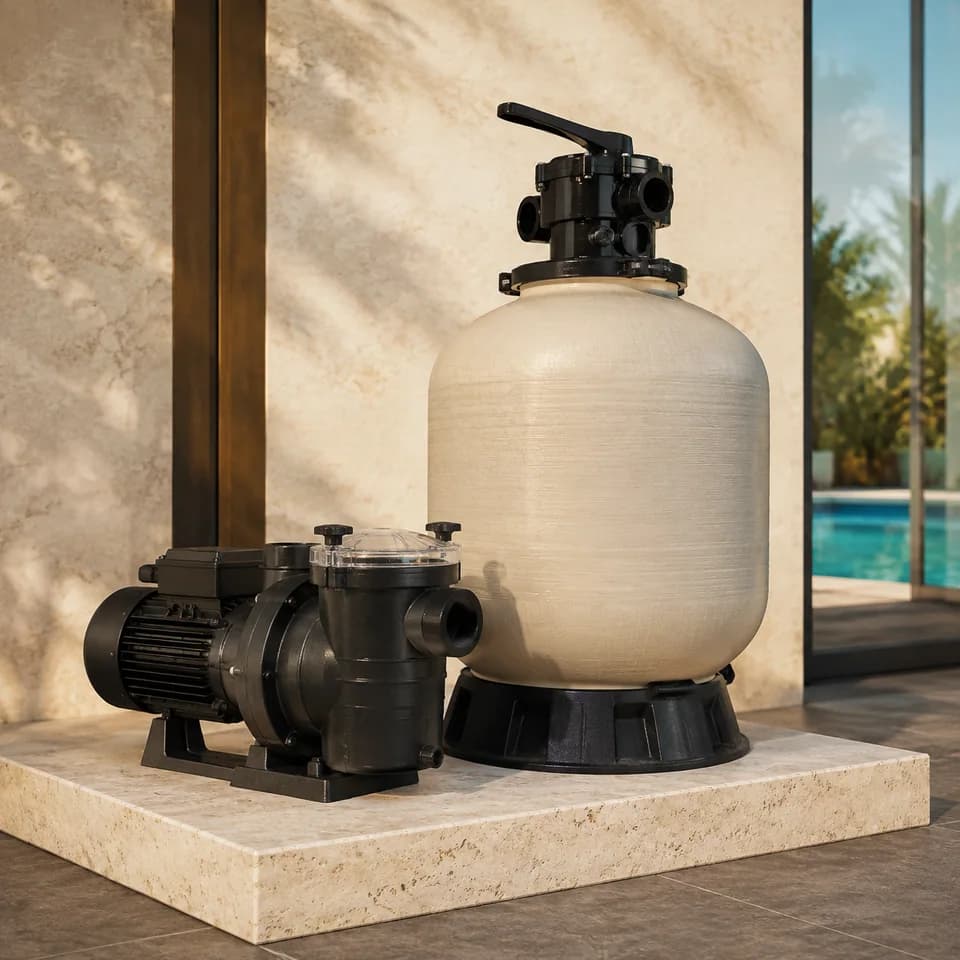
Pool Mechanical Equipment
Circulation pumps, filters, valves and automation: the mechanical infrastructure that forms the heart of the pool.
View- 65 products
 Product category
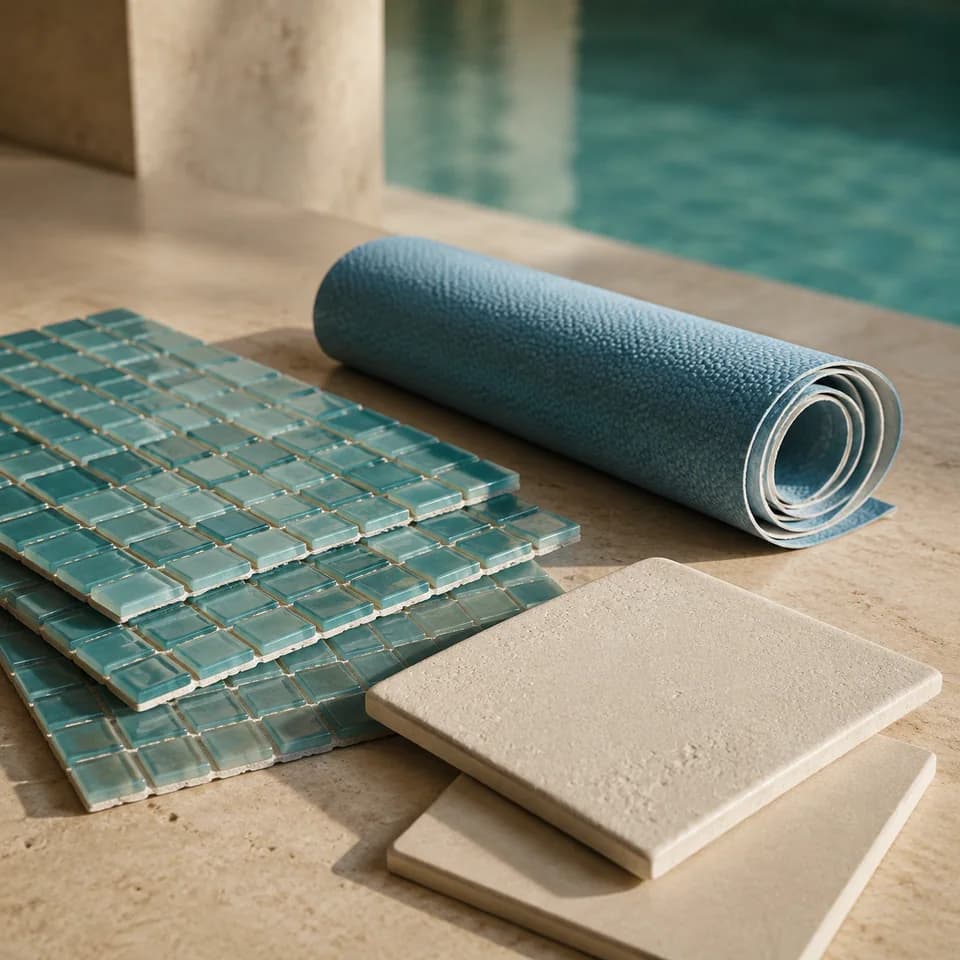
Pool Lining Systems
PVC liner, membrane, ceramic tile and glass mosaic: lining materials that make the pool watertight and form its finished surface.
View- 20 products
 Product category
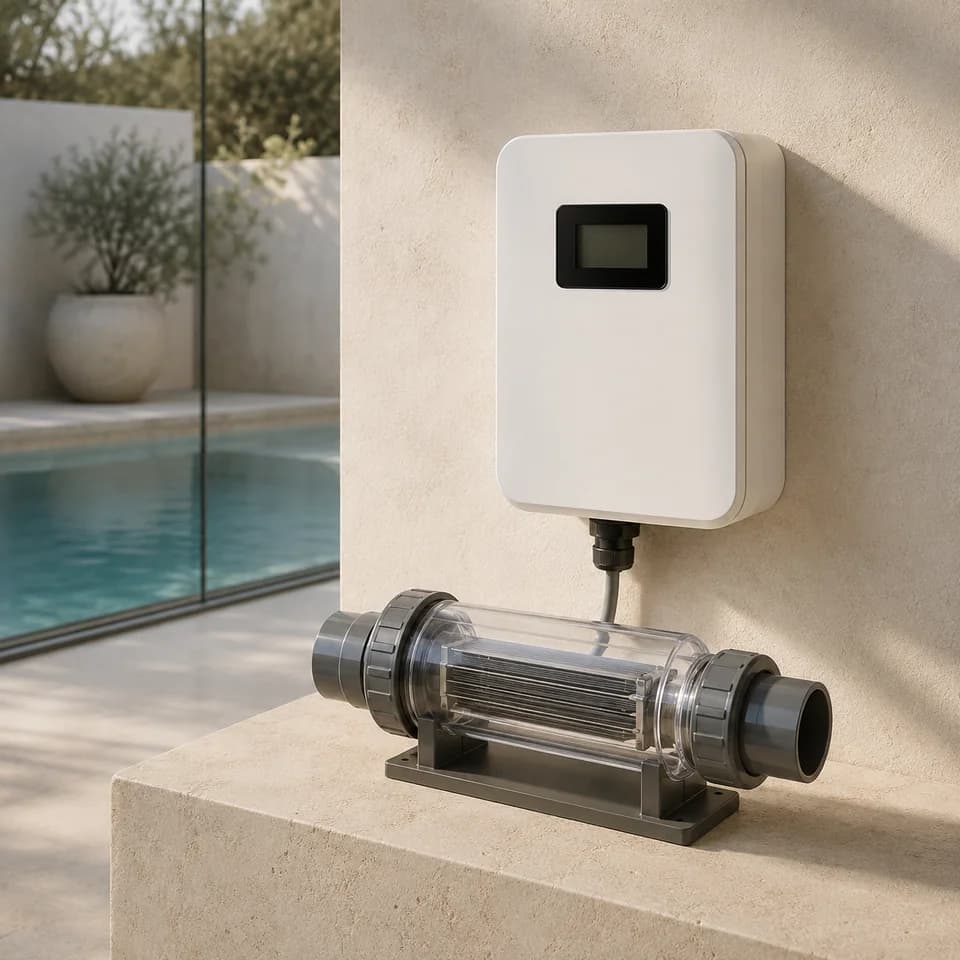
Pool Disinfection Systems
Fully automatic pool water disinfection that reduces chemical use with salt electrolysis, UV disinfection and smart dosing systems.
View- 52 products
Product category
Pool Mechanical Equipment
Circulation pumps, filters, valves and automation: the mechanical infrastructure that forms the heart of the pool.
65 productsProduct category
Pool Lining Systems
PVC liner, membrane, ceramic tile and glass mosaic: lining materials that make the pool watertight and form its finished surface.
20 productsProduct category
Pool Disinfection Systems
Fully automatic pool water disinfection that reduces chemical use with salt electrolysis, UV disinfection and smart dosing systems.
52 products
// 02 · Related service
The work in this article, we deliver from design to handover.
Çilek Havuz service
Swimming Pool Construction
Reinforced-concrete, prefabricated and infinity swimming pools, built turnkey for villa, residential and commercial projects.
Swimming pool construction is a turnkey build in which the site survey, structural and mechanical design, excavation, reinforced-concrete shell, waterproofing, finish, filtration plumbing and commissioning run under a single contract. The written project schedule follows the site survey.
How we work
- 01Initial meeting and site surveyWe inspect the site and listen to the brief.
- 02Design and quotationWe give the cost item by item, in writing.
- 03ExecutionThe same team builds to a written schedule.
- 04Handover and commissioningWe start the systems and explain their use.
- 05Maintenance and technical supportWe provide periodic maintenance and support.
// 03 · Guides
On Pool Construction, more articles to read.
First the articles directly related to this one, then the newest articles on the topic.
 Pool Construction
Pool construction in Bursa: what do frost, slopes and the Nilüfer plain change?
In Bursa, a pool is designed around a record low of -20.5 °C, 13 snow days a year, hillside excavation at the foot of Uludağ and the groundwater of the Nilüfer plain.
View- 9 September 2026
- 10 min read
 Pool Construction
Pool construction in Algeria: Mediterranean climate, earthquakes and specifications
Pool building in Algeria means planning for 685 mm of winter rain, a record 48.7 °C, seismic rules after the 2003 Boumerdès quake and imported equipment.
View- 9 September 2026
- 9 min read
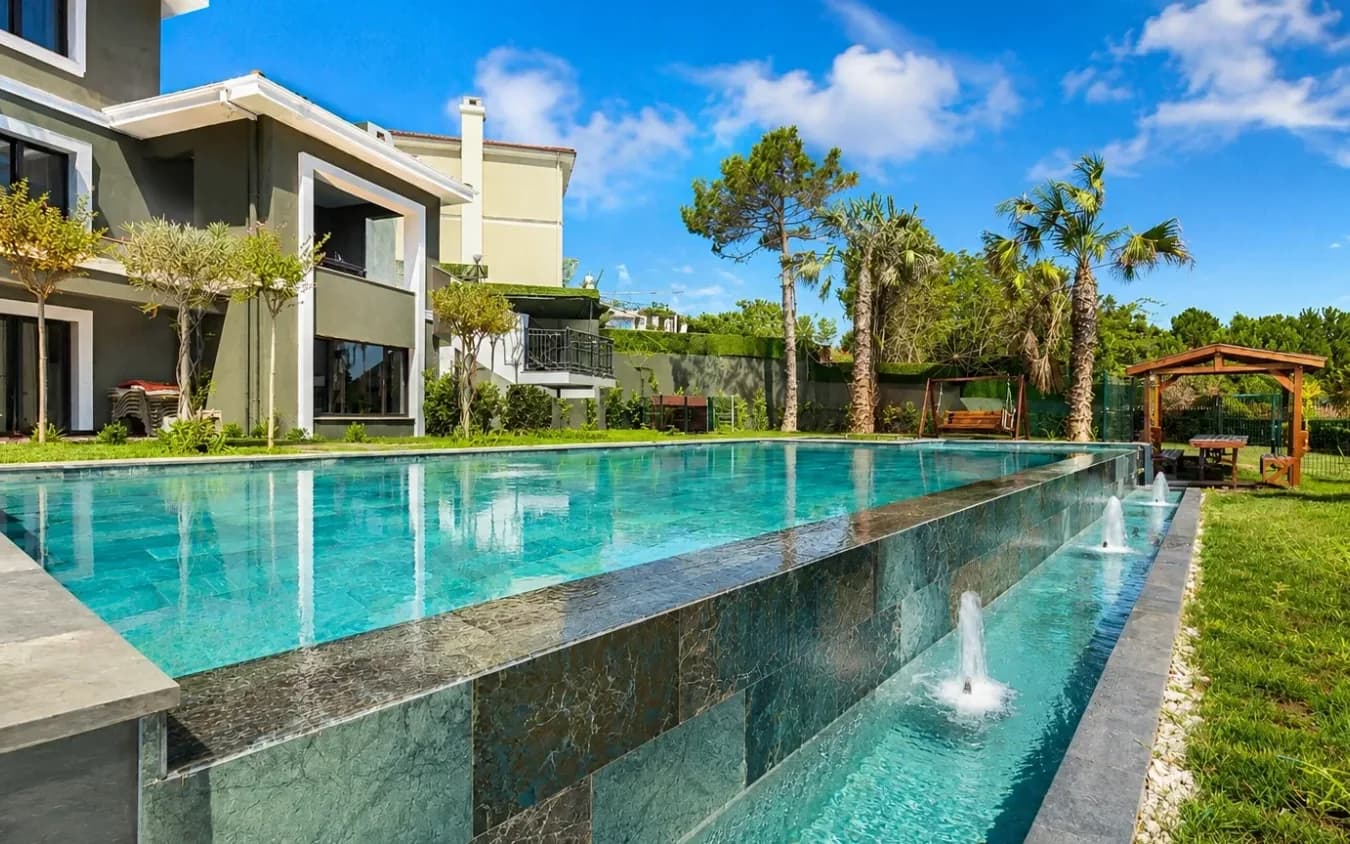
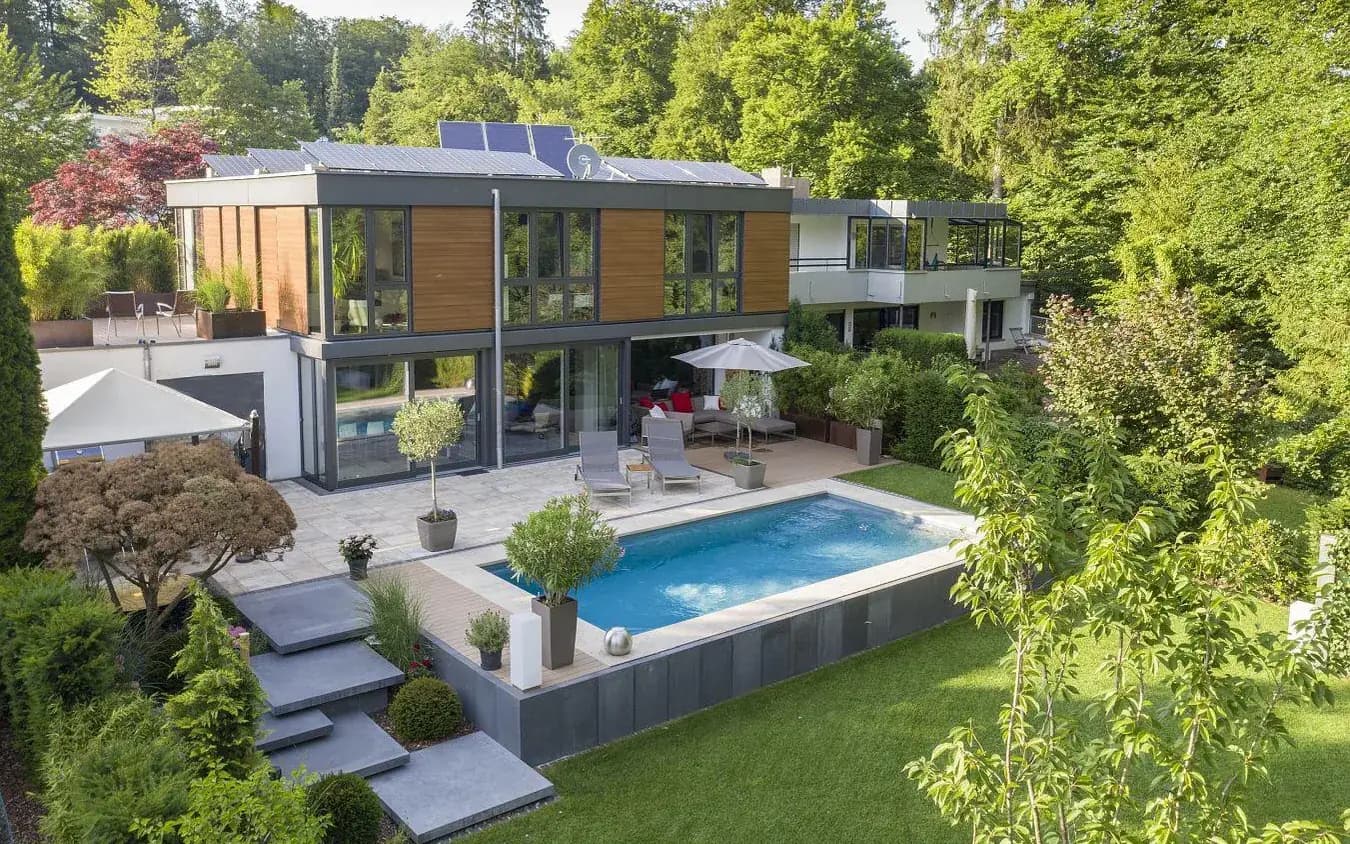 Pool Construction
Pool construction in Samsun: what do climate and groundwater change?
Pool construction in Samsun is a reinforced concrete pool project shaped by a humid subtropical climate, 729.7 mm of rain a year and high groundwater in the delta alluvium.
View- 9 September 2026
- 9 min read
 Pool Construction
Choosing Pool Showers and Waterfalls: Shower Types, Water Curtains and Plumbing Needs
Choosing a pool shower, waterfall or water curtain depends on the material, where the water comes from and where it is mounted. We compare solar and stainless steel shower types and their pump and plumbing needs.
View- 2 October 2026
- 8 min read
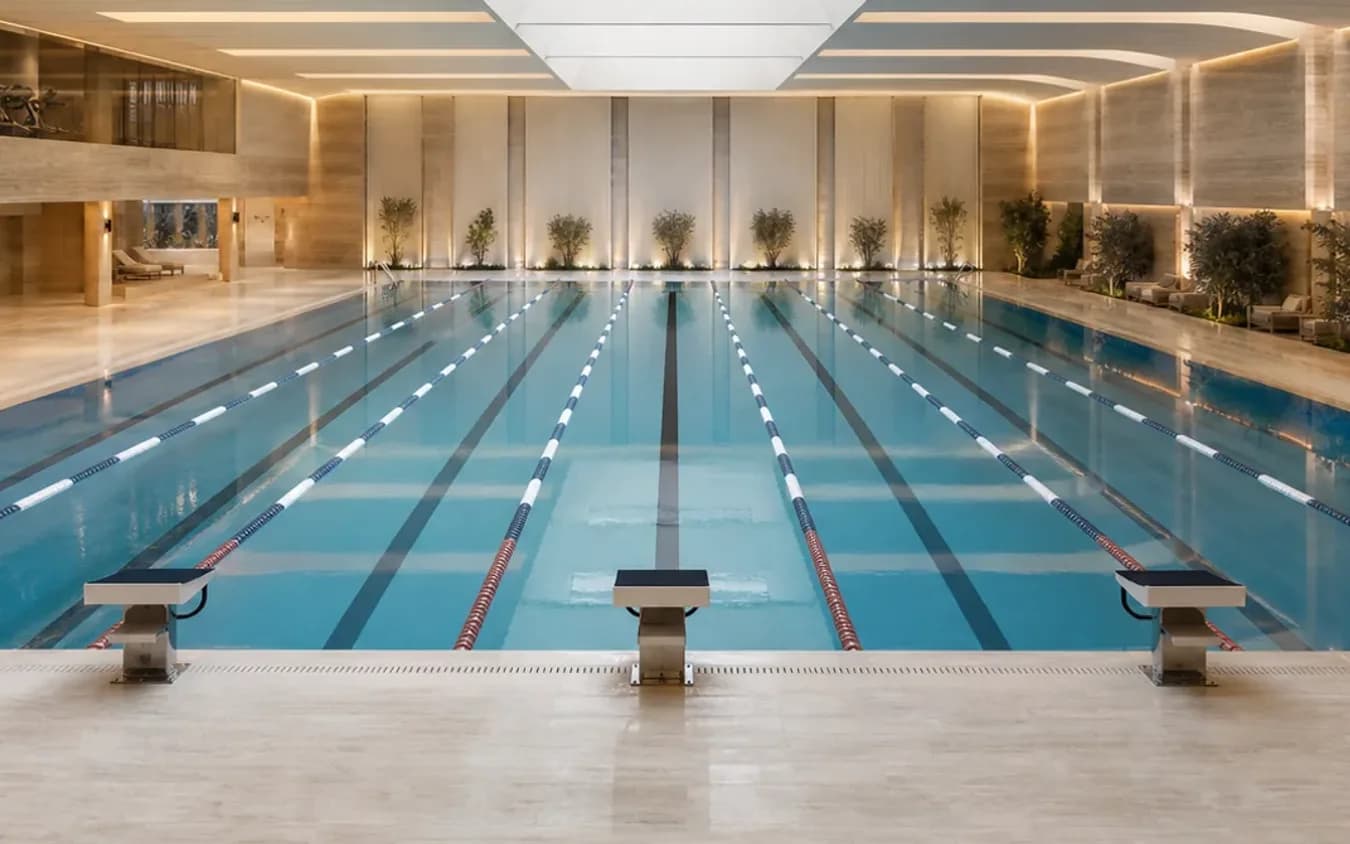 Pool Construction
Competition Pool Equipment: Which Pool Needs Which Equipment?
Starting blocks, lane ropes, warning and turn systems, underwater speakers and water polo goals are chosen according to how the pool is used. We explain which dimensions we check for each item.
View- 2 October 2026
- 7 min read
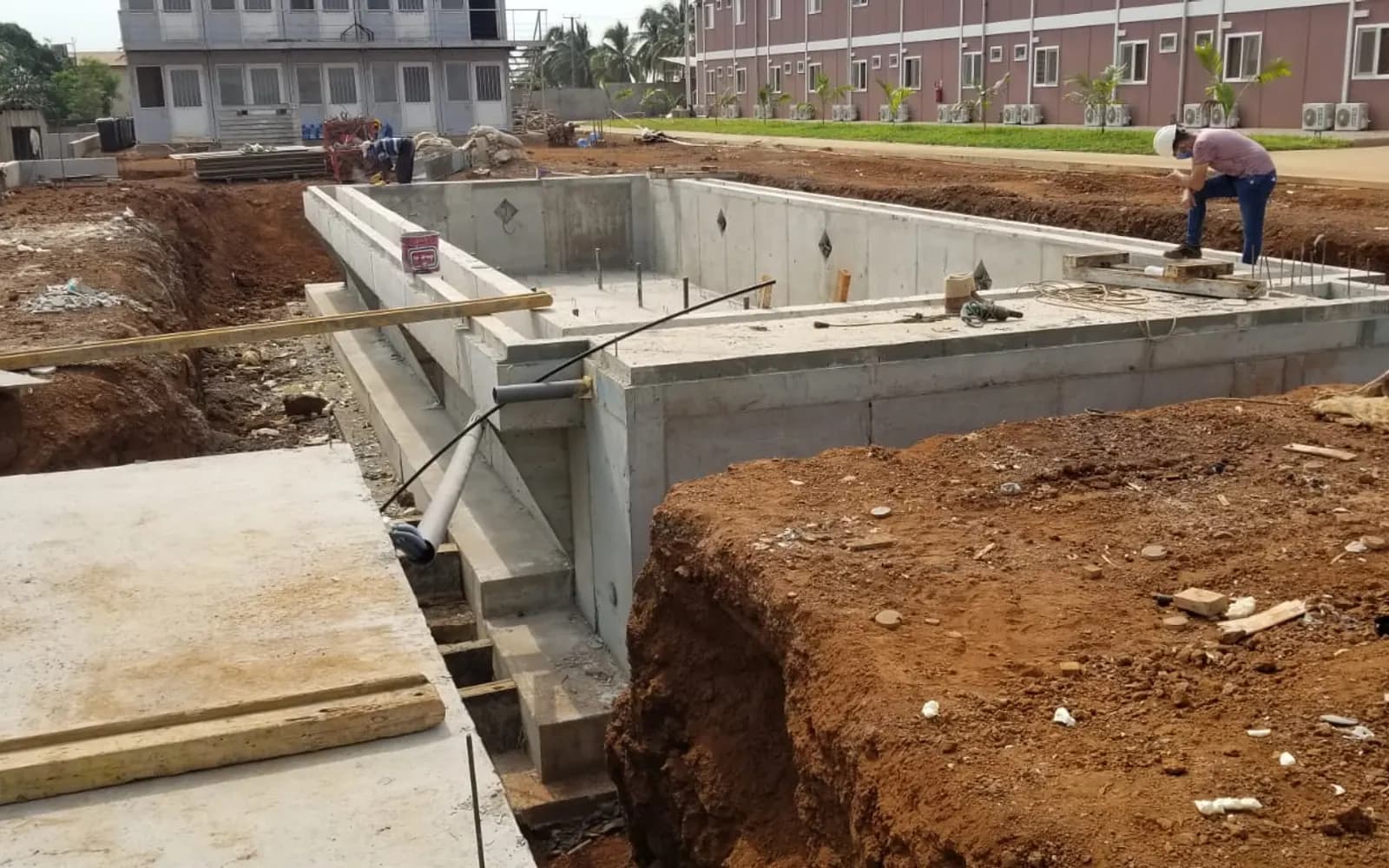 Pool Construction
Building a pool or spa abroad: what drives the cost of an international project?
A pool, hammam or spa project delivered abroad from Turkey has no single price per square metre. We cover design, equipment, shipping, customs and schedule.
View- 29 September 2026
- 8 min read
- Pool Construction · 9 September 2026Pool construction in Bursa: what do frost, slopes and the Nilüfer plain change?In Bursa, a pool is designed around a record low of -20.5 °C, 13 snow days a year, hillside excavation at the foot of Uludağ and the groundwater of the Nilüfer plain.10 min read
- Pool Construction · 9 September 2026Pool construction in Algeria: Mediterranean climate, earthquakes and specificationsPool building in Algeria means planning for 685 mm of winter rain, a record 48.7 °C, seismic rules after the 2003 Boumerdès quake and imported equipment.9 min read
- Pool Construction · 9 September 2026Pool construction in Samsun: what do climate and groundwater change?Pool construction in Samsun is a reinforced concrete pool project shaped by a humid subtropical climate, 729.7 mm of rain a year and high groundwater in the delta alluvium.9 min read
- Pool Construction · 2 October 2026Choosing Pool Showers and Waterfalls: Shower Types, Water Curtains and Plumbing NeedsChoosing a pool shower, waterfall or water curtain depends on the material, where the water comes from and where it is mounted. We compare solar and stainless steel shower types and their pump and plumbing needs.8 min read
- Pool Construction · 2 October 2026Competition Pool Equipment: Which Pool Needs Which Equipment?Starting blocks, lane ropes, warning and turn systems, underwater speakers and water polo goals are chosen according to how the pool is used. We explain which dimensions we check for each item.7 min read
- Pool Construction · 29 September 2026Building a pool or spa abroad: what drives the cost of an international project?A pool, hammam or spa project delivered abroad from Turkey has no single price per square metre. We cover design, equipment, shipping, customs and schedule.8 min read
// Sources and regulations
Sources and regulations
The official documents behind the technical framework on this page; links open the institutions' own sites.
- Regulation on the Health Principles and Conditions for Swimming Pools (Official Gazette No. 27866, 6 March 2011)Official Gazette of Türkiye
- Regulation Amending the Swimming Pools Regulation (Official Gazette, 15 December 2011)Official Gazette of Türkiye
- Guidelines for safe recreational water environments, Volume 2: Swimming pools and similar environments
// 04 · Company & Contact
To talk about your project, call or write to us.
Legal Name
Çilek Havuz
Founded
1998 · Istanbul
Head Office
Çilek Plaza, Eyüp Sultan Mah. Yakacık Cd. Feshane Cd. No: 2 D:4 D:1, 34885 Sancaktepe / İstanbul
Service Area
All of Türkiye · exports to 14 countries
Branches
Kyrgyzstan · Egypt · Algeria · Iraq
Showroom
Plan a showroom visit
At our showroom in Çilek Plaza, Sancaktepe, you can discuss your project with our team. We recommend booking an appointment by phone before your visit.
Working Hours
- Monday – Friday · 08:00 – 17:30
- Saturday · 08:00 – 12:30
- Closed on Sunday
Frequently Asked Questions
About Pool construction in Ankara, frequently asked questions.
Çilek Havuz Corporate
Pool and Wellness Engineering
- Response Time
- Same day
- Channels
- Phone · Email · WhatsApp
If the answer you are looking for is not here, send your question directly to us and our team will reply as soon as possible.
+90 216 475 39 37No. The water level is lowered below the skimmer mouth, the lines are drained and the pool is covered; the shell is left full of water. An empty shell is both exposed to freeze-thaw while saturated and can be moved by uplift where groundwater is high.
Çilek Havuz Corporate
For an unheated outdoor pool, the practical season is June to September; average monthly air temperature in these months is between 19.6 and 24.3 °C. With a heat pump and a cover, the season extends from early May to late September. May and September carry a larger heating deficit than the three summer months combined.
Çilek Havuz Corporate
No. The entrained air consists of closed bubbles 10 to 500 micrometres in diameter that do not form an interconnected capillary network. The bubbles make room for the expansion of freezing water and raise the freeze-thaw resistance of the shell; water-tightness is achieved through the water/cement ratio and curing.
Çilek Havuz Corporate
Because the real heating deficit is at the ends of the season. For a 26 °C water target, May gives a deficit of about 295 degree days and September 192, while July and August together come to around 110. In addition, the heat pump's COP falls at low air temperatures; capacity is chosen for May and September conditions.
Çilek Havuz Corporate
Twelve months of use, and the shell being freed from external freeze-thaw load. In return, a dehumidification and ventilation system is added; Ankara's dry outdoor air makes humidity control possible with less energy than in coastal cities.
Çilek Havuz Corporate