

Concrete swimming pool construction: shotcrete or formwork?
Concrete swimming pool construction covers shotcrete or double-sided formwork for the shell, the C30/37 concrete class, a water/cement ratio below 0.45 and the waterproofing details.
Concrete swimming pool construction covers shotcrete or double-sided formwork for the shell, the C30/37 concrete class, a water/cement ratio below 0.45 and the waterproofing details.
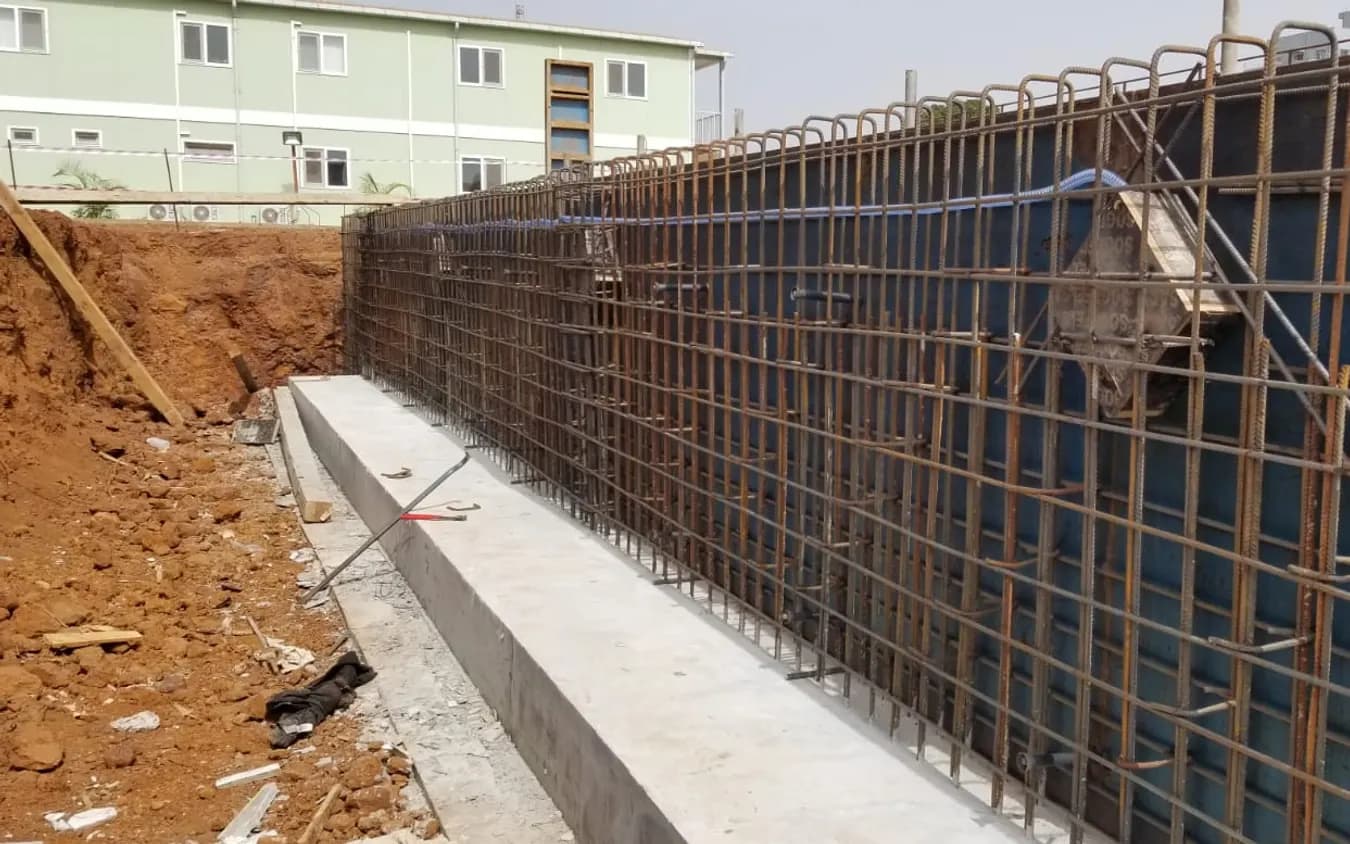
The concrete swimming pool construction technique is the production of the water-bearing shell as a single-piece (monolithic) vessel of steel reinforcement and concrete. The shell is built by two methods: shotcrete, where the concrete is carried by hose and sprayed onto the surface with compressed air, and formed casting, where the concrete is poured between two-sided formwork and compacted with a vibrator. Both methods serve the same goal: a box that does not crack, does not leak and carries the load of the ground.
This article is not a comparison of prefabricated and concrete pools, nor a cost article. The subject is how the concrete pool shell is produced, what the concrete class and the water/cement ratio mean, and by which rule the reinforcement and waterproofing details are written. The sequence of the pool construction process is covered in a separate article on the stages.
Wikipedia defines shotcrete as concrete or mortar conveyed through a hose and pneumatically projected at high velocity onto a surface; the technique was developed by Carl Akeley and first used in 1907. It has two sub-methods: dry mix (gunite) and wet mix. In the dry mix the dry components are conveyed through the hose and the water is added at the nozzle by the operator; in the wet mix ready-mixed concrete is pumped and compressed air is supplied at the nozzle. The source states that the wet mix produces less rebound, waste and dust than the dry mix and places a larger volume in a shorter time.
| Criterion | Shotcrete (wet mix) | Formed casting (double-sided formwork) |
|---|---|---|
| Shell shape | Free form; curved walls and stepped floors are easy | Vertical and flat surfaces; special formwork for curves |
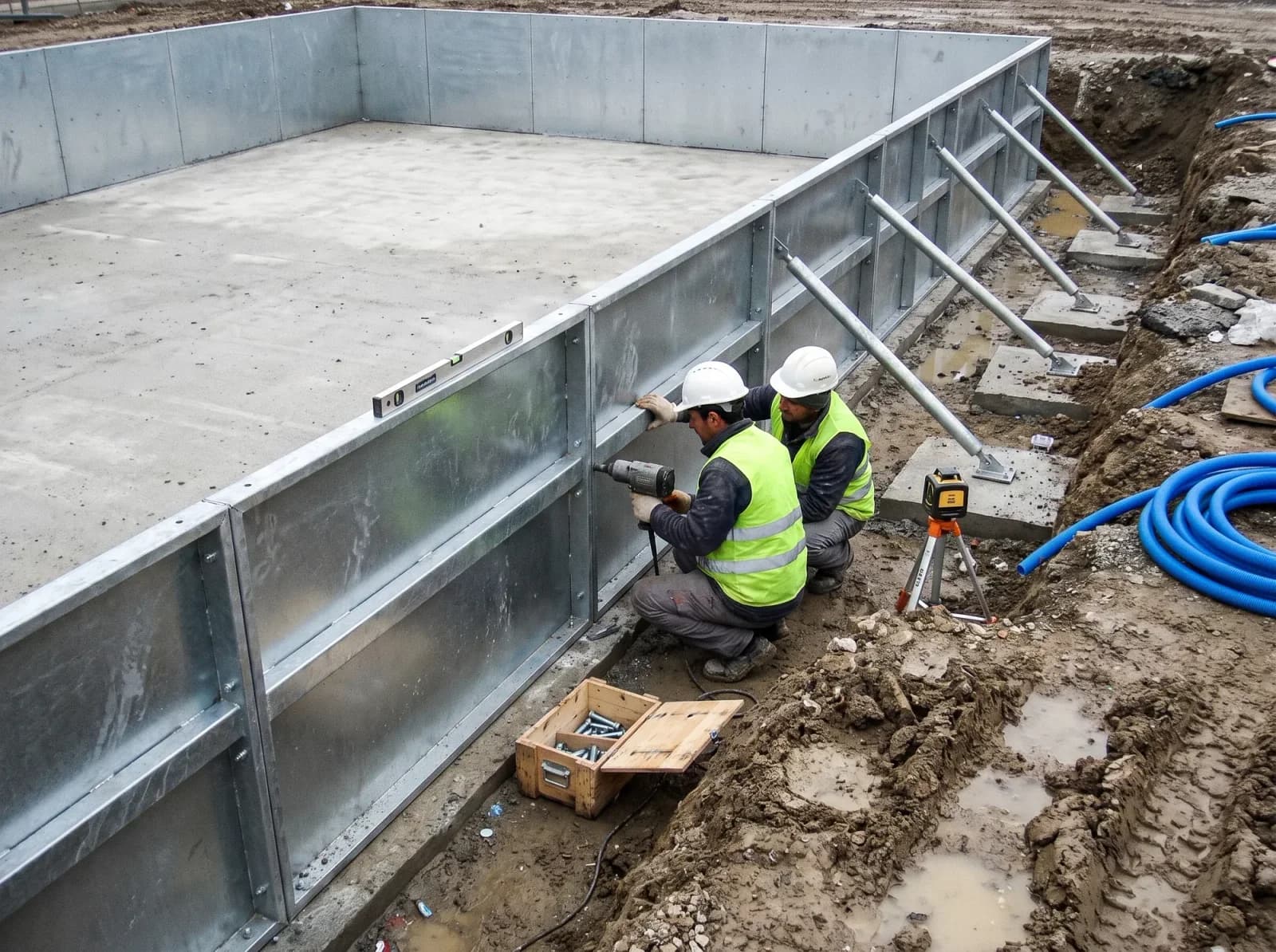
| Formwork need | One face only (excavation slope or back-face formwork) | Two faces; form ties and waterstop plugs required |
| Cold joint | Floor and walls can be sprayed on the same day; few joints | Floor and walls cast separately; the floor-wall joint is sealed with a waterstop |
| Compaction | Compacts by spray velocity; depends on nozzle skill | Compacts by vibrator; measurable and repeatable |
| Surface | Finished with a trowel; render coat required | Formwork surface is flat; thinner render coat |
| Quality control | Cores from a test panel; nozzle distance and angle are checked | Cube or cylinder samples; slump and curing record |
| Suitable project | Villa pools, free-form pools and pools of varying depth | Olympic, semi-Olympic and square-cornered commercial pools |
The source states that shotcrete shows high compressive strength, good durability, watertightness and frost resistance, and lists swimming pool construction among its applications. The advantage of formed casting is measurability: the concrete is sampled as it arrives from the batching plant, and the vibration time goes into the record. In commercial pools and square-cornered geometry we prefer formed casting; in free-form villa pools we prefer wet-mix shotcrete.
The concrete class is written in EN 206 notation: C30/37 is concrete whose 28-day characteristic compressive strength is 30 N/mm² on a cylinder sample and 37 N/mm² on a cube sample. The source states that 28-day compressive strength is the standard specification measure of concrete quality and that, against its high compressive strength, the tensile strength of concrete is markedly low; that is why the shell carries steel reinforcement in the tension zones. For a pool shell C30/37 is the lower limit; on plots in contact with salt water or with a high water table it goes up to C35/45.
The water/cement ratio is the mass of water in the mix divided by the mass of cement. The source writes that full hydration needs about 0.35 mass of water per cement, that typical ratios lie between 0.40 and 0.60, and that mixes above 0.60 give porous and weak concrete. Excess water increases porosity and permeability, accelerates carbonation and reinforcement corrosion, and multiplies shrinkage cracks. Because watertightness is more decisive than strength in a pool shell, our specification keeps the water/cement ratio below 0.45; workability is obtained with a plasticiser admixture, not with water.
Concrete specification items for the pool shell
- Concrete class at least C30/37; C35/45 in salt water and high water table.
- Water/cement ratio at most 0.45; slump adjusted with plasticiser, no water added to the mixer truck on site.
- Crystalline or hydrophobic waterproofing admixture; admixture quantity written on the plant delivery note.
- Cube or cylinder samples on every casting day; test panel and cores for shotcrete.
- Curing: the surface is kept moist for at least seven days; night casting and wet covering when the air temperature is above 30 °C.
- Reinforcement cover at least 40 mm on surfaces in contact with water; 50 mm under seawater exposure.
The source puts it in one plain sentence: all concrete structures crack to some extent, due to shrinkage and tension. The task of pool technique is to keep the crack thin and closed enough not to pass water, rather than to eliminate it. The tool for this is crack control reinforcement added on top of the load-bearing reinforcement set by calculation: closely spaced bars in both faces and both directions produce many hairline cracks instead of one wide crack, and a hairline crack closes itself with the crystalline admixture.
Double-layer reinforcement is standard in a pool shell: the floor and walls are reinforced with separate meshes on the inner and outer faces, and lapped corner bars are used at corners and at the floor-wall junction. Extra reinforcement is placed at changes of section such as steps, benches and depth transitions; cracks start most often where the section narrows. The surround of parts that pierce the shell, such as skimmers, inlets and the main drain, is wrapped with diagonal bars running out from the corners of the opening.
In a concrete pool shell, water escapes at three places: the cold joint, the form tie hole and the pipe penetration through the shell. The cold joint is the line of junction between the floor concrete and the wall concrete; when the two pours are made on different days, no monolithic bond forms between them. The remedy is a waterstop embedded in the floor concrete and running into the wall concrete; PVC waterstop or water-swelling bentonite strip is used. In shotcrete, making the floor and the wall on the same day removes this joint.
Form ties are the rods that connect the two faces of double-sided formwork; when removed, they leave holes in the shell. In pool formwork, ties with waterstop plugs are used, or the holes are sealed from inside out with epoxy mortar. At pipe penetrations a sleeve and a waterstop flange are used; the pipe is not embedded directly in the concrete. On top of these three details come a waterproofing admixture inside the shell and a cement-based flexible waterproofing layer on top of the shell; the layers are described separately in the waterproofing article on this site.
Curing keeps the moisture of the concrete during the first days so that hydration continues. Concrete poured at a 0.45 ratio without excess water cannot complete hydration if its surface dries out, and shrinkage cracks open on the surface; on a pool site the shell is kept wet for seven days and covered with wet sheeting in heat above 30 °C. The water-holding test is done after curing and before finishing: the pool is filled and the level loss is monitored for 48 hours with evaporation deducted.
Glossary
- Shotcrete
- Concrete conveyed through a hose and projected onto a surface at high velocity with compressed air; there are two methods, dry mix (gunite) and wet mix.
- Gunite
- The old registered name of dry-mix shotcrete; the method in which the water is added at the nozzle. Wikipedia states that, as of 1951, shotcrete is the generic term covering both methods.
- C30/37
- EN 206 concrete class: 28-day characteristic compressive strength of 30 N/mm² on a cylinder and 37 N/mm² on a cube.
- Water/cement ratio
- The ratio of the mass of water in the mix to the mass of cement; as it falls, strength and watertightness rise, and workability is obtained with a plasticiser.
- Cold joint
- The line where two concrete masses poured at different times meet without forming a monolithic bond; sealed with a waterstop.
- Cover
- The thickness of concrete between the reinforcement surface and the concrete surface; at least 40 mm on surfaces in contact with water.
- Rebound
- Concrete that does not adhere to the surface during spraying and falls away; it is greater in the dry mix than in the wet mix and does not become part of the shell.
Pour-day checklist
- Are the class (C30/37), admixture and water/cement ratio written on the concrete delivery note; no water to be added on site.
- Is the reinforcement double-layer, are the cover spacers in place, is the reinforcement around corners and openings tied.
- Is there a waterstop in the floor-wall joint and are there waterstop plugs on the form ties.
- Have the pipe penetrations been placed with sleeve and flange; no pipe to be embedded directly in the concrete.
- For shotcrete, is the test panel ready; are the nozzle distance and angle being watched by the crew foreman.
- Curing plan: seven days wet, night casting and wet covering in heat.
Shotcrete was developed by Carl Akeley in 1907; the dry-mix method was registered under the name gunite, and by 1951 shotcrete had become the official general term covering both methods. The applications Wikipedia lists are tunnel and mine lining, underground car parks and excavation support, slope stabilisation and swimming pool construction. The reason it entered pool technique is plain: it can produce a free-form, watertight and frost-resistant shell with single-sided formwork.
Formed casting is the direct adaptation of reinforced concrete building technique to the pool; the knowledge of waterstops, form tie plugs and crystalline admixtures from water tanks and treatment structures was transferred to the pool shell by this route. The rule common to both methods is this: the concrete pool shell is a structure, the concrete class and the water/cement ratio are written in the specification, the joint and penetration details are drawn before the pour, and on site curing water is used, not mixer water.
Solutions for your project
Explore services and product categories related to this topic.
Company & Contact
To talk about your project, we are one call away.
Legal Name
Çilek Havuz
Founded
1998 · Istanbul
Head Office
Çilek Plaza, Eyüp Sultan Mah. Yakacık Cd. Feshane Cd. No: 2 D:4 D:1, 34885 Sancaktepe / İstanbul
Service Area
All of Türkiye · exports to 14 countries
Related articles
Keep reading.
References
- 1.Shotcrete — Wikipedia, 2026
- 2.Properties of concrete — Wikipedia, 2026
- 3.Water–cement ratio — Wikipedia, 2026
Frequently Asked Questions
Our readers' most asked; with expert answers.
Çilek Havuz Content & Technical Team
Guides & Technical Content
- Response Time
- Same day
- Channels
- Phone · E-mail · WhatsApp
If the answer you are looking for is not here, send your question directly to us and our team will reply as soon as possible.
Book a free site surveyBoth give a watertight shell when applied correctly. In free-form villa pools, wet-mix shotcrete is preferred for its single-sided formwork and few cold joints; in square-cornered commercial and Olympic pools, formed casting is preferred for its measurable compaction and flat surface.
Çilek Havuz Content & Technical Team
At least C30/37; that is, a 28-day characteristic compressive strength of 30 N/mm² on a cylinder and 37 N/mm² on a cube. On plots in contact with salt water or with a high water table it goes up to C35/45. The class alone is not enough; the water/cement ratio must be below 0.45 and the waterproofing admixture must be written on the delivery note.
Çilek Havuz Content & Technical Team
About 0.35 mass of water per cement is enough for full hydration; the excess leaves pores in the concrete. Pores increase permeability, accelerate carbonation and reinforcement corrosion, and multiply shrinkage cracks. Because watertightness comes before strength in a pool, the ratio is kept below 0.45 and flow is obtained with a plasticiser.
Çilek Havuz Content & Technical Team
Gunite is the old registered name of dry-mix shotcrete, in which the water is added at the nozzle. Since 1951 shotcrete has been the general term covering both dry and wet mix. In pool shells today the wet mix is used more; it produces less rebound and dust and places a larger volume in a shorter time.
Çilek Havuz Content & Technical Team
All concrete cracks to some extent through shrinkage and tension. The goal of pool technique is to keep the crack thin enough not to pass water: double-layer, closely spaced reinforcement, a water/cement ratio below 0.45, seven days of curing and a crystalline admixture. Water loss is most often at the cold joint, the form tie hole and the pipe penetration rather than through a shell crack.
Çilek Havuz Content & Technical Team