

Pool Waterproofing: Material, Layers, Testing
How is pool waterproofing done? Which material suits which pool, what is the layer order, and how does the 24-hour water-retention test work?
Project Manager · Mechatronics Engineer · Çilek Havuz
- Published
- Updated
- Reading
- 3 min read
- Category
- Pool Construction
How is pool waterproofing done? Which material suits which pool, what is the layer order, and how does the 24-hour water-retention test work?
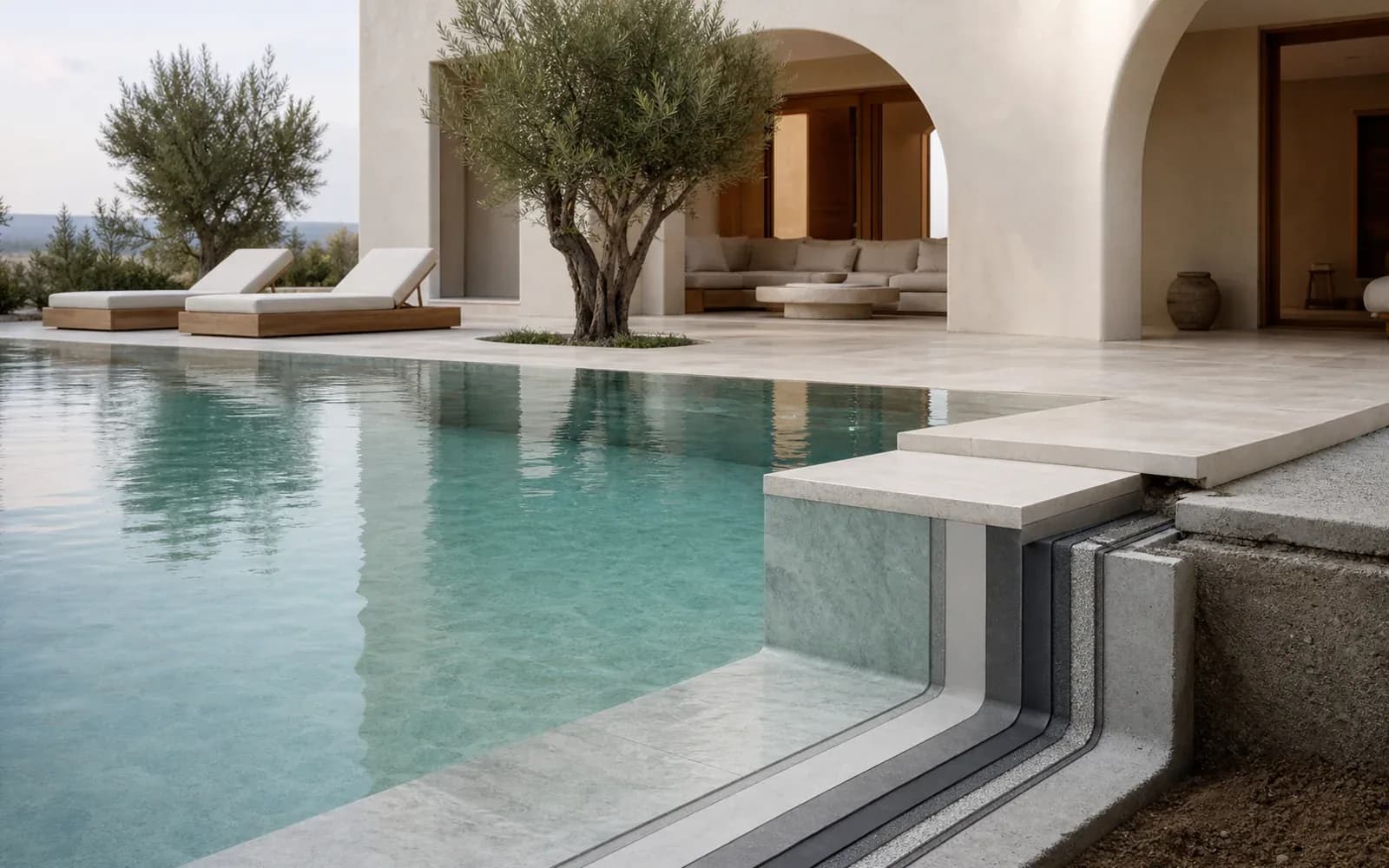
Waterproofing is the single most decisive layer determining the service life of a swimming pool.
Regardless of concrete strength, without an impermeable hydraulic barrier, moisture gradually penetrates the concrete matrix, corroding steel rebar and causing catastrophic structural degradation.
It sits under the lining where nobody sees it, yet a properly built waterproofing system is what saves you from costly remedial work decades later.
In the market, "pool insulation" is used to mean two separate jobs: waterproofing (sealing against leaks) and thermal insulation (reducing heat loss with XPS board applied to the outside of the pool wall).
This article covers waterproofing; thermal insulation is planned separately for heated pools, and the two layers do not substitute for one another. Waterproofing materials fall into three main groups: two-component cementitious coating systems, PVC or TPO membranes, and under-tile polyurea or polyurethane systems.
The layer order does not change in a reinforced-concrete pool: concrete surface repair, corner fillet, two coats of waterproofing (the second coat applied perpendicular to the first), a 24-hour water-retention test, and only then glass mosaic or tile cladding. Glass mosaic itself is not watertight; grout and adhesive let water through, which is why waterproofing must be a separate layer underneath. Thermal insulation applied on the outside does not stop a leak on the inner surface; the two jobs are engineered separately.
Waterproofing materials are selected based on structural typology and site stress conditions.
Cementitious two-component flexible polymer membranes represent a proven standard for reinforced concrete shells. Liquid-applied polyurethane membranes provide smooth detailing around complex fixtures, while heavy-duty PVC/TPO sheet membranes offer rapid, continuous barrier coverage over large expanses.
No single product suits every pool; site conditions decide. Ground movement, water table hydrostatic pressure, and seasonal thermal fluctuations directly dictate material selection.
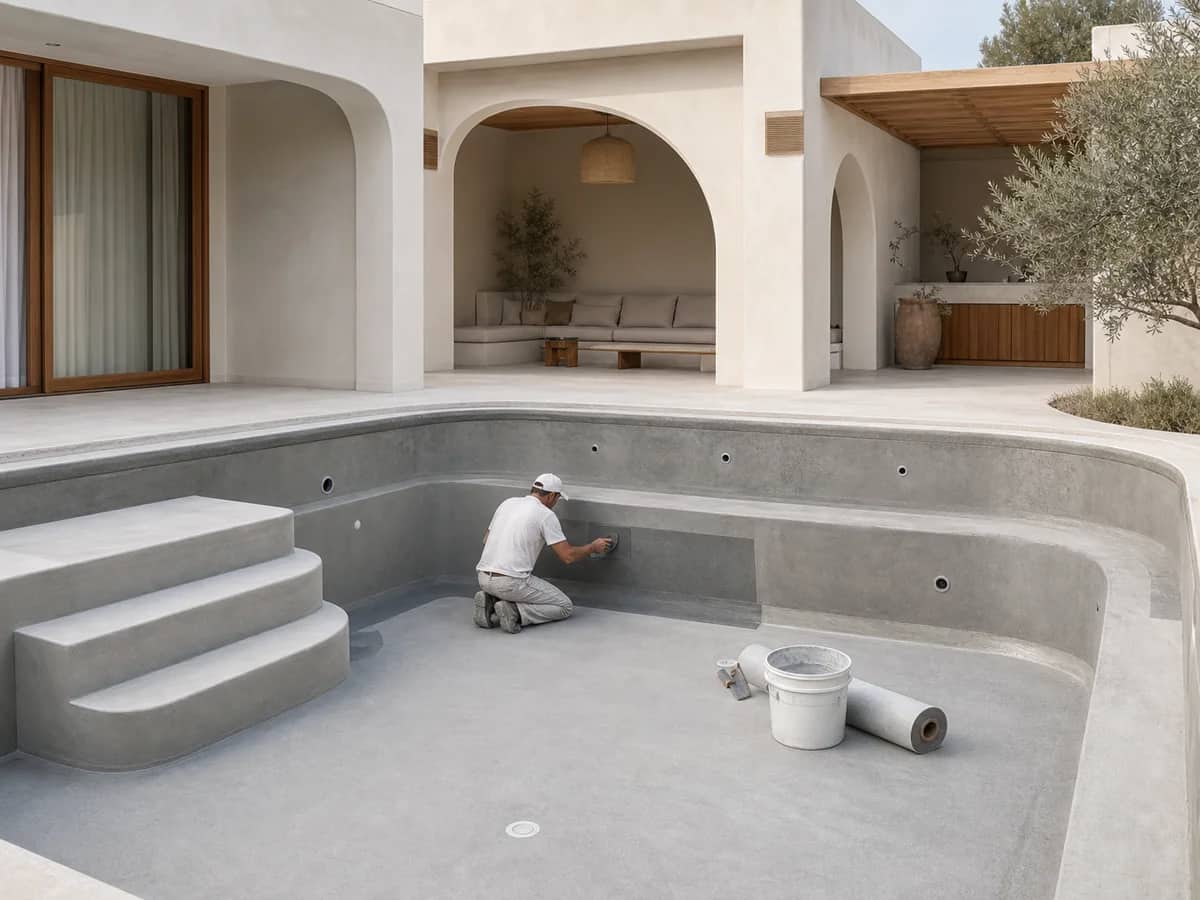
A reliable application follows a rigorous sequence: surface grinding and defect patching, penetrating primer application, reinforcing corners and pipe penetrations with fiberglass mesh and elastomeric sealing tapes, followed by multi-coat membrane application and final protection.
Each coat is applied strictly after the previous layer achieves full cure.
The most prevalent failure point is neglecting transition details (floor drains, lighting niches, return inlets, and wall-to-floor cove joints). Most leaks originate not from broad wall expanses, but from these improperly detailed transitions.
Upon completion of waterproofing, the pool is filled to capacity and monitored over a set observation period.
Factoring in evaporation and precipitation via control vessels, any measurable water loss is detected. This test empirically verifies that the membrane is watertight prior to finish installation.
Skipping the hydrostatic retention test is one of the costliest construction errors; once tiles or mosaic finishes are laid, identifying and repairing leaks requires complete demolition of the finishes. We mandate hydrostatic testing as a standard quality gate.
Waterproofing cannot be designed in isolation; plumbing penetrations, skimmer throats, main drains, and lighting niches must be engineered with compatible compression flanges and hydrostatic hydrophilic gaskets.
These fittings ensure that joints never become the weak link.
Hydraulic circulation quality also indirectly preserves waterproofing by keeping chemical balance stable. Leak-proof fittings and flanges on the pipework are part of the same picture.
Pool waterproofing is not about purchasing premium materials off the shelf, but executing the correct multi-layer system in exact sequence while adhering strictly to joint detailing.
It looks simple, but a mistake only shows once the finish has to come off again.
Our field experience since 1993 enables us to foresee critical stress details and specify the ideal membrane for every structural context. Well-built waterproofing is something you simply never think about for years.
Next step
Let us discuss your project in the way that suits you best.
You can fill in the form for a written quote, schedule a video project presentation or ask us to survey your project site.
Get a Quote
Send us your dimensions and expectations in writing.
Online presentation
Video project presentation
On-site survey
Inspection at your project site
Image gallery
Photos: 04
 01
01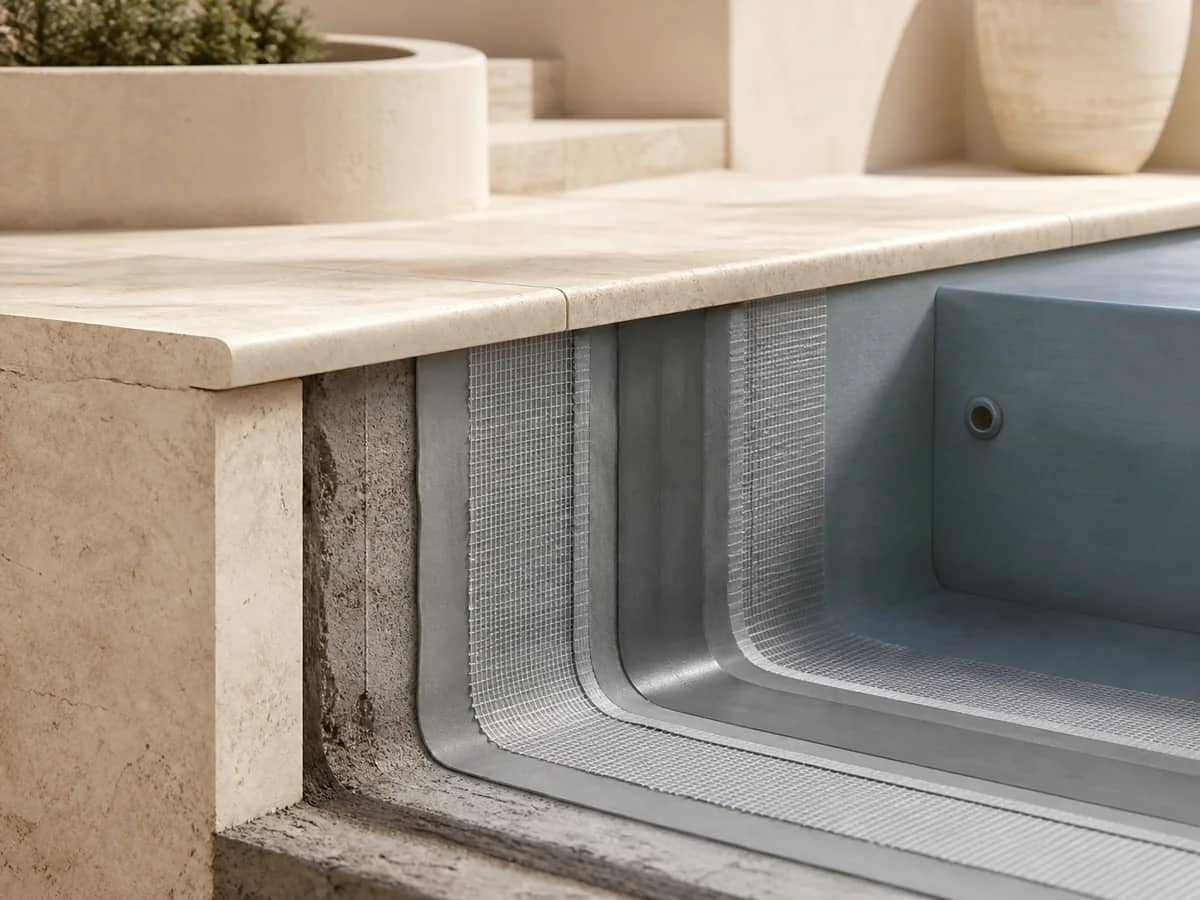 02
02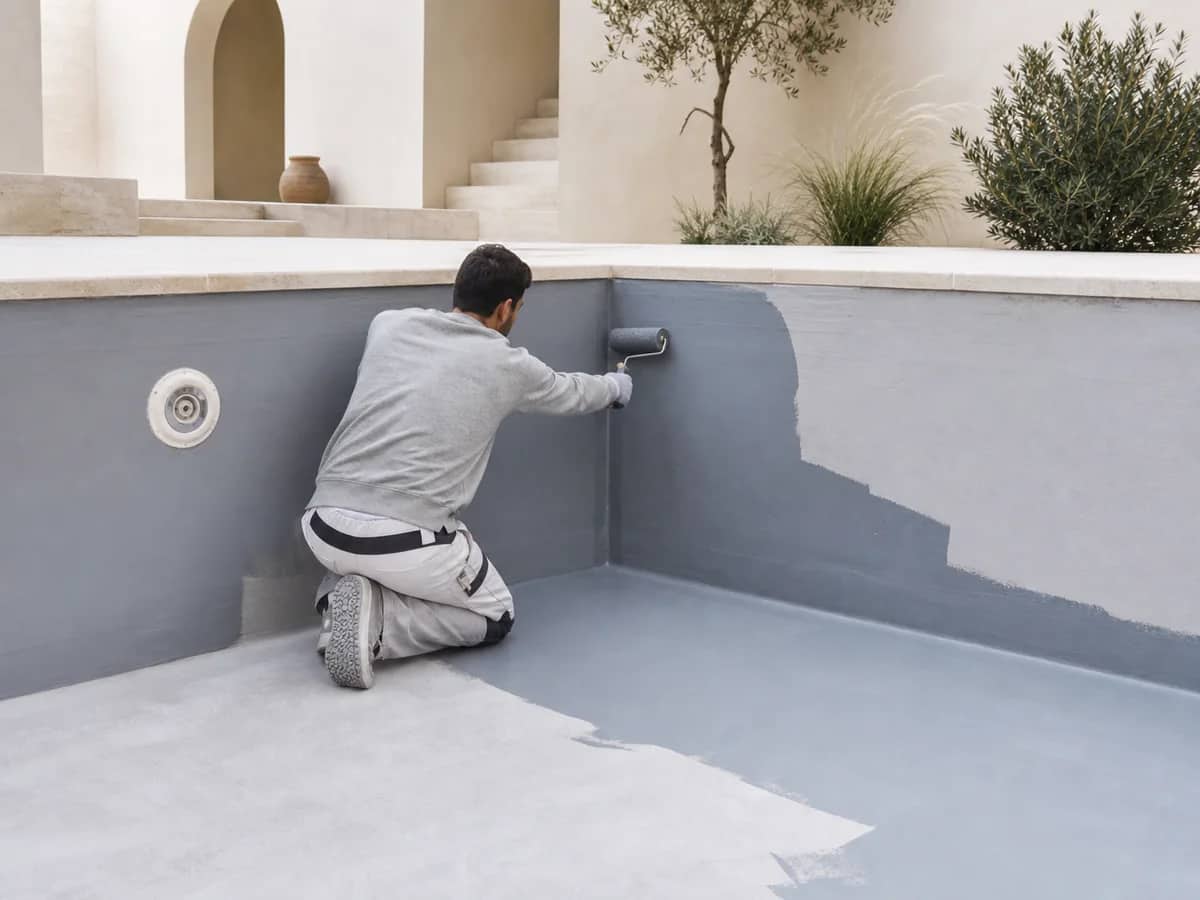 03
03 04
04// 01 · Products in this article
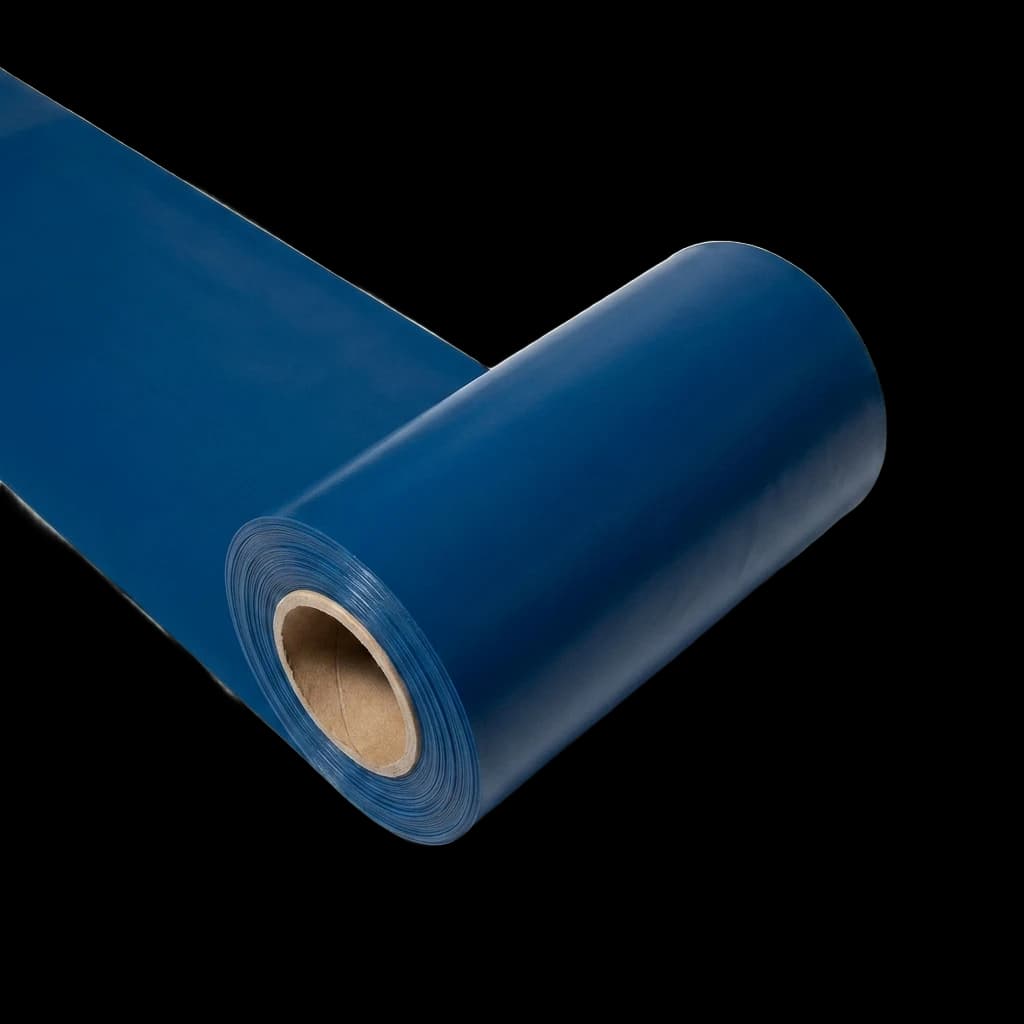
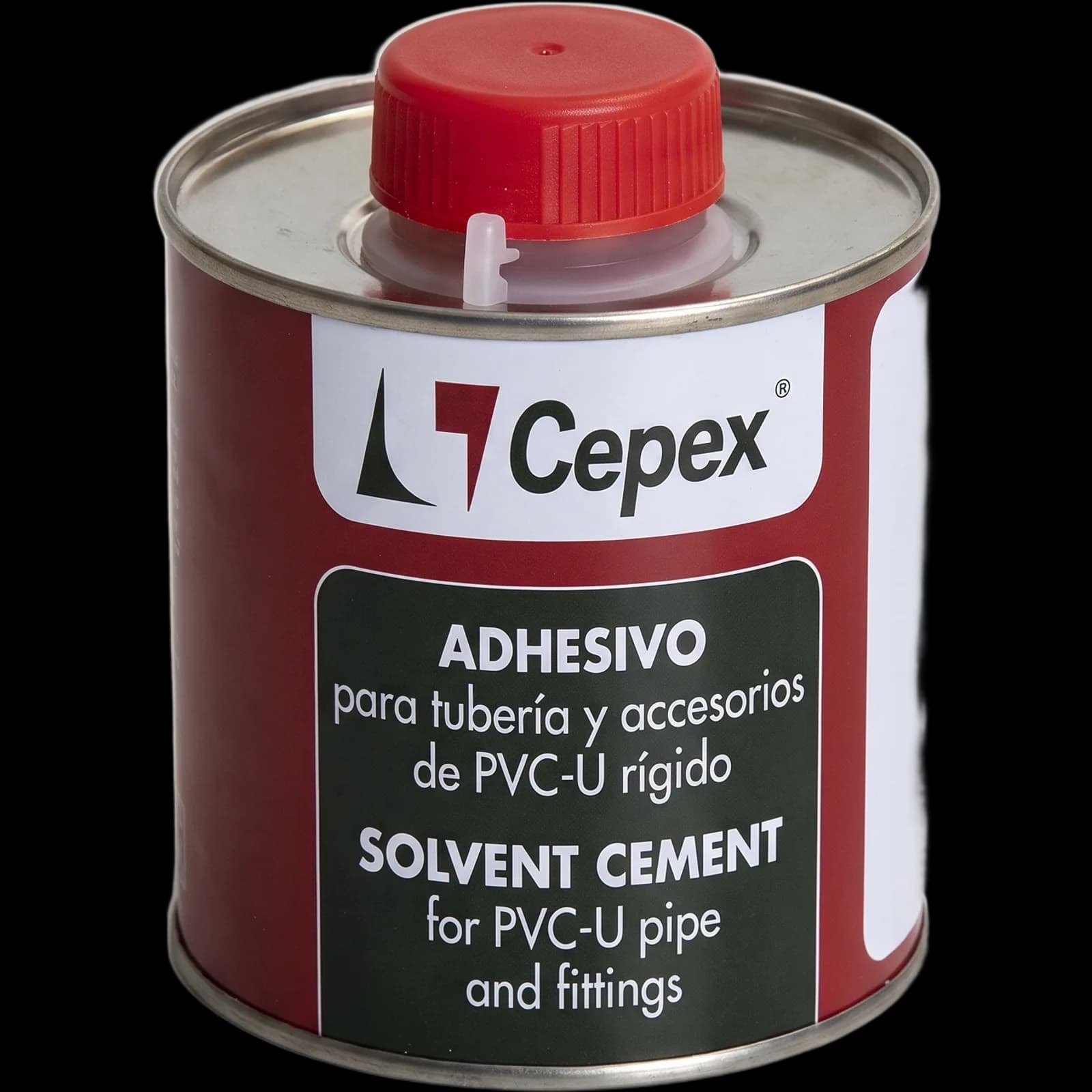
For the work described in this article, waterproofing.
Each card leads to the product page with its data sheet, model list and quotation.
- 13 models
- 2 models
// 02 · Product groups
Compare the products on this topic on their category pages.
Each card leads to a product category; models, technical sheets and list prices are there.
 Product category
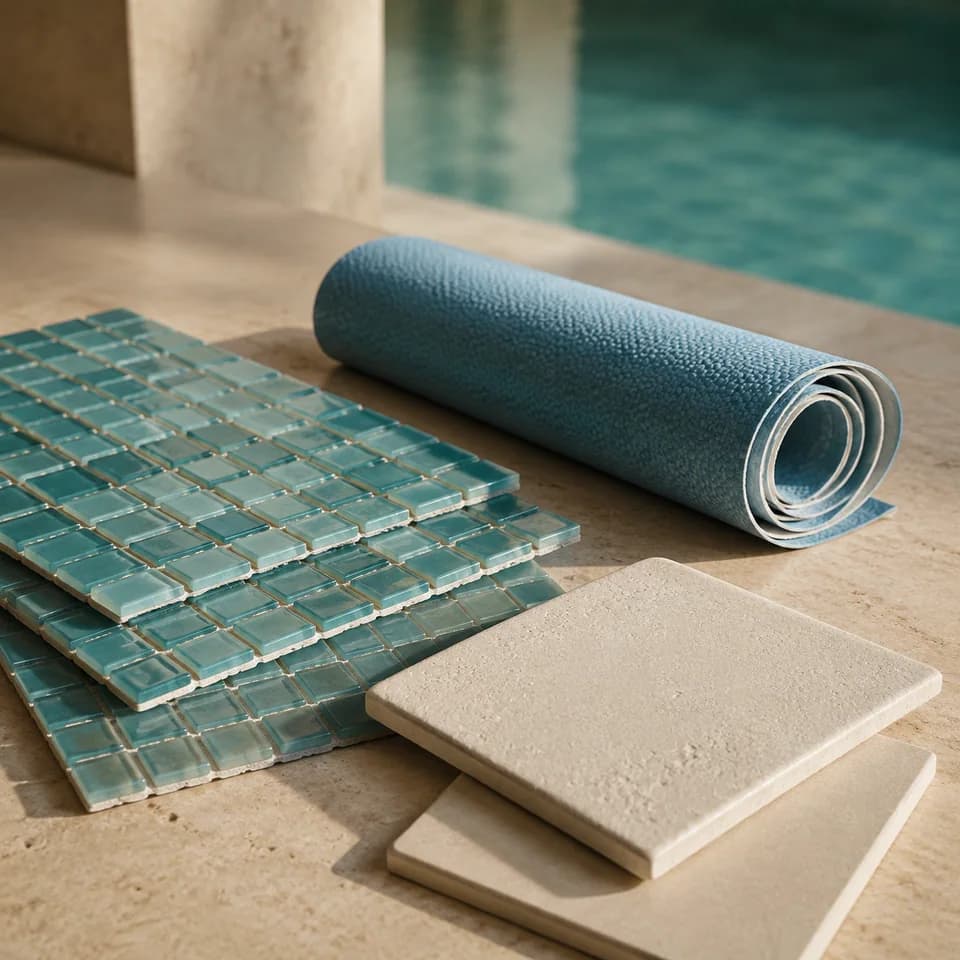
Pool Lining Systems
PVC liner, membrane, ceramic tile and glass mosaic: lining materials that make the pool watertight and form its finished surface.
View- 20 products
 Product category
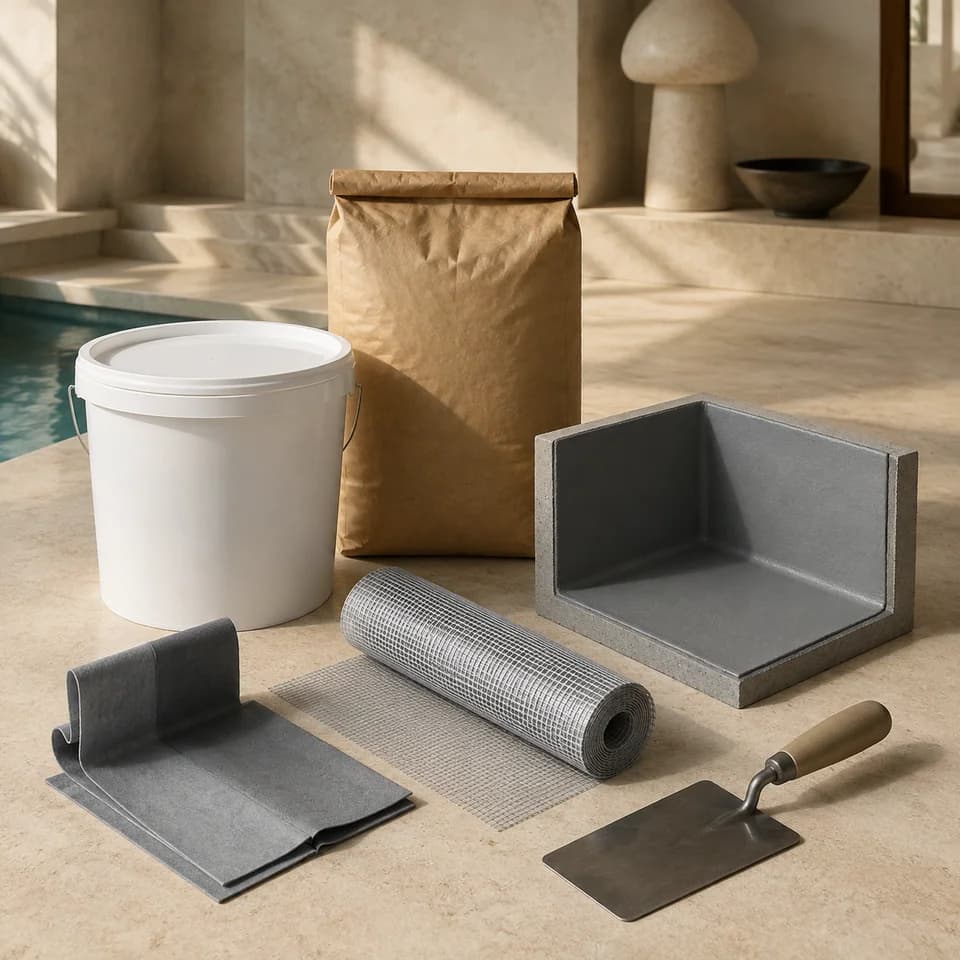
Waterproofing
Waterproofing systems built from membranes, adhesives and joint sealants that permanently seal the pool structure against water.
View- 2 products
- Product category
Pool Liner Models
PVC pool liners supplied in 1.65 x 25 m rolls for the inner surface of the pool. The 1.8 mm models have a 3D printed, class C anti-slip texture; the 1.5 mm models are smooth or plain colours with a protected surface. Ceramic and glass mosaics are on the pool mosaic page.
View- 5 products
Product category
Pool Lining Systems
PVC liner, membrane, ceramic tile and glass mosaic: lining materials that make the pool watertight and form its finished surface.
20 productsProduct category
Waterproofing
Waterproofing systems built from membranes, adhesives and joint sealants that permanently seal the pool structure against water.
2 productsProduct category
Pool Liner Models
PVC pool liners supplied in 1.65 x 25 m rolls for the inner surface of the pool. The 1.8 mm models have a 3D printed, class C anti-slip texture; the 1.5 mm models are smooth or plain colours with a protected surface. Ceramic and glass mosaics are on the pool mosaic page.
5 products
// 03 · Related service
The work in this article, we deliver from design to handover.
Çilek Havuz service
Swimming Pool Construction
Reinforced-concrete, prefabricated and infinity swimming pools, built turnkey for villa, residential and commercial projects.
Swimming pool construction is a turnkey build in which the site survey, structural and mechanical design, excavation, reinforced-concrete shell, waterproofing, finish, filtration plumbing and commissioning run under a single contract. The written project schedule follows the site survey.
How we work
- 01Initial meeting and site surveyWe inspect the site and listen to the brief.
- 02Design and quotationWe give the cost item by item, in writing.
- 03ExecutionThe same team builds to a written schedule.
- 04Handover and commissioningWe start the systems and explain their use.
- 05Maintenance and technical supportWe provide periodic maintenance and support.
// 04 · Guides
On Pool Construction, more articles to read.
First the articles directly related to this one, then the newest articles on the topic.
 Pool Construction
Rooftop & Terrace Pools: Structure, Load and Waterproofing
Can you build a pool on a terrace or rooftop? We explain load calculation, structural reinforcement, waterproofing and seismic load as critical engineering topics.
View- 13 July 2026
- 6 min read
 Maintenance
Pool Water Test Kit Selection: Strips, DPD and Photometers
Compare strips, reagent tests and photometers by the values they measure. Check range, storage and calibration before making treatment decisions.
View- 13 September 2026
- 3 min read
 Maintenance
Pool equipment: how to choose each item and what to base it on
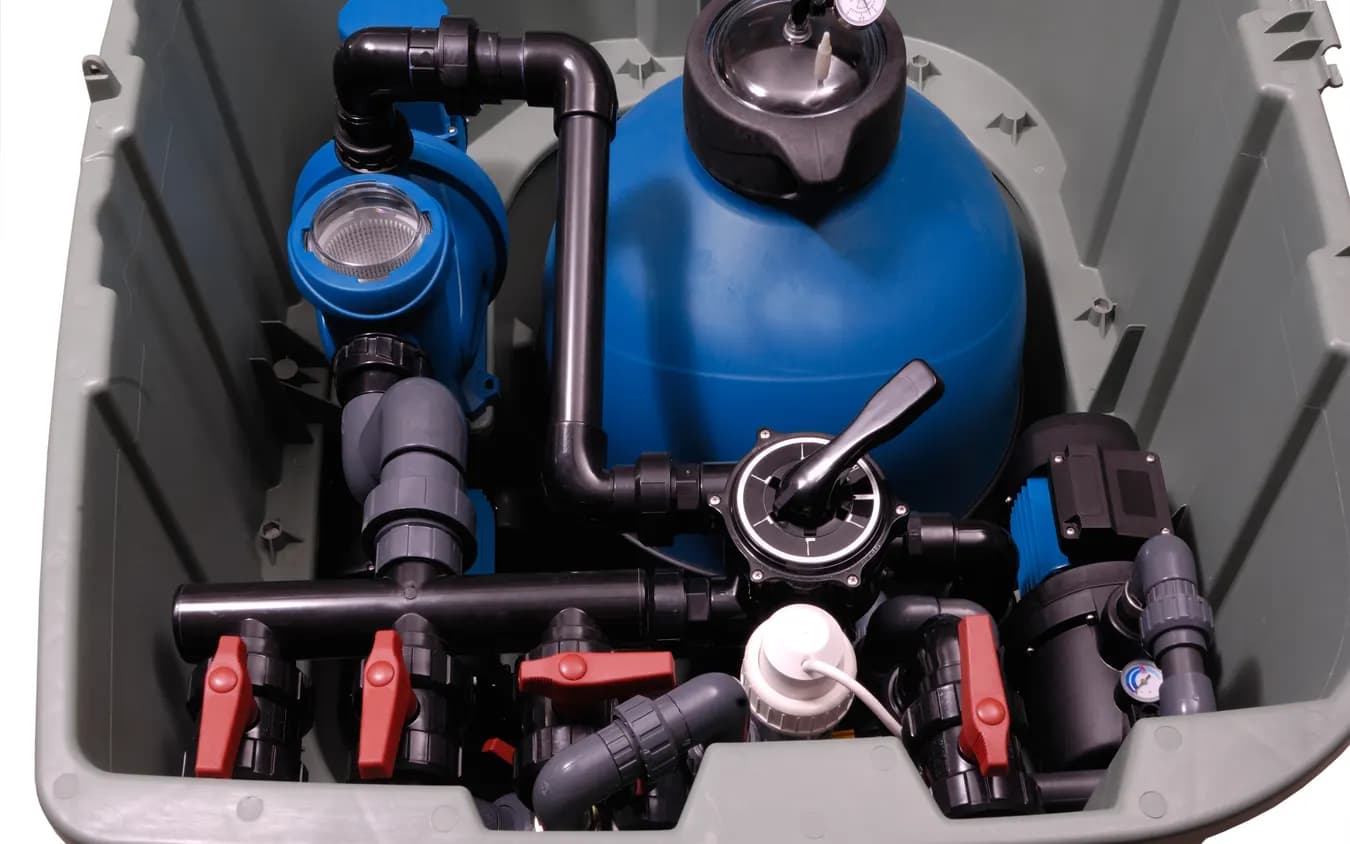
Pump flow rate, filter diameter, chemicals, robot type and lighting should be chosen by calculation, not guesswork. Here is how to size each item.
View- 4 September 2026
- 9 min read
 Pool Construction
Choosing Pool Showers and Waterfalls: Shower Types, Water Curtains and Plumbing Needs
Choosing a pool shower, waterfall or water curtain depends on the material, where the water comes from and where it is mounted. We compare solar and stainless steel shower types and their pump and plumbing needs.
View- 2 October 2026
- 8 min read
 Pool Construction
Competition Pool Equipment: Which Pool Needs Which Equipment?
Starting blocks, lane ropes, warning and turn systems, underwater speakers and water polo goals are chosen according to how the pool is used. We explain which dimensions we check for each item.
View- 2 October 2026
- 7 min read
 Pool Construction
Building a pool or spa abroad: what drives the cost of an international project?
A pool, hammam or spa project delivered abroad from Turkey has no single price per square metre. We cover design, equipment, shipping, customs and schedule.
View- 29 September 2026
- 8 min read
- Pool Construction · 13 July 2026Rooftop & Terrace Pools: Structure, Load and WaterproofingCan you build a pool on a terrace or rooftop? We explain load calculation, structural reinforcement, waterproofing and seismic load as critical engineering topics.6 min read
- Maintenance · 13 September 2026Pool Water Test Kit Selection: Strips, DPD and PhotometersCompare strips, reagent tests and photometers by the values they measure. Check range, storage and calibration before making treatment decisions.3 min read
- Maintenance · 4 September 2026Pool equipment: how to choose each item and what to base it onPump flow rate, filter diameter, chemicals, robot type and lighting should be chosen by calculation, not guesswork. Here is how to size each item.9 min read
- Pool Construction · 2 October 2026Choosing Pool Showers and Waterfalls: Shower Types, Water Curtains and Plumbing NeedsChoosing a pool shower, waterfall or water curtain depends on the material, where the water comes from and where it is mounted. We compare solar and stainless steel shower types and their pump and plumbing needs.8 min read
- Pool Construction · 2 October 2026Competition Pool Equipment: Which Pool Needs Which Equipment?Starting blocks, lane ropes, warning and turn systems, underwater speakers and water polo goals are chosen according to how the pool is used. We explain which dimensions we check for each item.7 min read
- Pool Construction · 29 September 2026Building a pool or spa abroad: what drives the cost of an international project?A pool, hammam or spa project delivered abroad from Turkey has no single price per square metre. We cover design, equipment, shipping, customs and schedule.8 min read
// 05 · Company & Contact
To talk about your project, call or write to us.
Legal Name
Çilek Havuz
Founded
1998 · Istanbul
Head Office
Çilek Plaza, Eyüp Sultan Mah. Yakacık Cd. Feshane Cd. No: 2 D:4 D:1, 34885 Sancaktepe / İstanbul
Service Area
All of Türkiye · exports to 14 countries
Branches
Kyrgyzstan · Egypt · Algeria · Iraq
Showroom
Plan a showroom visit
At our showroom in Çilek Plaza, Sancaktepe, you can discuss your project with our team. We recommend booking an appointment by phone before your visit.
Working Hours
- Monday – Friday · 08:00 – 17:30
- Saturday · 08:00 – 12:30
- Closed on Sunday
Frequently Asked Questions
About Pool Waterproofing, frequently asked questions.
Çilek Havuz Corporate
Pool and Wellness Engineering
- Response Time
- Same day
- Channels
- Phone · Email · WhatsApp
If the answer you are looking for is not here, send your question directly to us and our team will reply as soon as possible.
+90 216 475 39 37Duration depends on pool surface area, selected membrane system, and penetration count. Substrate preparation, primer, multi-coat application, and inter-coat curing intervals require time, followed by the mandatory hydrostatic water retention test period. We provide a firm schedule following on-site inspection.
Çilek Havuz Corporate
This is an engineering decision based on soil stability, groundwater hydrostatic pressure, temperature extremes, and structural geometry. Two-component cementitious systems excel for mosaic/tiled concrete pools, while reinforced PVC sheet membranes provide combined waterproofing and finished aesthetic in one. We advise after an on-site survey.
Çilek Havuz Corporate
Tiling must only proceed after the membrane has fully cured and passed the water retention test. Tiling over an untested membrane obscures potential leaks, resulting in expensive demolition if issues arise later.
Çilek Havuz Corporate
If water loss exceeds the evaporation control baseline, specialized acoustic and pressure diagnostics identify the leak source. Leaks are predominantly found around pipe penetrations or cold joints. These areas are reinforced, resealed, and the test is repeated until the pool is proven watertight.
Çilek Havuz Corporate
Yes, warranties cover material integrity and application watertightness according to the specified system tier. The true warranty lies in adhering strictly to multi-coat application standards and certified testing. Warranty terms are detailed clearly in our contract.
Çilek Havuz Corporate
Cementitious and membrane systems cure properly only within certain temperature and humidity ranges. A coat applied in very hot, very cold or very humid weather will not reach its expected strength, so we plan the application around the weather. Applying membranes under adverse weather is the primary hidden cause of premature delamination.
Çilek Havuz Corporate