

Automatic Pool Covers for a Private Home Pool: Systems and How to Choose
Choosing an automatic cover for a private home pool: slatted and track systems, underwater and above-ground types, safety, water savings, cost and installation.
Project Manager · Mechatronics Engineer · Çilek Havuz
- Published
- Reading
- 13 min read
- Category
- Technology
Choosing an automatic cover for a private home pool: slatted and track systems, underwater and above-ground types, safety, water savings, cost and installation.
An automatic pool cover is an investment worth considering for a private home pool that is used often, heated and closed regularly when not in use.
The decision does not depend on the purchase price alone: the geometry of the pool, the technical space that can be set aside for the cover, cleaning needs and the family's habits of use should be considered together. In a pool used only occasionally, or one whose shape is unsuitable, a manual solution may be more balanced.
Owning a pool in the garden also means managing water level, cleaning and heating costs. Planning the cover system during pool construction makes it possible to resolve the roller compartment, power supply and service access together with the architectural design. For an existing pool, measurement and an on-site inspection come first. It is not right to recommend the same motor or the same cover for every pool.
The word automatic describes how the cover is moved; on its own it does not define its material or safety class.
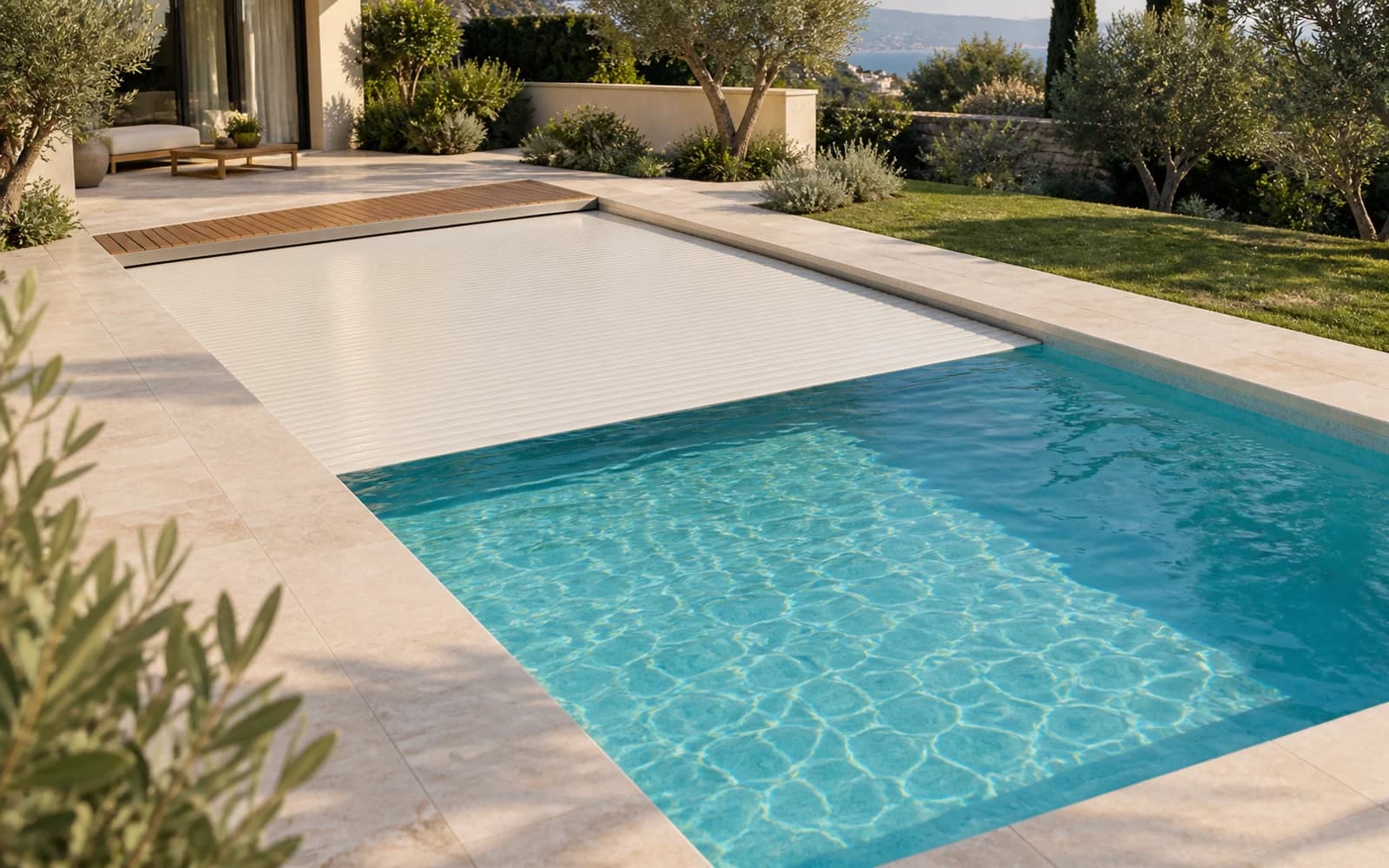
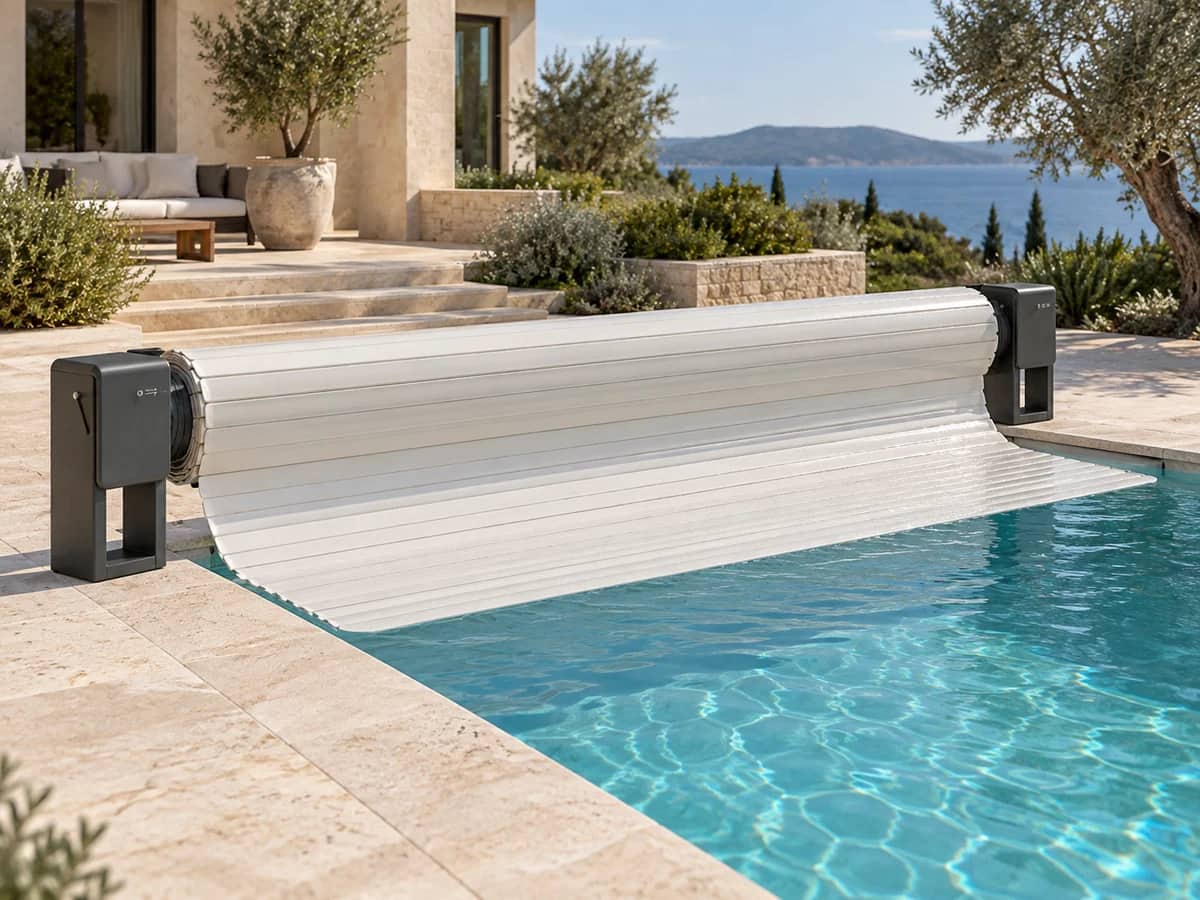
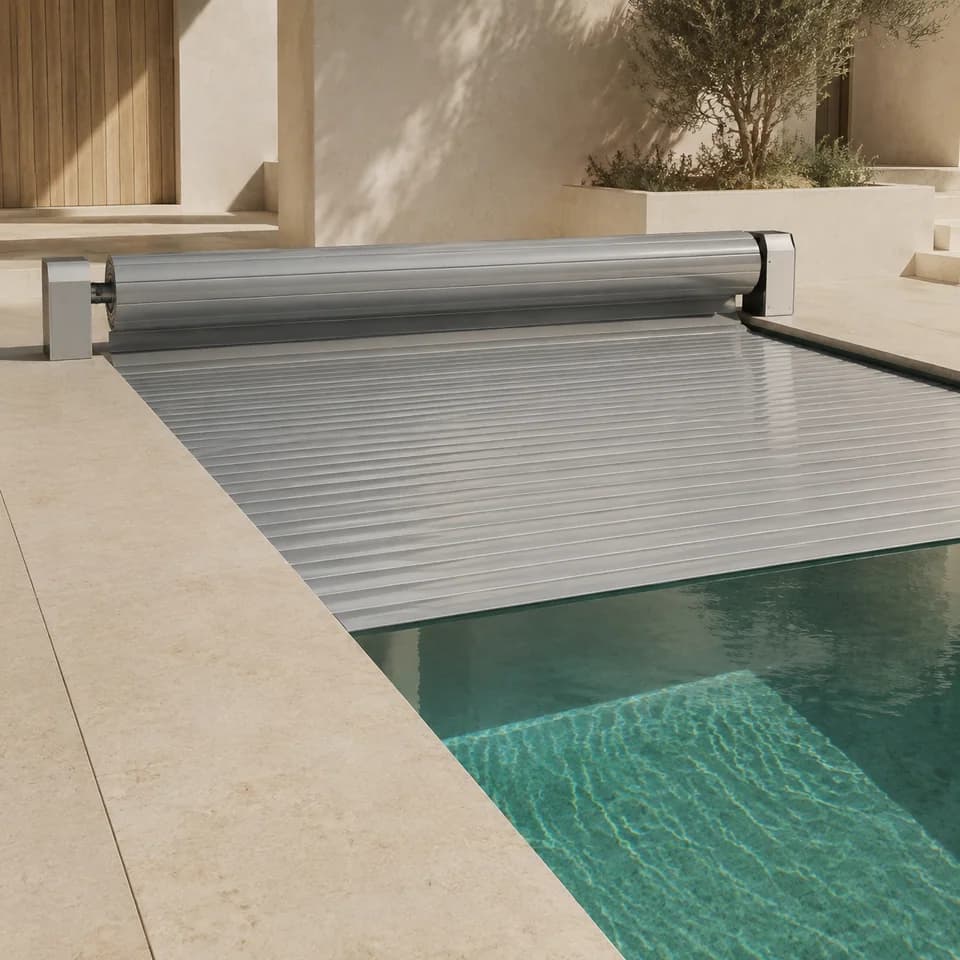
In a slatted system, narrow profiles joined together travel across the water surface and wind onto a shaft at one end of the pool. The shaft may be in a separate underwater compartment or between legs above ground. The slats run across the pool, and the cover opens and closes along its length.
In a fabric track system, by contrast, a flexible cover moves with guides along the edges and a pulling mechanism. The track, rope, fabric tension and draining rainwater from the surface are design issues specific to this system. These details should not be generalised to all automatic covers. Using an image of fabric or side tracks to describe a slatted system is technically misleading.
The two common slat materials are PVC and polycarbonate. The choice is not made on colour alone; the manufacturer's conditions for temperature, water chemistry, use and cleaning are also examined. The life or safety performance of the whole product cannot be inferred from a single property of the material.
Slatted automatic covers fall into two groups by installation: systems whose roller shaft sits in an underwater compartment, and systems that carry the shaft above ground between two legs.
In the underwater solution, the roller compartment can be hidden within the architecture; in return, the compartment in the pool, its lid and maintenance access have to be designed. Above ground, the mechanism stays visible, but in suitable existing pools it can reduce the need for an in-pool roller compartment.
| System type | Installation and drive | Example manufacturer size limit | Point to watch in the design |
|---|---|---|---|
| Underwater slatted system | Underwater; dry compartment, tubular motor inside the shaft or water-level motor options | Tubular motor: up to 8 m wide (8 × 12 m). Water-level motor: new pools and existing pools up to 6 m wide. | Separating the cover and shaft compartment from the main pool; service and drainage according to the motor option. |
| Above-ground slatted system (large pool) | Above ground; tubular motor, motorised shaft with limit switch | Maximum internal pool size is given as 7.5 × 17 m. | Fixing the legs to load-bearing ground, roll diameter and passage space around it. |
| Above-ground slatted system (compact) | Above ground; tubular motor, motorised shaft with limit switch | Maximum internal pool size is given as 5 × 10 m. | Compact leg layout and compatibility of the cover mode with the disinfection system. |
Underwater slatted systems come with three different motor arrangements (motor in a dry compartment, tubular motor fitted inside the shaft, motor at water level); the capacity of one should not be carried over to another. The separate space for a dry motor and the service access for a motor integrated into the shaft are not the same. Separating the roller section from the main pool, either with a wall during construction or later with a suitable compartment, is also a condition manufacturers look for.
In some systems the cover can be controlled through an app; in others this is an option sold separately. An app or remote control should not be assumed to be standard in every package, and the scope of the quotation should be checked in writing. A manually operated version of the same product family may also exist; it should not be confused with the motorised model.
A pool cover used correctly can prevent up to 95 percent of evaporation.
This is not measured performance for a particular model, nor a guarantee of a 95 percent reduction in total pool water consumption. Climate, wind, water temperature and how long the cover stays closed change the real result. Leaks, backwashing and water losses from use are assessed separately.
In heated pools, covering the surface also limits heat loss due to evaporation. The effect becomes more pronounced on cool nights and in homes that want to extend the season. A cover does not replace a heating unit; it helps to keep the existing heat. The expected benefit should be calculated together with the target water temperature and the heating system.
Leaves, pollen and dirt carried in from the surroundings may reach the water less. However, if dirt left on the cover is not cleaned off, it can be carried into the water when the cover opens. Pool maintenance, filtration and water analysis continue. Reducing pump time or disinfectant dose without testing because the cover is closed is not a correct way of running a pool.
How often the cover is used is decisive in the choice.
| Option | Daily use | Main function | Safety assessment |
|---|---|---|---|
| Motorised slatted cover | Rolling with a key switch or compatible control system | Regular closing, limiting water and heat loss | Model, fixing arrangement and conformity certificate are examined together. |
| Automatic fabric track cover | Motorised; includes track and pulling mechanism | Covering the surface and protection depending on the model | Fabric, anchoring, drainage and test conditions are specific to the product. |
| Manual safety cover | Needs spreading, gathering and fixing by hand | Limiting access to a pool kept closed | A correctly documented product and installation are needed for safety purposes. |
| Bubble solar cover | Handled by hand or with a suitable roller system | Reducing evaporation and heat loss | Not used as a safety barrier or as a surface to stand on. |
| Winter cover | Seasonal use | Protection according to the winterising plan | Snow, water build-up and load limit are assessed by model. |
In a pool swum in every day, if spreading the cover by hand gets skipped, a motorised system can make the daily routine easier. In a pool closed only at the end of the season, the same investment has a different value in use. The comparison should cover installation, maintenance and the effort of use as well as the initial price.
For slatted systems sold as safety covers, the manufacturer ties conformity with the safety standard to conditions such as the chosen locking system and the internal width of the pool.
That is why the whole installation cannot be called a safety cover just by looking at the name of the motor or the slat. The exact model offered, the locking and fixing parts, the installation conditions and the conformity certificate should be verified together. A general reference to another standard does not replace the certificate for this model.
A cover does not replace adult supervision, controlled access and suitable barriers. Before the pool is used, the cover should be fully opened; before closing, check that no one is in the pool. The key switch or authorised remote control should be kept out of children's reach. Walking, sitting or playing on the cover is not its intended use.
Rain drainage is solved according to the type of cover. On solid fabric surfaces the manufacturer may provide a cover pump; this solution does not apply as it is to every slatted product. Drainage of the underwater roller compartment and the dry motor space is a separate technical matter. If there is standing water, snow or mechanical strain, the product instructions and a service assessment should be followed before operating the system.
Installation can be considered for many existing pools; however, suitable dimensions alone are not enough.
The net internal dimensions of the pool, corners, steps, overflow channel, ladders and changes in water level affect the cover's path. Freeform shapes, shallow sun ledges and infinity edges need special examination. The conditions for a standard rectangular installation cannot be transferred directly to these pools.
At a survey carried out as part of pool consulting, two separate scenarios can be compared: the construction work needed to hide the roller arrangement underwater, and the space an above-ground arrangement would take up around the pool. Sometimes a more visible system needs less intervention in the existing structure; sometimes, in a pool yet to be built, a hidden compartment can be solved from the start.
Points to check at the survey
- Net internal width and length; corners, steps, overflow and skimmer layout.
- The cover's path of travel, the space and openings needed for the roll.
- The condition of the ground where the legs or supports will be fixed.
- Electrical infrastructure and protection suited to the motor option.
- Drainage for the roller compartment, dry motor space and surroundings.
- Access for the service lid, motor removal and part replacement.
- Safety fixings and visibility of the pool from the control point.
- Compatibility of the existing disinfection unit with the cover mode.
Stating a fixed payback period requires real consumption data for the pool.
The total investment covers more than the motor and the cover: slats or fabric, shaft, legs or compartment, supports, safety fittings, control hardware, electrical and drainage work, changes to the finish, transport and installation should be examined together. The product's list price is not an installation quotation covering all these items.
In the running cost comparison, the cover's maintenance, service and electricity costs are deducted from the measured reduction in annual water and energy costs. If the net annual saving is positive, a simple payback period can be calculated by dividing the additional investment by this saving. Renewal costs and financing fall outside this simple calculation; giving a single exact year from uncertain inputs is misleading.
For example, a heated pool closed every evening and an unheated pool closed a few times a month will not gain the same. The value of convenience also shows here: a cover that is installed but left open cannot deliver the benefits that depend on how long it stays closed. The effort spent on cleaning can be assessed separately; reducing the need for safety to a financial return alone is not right.
Slat surfaces, the path of travel, guide parts, safety fittings and service areas should be cleaned using the method in the product instructions.
A track system needs track and rope checks, but the same parts should not be assumed to exist in a slatted system. If the motor or roller arrangement is under strain, do not try to solve the problem by giving repeated open and close commands.
Water chemistry continues to be monitored while the cover is closed. Some above-ground systems have a cover mode that works together with the disinfection unit; this does not mean it connects to every unit as supplied or that chemical testing becomes unnecessary. The inputs and settings of the salt chlorinator or dosing unit in use should be checked by the technical team. For when to close the cover after a shock treatment, the relevant product instructions apply.
The procedure to follow in a power cut should be learned for the specific model and shown to the user at handover. In winter, frost, snow load and lowering the water level can affect how the cover behaves. Not every automatic product is a winter cover; the winterising plan is prepared by assessing the conditions of the pool and the cover manufacturer together.
You can start an assessment with Çilek Havuz by preparing the pool dimensions, general and short-side photographs, a detail of the water level, the heating and disinfection equipment and how often the pool is used.
| Situation | Assessment | Next step |
|---|---|---|
| The pool is used often and will be closed regularly | Motorised operation can offer meaningful convenience. | Underwater and above-ground options are compared on the basis of measurements. |
| The pool is heated and stays open at night | Limiting heat loss becomes the priority. | Seasonal consumption and the time the cover stays closed are recorded. |
| The priority is access by children or pets | Being "automatic" alone is not enough. | Conformity certificate, fixings and other layers of protection are assessed together. |
| The pool is used rarely and the budget is limited | Manual or solar/thermal options can be compared. | The safety limit and effort of use of each option are assessed separately. |
| The shape is complex or the service area is tight | A standard installation may not be suitable. | An on-site technical feasibility check is done before ordering. |
The aim is not to get the most features but to choose the system that fits the pool and will be used regularly. Writing the technical scope, and the use and maintenance procedure to be shown at handover, clearly into the quotation reduces later uncertainty.
// Comparison
Pool cover systems, in one table.
| Model | Pool Size | Motor Type | List price |
|---|---|---|---|
| Roussillon Hidden Automatic Cover4 models | 3 x 6 m | Dry motor / tubular motor / water-level motor | €16,642.50excl. VAT |
| Above-Ground Automatic Cover15 models | 4 x 8 m | Tubular motor (motorised shaft, limit switch) | €6,090.00excl. VAT |
| AstralPool Sveltea Automatic Pool Cover3 models | 4 x 8 m | Tubular / motorised shaft (by model) | €7,864.50excl. VAT |
Next step
Let us discuss your project in the way that suits you best.
You can fill in the form for a written quote, schedule a video project presentation or ask us to survey your project site.
Get a Quote
Send us your dimensions and expectations in writing.
Online presentation
Video project presentation
On-site survey
Inspection at your project site
Image gallery
Photos: 01
 01
01// 01 · Products in this article
For the work described in this article, pool cover systems.
Each card leads to the product page with its data sheet, model list and quotation.
- 4 models
- 15 models

- 3 models
// 02 · Product groups
Compare the products on this topic on their category pages.
Each card leads to a product category; models, technical sheets and list prices are there.
Product category
Pool Cover Systems
Automatic covers, safety lids and shaft systems, cover solutions that cut heat loss while protecting your pool against accidents.
10 productsProduct category
Automatic Pool Cover Models
Underwater and above-ground automatic pool covers. The underwater cover sits in a separate compartment inside the pool; above-ground covers are installed at the pool edge and run on a motor, by hand or on solar power. The cover is chosen by the inner pool size and the available power supply.
5 products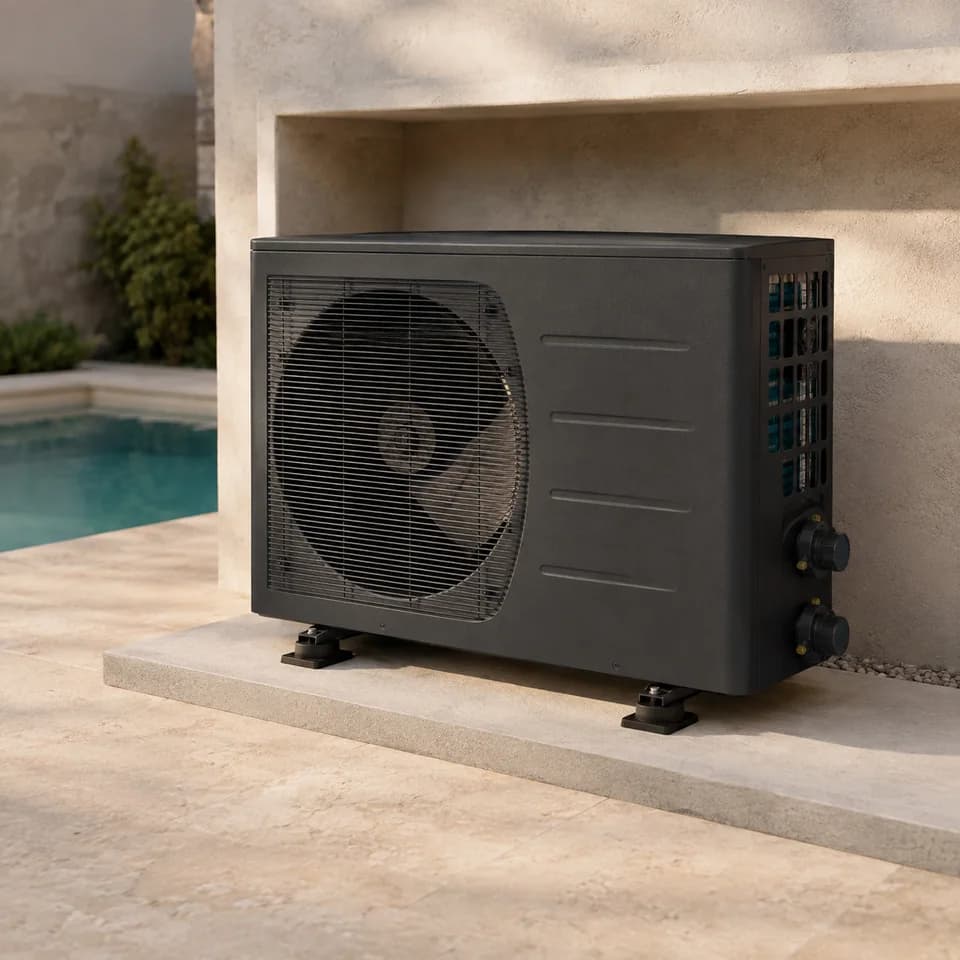
Product category
Pool Heating Systems
Inverter heat pumps, solar and electric systems: pool heating solutions that extend your swim season and lower operating costs.
27 products
// 03 · Related service
The work in this article, we deliver from design to handover.
Çilek Havuz service
Swimming Pool Construction
Reinforced-concrete, prefabricated and infinity swimming pools, built turnkey for villa, residential and commercial projects.
Swimming pool construction is a turnkey build in which the site survey, structural and mechanical design, excavation, reinforced-concrete shell, waterproofing, finish, filtration plumbing and commissioning run under a single contract. The written project schedule follows the site survey.
How we work
- 01Initial meeting and site surveyWe inspect the site and listen to the brief.
- 02Design and quotationWe give the cost item by item, in writing.
- 03ExecutionThe same team builds to a written schedule.
- 04Handover and commissioningWe start the systems and explain their use.
- 05Maintenance and technical supportWe provide periodic maintenance and support.
// 04 · Guides
On Technology, more articles to read.
First the articles directly related to this one, then the newest articles on the topic.
 Technology · 23 April 2026Pool Automation: Smart Control and Remote ManagementA modern pool is no longer just water and mechanical equipment; it is a smart system that links dosing, pumps, filtration and lighting together.7 min read
 Turkish Bath · 18 March 2026Göbek Taşı (Heated Stone): Selection, Heating System and CareWe focus on the göbek taşı, the heart of the hammam: correct stone selection, under-stone heating systems, proper dimensions and maintenance methods for long-lasting use, step by step.5 min read
 Technology · 7 July 2026Pool Lighting: LED Selection, Safety and PlacementHow to choose pool LED lighting? We explain underwater fixture safety, IP rating, low-voltage transformers and correct placement from an engineer's perspective.6 min read
 Technology · 13 September 2026Pool heat pump electricity use: calculation with COPHeating output, electrical input and kWh are different quantities. A realistic estimate uses operating conditions, cover use and the applicable tariff.3 min read
 Technology · 13 September 2026Salt Chlorinator Sizing: Volume, g/h Output and Run TimeSalt chlorinator capacity depends on pool volume, g/h output, water temperature and daily run time. What to compare in a quotation.3 min read
 Technology · 13 September 2026Salt Chlorinator Not Producing Chlorine: Causes and ChecksPossible causes of low chlorine with a running salt chlorinator: measurement, flow, salinity, temperature and cell condition. When service is needed.3 min read
// 05 · Company & Contact
To talk about your project, call or write to us.
Legal Name
Çilek Havuz
Founded
1998 · Istanbul
Head Office
Çilek Plaza, Eyüp Sultan Mah. Yakacık Cd. Feshane Cd. No: 2 D:4 D:1, 34885 Sancaktepe / İstanbul
Service Area
All of Türkiye · exports to 14 countries
Branches
Kyrgyzstan · Egypt · Algeria · Iraq
Showroom
Plan a showroom visit
At our showroom in Çilek Plaza, Sancaktepe, you can discuss your project with our team. We recommend booking an appointment by phone before your visit.
Working Hours
- Monday – Friday · 08:00 – 17:30
- Saturday · 08:00 – 12:30
- Closed on Sunday
Frequently Asked Questions
About Automatic Pool Covers for a Private Home Pool, frequently asked questions.
Çilek Havuz Corporate
Pool and Wellness Engineering
- Response Time
- Same day
- Channels
- Phone · Email · WhatsApp
If the answer you are looking for is not here, send your question directly to us and our team will reply as soon as possible.
+90 216 475 39 37No. Net internal dimensions, shape, steps, overflow layout, roller space and service access should be checked together. The size limit given by the manufacturer does not by itself show that installation is suitable.
Çilek Havuz Corporate
A slatted cover and a fabric track cover are different systems. The underwater and above-ground examples in the table are slatted; the guide and fixing details of a model should be read from its own technical document.
Çilek Havuz Corporate
An underwater system can blend into the architecture but needs a separate roller compartment. In an above-ground system the legs and roll are visible; load-bearing ground and enough space around the pool are needed. The scope of work differs between new and existing pools.
Çilek Havuz Corporate
Its main benefit is helping to keep existing heat by reducing losses due to evaporation. There may be some solar gain depending on the material; a cover does not replace a controlled heating unit.
Çilek Havuz Corporate
No. A product with documented safety conformity needs to be correctly installed and locked; other measures such as adult supervision and controlled access must also be kept up.
Çilek Havuz Corporate
A cover is not a walking or play area. Load performance stated in a document does not mean the cover can be stood on in everyday use.
Çilek Havuz Corporate
The operating pattern is set according to the hydraulic design of the pool and the product instructions. With a disinfection unit that has a cover mode, the connection and settings should be verified; water analysis should continue.
Çilek Havuz Corporate
No single period can be given. Total installation and maintenance costs should be calculated together with measured water and energy consumption, climate and usage habits.
Çilek Havuz Corporate
The need for a cover pump in rain depends on the type of cover and its drainage solution. A pump required for a solid fabric cover does not apply to every slatted system; drainage of the motor and roller compartment is checked separately.
Çilek Havuz Corporate
The internal dimensions of the pool and photographs of corners and steps should be prepared. The overflow or skimmer layout, existing equipment and frequency of use are also needed. The final choice needs on-site measurement and model confirmation.
Çilek Havuz Corporate