

Building a Salt Room at Home: The Process and What Drives the Cost
A home salt room is built in steps, from a humidity survey to the halogenerator. We explain how the process works and which items determine the cost.
Project Manager · Mechatronics Engineer · Çilek Havuz
- Published
- Updated
- Reading
- 4 min read
- Category
- Sauna
A home salt room is built in steps, from a humidity survey to the halogenerator. We explain how the process works and which items determine the cost.
The only real requirement for a salt room is a space that is dry and can be ventilated.
A basement, an unused room or a spa corner can take a home-scale salt room as long as it meets that description. The critical point is the humidity profile of the space: rooms next to a bathroom or prone to damp need extra insulation and climate control, because salt cladding reacts directly to moisture.
That is why every project starts with a site survey that records the floor area and ceiling height and measures moisture in the walls and floor; adjacent wet rooms and condensation on exterior walls are checked one by one. How dry the space is becomes the first screening criterion for the project, and every other decision is built on that assessment.
The site survey and space analysis are followed by concept and microclimate design: the systems that will keep the room at 20-24°C and 40-60 percent relative humidity are sized to the room volume, and the make-up of the salt wall, divided into brick, plaster and granule zones, is settled at this stage.
Next the climate control and ventilation infrastructure is installed. This step deliberately comes before the salt wall, because if the system goes in after the wall, the wall may have to be taken down.
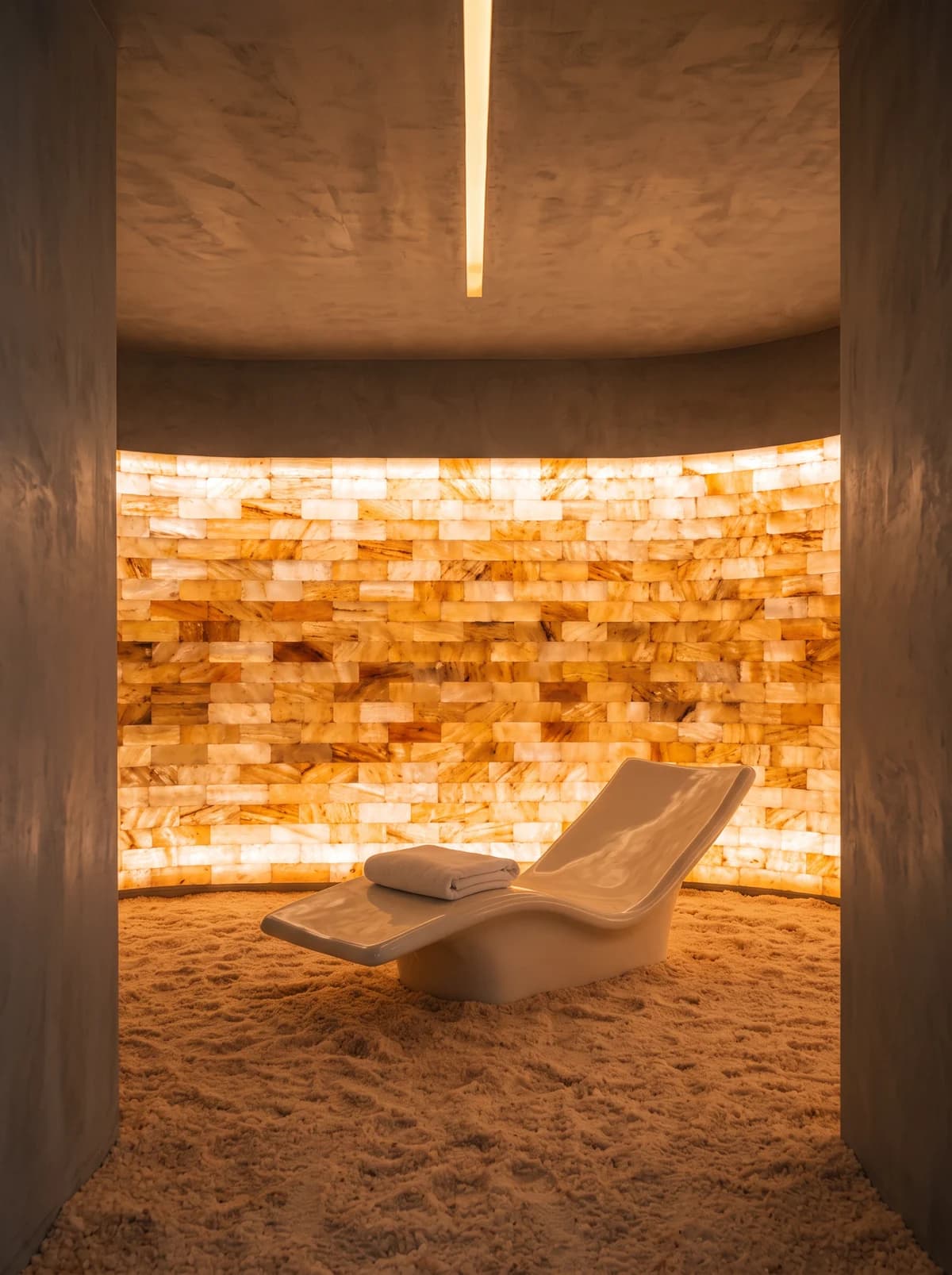
Once the infrastructure is ready, work moves on to the salt wall and floor: salt brick masonry suitable for backlighting, hand-applied salt plaster and coarse rock salt spread on the floor can be used together or on their own. In the last two steps the halogenerator and amber lighting are commissioned, then the humidity and temperature cycle is tested and the room is handed over with user training.
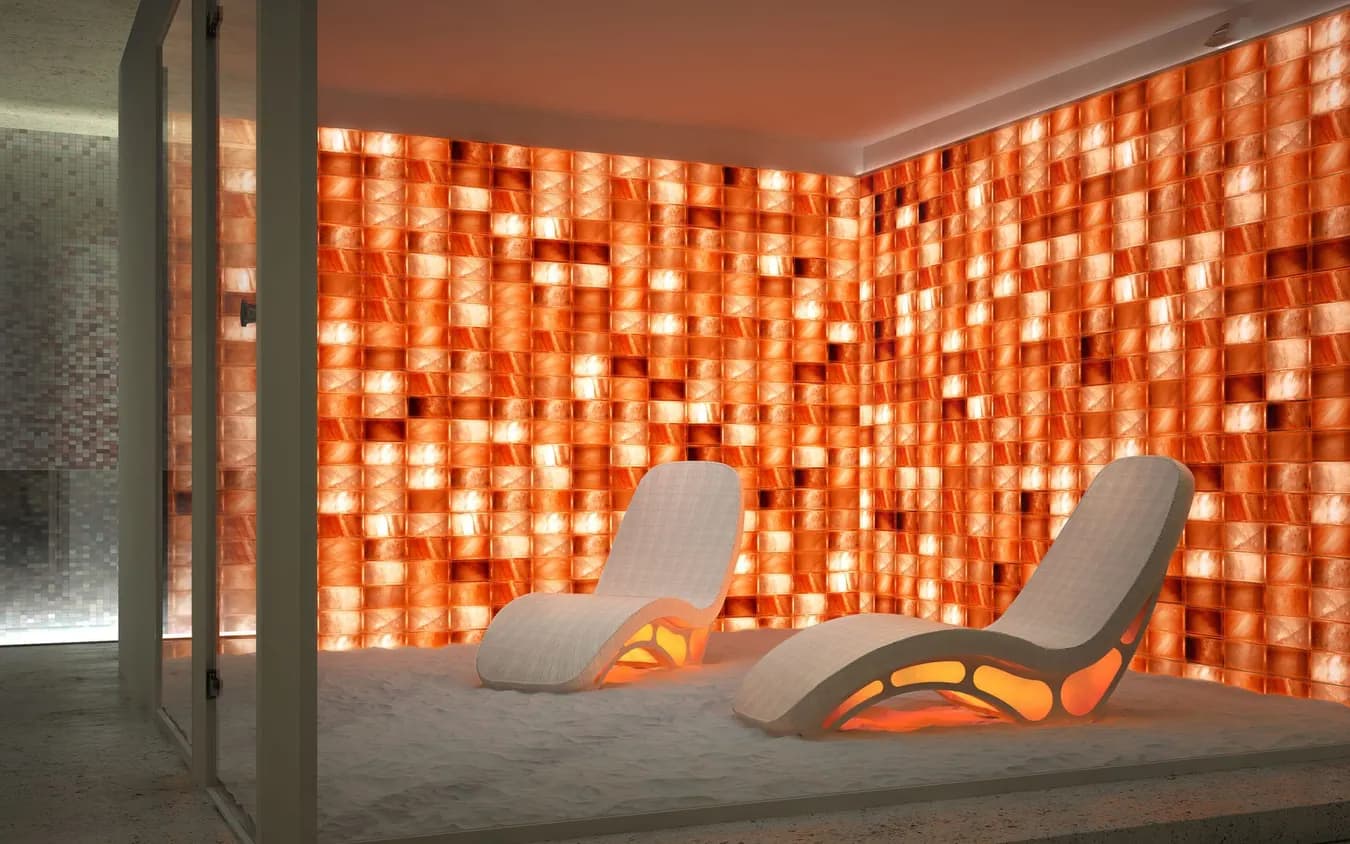
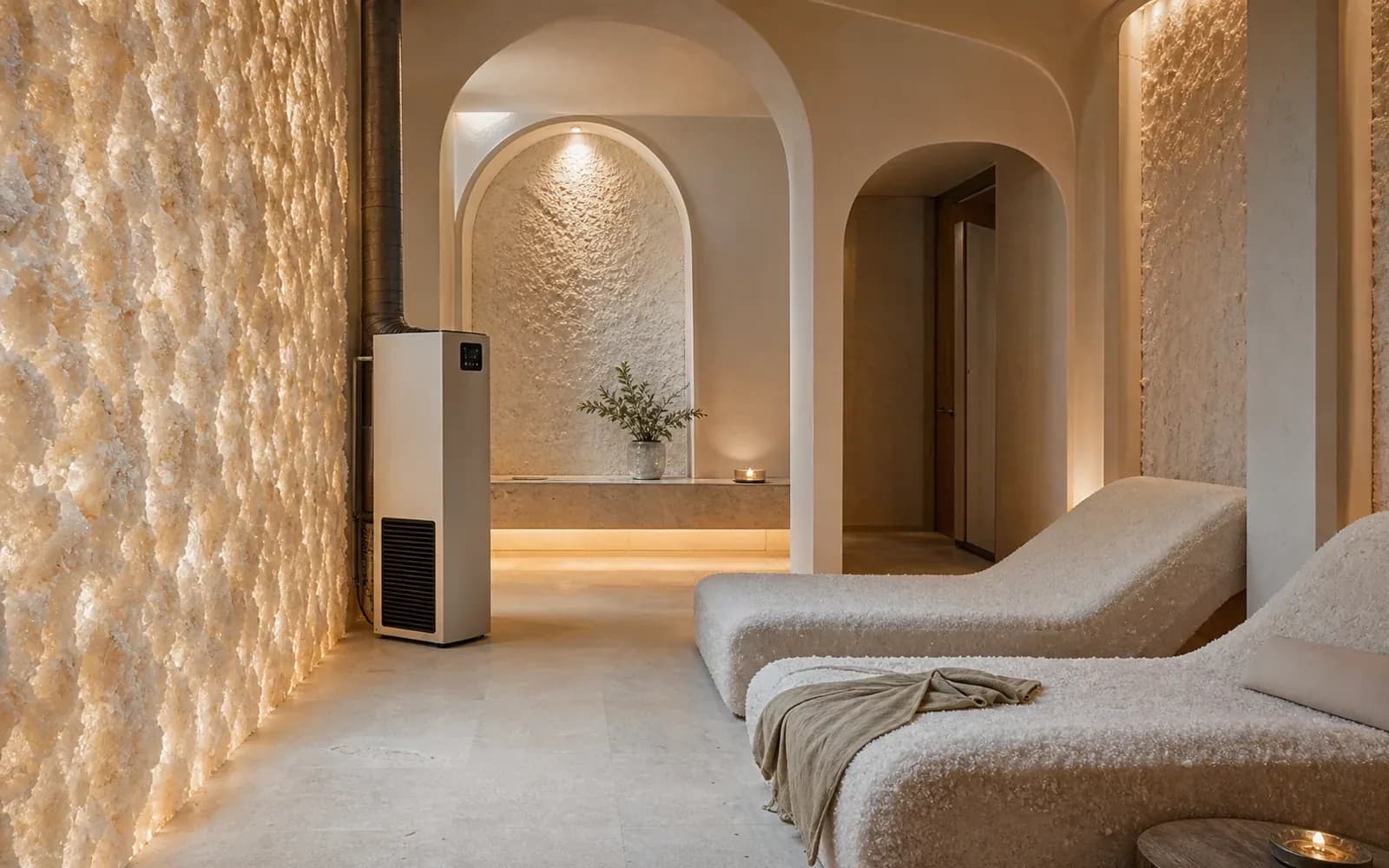
Three different techniques can be used on the walls: salt brick masonry suitable for backlighting, salt plaster applied by hand layer by layer, and granular rock salt cladding.
Salt brick masonry is laid with a special adhesive on a supporting frame, with a joint pattern planned around how the light passes through, so it takes more intensive labour than a plastered finish; that difference shows up directly in the cost.
The floor is covered with washed, coarse-grained rock salt; depending on the project, white Çankırı rock salt (mined in central Turkey) and pink Himalayan salt can be used alone or together. Which salt and which technique you choose depends on both visual preference and budget; a salt brick wall is usually the option with the strongest visual effect, but also the most labour-intensive.
The salt wall and floor set the atmosphere of the room, but it is the halogenerator that turns it into an active halotherapy system.
This device grinds refined dry salt to micron size and releases it into the room as a breathable dry salt aerosol; its capacity is chosen according to room volume, and the chosen capacity directly sets the cost of the device. A salt room without this device is like a sauna without a stove: the wall stays decorative, and the therapeutic function is carried by the halogenerator.
Dehumidification capacity is also calculated from the room volume and how often the room is used. Salt is hygroscopic, meaning it draws moisture from the air, so if relative humidity rises above 60 percent the wall surface first starts to sweat and then begins to lose its shape. For that reason climate control capacity is a line in the salt room budget that is not negotiable and should not be overlooked.
Four main items determine the cost of a salt room: room size, salt wall technique (brick, plaster or granule cladding), halogenerator class and climate control capacity.
On top of these, how dry the existing space is and the condition of the electrical installation are practical factors that affect the calculation; if the space has damp problems, the extra insulation it needs appears in the budget as a separate item.
Because an active system can also be built at home with compact halogenerators, you can work with a smaller room and a lower-capacity device than a hotel spa would need. Whatever the scale, though, these four items (size, wall technique, device class and climate control) form the backbone of the budget; after the free site survey they are presented in writing, with the reasoning behind each.
Next step
Let us discuss your project in the way that suits you best.
You can fill in the form for a written quote, schedule a video project presentation or ask us to survey your project site.
Get a Quote
Send us your dimensions and expectations in writing.
Online presentation
Video project presentation
On-site survey
Inspection at your project site
// 01 · Related service
The work in this article, we deliver from design to handover.
Çilek Havuz service
Salt Rooms
Salt rooms with salt walls, a halogenerator and humidity control.
How we work
- 01Initial meeting and site surveyWe inspect the site and listen to the brief.
- 02Design and quotationWe give the cost item by item, in writing.
- 03ExecutionThe same team builds to a written schedule.
- 04Handover and commissioningWe start the systems and explain their use.
- 05Maintenance and technical supportWe provide periodic maintenance and support.
// 02 · Guides
On Sauna, more articles to read.
First the articles directly related to this one, then the newest articles on the topic.
 Sauna
SaunaSalt Room (Halotherapy): Benefits, System and Installation
The heart of a salt room is the halogenerator, not a salt lamp. An honest guide to how it works, installation criteria and why health claims need caution.
View- 10 June 2026
- 7 min read
 Sauna
SaunaSteam Room Guide: Generator System, Temperature and Cost Factors
How does a steam room work, and how is the generator sized? The correct temperature-humidity balance, why sealing is non-negotiable, and the cost items that make up a steam room's price.
View- 16 June 2026
- 6 min read
 Sauna
SaunaSnow Room: System, Benefits, Installation
A snow room turns the cooling phase after the sauna into a distinct experience. We explain how the system makes real snow and what installation requires.
View- 27 March 2026
- 5 min read
 Sauna
SaunaHow many kW should a sauna heater be? Sizing by cabin volume
Sauna heater size follows cabin volume: 1 kW per 1 m³ in an insulated cabin, with a correction added for glass and uninsulated surfaces.
View- 9 September 2026
- 10 min read
 Sauna
SaunaWhat Temperature Should a Sauna Be? Heat, Humidity, and Duration Guide
What's the ideal Finnish sauna temperature, and how long should a first-timer stay in? Heat-humidity balance, safe session lengths, and common mistakes.
View- 7 September 2026
- 8 min read
 Sauna
SaunaWhat is a sauna and how do you use it? Temperature, time and the right order
A classic Finnish sauna runs at 80 to 100 degrees and 10 to 20 percent humidity. How hot, how long, and in what order do you use sauna, hammam and steam room?
View- 4 September 2026
- 9 min read
- Sauna · 10 June 2026Salt Room (Halotherapy): Benefits, System and InstallationThe heart of a salt room is the halogenerator, not a salt lamp. An honest guide to how it works, installation criteria and why health claims need caution.7 min read
- Sauna · 16 June 2026Steam Room Guide: Generator System, Temperature and Cost FactorsHow does a steam room work, and how is the generator sized? The correct temperature-humidity balance, why sealing is non-negotiable, and the cost items that make up a steam room's price.6 min read
- Sauna · 27 March 2026Snow Room: System, Benefits, InstallationA snow room turns the cooling phase after the sauna into a distinct experience. We explain how the system makes real snow and what installation requires.5 min read
- Sauna · 9 September 2026How many kW should a sauna heater be? Sizing by cabin volumeSauna heater size follows cabin volume: 1 kW per 1 m³ in an insulated cabin, with a correction added for glass and uninsulated surfaces.10 min read
- Sauna · 7 September 2026What Temperature Should a Sauna Be? Heat, Humidity, and Duration GuideWhat's the ideal Finnish sauna temperature, and how long should a first-timer stay in? Heat-humidity balance, safe session lengths, and common mistakes.8 min read
- Sauna · 4 September 2026What is a sauna and how do you use it? Temperature, time and the right orderA classic Finnish sauna runs at 80 to 100 degrees and 10 to 20 percent humidity. How hot, how long, and in what order do you use sauna, hammam and steam room?9 min read
// 03 · Company & Contact
To talk about your project, call or write to us.
Legal Name
Çilek Havuz
Founded
1998 · Istanbul
Head Office
Çilek Plaza, Eyüp Sultan Mah. Yakacık Cd. Feshane Cd. No: 2 D:4 D:1, 34885 Sancaktepe / İstanbul
Service Area
All of Türkiye · exports to 14 countries
Branches
Kyrgyzstan · Egypt · Algeria · Iraq
Showroom
Plan a showroom visit
At our showroom in Çilek Plaza, Sancaktepe, you can discuss your project with our team. We recommend booking an appointment by phone before your visit.
Working Hours
- Monday – Friday · 08:00 – 17:30
- Saturday · 08:00 – 12:30
- Closed on Sunday
Frequently Asked Questions
About Building a Salt Room at Home, frequently asked questions.
Çilek Havuz Corporate
Pool and Wellness Engineering
- Response Time
- Same day
- Channels
- Phone · Email · WhatsApp
If the answer you are looking for is not here, send your question directly to us and our team will reply as soon as possible.
+90 216 475 39 37Four main items determine the cost of a salt room. They are room size, salt wall technique (brick, plaster or granule cladding), halogenerator class and climate control capacity. A backlit salt brick wall needs a larger budget than a plastered finish because of the labour involved. How dry the existing space is and the electrical installation also affect the calculation.
Çilek Havuz Corporate
Yes; if a dry room or basement space that can be ventilated is available, a salt room can be built at home scale. The critical condition is the humidity profile of the space: rooms next to a bathroom or prone to damp need extra insulation and climate control. Active systems are also installed in home projects using compact halogenerators.
Çilek Havuz Corporate
The process starts with the site survey and space analysis and continues with concept and microclimate design and the climate control infrastructure. It reaches its busiest stage with the salt wall and floor work, and is completed with the halogenerator and lighting. The duration of each step depends on the size of the space and the wall technique; a firm schedule is given after the site survey.
Çilek Havuz Corporate
For the floor layer and wall work, white Çankırı rock salt and pink Himalayan salt can be used alone or together, depending on the project. The choice is made together at the survey stage, based on both the visual effect and budget planning.
Çilek Havuz Corporate
No, maintaining a properly climate-controlled salt room comes down to three tasks. They are cleaning the halogenerator reservoir and filters, monitoring humidity levels and refreshing the floor salt from time to time. Surfaces are cleaned with dry methods, not with a damp cloth.
Çilek Havuz Corporate