

How many kW should a sauna heater be? Sizing by cabin volume
The question of how many kW a sauna heater should be is answered from cabin volume: 1 kW per 1 m³ in an insulated cabin, with a correction added for glass and uninsulated surfaces.
The question of how many kW a sauna heater should be is answered from cabin volume: 1 kW per 1 m³ in an insulated cabin, with a correction added for glass and uninsulated surfaces.
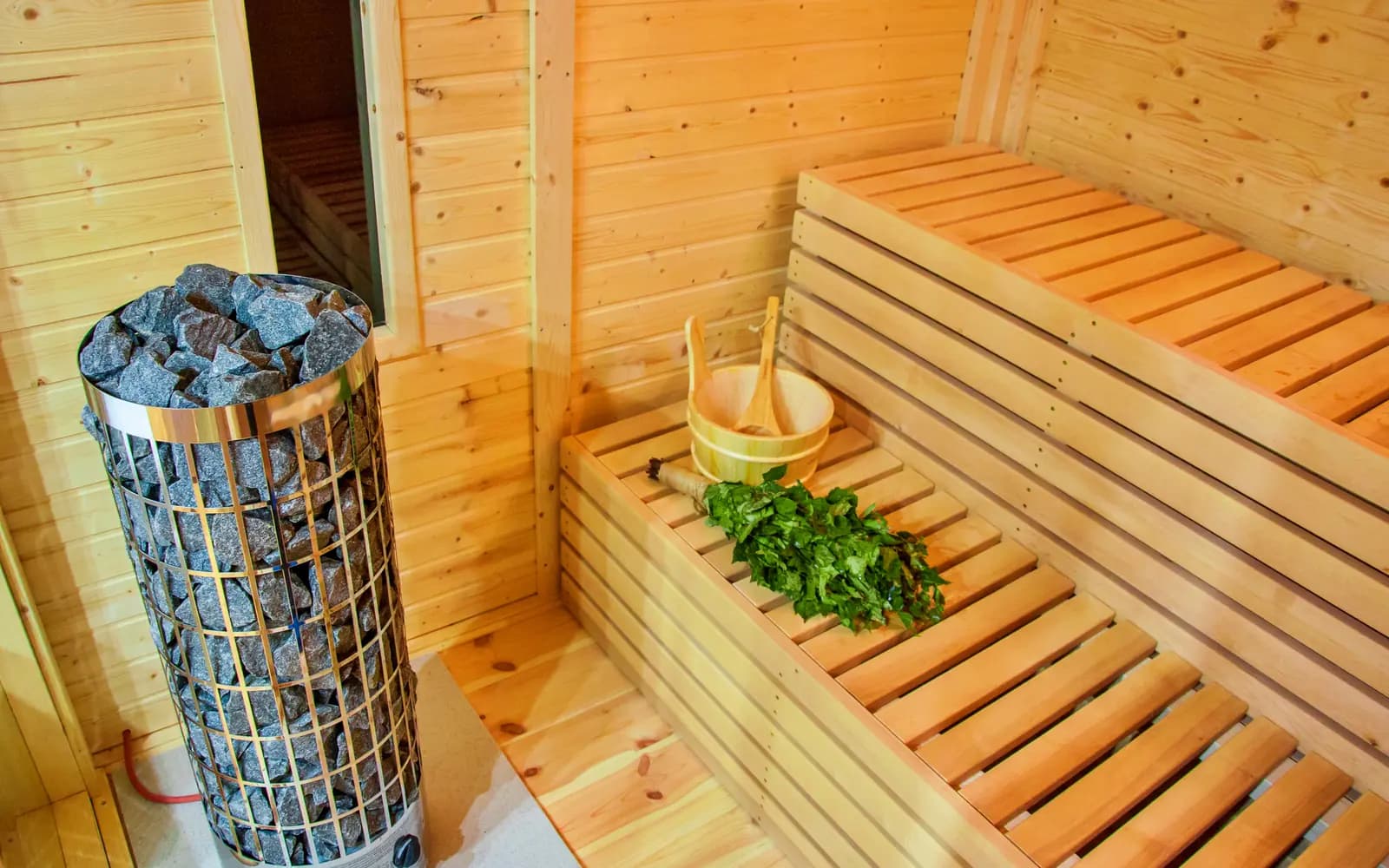
The answer to how many kW a sauna heater should be comes from a single variable: the internal volume of the cabin to be heated. Sauna heater selection is completed by adding corrections for glass surface, uninsulated wall, stone quantity and electrical infrastructure on top of this volume. For an insulated dry sauna room with solid wood interior cladding, the standard sizing rule is approximately 1 kW of electrical power per 1 m³ of internal volume. A cabin with a 2.0 m by 2.0 m floor and 2.1 m internal height has a volume of 8.4 m³, and if no correction is needed, it reaches the 80 to 90 °C band with a 9 kW class electric sauna heater.
This article is not a general selection guide. Heater brands, design choices, bench layout and the whole sauna construction process are not covered here. The subject is only the sizing calculation: how volume is found, which surfaces are added to volume, which kW class corresponds to which volume, where the single-phase limit ends, and how stone quantity and heating time change this number.
The calculation is done with internal dimensions. Net width, net depth and net height under the ceiling, all after cladding, are multiplied; wall thicknesses outside the cabin do not enter the calculation. The sauna room ceiling is kept at around 2.1 m, because as height increases the heated air volume grows directly and the temperature difference between above the bench and the floor widens. A cabin with a 2.4 m ceiling requires 14 percent more power for the same floor area.
Two types of correction are added to the net volume. The first is glass surface: a single-leaf glass door, glass wall or window conducts far more heat than wood cladding. Common practice is to add 1.2 m³ of equivalent volume to the calculation for every 1 m² of glass surface. The second is an uninsulated or non-wood surface: tile, concrete, stone, or a wall with no insulation layer is likewise added at 1.2 m³ per m². A cabin with 8.4 m³ volume that has a 1.8 m² glass door and 2.5 m² of unclad stone wall works out in the calculation as 8.4 + (1.8 x 1.2) + (2.5 x 1.2) = 13.6 m³, and shifts to the 15 kW class.
Sources of heat loss in the cabin
- Glass door and window: heat transfer coefficient is many times that of wood cladding; the single largest loss in the cabin.
- Uninsulated wall and ceiling: on a surface without rock wool or an equivalent, loss continues steadily regardless of wood thickness.
- Missing vapour barrier: without an aluminium foil layer, moisture passes through the wood and wets the insulation, reducing its effective thickness.
- Ventilation rate: fresh air intake is taken from below the heater, exhaust from above the opposite wall; a vent with too large a cross-section sends heated air straight outside.
- Door sealing and opening frequency: a portion of the cabin air is exchanged every time the door opens, lengthening the heater's recovery time.
- Position of the exterior wall: a wall facing a basement, terrace or cold space loses more than one facing an interior space.
Electric sauna heaters are manufactured in standard power classes. The table below fits the 1 kW / m³ rule to these classes; the volume in the left column is the calculated volume after corrections have been added, not the cabin's net volume.
| Power (kW) | Calculated volume (m³) | Single-phase 230 V current (A) | Three-phase 400 V current, per phase (A) | Typical stone capacity (kg) |
|---|---|---|---|---|
| 3.5 | 3 to 4.5 | 15.2 | Not required | 15 to 20 |
| 4.5 | 4 to 6 | 19.6 | Not required | 18 to 25 |
| 6 | 5 to 8 | 26.1 | 8.7 | 20 to 30 |
| 8 | 7 to 12 | Not recommended | 11.5 | 25 to 35 |
| 9 | 8 to 13 | Not recommended | 13.0 | 25 to 40 |
| 10.5 | 10 to 15 | Not recommended | 15.2 | 30 to 45 |
| 15 | 14 to 22 | Not recommended | 21.7 | 40 to 60 |
The volume ranges in the table overlap. For intermediate values, the rule is: if the calculated volume falls within the overlap of two classes, choose the larger class for cabins with more glass surface and adjoining an exterior wall, and the smaller class for cabins kept indoors and fully insulated. An oversized heater warms the cabin quickly, but because the thermostat cycles on and off frequently, the stone surface temperature fluctuates and the steam becomes uneven when water is poured. An undersized heater never reaches the target temperature at all, and the element runs continuously, shortening its life.
The two heater types heat the same volume, but their nominal power figures are not directly comparable. In an electric heater, all of the electrical energy consumed by the element is converted to heat inside the cabin; as stated in the Wikipedia "Electric heating" article, the conversion efficiency from the user's point of view is 100 percent, because all of the energy purchased is converted to heat. In a wood-burning stove, combustion products are expelled through the flue, and because of flue loss, the nominal thermal power shown in the catalogue for the same cabin is higher. For this reason, wood-burning stove selection is based not on the kW figure but on the cabin volume range given by the manufacturer.
The operating difference is also distinct. An electric heater has a thermostat, a temperature limiter and a time-delay setting; the control panel is mounted outside the cabin, in most installations on the wall next to the door, and temperature and duration are set from there. In a wood-burning stove, temperature is managed by hand through the amount of wood loaded and the air damper; the flue, the fire-rated wall penetration and the spark arrestor enter the project during the sauna construction phase. A continuously burning wood stove brings the cabin up to working temperature in roughly one hour; in the flueless smoke sauna tradition, the stone pile is fired for 6 to 8 hours and the heat is held in the stone for up to 12 hours.
Glossary of terms
- Calculated volume
- The volume used to determine heater power, found by adding glass and uninsulated-surface corrections to the cabin's net internal volume. Larger than the cabin's net volume.
- Kiuas
- The Finnish name for a sauna heater. A heater body with a stone bed on top that heats both the air and, when water is poured on it, produces steam.
- Löyly
- The burst of steam produced when water is poured onto hot stones. As stone mass increases, the steam becomes softer and longer-lasting; with fewer stones it comes out sharp and short.
- Sauna stone
- Heat-retaining, thermal-shock-resistant volcanic stone; peridotite is one of the commonly used types. Angular, non-rounded and non-porous stones are chosen, checked once a year, and broken ones replaced.
- Temperature limiter
- A safety component operating independently of the thermostat that cuts the supply circuit if cabin temperature exceeds the set value. Reset manually or by a service call.
- Stainless steel body
- Steel used in the heater's inner body and stone basket, resistant to oxidation under high temperature and humidity. Painted sheet-metal bodies discolour and flake under the stone bed over time.
Turkey's distribution voltage is arranged as 230 V phase-to-neutral and 400 V phase-to-phase; as defined on Wikipedia, in a three-phase system the phase-to-phase voltage is 1.732 times the phase-to-neutral voltage. This relationship directly drives the phase decision in sauna heater selection. Since single-phase current draw is P / 230, a 6 kW heater draws 26.1 A; this value is near the upper limit for a typical residential circuit, so in practice heaters above roughly 6 kW are supplied three-phase. In three phase, the same power is split across three element groups and the per-phase current drops to 8.7 A; even at 15 kW, the per-phase current remains 21.7 A.
The supply is run as a dedicated circuit from the panel to the sauna heater control panel and is not fed from a socket outlet. Cross-section and protection device selection are determined by the project's electrical engineer based on the calculated current, cable length and installation method; a single cross-section value from a catalogue does not fit every installation. Three points are fixed: the section of cable inside the cabin is a high-temperature-resistant type, the circuit is protected by a residual current device, and the protection breaker is set one step above the calculated continuous current. All cable and terminal connections inside the cabin are grouped away from the heat effect, not behind the heater.
Heating time follows from the ratio between heater power and calculated volume. In a correctly sized modern electric heater, the cabin reaches working temperature in 15 to 30 minutes. This figure shows only air temperature; the stone bed fully heating and producing steady steam when water is poured generally takes 45 to 60 minutes. As stone mass increases, preparation time lengthens, but in return, temperature recovers faster every time the door opens. In hotel and facility applications, because the door is opened frequently throughout the day, the class at the upper end of the calculated volume and a body with higher stone capacity are preferred.
The relationship between stone quantity and power also follows a pattern. In continuously heated heaters, roughly 3 to 4 kg of stone is used per 1 kW; for a 9 kW heater this works out to between 25 and 40 kg. In smoke saunas and heat-storage heaters, stone mass is much higher, because heat is loaded once and held in the stone for hours. Stones are arranged loosely, not packed tight, so that air can pass between them; a tightly packed stone bed traps the air around the element and shortens its life.
Pouring water onto hot stones is the oldest part of sauna culture. In the flueless smoke sauna, the stone pile is fired for many hours, and the space is used after the fire is put out and the room ventilated. The flued, continuously burning wood stove cut this time down to roughly an hour. The electric heater was introduced in 1938 in Vaasa, Finland, by Metos, turning cabin heating into a process measurable with a thermostat. Today's standard power steps between 3.5 kW and 15 kW are a product of this history and of typical residential cabin volumes.
Finnish sauna culture was added to the UNESCO list of intangible cultural heritage in December 2020, and Estonia's smoke sauna tradition was added to the same list in 2014. In sizing terms, the summary rule that follows from this history has not changed: first measure net internal volume, add glass and uninsulated surfaces at 1.2 m³ per m², fit the resulting calculated volume to a kW class, plan a three-phase supply above 6 kW, and check stone capacity against the chosen power. A sauna construction carried out without establishing this link between sauna room size and heater power can only be corrected afterward by shrinking the cabin or replacing the heater.
Solutions for your project
Explore services and product categories related to this topic.
Services
Products
Company & Contact
To talk about your project, we are one call away.
Legal Name
Çilek Havuz
Founded
1998 · Istanbul
Head Office
Çilek Plaza, Eyüp Sultan Mah. Yakacık Cd. Feshane Cd. No: 2 D:4 D:1, 34885 Sancaktepe / İstanbul
Service Area
All of Türkiye · exports to 14 countries
Related articles
Keep reading.
References
- 1.Sauna — Wikipedia, 2026
- 2.Finnish sauna — Wikipedia, 2026
- 3.Electric heating — Wikipedia, 2026
- 4.Three-phase electric power — Wikipedia, 2026
Frequently Asked Questions
Our readers' most asked; with expert answers.
Çilek Havuz Content & Technical Team
Guides & Technical Content
- Response Time
- Same day
- Channels
- Phone · E-mail · WhatsApp
If the answer you are looking for is not here, send your question directly to us and our team will reply as soon as possible.
Book a free site surveyIn an insulated cabin with little glass surface, 8 m³ corresponds to the 8 or 9 kW class. If the cabin has a 2 m² glass door, the calculated volume becomes 8 + 2.4 = 10.4 m³, and the 10.5 kW class is chosen. The decision is always made based on the calculated volume after corrections are added.
Çilek Havuz Content & Technical Team
Single-phase current is calculated from I = P / 230; a 6 kW heater draws 26.1 A. This value is close to the upper limit for typical residential circuits, so heaters above roughly 6 kW are supplied 400 V three phase. In three phase, a 9 kW heater draws only 13.0 A per phase.
Çilek Havuz Content & Technical Team
Glass surface conducts far more heat than wood cladding. Common practice is to add 1.2 m³ to the calculation for every 1 m² of glass; a glass door measuring 1.9 m by 0.7 m, about 1.33 m², adds roughly 1.6 m³ to the calculation. In cabins with glass walls, this correction can make the difference of a whole power class.
Çilek Havuz Content & Technical Team
In continuously heated electric heaters, roughly 3 to 4 kg of stone is used per 1 kW; typical values are 20 to 30 kg for a 6 kW heater and 25 to 40 kg for a 9 kW heater. The upper limit is set by the volume of the heater's stone basket. Stones are arranged loosely to allow airflow, and broken ones are replaced.
Çilek Havuz Content & Technical Team
In a correctly sized modern electric heater, the cabin air reaches working temperature in 15 to 30 minutes. The stone bed heating enough to produce steady steam generally takes 45 to 60 minutes. In a continuously burning wood stove this takes roughly an hour, and in a flueless smoke sauna, 6 to 8 hours.
Çilek Havuz Content & Technical Team