

Children's Pool Depth and Safe Dimensions: A Guide
A children's pool depth is planned around age group, use and floor safety. We cover depth ranges by age, floor measures and barriers.
Project Manager · Mechatronics Engineer · Çilek Havuz
- Published
- Updated
- Reading
- 9 min read
- Category
- Pool Construction
A children's pool depth is planned around age group, use and floor safety. We cover depth ranges by age, floor measures and barriers.
For a small child, 20-40 cm of water is used; for a child learning to swim, 60-90 cm.
There is no single correct figure: the depth is chosen according to the child's height.
When we set the depth, we look at the child's shoulder height. For a standing child, the water should not rise above chest level, and the mouth and nose should stay comfortably above the surface. A two-year-old is around 85-90 cm tall; sitting in 25 cm of water, the child's head stays well clear of the surface. This is why the splash area is kept at 20-30 cm: the child plays sitting down and, even if they lose their balance, can put a hand on the floor and push themselves back up.
| Age group | Water depth | Type of use |
|---|---|---|
| 0-3 years | 20-30 cm | Seated play, splash area, constant supervision within arm's reach |
| 3-6 years | 30-60 cm | Standing play, water play features, small sets with slides |
| 6-10 years | 60-90 cm | Learning to swim, practice area where feet touch the floor |
| Over 10 years | 90-120 cm | Shallow end of the family pool, use together with an adult |
The ranges in the table reflect accepted practice on site; they are not regulatory figures. In a commercial pool such as a school or hotel, the depth of the children's section is finalised at the design stage together with local permit requirements. In a villa pool, the ages of the family's children today and in five years' time are considered together; a 30 cm section built for a two-year-old may become unusable a few years later.
The 120 cm of water in which an adult can stand is over the head of a child 1 metre tall; that is why the children's area is designed independently of the pool's average depth.
In small children, drowning is silent. The child does not thrash about or shout; because the head is heavy, it tips forward and the child loses control within a few seconds. Even a bucket, a paddling pool or a pool cover with 5 cm of water collected on it is a risk for a child of this age. Keeping the depth low reduces the risk but does not solve it on its own; it is equally necessary for both the child and the supervising adult to notice where the depth changes.
The mistake we see most often on site is treating the shallow end of a family pool as the 'children's area'. A shallow end of 100-110 cm is comfortable for an adult, but for a five-year-old it is water in which they cannot stand without knowing how to swim. A children's area is either a separate pool or a clearly defined section within the pool, separated by a step, a ledge and colour.
In a family pool, the transition from shallow to deep is not made with a single step, but gradually, with a ramp at a 5-7 per cent gradient or with wide steps.
When the floor gradient exceeds this ratio, a child slides into deeper water without realising it. The profile we apply is as follows: a wide step or beach entry of 30-60 cm at the entrance, then a gentle slope down to 1.2 metres, and a change of colour on the floor at the transition to the deep section. This arrangement is drawn at the very start, when the position and dimensions of a garden pool are decided; if the pool is short, there is no room for a gradual transition and the deep section becomes smaller.
Points the craftsman checks on a gradual transition
- Step depth at least 30 cm, riser height 15-20 cm; a child should be able to sit on the step
- Step nosing in a different colour from the floor, with a rounded edge
- A dark band on the floor along the line where the depth exceeds 120 cm
- No sudden level change, steep slope or protrusion in the transition zone
- The shallow section on the side of the pool closest to the house and the seating area
A gradual profile also offers an economic advantage. As the deep section becomes smaller, the water volume falls and the filtration and heating load is reduced. We have calculated the relationship between dimensions and volume separately in our article on pool dimensions and depths.
In a children's pool, matt, textured ceramic tiles or non-slip glass mosaic are used, as they give the highest slip resistance under bare feet.
Slipping on a wet floor is a cause of accidents independent of depth. Glossy glazed ceramics and polished stone lose their grip when wet. For areas walked on barefoot, surfaces are assessed in three slip classes; steps inside the pool and floors shallower than 80 cm should be in the highest class. Non-slip 2.5 x 2.5 cm glass mosaic is produced in this class with a matt surface, and thanks to the small tile size, the density of the joints gives the foot additional grip.
| Area | Recommended surface | Surface to avoid |
|---|---|---|
| Shallow floor inside the pool | Matt non-slip mosaic | Glossy glazed ceramic |
| Steps and risers | Non-slip mosaic, coloured nosing | Polished stone |
| Pool surround | Textured natural stone, non-slip ceramic | Polished marble, timber flooring |
| In front of the shower | Non-slip ceramic and drain | Plain concrete |
Around the pool, the floor gradient is kept between 1 and 2 per cent. With a lower gradient, water pools and algae takes hold; with a higher gradient, a running child loses their balance. We have compared ceramic, mosaic and liner among pool finish options in a separate article; in the children's area, the decision begins with the slip resistance class and ends with colour.
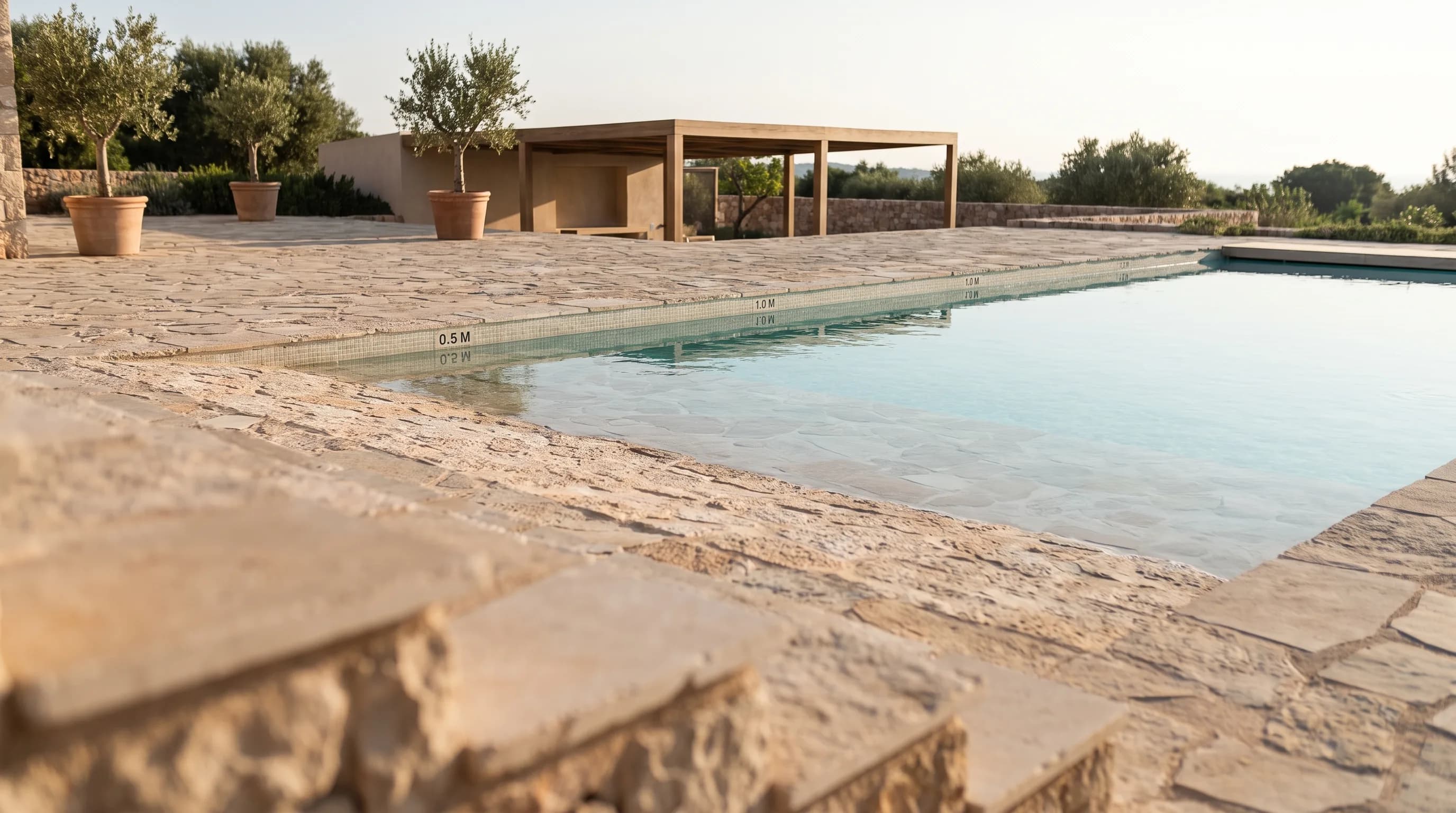
The line where the depth increases is marked with a dark-coloured band on the floor and with figures on the coping stone, so that both the child and the supervising adult notice it from within the water.
On a light blue floor, a navy or dark grey band 15-20 cm wide is sufficient. The depth figures on the coping stone are placed on a non-slip surface, at least 10 cm high, and repeated along both long sides of the pool. These markings do not spoil the pool's design; a band chosen in the right shade becomes part of the mosaic palette.
In a home with a small child, a barrier at least 120 cm high with a self-closing gate is needed around the pool; an alarm complements it.
The gap between the barrier's uprights should not exceed 10 cm, and its lower edge should not be more than 10 cm above the ground, so that a child cannot pass underneath or use it as a foothold. The gate opens outwards, away from the pool, and its latch is at a height the child cannot reach. No chair, plant pot or other object a child could climb on is placed next to the barrier. In our article on pool safety measures, we compared barrier, safety cover and alarm types one by one.
A water surface alarm detects the wave created by an object falling into the water and gives an audible warning. In a windy garden, basic models can produce false alarms; a model with adjustable sensitivity is chosen. An alarm is not a safeguard on its own; it speeds up the detection of a child who has got past the barrier. Shared safety works differently in a residential complex pool: there, the barrier, lifeguard and operating rules are planned together.
Water play features are placed on the shallow floor at a water depth of 30-40 cm, and the shower close to the pool entrance at a point that slopes towards a drain.
At this depth, fixed features and small sets with slides define the area in which the child plays standing up. Larger sets with slides need a depth of at least 110 cm; these sets are not placed in the shallow end of the family pool but in a separately planned section. The anchor sockets and supply pipes for the features are set into the concrete before the finish is applied; adding them to a finished pool later means removing the finish. We explained the pump and pipe requirements for children's water play and showers in our article on choosing pool showers and waterfalls.
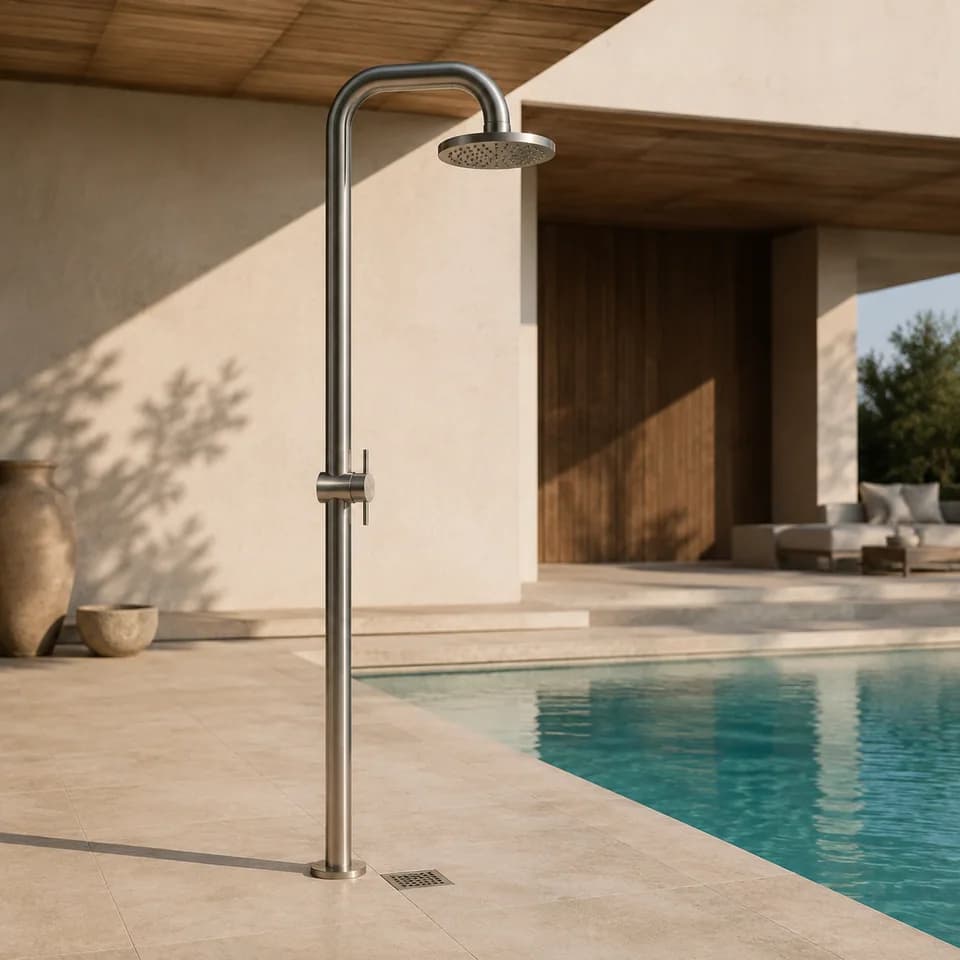
The shower at the poolside lets the child rinse off sand and sun cream before entering the water, which in turn reduces the load on the filter. The floor in front of the shower is finished with non-slip ceramic, and the water runs directly into the drain, not back into the pool.
No.
The right depth, a non-slip floor, a barrier and an alarm reduce the risk, but they do not replace an undistracted adult at the poolside.
The routine we recommend to families is simple: if there is a child in the water, one adult is 'on watch' at the poolside, without a phone in hand, and if the duty is to be handed over, it is handed over out loud. For a small child, the supervision distance is arm's length. Positioning the pool where it can be seen from the windows of the house and the seating area makes supervision easier; shrubs, a pergola or a plant room shed should not block the view.
When planning pool construction with a family with children, we discuss these decisions before the building permit. Because the depth profile is cast together with the concrete, changing it later requires breaking out and refinishing; the barrier, alarm and markings, on the other hand, can be added at any stage.
Next step
Let us discuss your project in the way that suits you best.
You can fill in the form for a written quote, schedule a video project presentation or ask us to survey your project site.
Get a Quote
Send us your dimensions and expectations in writing.
Online presentation
Video project presentation
On-site survey
Inspection at your project site
// 01 · Product groups
Compare the products on this topic on their category pages.
Each card leads to a product category; models, technical sheets and list prices are there.
 Product category
Pool Showers
Poolside showers offering standard and solar-powered models together, in stainless steel, aluminum and tropical wood options.
View- 16 products
 Product category
Pool Ladder Models
Stainless steel and coated pool ladders, a model with plastic treads and an overflow pool ladder.
View- 9 products
 Product category
Pool Cover Systems
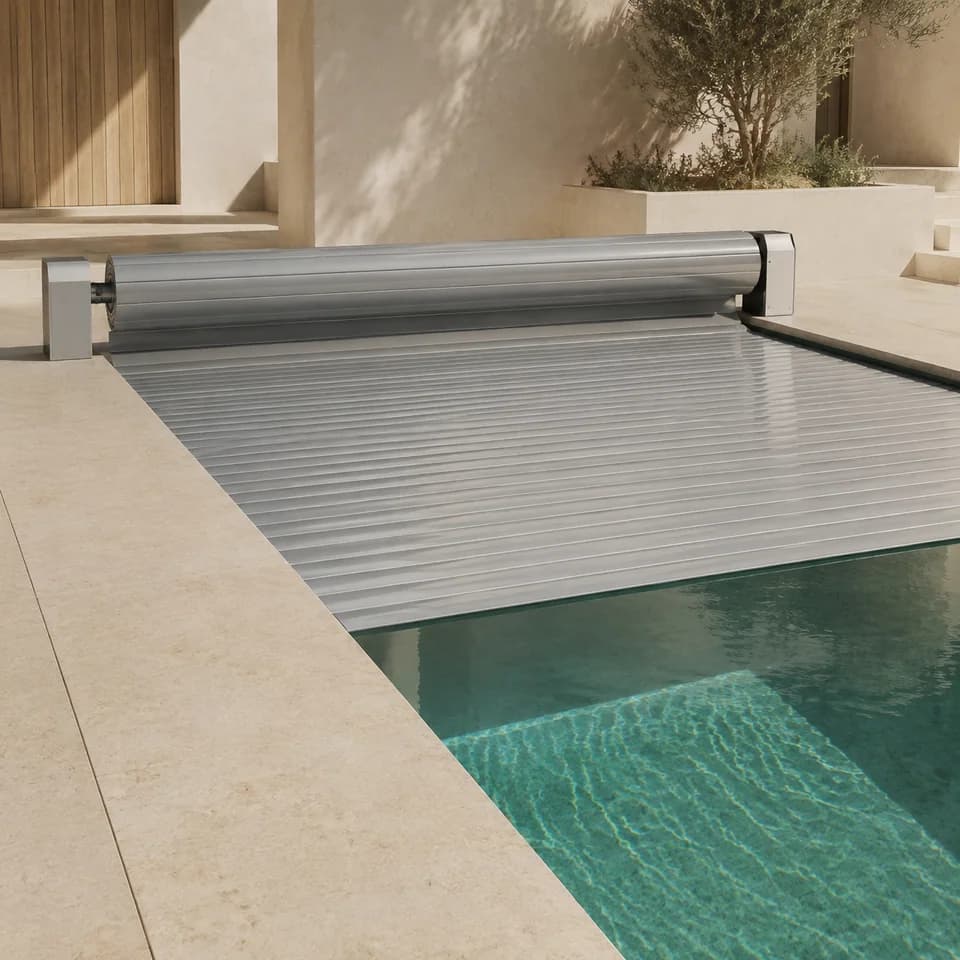
Automatic covers, safety lids and shaft systems, cover solutions that cut heat loss while protecting your pool against accidents.
View- 10 products
Product category
Pool Showers
Poolside showers offering standard and solar-powered models together, in stainless steel, aluminum and tropical wood options.
16 productsProduct category
Pool Ladder Models
Stainless steel and coated pool ladders, a model with plastic treads and an overflow pool ladder.
9 productsProduct category
Pool Cover Systems
Automatic covers, safety lids and shaft systems, cover solutions that cut heat loss while protecting your pool against accidents.
10 products
// 02 · Related service
The work in this article, we deliver from design to handover.
Çilek Havuz service
Swimming Pool Construction
Reinforced-concrete, prefabricated and infinity swimming pools, built turnkey for villa, residential and commercial projects.
Swimming pool construction is a turnkey build in which the site survey, structural and mechanical design, excavation, reinforced-concrete shell, waterproofing, finish, filtration plumbing and commissioning run under a single contract. The written project schedule follows the site survey.
How we work
- 01Initial meeting and site surveyWe inspect the site and listen to the brief.
- 02Design and quotationWe give the cost item by item, in writing.
- 03ExecutionThe same team builds to a written schedule.
- 04Handover and commissioningWe start the systems and explain their use.
- 05Maintenance and technical supportWe provide periodic maintenance and support.
// 03 · Guides
On Pool Construction, more articles to read.
First the articles directly related to this one, then the newest articles on the topic.
 Pool Construction
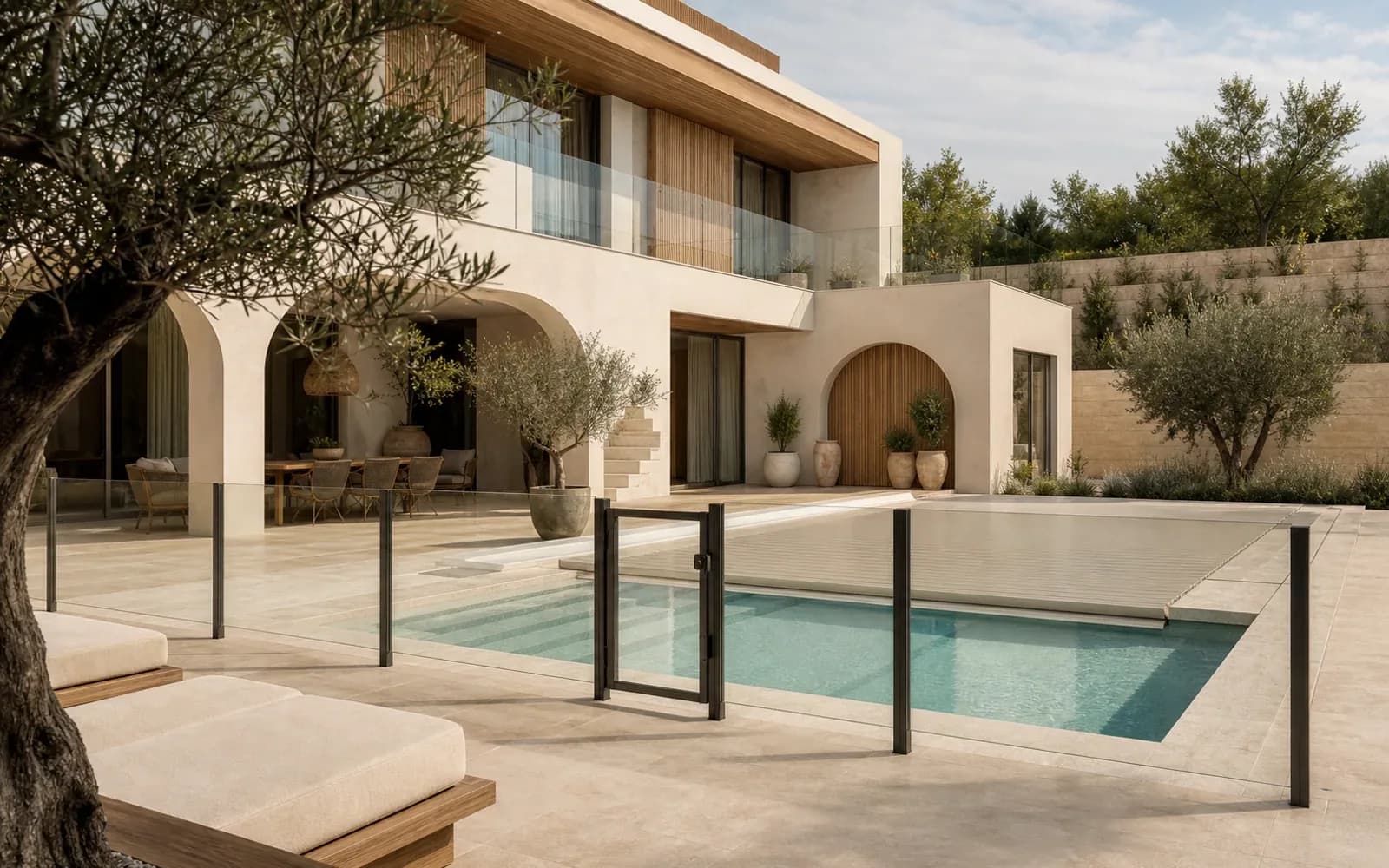
Pool Safety: Barriers, Covers and Alarms for Children
A pool is a source of enjoyment, but in homes with children it is also a responsibility that must be taken seriously.
View- 20 April 2026
- 6 min read
 Design
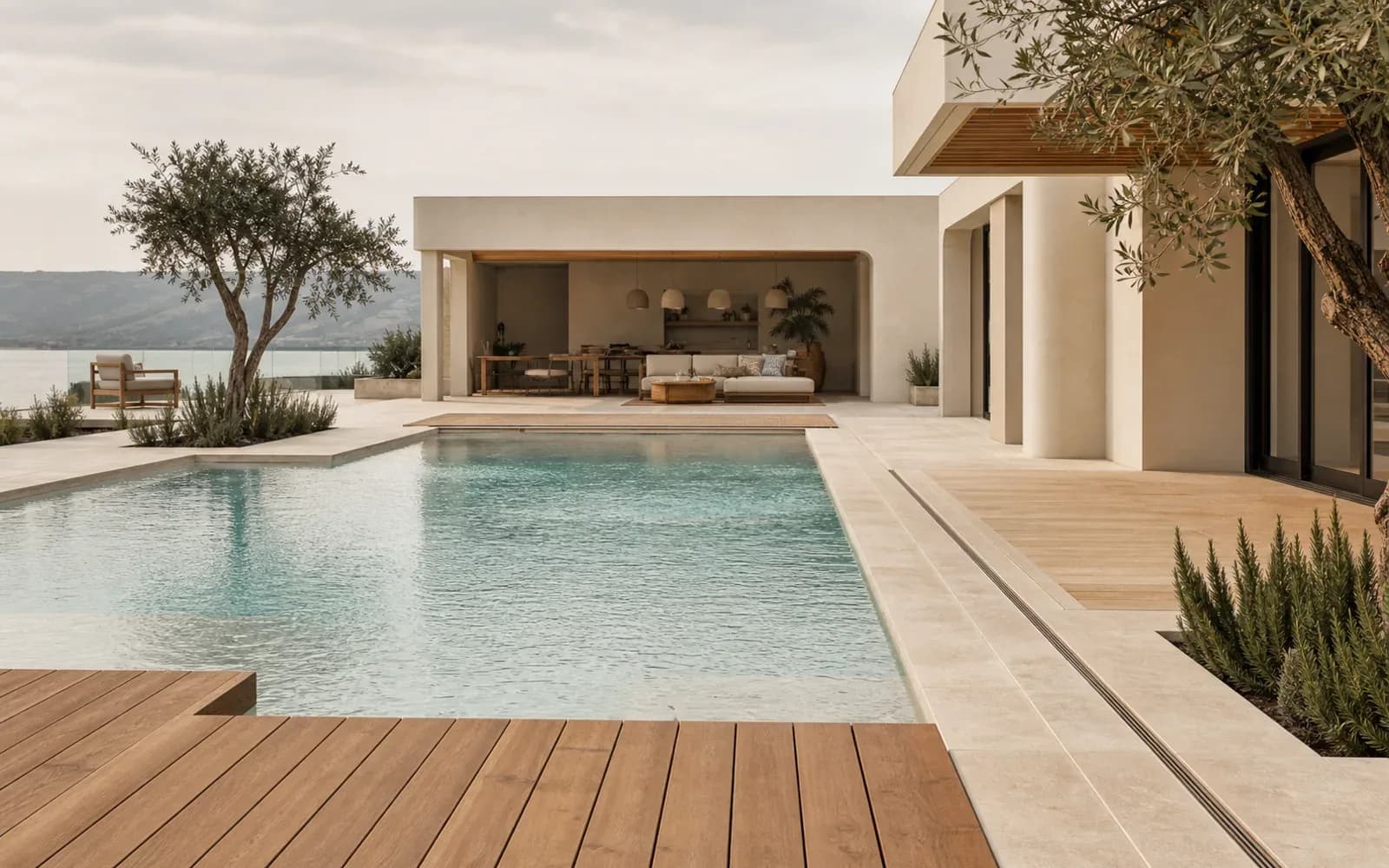
Pool Surroundings and Decking: Slip-Resistant Surfaces, Wood, Landscaping
A pool's value is measured not only by its body of water but by the surfaces, decking and landscaping that surround it.
View- 26 April 2026
- 6 min read
 Pool Construction
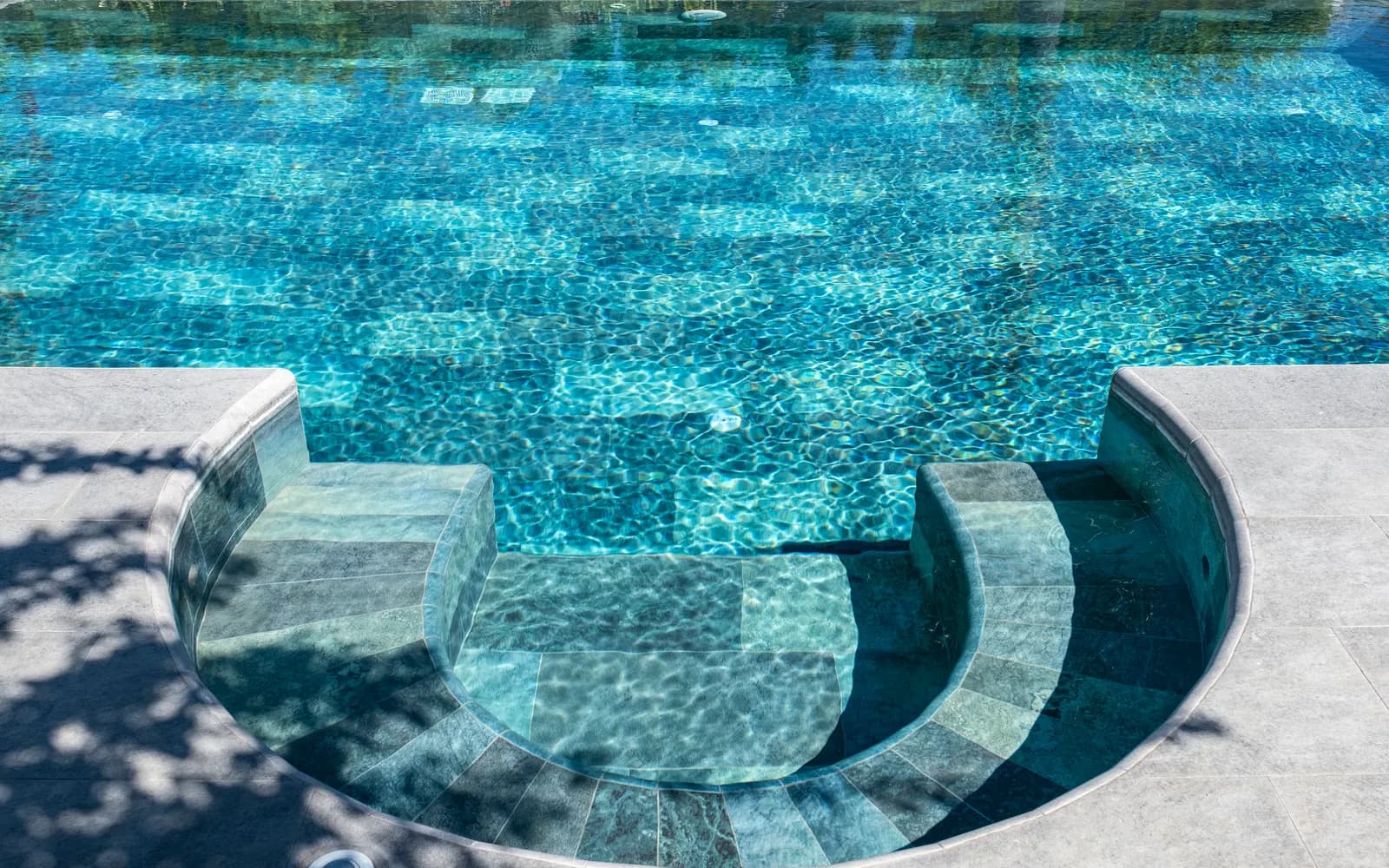
Pool sizes and depths: how to choose the right size
Common residential pool sizes are 3x6, 4x8, 5x10 and 6x12 metres. Depth is planned between 1.20 and 1.80 metres, depending on who will use the pool and how.
View- 4 September 2026
- 9 min read
 Pool Construction
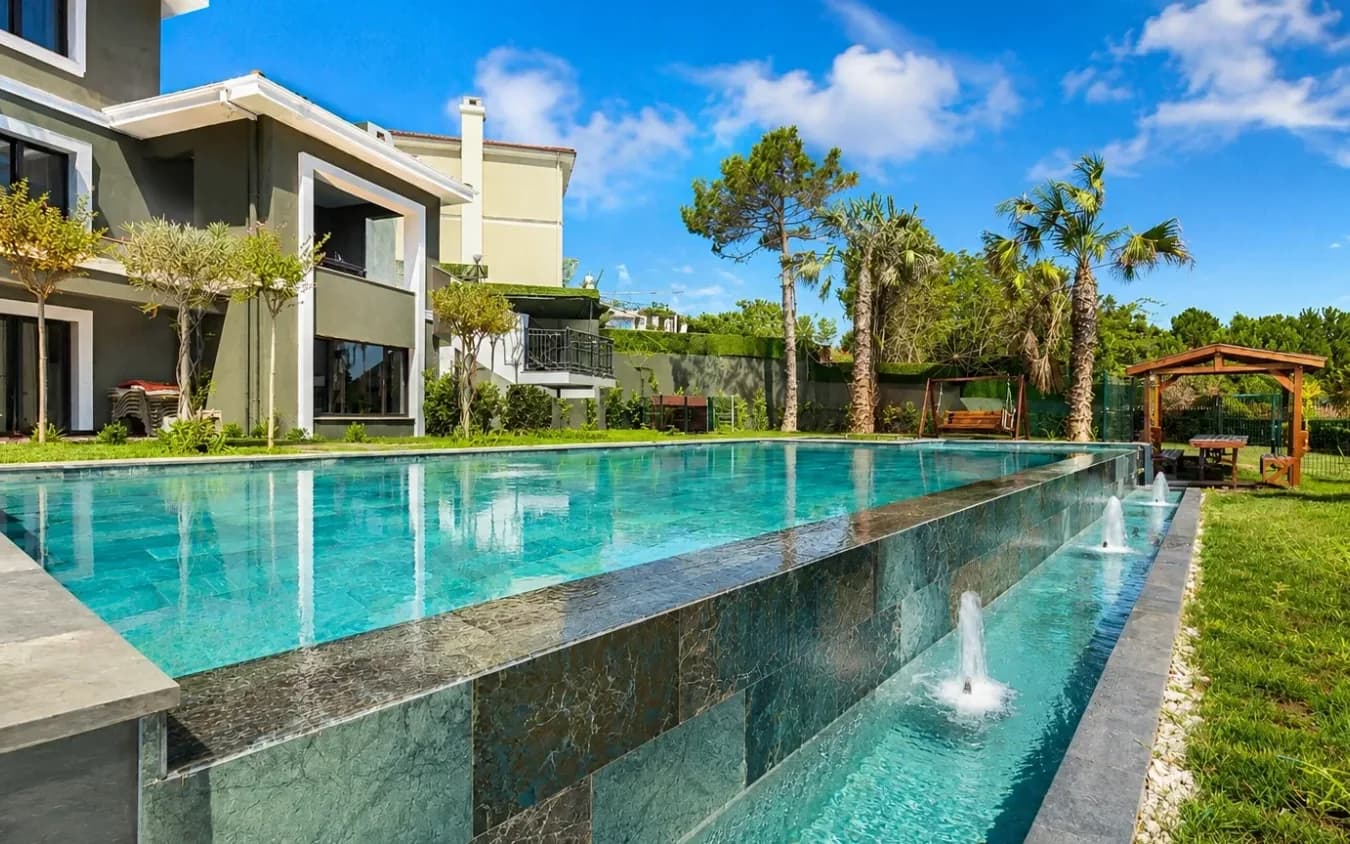
Choosing Pool Showers and Waterfalls: Shower Types, Water Curtains and Plumbing Needs
Choosing a pool shower, waterfall or water curtain depends on the material, where the water comes from and where it is mounted. We compare solar and stainless steel shower types and their pump and plumbing needs.
View- 2 October 2026
- 8 min read
 Pool Construction
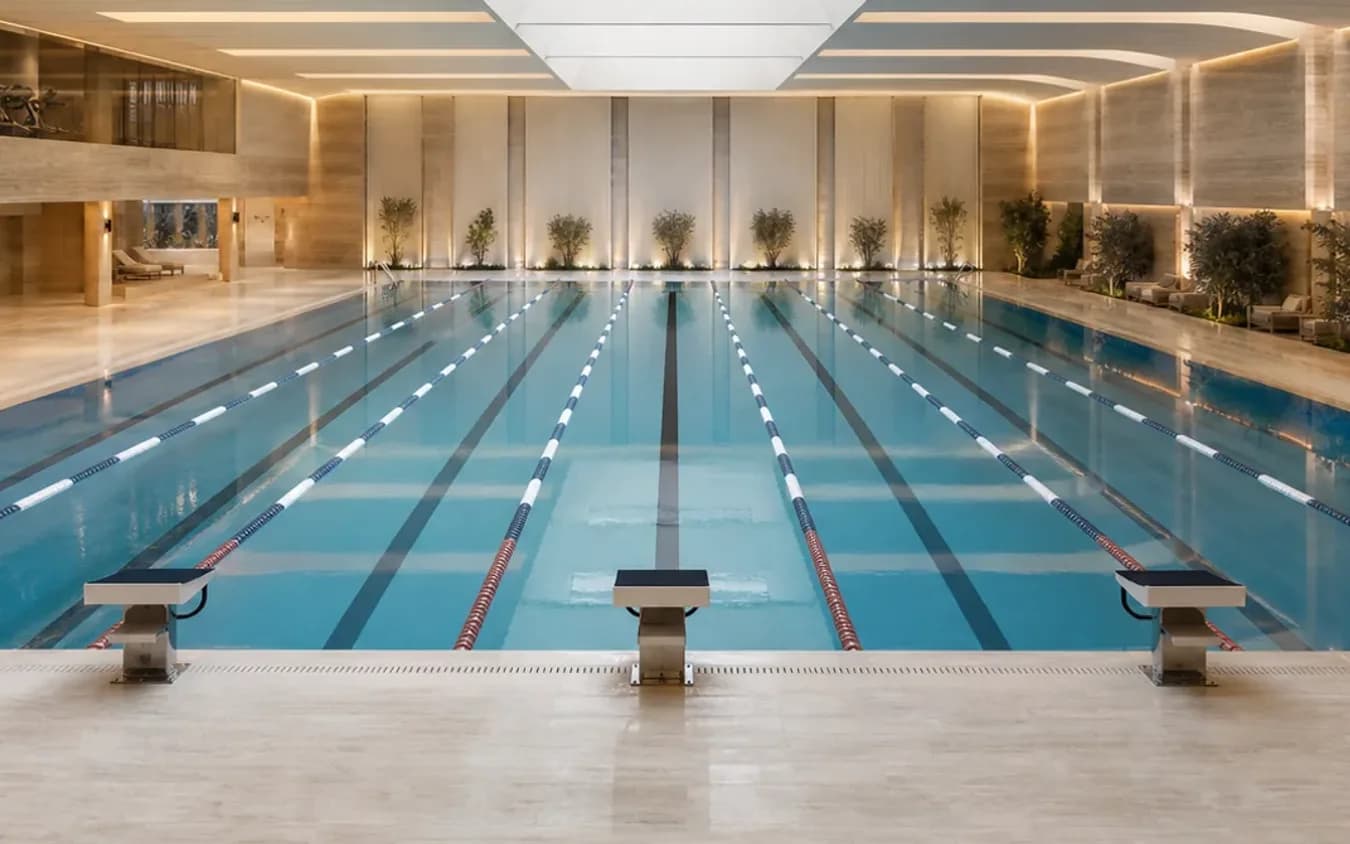
Competition Pool Equipment: Which Pool Needs Which Equipment?
Starting blocks, lane ropes, warning and turn systems, underwater speakers and water polo goals are chosen according to how the pool is used. We explain which dimensions we check for each item.
View- 2 October 2026
- 7 min read
 Pool Construction
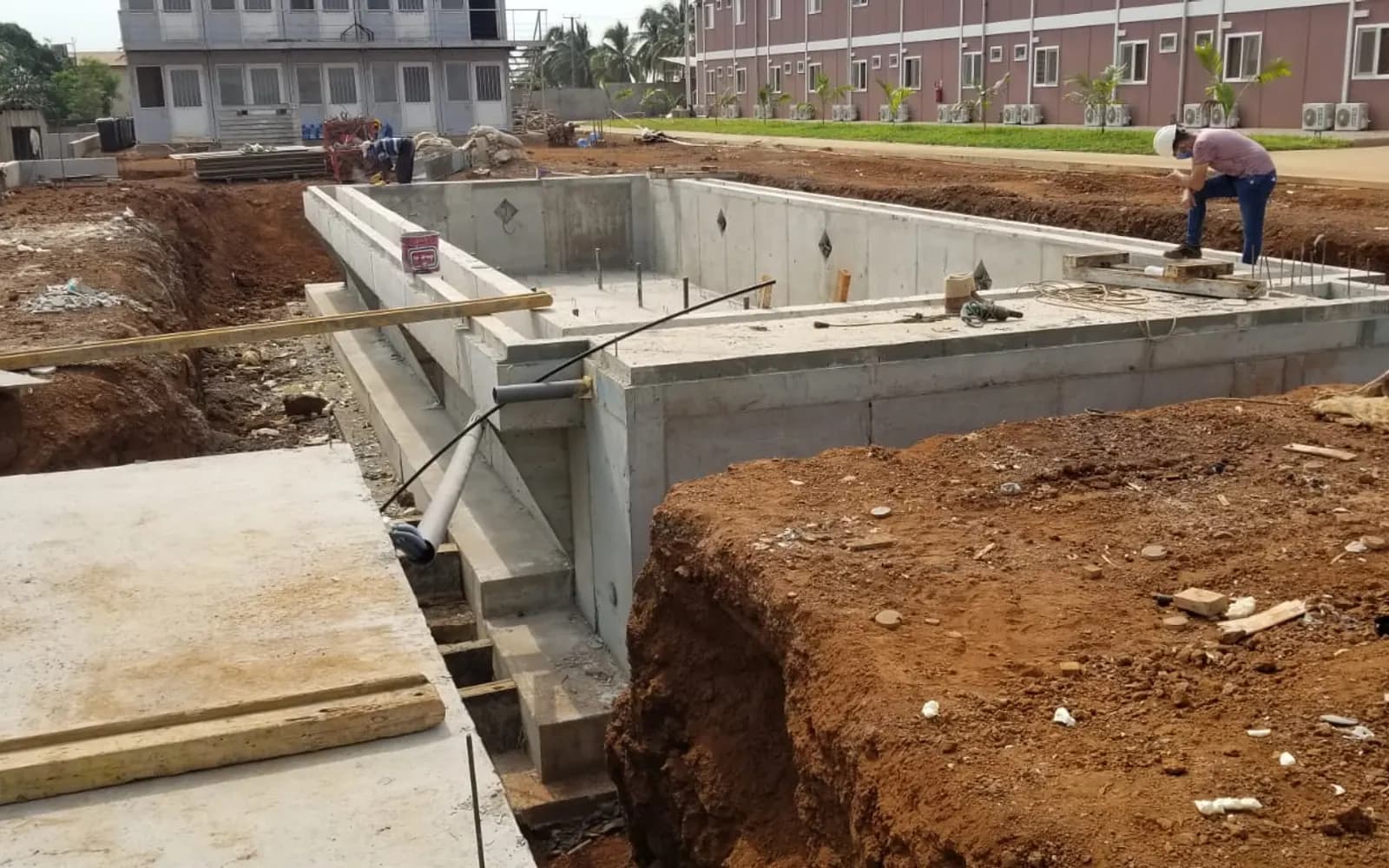
Building a pool or spa abroad: what drives the cost of an international project?
A pool, hammam or spa project delivered abroad from Turkey has no single price per square metre. We cover design, equipment, shipping, customs and schedule.
View- 29 September 2026
- 8 min read
- Pool Construction · 20 April 2026Pool Safety: Barriers, Covers and Alarms for ChildrenA pool is a source of enjoyment, but in homes with children it is also a responsibility that must be taken seriously.6 min read
- Design · 26 April 2026Pool Surroundings and Decking: Slip-Resistant Surfaces, Wood, LandscapingA pool's value is measured not only by its body of water but by the surfaces, decking and landscaping that surround it.6 min read
- Pool Construction · 4 September 2026Pool sizes and depths: how to choose the right sizeCommon residential pool sizes are 3x6, 4x8, 5x10 and 6x12 metres. Depth is planned between 1.20 and 1.80 metres, depending on who will use the pool and how.9 min read
- Pool Construction · 2 October 2026Choosing Pool Showers and Waterfalls: Shower Types, Water Curtains and Plumbing NeedsChoosing a pool shower, waterfall or water curtain depends on the material, where the water comes from and where it is mounted. We compare solar and stainless steel shower types and their pump and plumbing needs.8 min read
- Pool Construction · 2 October 2026Competition Pool Equipment: Which Pool Needs Which Equipment?Starting blocks, lane ropes, warning and turn systems, underwater speakers and water polo goals are chosen according to how the pool is used. We explain which dimensions we check for each item.7 min read
- Pool Construction · 29 September 2026Building a pool or spa abroad: what drives the cost of an international project?A pool, hammam or spa project delivered abroad from Turkey has no single price per square metre. We cover design, equipment, shipping, customs and schedule.8 min read
// Sources and regulations
Sources and regulations
The official documents behind the technical framework on this page; links open the institutions' own sites.
- Regulation on the Health Principles and Conditions for Swimming Pools (Official Gazette No. 27866, 6 March 2011)Official Gazette of Türkiye
- Regulation Amending the Swimming Pools Regulation (Official Gazette, 15 December 2011)Official Gazette of Türkiye
- Guidelines for safe recreational water environments, Volume 2: Swimming pools and similar environments
// 04 · Company & Contact
To talk about your project, call or write to us.
Legal Name
Çilek Havuz
Founded
1998 · Istanbul
Head Office
Çilek Plaza, Eyüp Sultan Mah. Yakacık Cd. Feshane Cd. No: 2 D:4 D:1, 34885 Sancaktepe / İstanbul
Service Area
All of Türkiye · exports to 14 countries
Branches
Kyrgyzstan · Egypt · Algeria · Iraq
Showroom
Plan a showroom visit
At our showroom in Çilek Plaza, Sancaktepe, you can discuss your project with our team. We recommend booking an appointment by phone before your visit.
Working Hours
- Monday – Friday · 08:00 – 17:30
- Saturday · 08:00 – 12:30
- Closed on Sunday
Frequently Asked Questions
About Children's Pool Depth and Safe Dimensions, frequently asked questions.
Çilek Havuz Corporate
Pool and Wellness Engineering
- Response Time
- Same day
- Channels
- Phone · Email · WhatsApp
If the answer you are looking for is not here, send your question directly to us and our team will reply as soon as possible.
+90 216 475 39 37There is no single ideal figure; 20-30 cm is used for ages 0-3, 30-60 cm for ages 3-6 and 60-90 cm for a child learning to swim. The depth is chosen according to the child's height: for a standing child, the water should not rise above chest level.
Çilek Havuz Corporate
In most cases it cannot, because the shallow end of a family pool is usually 100-120 cm deep and a five-year-old cannot stand there. For a small child, a separate shallow section or a wide seating step is planned.
Çilek Havuz Corporate
The depth profile can be changed later, but this requires breaking out and refinishing. Measures that can be applied immediately are a barrier, an alarm, a non-slip finish on the steps and depth markings; the permanent solution is to build a shallow ledge as part of a pool renovation.
Çilek Havuz Corporate
Only a cover manufactured specifically for safety, fixed at its edges and able to bear an adult's weight can do so. Thermal and debris covers cannot bear a child's weight, and a few centimetres of water collected on top of them are also a risk for a small child.
Çilek Havuz Corporate
Non-slip glass mosaic with a matt surface and textured non-slip ceramic are used. Glossy glazed tiles and polished stone are slippery when wet; the steps and shallow floor should be in the highest slip resistance class.
Çilek Havuz Corporate
Models with basic surface sensors can give false alarms in wind and with circulation waves. Models with adjustable sensitivity that respond to the strong wave created by an object falling into the water reduce this problem.
Çilek Havuz Corporate
In a shallow, small-volume children's pool the water becomes dirty more quickly. The turnover time is therefore kept short and the chlorine level is measured more frequently. If there is a separate children's pool, it is preferable for it to run with its own pump and filter.
Çilek Havuz Corporate