

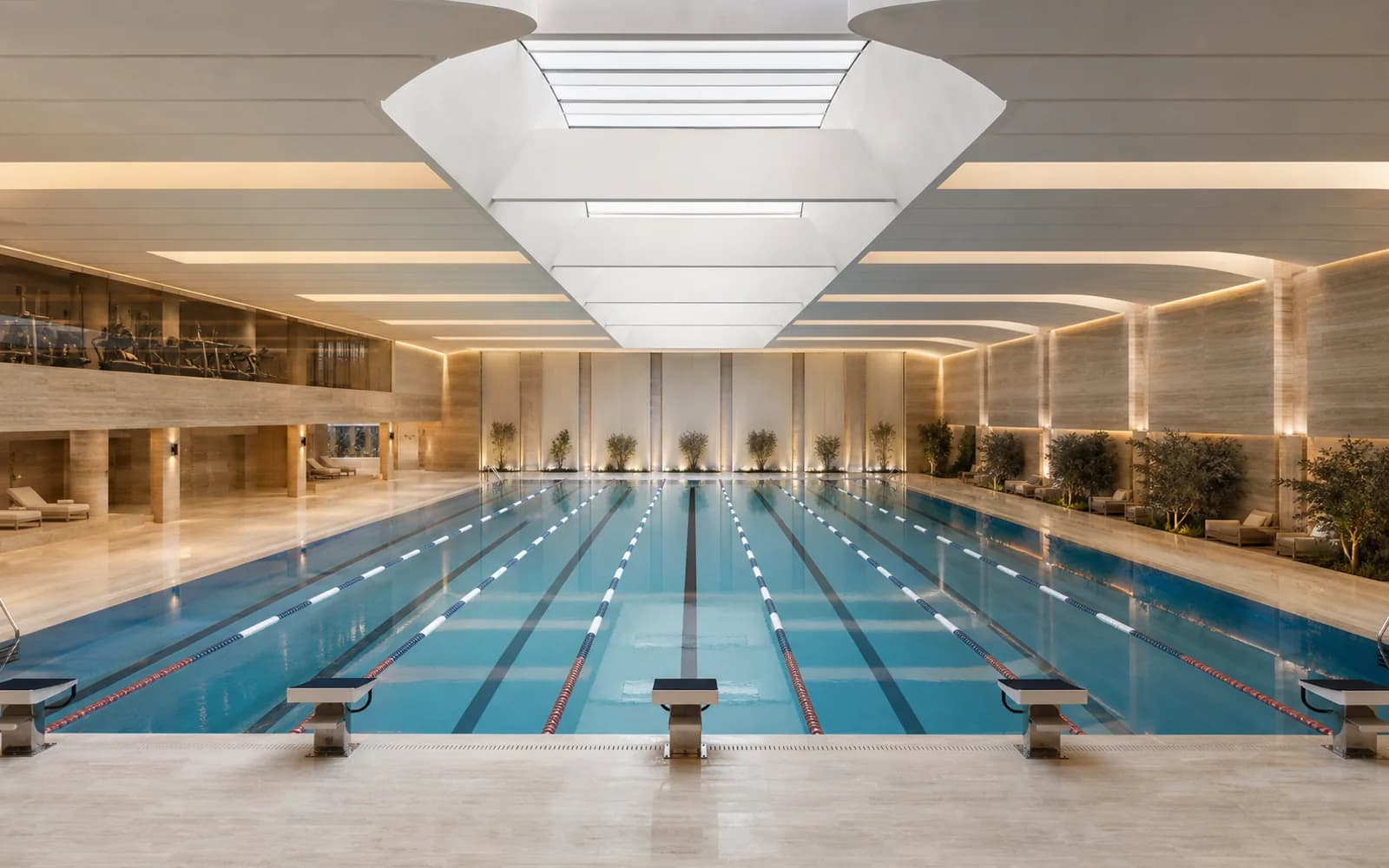
Olympic and Semi-Olympic Pool Dimensions and Standards
An Olympic pool is 50 meters long and a semi-Olympic pool 25 meters, built to international competition rules. This article details standards such as lanes, depth, overflow systems and timing.
Project Manager · Mechatronics Engineer · Çilek Havuz
- Published
- Updated
- Reading
- 12 min read
- Category
- Pool Construction
An Olympic pool is 50 meters long and a semi-Olympic pool 25 meters, built to international competition rules. This article details standards such as lanes, depth, overflow systems and timing.
An Olympic pool is 50 metres long; the short-course pool, which in Turkey is called semi-Olympic, is 25 metres.
Official races are swum over these two lengths, and world records are kept separately in the two categories.
Length is held to the millimetre because the thickness of the touch timing panels counts inside that measurement. The basin is cast with an allowance for the panels; a mistake in the formwork cannot be corrected once the concrete is poured.
| Dimension | 50 m pool | 25 m pool |
|---|---|---|
| Length | 50.000 m (with touch panels fitted; tolerance +0.030 / -0.000 m) | 25.000 m (same tolerance logic) |
| Width | 25.0 m (10-lane layout) | varies by facility; commonly 12.5 m in Turkey |
| Number of lanes | 8 or 10 | depends on pool width; 5 at 12.5 m |
| Lane width | 2.50 m | 2.50 m |
| Side clearance | 2.50 m outside lanes 1 and 8 on each side | according to the lane layout |
| Depth | at least 2.00 m for the Olympic Games and World Championships; 3.00 m recommended | at least 1.35 m in the starting block zone |
| Water temperature | 25-28 °C | 25-28 °C |
| Lighting | at least 1500 lux | at least 1500 lux |
| Water volume | 2,500 m³ at 2 m depth · 3,750 m³ at 3 m depth | 625 m³ at 12.5 m width and 2 m depth |
An Olympic pool is designed with eight or ten lanes, each 2.50 metres wide.
The outer lanes are laid out to reduce the wave that bounces back off the wall.
Lane ropes mark the direction and also break up the wave a swimmer produces, so the swimmer in the next lane does not have to deal with it. A fair race depends partly on those ropes.
| Basin width | Number of lanes | Layout |
|---|---|---|
| 25.0 m | 10 | 8 racing lanes + a 2.50 m buffer zone at each side |
| 21.0 m | 8 | outer lanes close to the wall; narrow buffer zone |
| 16.5 m | 6 | common in municipal and school facilities |
| 12.5 m | 5 | the basin known in Turkey as "semi-Olympic" |
Depth governs both swimmer safety and how calm the water is.
In deep water a wave dies out before it can reflect off the floor and return to the surface; the water stays still and swimmers go faster.
Depth at the start end is defined separately because swimmers enter the water head first from the block. The values below are minimum thresholds; a facility aiming to host competitions should stay above them.
| Situation | Depth |
|---|---|
| At the end where starting blocks are used, from 1.0 m to at least 6.0 m from the wall | at least 1.35 m |
| In the rest of the pool | at least 1.00 m |
| Olympic Games and World Championships | at least 2.00 m |
| Recommended for multi-discipline use | 3.00 m |
| Water polo (deep field) | at least 2.00 m |
| Diving pool, for a 10 m platform | approximately 5.00 m |
International competition rules contain no definition of a "semi-Olympic pool".
The rules divide pools into two by length: the 50-metre long course and the 25-metre short course. "Semi-Olympic" is the everyday name given in Turkey to the 25-metre pool; it appears under this name in tender specifications and municipal announcements.
The confusion arises here: when "semi-Olympic" is mentioned, most sources give a single size, 25 × 12.5 metres. Since this is the basin built most often in Turkey, it is an accurate observation, but it is not a standard. A pool 25 metres long may be 12.5 or 21 metres wide depending on the project. The number of lanes follows from that width.
When writing a specification, do not rely on the term "semi-Olympic". State three figures explicitly: length, width and number of lanes. Otherwise there are facilities that expect 25 × 12.5 and receive 25 × 10; the 2.5-metre difference is a whole lane.
Six figures that belong in the specification
- 01Basin length (whether touch panels are included or not)
- 02Basin width
- 03Number of lanes and lane width
- 04Depth at the start end and in the rest of the pool
- 05Target water turnover time (hours)
- 06Water and air temperature band
Olympic and semi-Olympic pools use an overflow edge: water flows continuously out through the overflow channel at the edge, and the surface wave dies out there.
The overflow channel removes the film of oil and dust on the surface, and a swimmer's wave does not strike the edge and come back. As a result every lane is swum in the same calm water. The same principle applies to every overflow pool design; a competition pool is the tightest-tolerance version of this system.
In official races, times are measured by touch timing panels mounted at the end of each lane.
Starting platforms, backstroke turn indicators and the electronic timing system work as one set.
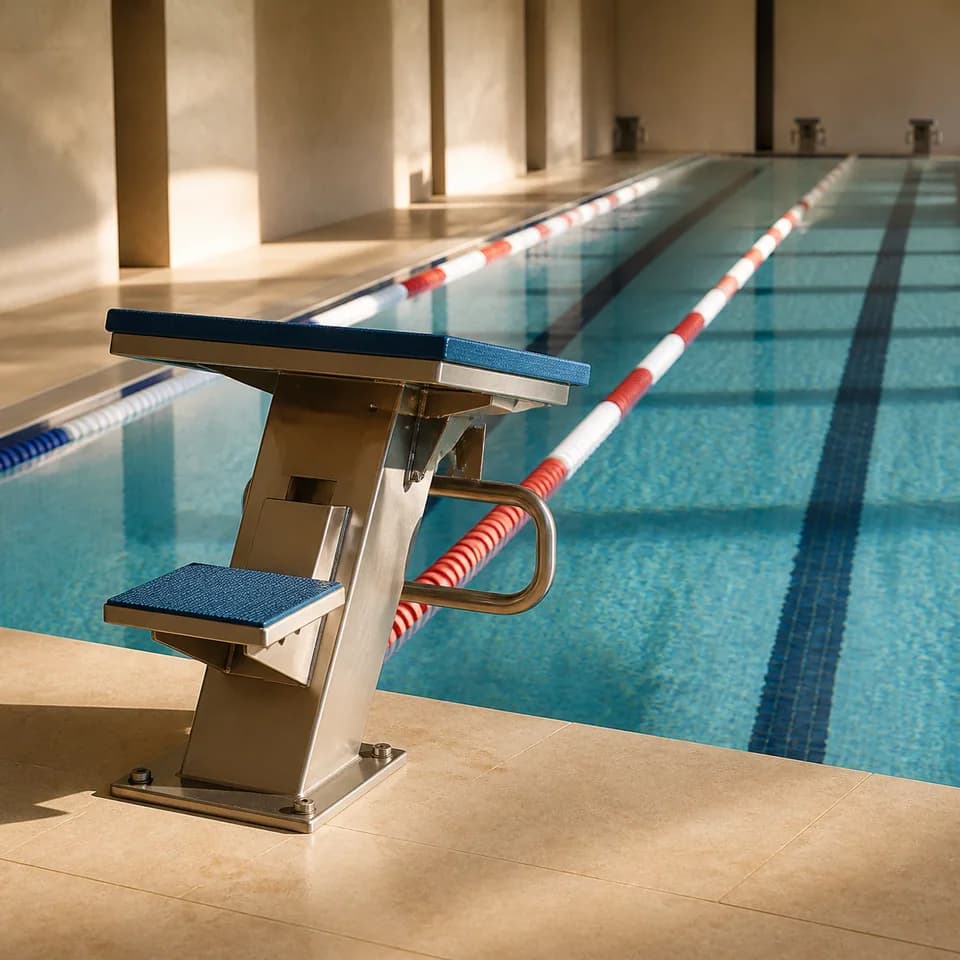
This equipment is positioned according to the pool geometry: panel thickness and the position of the starting platforms must be known before the basin is cast. You can find timing and starting equipment together in our Olympic pool equipment product group.
An Olympic pool is not a garden pool scaled up; it is an engineering structure in which dimensions, hydraulic balance and high-capacity filtration work together.
Turnover time, temperature stability and overflow balance are calculated at the drawing stage; once the concrete is poured, none of them is easy to change.
In the projects we have carried out since 1993, we have built water structures with demanding technical requirements, including Türkiye's deepest training pool (10 m, 3,600 m³). On a competition pool, engineering must come in at the drawing stage; that is when the rule dimensions fit comfortably into the project. Once the pool is in operation, maintenance also runs differently: lane ropes, starting blocks and overflow grilles call for a separate checklist.
Under international competition rules an Olympic pool is 50.000 metres long, and in pools using touch panels this length is built with a +0.030 m tolerance so that it is achieved with the panels fitted.
Lane width is 2.5 metres; the Olympic standard is a 10-lane pool 25 metres wide. The minimum depth is 2.0 metres, and the recommended value is 3.0 metres.
Water temperature in competition is kept within the 25-28 °C band; disciplines such as artistic swimming and water polo have their own ranges. Every item is written down, from lighting and starting platform height (0.5-0.75 m above the water surface) to panel surface standards. These figures are not a preference of the design team; they are a precondition for homologation.
Competition pool glossary
- Long course / short course
- Races swum in a 50-metre pool count as long course, those in a 25-metre pool as short course. World records are kept separately in the two categories, because a short pool has twice as many turns and the push-off at each turn adds speed.
- Touch panel
- The plate mounted at the end of each lane that converts the swimmer's touch into a time. Its thickness is included in the basin dimension: the 50 metres are measured between the panels, so the concrete basin is cast slightly longer.
- Overflow channel
- The gutter around the pool edge into which water flows continuously. It absorbs the surface wave and removes the oil and dust film from the surface. Competition pools use this system instead of skimmers.
- Balance tank
- The tank in which overflowing water is collected. It holds the volume displaced by swimmers entering the pool and supplies the pump without interruption. If its volume is insufficient, the pump draws air during a crowded session.
- Water turnover time
- The time it takes for all the water in the pool to pass through the filter once. Competition pools call for a range of 4-6 hours; as the volume grows, the pump flow rate grows proportionally to hold the same time.
- Combined chlorine (chloramine)
- The compound formed when chlorine combines with sweat, urine and cosmetics. The sharp "pool smell" so often noticed in indoor facilities comes from this, not from free chlorine; UV or ozone support reduces this load.
- Homologation
- Certification that a facility is suitable for official competition. Besides the dimension survey, ancillary spaces such as the officials' room, doping control room, warm-up area and changing capacity are included in the file.
A 25-metre pool is a balanced point for municipal swimming pools, schools, university facilities and training centres.
Its water volume is roughly a third of an Olympic pool's, so heating, filtration and chemical costs shrink in the same proportion; because short-course competitions can be held at this size, its sporting function is preserved.
In hotel and residential projects, 25 metres stands out as the smallest length that satisfies users who want 'serious swimming'. When deciding, we ask what use the facility is intended for: if licensed training and competition are planned, dimensional tolerances and depth are built to the standards; if recreational use comes first, the same budget can be spread over a wider pool and ancillary spaces.
A 10-lane Olympic pool 3 metres deep holds around 3,750 m³ of water.
Regulations require the water in competition pools to turn over every 4-6 hours; this means parallel pump groups delivering 600-900 m³ per hour without interruption. At this scale, the balance tank of the overflow system reaches the size of a small pool in its own right.
Chlorine is not left to work alone in disinfection; UV or ozone-assisted systems reduce the combined chlorine (chloramine) load, protecting both athlete comfort and, in indoor facilities, air quality. At this scale the plant room is no longer a services room but an operational floor with its own ventilation, crane runway and service corridor; it must be planned that way in the project from the start.
A competition facility includes much more than the pool basin.
The athletes' warm-up area, officials' rooms, doping control room, spectator stand and sufficient changing capacity are part of the homologation file. Stand capacity determines the level of competition the facility can host.
In an indoor facility, climate control carries the invisible load of the work: air temperature is kept 1-2 °C above water temperature, and relative humidity within the 50-60 per cent band. If this balance is not achieved, condensation wears down the steel structure and the chloramine smell settles over the stands. On the energy side, heat-recovery ventilation and a pool cover bring annual costs down considerably at this scale.
Today's competition pool dimensions were not written in one go.
The pool was first a bathing structure and later became a sports facility; the dimensions settled into place during this transition.
| Date | Event |
|---|---|
| 3rd millennium BC | The Great Bath at Mohenjo-daro: 12 × 7 metres, brick lining, bitumen-based waterproofing |
| Between 38 and 8 BC | The heated pool built by Gaius Maecenas; the first known example |
| 1837 | Six indoor pools with diving boards in London |
| 1869 | Founding of the amateur swimming association in England; swimming becomes a sport with rules |
| 1896 | Start of the modern Olympics; swimming races held in open water |
| 1924 | First use of an Olympic-size pool |
| 2008 | A 10-lane, 3-metre-deep pool in Beijing |
| 2009 | The ten-lane layout written into the rules at the congress of the international swimming federation |
| 2024 | Debate on depth over the 2.2-metre-deep temporary pool in Paris |
The practical conclusion from this sequence is that the dimensions are not fixed; they are revised. Building a facility to today's minimum values may cause difficulties at a homologation renewal ten years later. Depth and plant room capacity are the two items that cannot be corrected afterwards, so they should target the recommended band.
Next step
Let us discuss your project in the way that suits you best.
You can fill in the form for a written quote, schedule a video project presentation or ask us to survey your project site.
Get a Quote
Send us your dimensions and expectations in writing.
Online presentation
Video project presentation
On-site survey
Inspection at your project site
Image gallery
Photos: 04
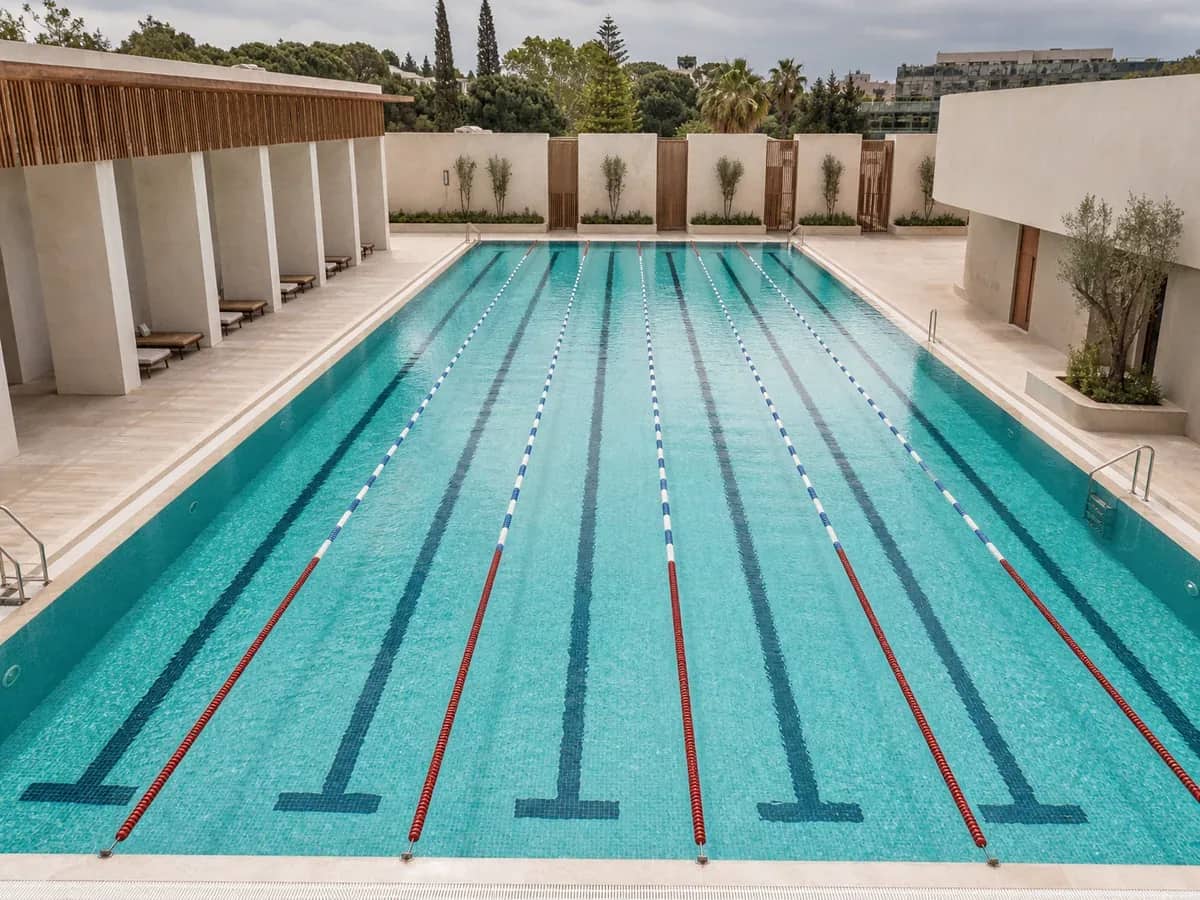 01
01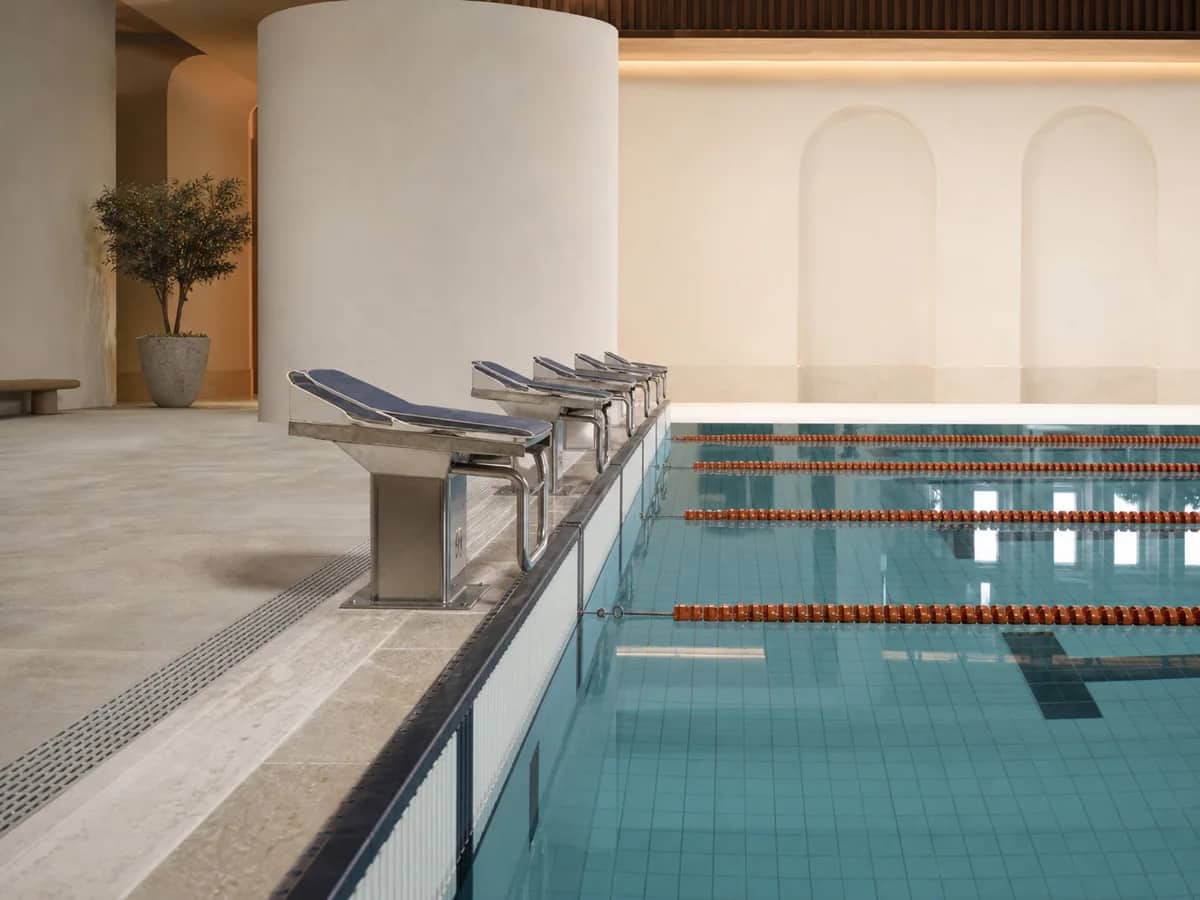 02
02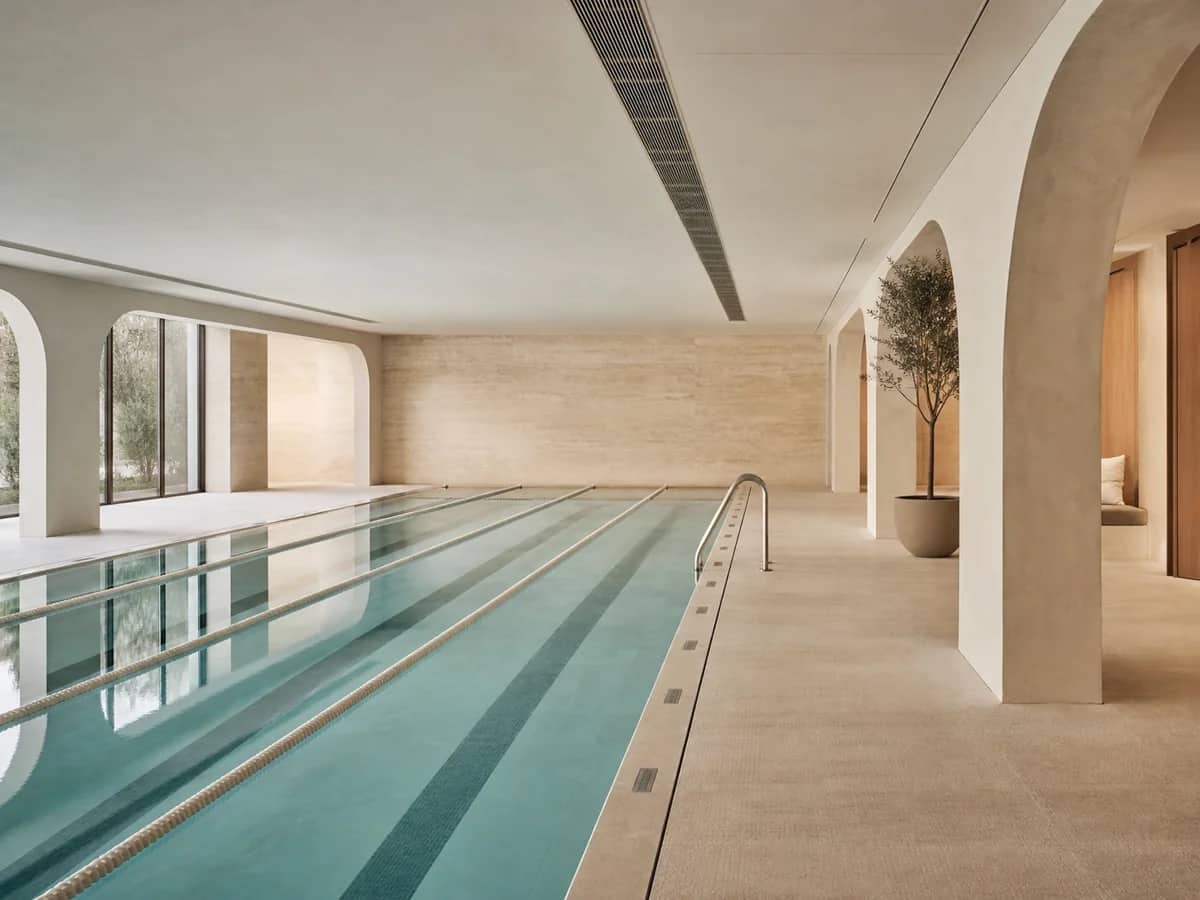 03
03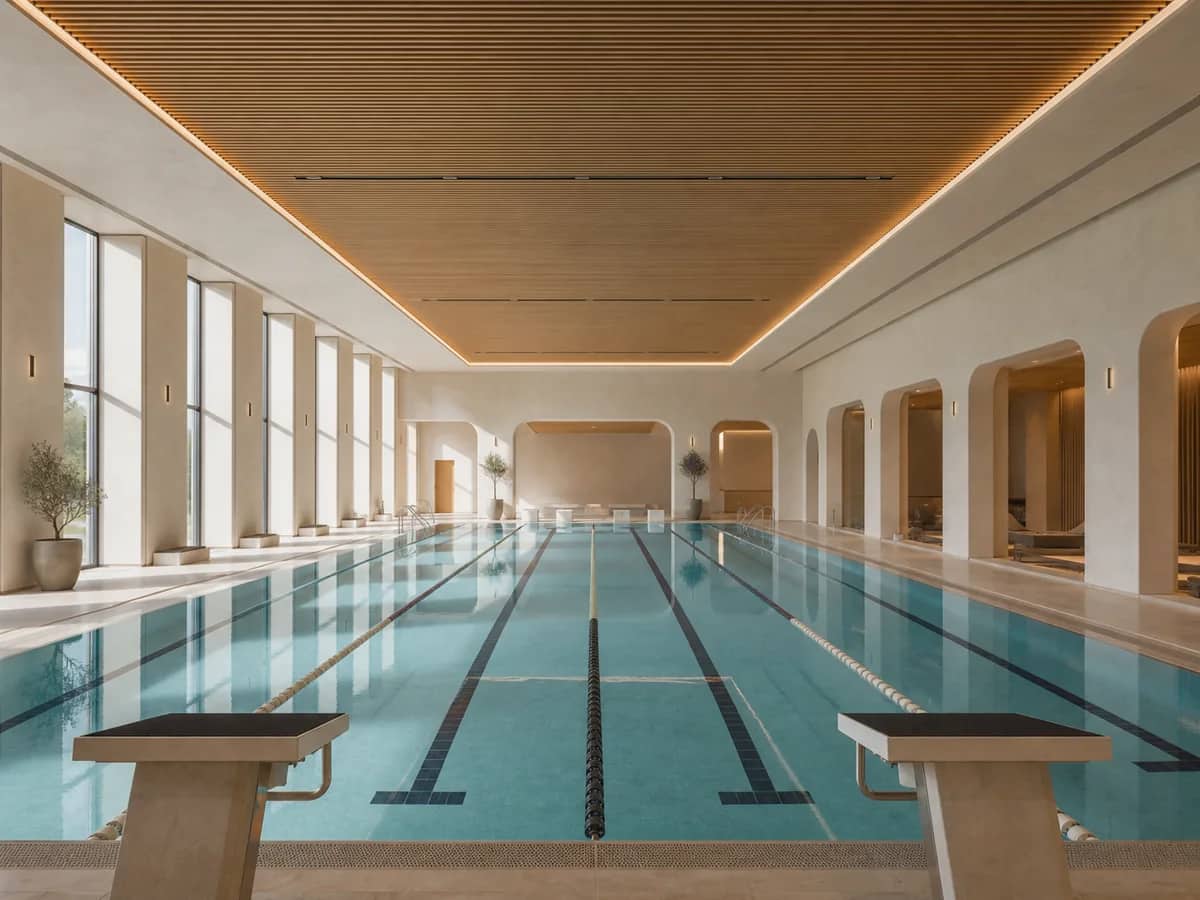 04
04// 01 · Product groups
Compare the products on this topic on their category pages.
Each card leads to a product category; models, technical sheets and list prices are there.
 Product category
Olympic Pool Equipment
Olympic pool equipment built to official competition standards, with lane dividers, starting blocks, timing systems and water polo goals.
View- 8 products
 Product category
Pool Mechanical Equipment
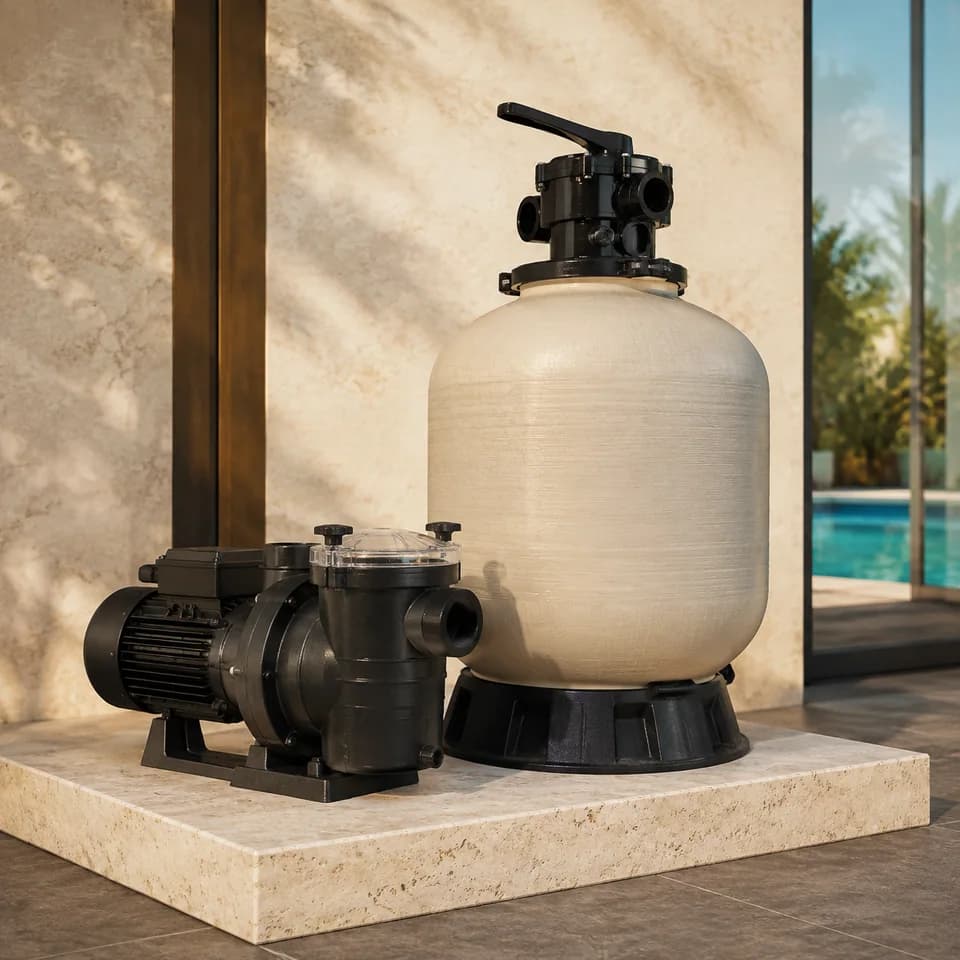
Circulation pumps, filters, valves and automation: the mechanical infrastructure that forms the heart of the pool.
View- 65 products
 Product category
Pool Lining Systems
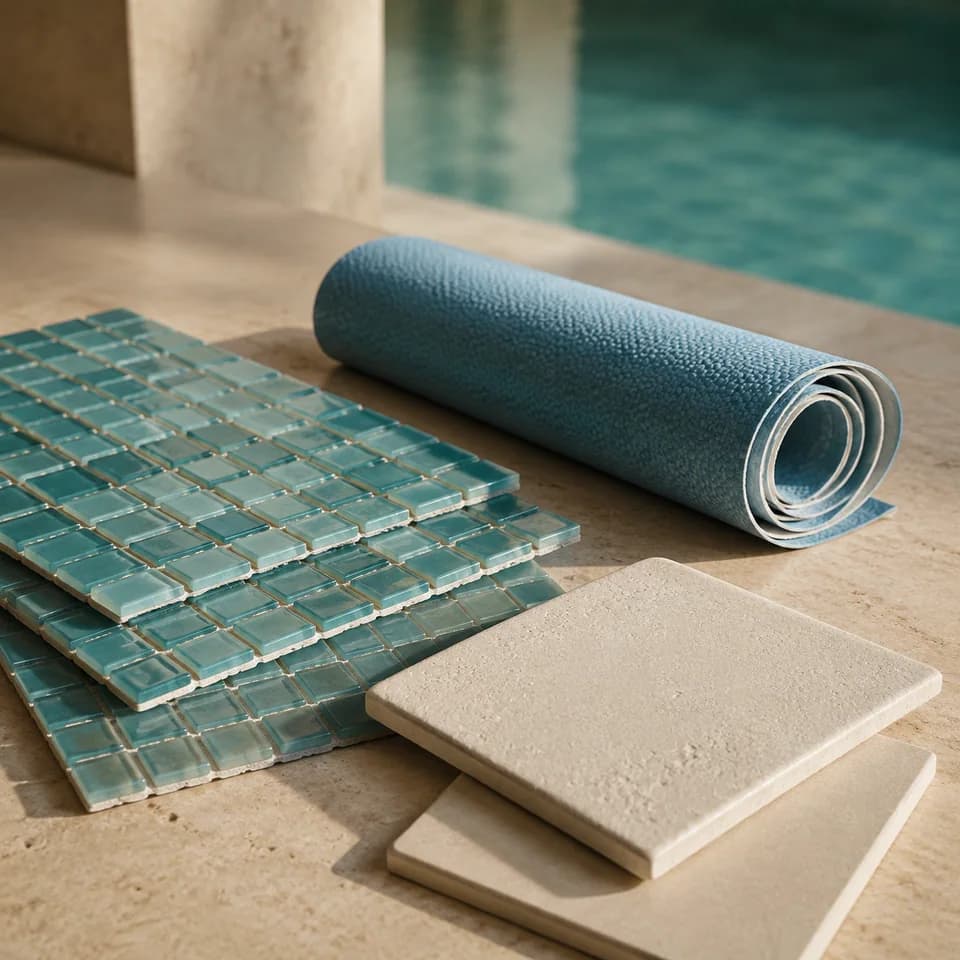
PVC liner, membrane, ceramic tile and glass mosaic: lining materials that make the pool watertight and form its finished surface.
View- 20 products
Product category
Olympic Pool Equipment
Olympic pool equipment built to official competition standards, with lane dividers, starting blocks, timing systems and water polo goals.
8 productsProduct category
Pool Mechanical Equipment
Circulation pumps, filters, valves and automation: the mechanical infrastructure that forms the heart of the pool.
65 productsProduct category
Pool Lining Systems
PVC liner, membrane, ceramic tile and glass mosaic: lining materials that make the pool watertight and form its finished surface.
20 products
// 02 · Related service
The work in this article, we deliver from design to handover.
Çilek Havuz service
Swimming Pool Construction
Reinforced-concrete, prefabricated and infinity swimming pools, built turnkey for villa, residential and commercial projects.
Swimming pool construction is a turnkey build in which the site survey, structural and mechanical design, excavation, reinforced-concrete shell, waterproofing, finish, filtration plumbing and commissioning run under a single contract. The written project schedule follows the site survey.
How we work
- 01Initial meeting and site surveyWe inspect the site and listen to the brief.
- 02Design and quotationWe give the cost item by item, in writing.
- 03ExecutionThe same team builds to a written schedule.
- 04Handover and commissioningWe start the systems and explain their use.
- 05Maintenance and technical supportWe provide periodic maintenance and support.
// 03 · Guides
On Pool Construction, more articles to read.
First the articles directly related to this one, then the newest articles on the topic.
 Pool Construction
Pool sizes and depths: how to choose the right size
Common residential pool sizes are 3x6, 4x8, 5x10 and 6x12 metres. Depth is planned between 1.20 and 1.80 metres, depending on who will use the pool and how.
View- 4 September 2026
- 9 min read
 Pool Construction
Natural Swimming Pond: Biological Filtration
A natural swimming pond keeps water clean with plants and microorganisms instead of chlorine. We explain how biological filtration works and how to plan one.
View- 5 May 2026
- 5 min read
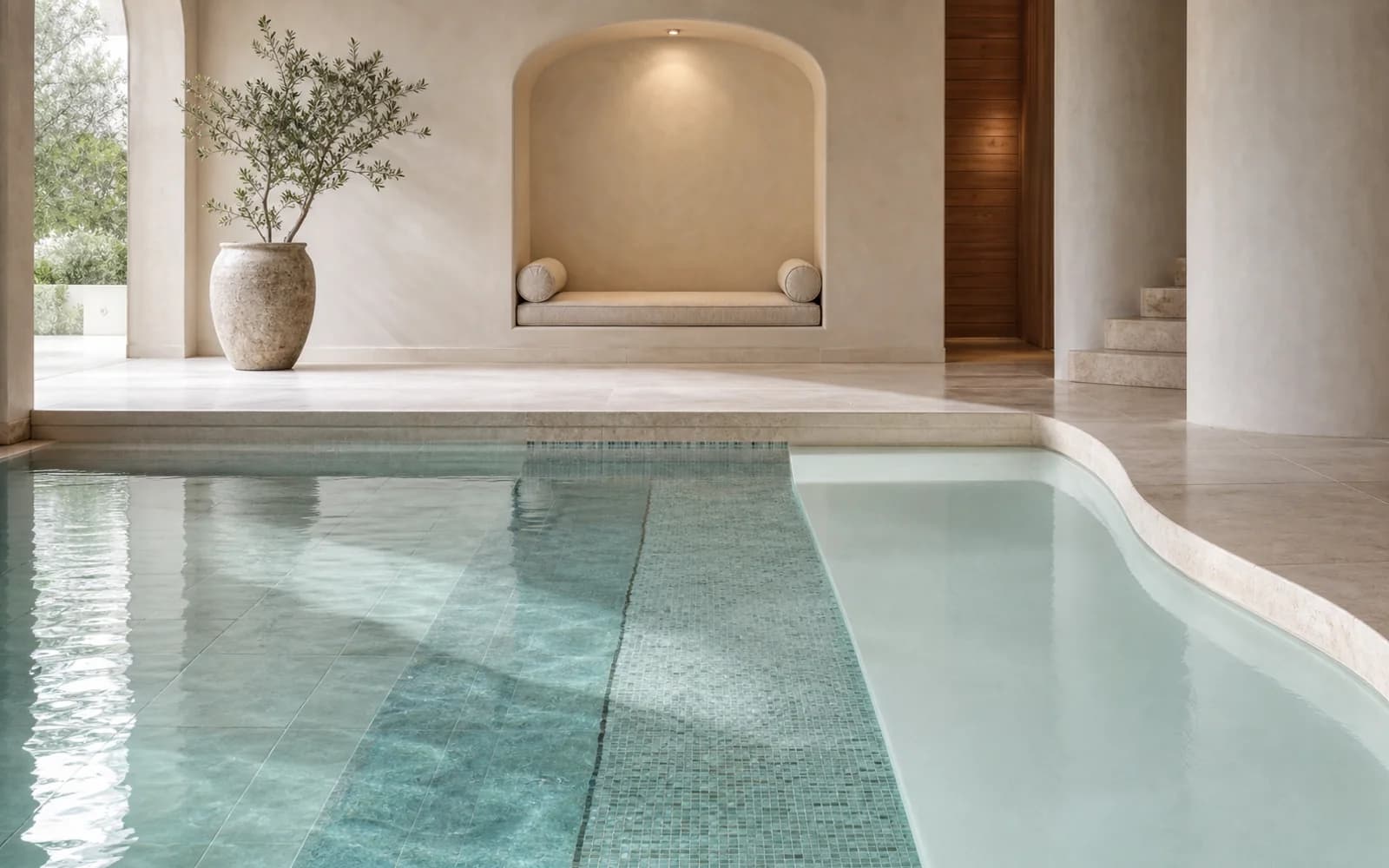 Pool Construction
Pool Finishing Options: Ceramic, Glass Mosaic, Liner
Pool finishes differ in looks, durability, maintenance and cost. We compare ceramic, glass mosaic and liner to help you pick the right surface.
View- 8 May 2026
- 5 min read
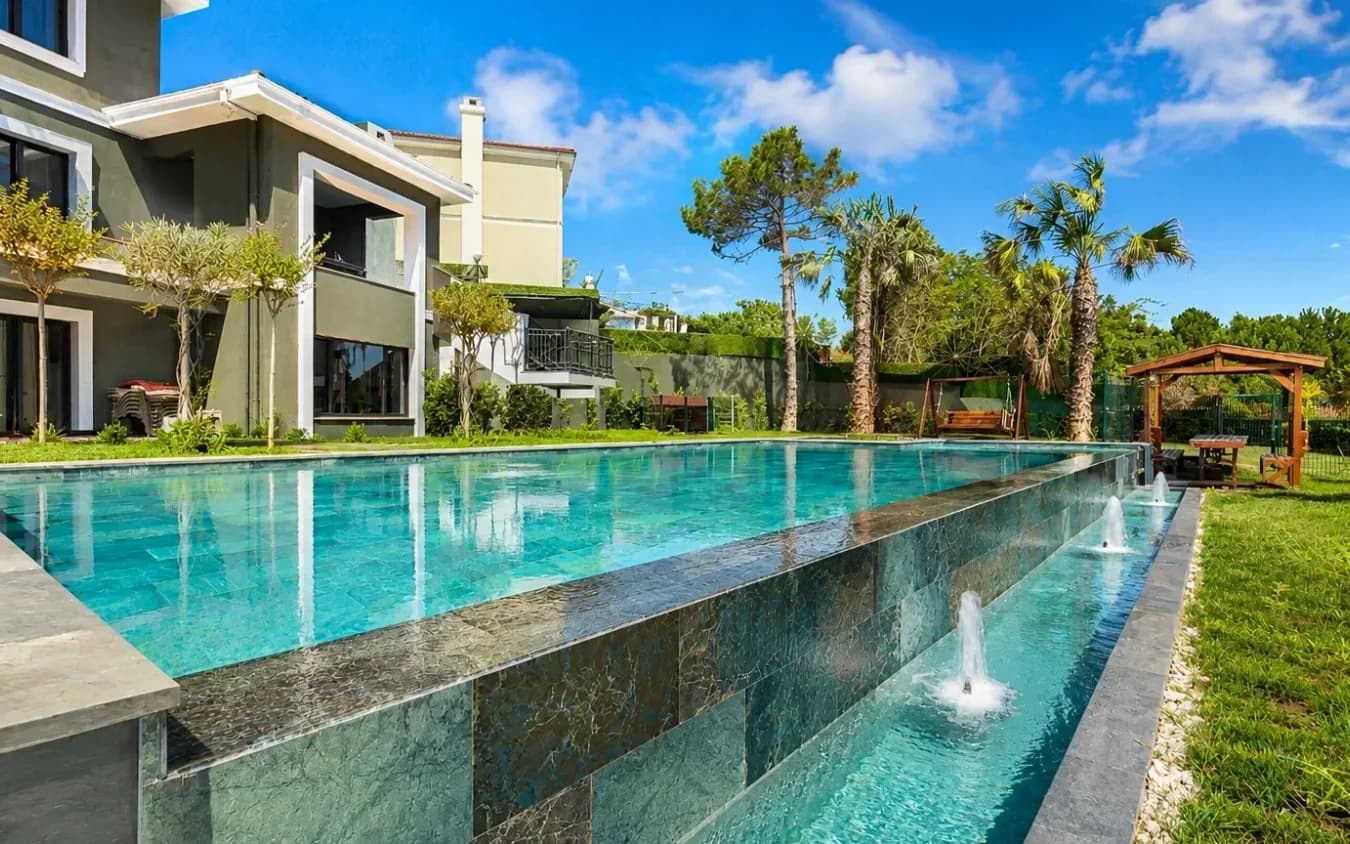 Pool Construction
Choosing Pool Showers and Waterfalls: Shower Types, Water Curtains and Plumbing Needs
Choosing a pool shower, waterfall or water curtain depends on the material, where the water comes from and where it is mounted. We compare solar and stainless steel shower types and their pump and plumbing needs.
View- 2 October 2026
- 8 min read
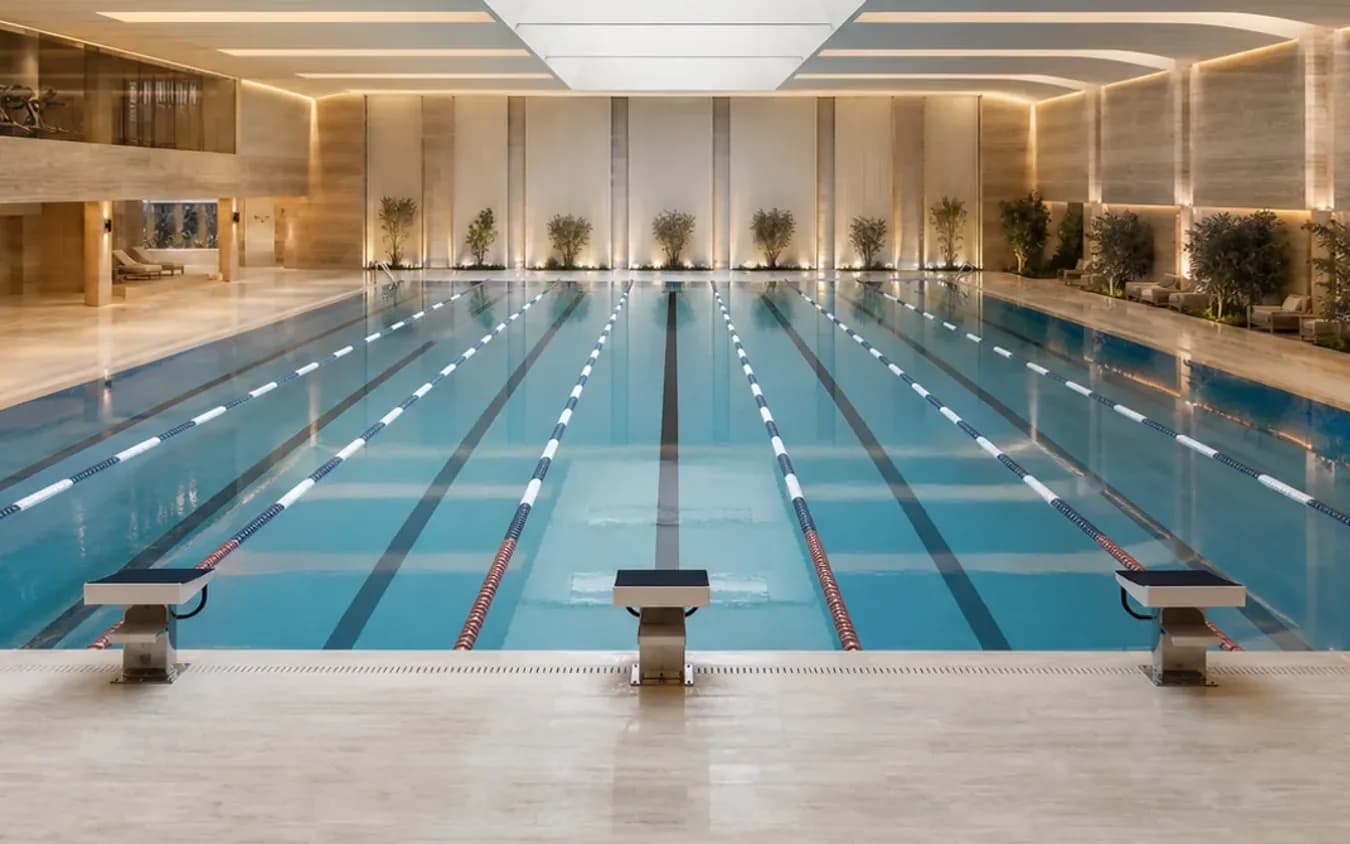 Pool Construction
Competition Pool Equipment: Which Pool Needs Which Equipment?
Starting blocks, lane ropes, warning and turn systems, underwater speakers and water polo goals are chosen according to how the pool is used. We explain which dimensions we check for each item.
View- 2 October 2026
- 7 min read
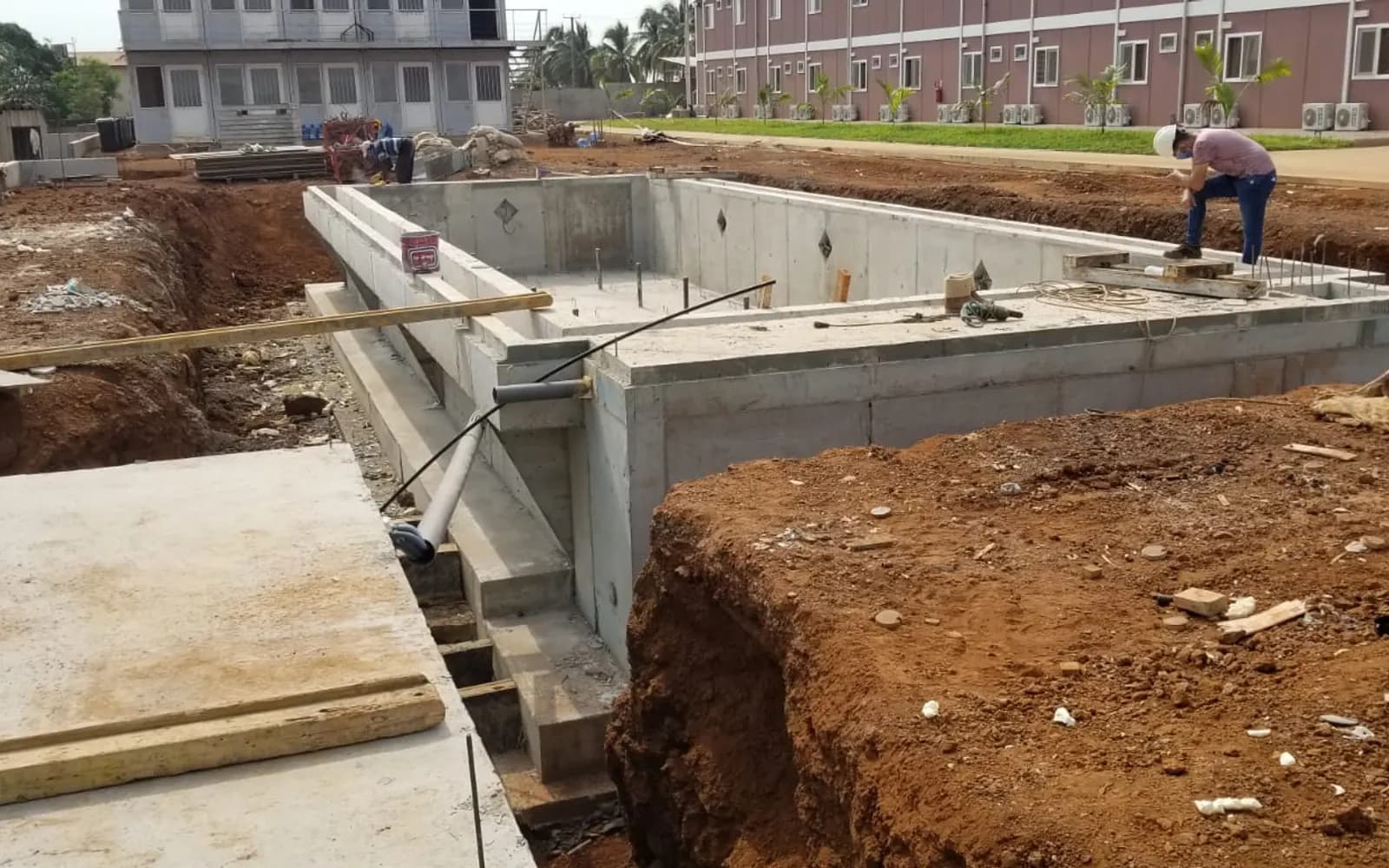 Pool Construction
Building a pool or spa abroad: what drives the cost of an international project?
A pool, hammam or spa project delivered abroad from Turkey has no single price per square metre. We cover design, equipment, shipping, customs and schedule.
View- 29 September 2026
- 8 min read
- Pool Construction · 4 September 2026Pool sizes and depths: how to choose the right sizeCommon residential pool sizes are 3x6, 4x8, 5x10 and 6x12 metres. Depth is planned between 1.20 and 1.80 metres, depending on who will use the pool and how.9 min read
- Pool Construction · 5 May 2026Natural Swimming Pond: Biological FiltrationA natural swimming pond keeps water clean with plants and microorganisms instead of chlorine. We explain how biological filtration works and how to plan one.5 min read
- Pool Construction · 8 May 2026Pool Finishing Options: Ceramic, Glass Mosaic, LinerPool finishes differ in looks, durability, maintenance and cost. We compare ceramic, glass mosaic and liner to help you pick the right surface.5 min read
- Pool Construction · 2 October 2026Choosing Pool Showers and Waterfalls: Shower Types, Water Curtains and Plumbing NeedsChoosing a pool shower, waterfall or water curtain depends on the material, where the water comes from and where it is mounted. We compare solar and stainless steel shower types and their pump and plumbing needs.8 min read
- Pool Construction · 2 October 2026Competition Pool Equipment: Which Pool Needs Which Equipment?Starting blocks, lane ropes, warning and turn systems, underwater speakers and water polo goals are chosen according to how the pool is used. We explain which dimensions we check for each item.7 min read
- Pool Construction · 29 September 2026Building a pool or spa abroad: what drives the cost of an international project?A pool, hammam or spa project delivered abroad from Turkey has no single price per square metre. We cover design, equipment, shipping, customs and schedule.8 min read
// 04 · Company & Contact
To talk about your project, call or write to us.
Legal Name
Çilek Havuz
Founded
1998 · Istanbul
Head Office
Çilek Plaza, Eyüp Sultan Mah. Yakacık Cd. Feshane Cd. No: 2 D:4 D:1, 34885 Sancaktepe / İstanbul
Service Area
All of Türkiye · exports to 14 countries
Branches
Kyrgyzstan · Egypt · Algeria · Iraq
Showroom
Plan a showroom visit
At our showroom in Çilek Plaza, Sancaktepe, you can discuss your project with our team. We recommend booking an appointment by phone before your visit.
Working Hours
- Monday – Friday · 08:00 – 17:30
- Saturday · 08:00 – 12:30
- Closed on Sunday
Frequently Asked Questions
About Olympic and Semi-Olympic Pool Dimensions and Standards, frequently asked questions.
Çilek Havuz Corporate
Pool and Wellness Engineering
- Response Time
- Same day
- Channels
- Phone · Email · WhatsApp
If the answer you are looking for is not here, send your question directly to us and our team will reply as soon as possible.
+90 216 475 39 37In competition the water is kept within the 25-28 °C band; artistic swimming and water polo have their own ranges. Heating capacity and water turnover are calculated together to hold this band. Whichever discipline the facility will host, the target temperature is written into the project from the start.
Çilek Havuz Corporate
Because a competition pool is used by many people, its turnover is kept much shorter than a residential pool's: 4-6 hours. Filters, pumps and balance tank are sized together for this time. For a 3,750 m³ pool, this means a flow rate of 600-900 m³ per hour.
Çilek Havuz Corporate
Official Olympic competition requires 50 metres, but most club and school training takes place in 25-metre pools. Length is decided by the plot, the budget and the intended use; if licensed competition is not the aim, 25 metres is enough for most facilities.
Çilek Havuz Corporate
Yes, starting blocks and touch timing panels are concentrated at one end. Depth and equipment layout at this end are designed with start safety in mind. Even the panel thickness is included in the 50-metre dimension. For this reason the two ends are planned separately in terms of geometry and equipment.
Çilek Havuz Corporate
A pool that will host competitions must comply with the relevant swimming federation's rules on dimensions and equipment. Building permits and facility approvals are also required. Which approvals are needed depends on the intended use and the operating body. Clarifying this at the start of the project avoids expensive changes after the concrete is poured.
Çilek Havuz Corporate
A large water volume, high filtration capacity and a constant temperature raise operating costs. Variable-speed pumps, heat-recovery ventilation and a pool cover are the main items that reduce them. All three should be decided at the project stage; adding them later is both difficult and expensive.
Çilek Havuz Corporate
At the standard size with 10 lanes and a depth of 3 metres, about 3,750 m³, that is 3,750 tonnes of water, is needed. Depending on mains capacity, the first fill takes days; for this reason the filling plan, water supply and, if necessary, tanker support are scheduled at the start of the work.
Çilek Havuz Corporate
Heating is provided with a system of several units. A central boiler via plate heat exchangers or high-capacity heat pump groups work together with heat-recovery ventilation in indoor facilities. The cost of keeping the water within the 25-28 °C band is managed through operating decisions such as a cover and a night regime.
Çilek Havuz Corporate
When the facility is complete, dimensions, depth, temperature and equipment are measured on site by the relevant federation's technical panel. The pool is opened to competition with a compliance report. Because details such as panel thickness and the starting platforms are checked in this survey, running the project to the set of standards from the start is the way to obtain approval in a single pass.
Çilek Havuz Corporate