

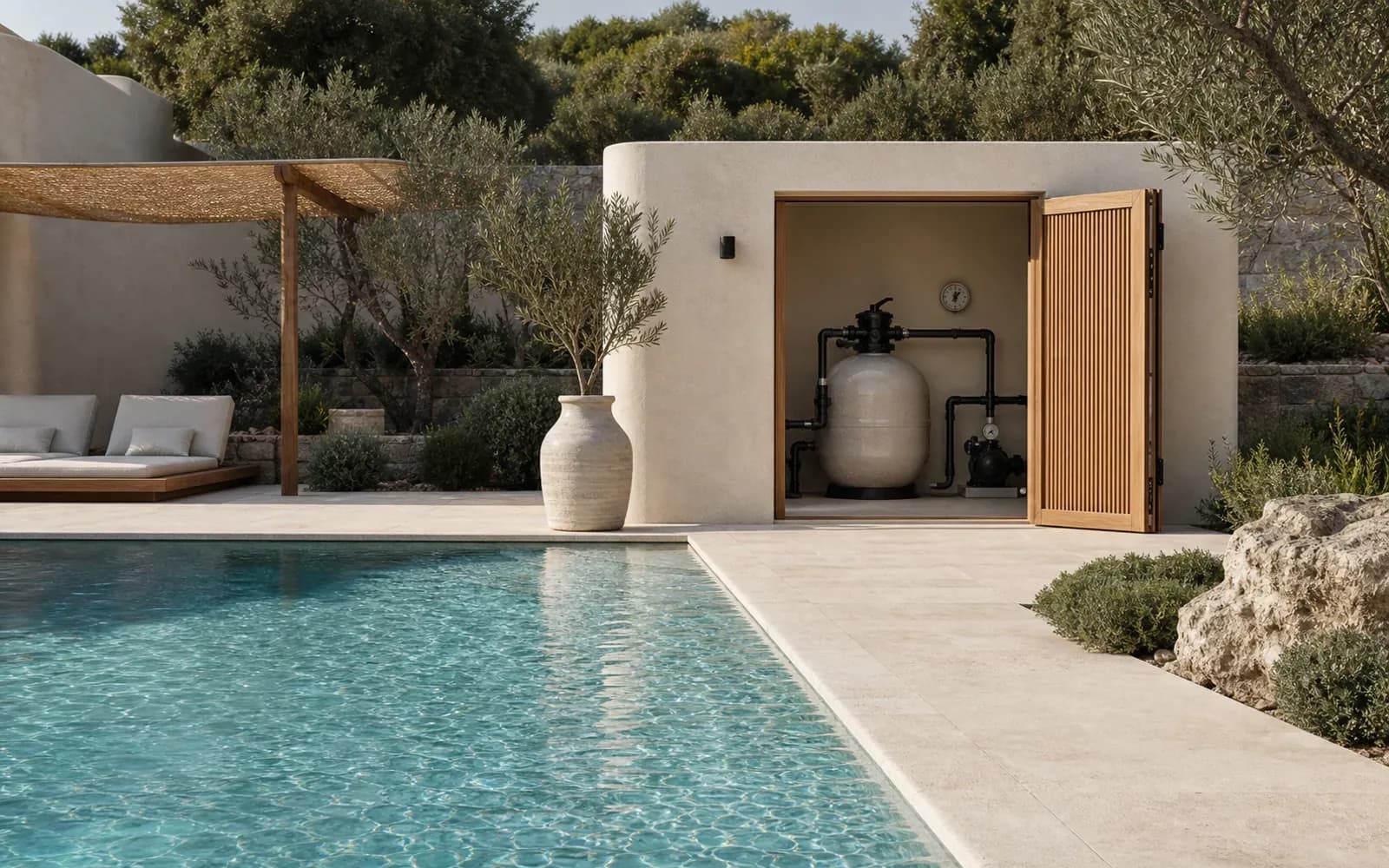
Pool Filter Backwashing: A Step-by-Step Multiport Valve Guide
Backwashing cleans your sand filter, but done wrong it drains and damages it. We explain each 6-way valve position and when to read the pressure gauge.
Project Manager · Mechatronics Engineer · Çilek Havuz
- Published
- Updated
- Reading
- 7 min read
- Category
- Maintenance
Backwashing cleans your sand filter, but done wrong it drains and damages it. We explain each 6-way valve position and when to read the pressure gauge.
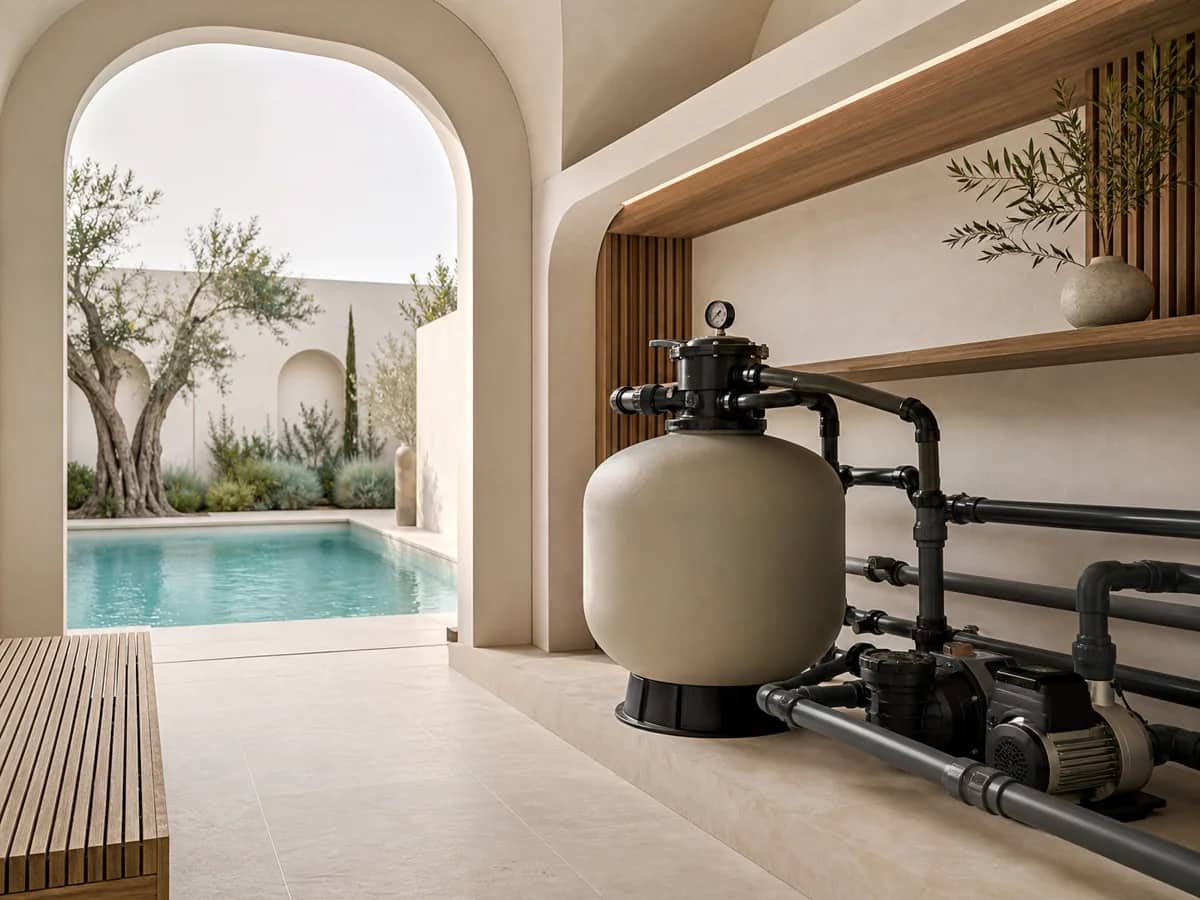
Your sand filter is the lungs of the pool.
As water passes through the sand bed inside it, dirt, dust and microscopic particles are trapped between the grains of sand, and clean water returns to the pool. Over time the sand bed fills up with this dirt and clogs. Backwashing is the process of reversing the direction of flow to dislodge this accumulated dirt from the sand bed and discharge it to the waste line.
As the name says: in normal filtration, water enters the sand bed from the top and leaves from the bottom. In backwashing this direction is reversed; water is pushed from the bottom upwards, lifts the sand bed, loosens the dirt trapped between the grains and sends the dirty water directly to the sewer or the waste line. This water does not return to the pool, because it is dirty. How practical this process will be is decided at the pool construction stage: the position of the valve group and the diameter of the waste line turn backwashing either into a two-minute routine or into a chore every time.
Backwashing is a routine job, but it is one of the maintenance tasks most often done wrong. When done wrong, it either does not clean the filter at all or lets filter sand escape into the pool and cloud the water.
The multiport valve on top of your sand filter (usually with 6 positions) determines where the water goes.
Before switching to backwash, know what each position does. FILTER (Filtration): the normal operating position; water passes through the sand and is cleaned. BACKWASH (Backwashing): reverses the flow and sends the dirt to waste.
RINSE (Rinsing): after backwashing, it resettles the sand bed and sweeps the remaining dirt to waste; if skipped, sand escapes into the pool, which we explain separately below. WASTE or DRAIN (Waste/Drain): sends water directly to waste without passing it through the filter at all; used when emptying the pool or when vacuuming the floor after flocculation.
RECIRCULATE (Recirculation): returns water to the pool without passing it through the sand; used when the filter is faulty or during some chemical treatments. CLOSED (Closed): shuts off all flow, is used for equipment maintenance, and the pump is never run in this position. The pump is stopped every time before the valve is turned; a valve turned while the pump is running damages its seals and the sand bed.
The pressure gauge tells you when to backwash.
The gauge is the pressure indicator on the filter and shows how clogged the sand bed is. When the filter is clean, that is, just after a backwash, the reading on the gauge is your clean starting pressure; note this value, because it is your reference.
As the sand bed fills with dirt, water passes through with more difficulty and the pressure rises. The general rule is this: when the gauge rises approximately 0.3-0.5 bar above the clean starting value, it is time to backwash. For example, if the clean pressure is 1.0 bar, you should backwash when the gauge reaches 1.3-1.5 bar. This rise is the most reliable sign that the sand bed is clogged.
Manage the pressure with the gauge, not the calendar. 'I backwash every week' is not a good rule; with heavy use it may be needed more than once a week, and in quiet periods once every two weeks. Reading the gauge regularly and deciding by the pressure threshold both protects the filter and prevents unnecessary waste of water and energy.
The correct sequence is as follows.
Step one: stop the pump. Never turn the valve while the pump is running. Step two: prepare the waste line; open the backwash hose or set the waste valve to the appropriate position, because dirty water will be discharged. Step three: set the multiport valve to the BACKWASH position.
Step four: start the pump and begin backwashing. Watch the water flowing through the sight glass on the valve; water that runs cloudy and dirty at first gradually clears. Continue backwashing until the water runs clear, usually 1.5-3 minutes. When you see clear water, the dirt in the sand bed has been dislodged.
Step five: stop the pump again. When the backwash is finished, do not switch the valve straight to FILTER; the RINSE step comes first, and we explain why in the next section. Because the dirty water is discharged, the pool's water level drops during backwashing; top up the water when the process is finished.
The step most often skipped, and the one that causes the most trouble afterwards, is RINSE.
During backwashing the sand bed lifts, the grains shift and settle into an uneven position. If you switch the valve to FILTER and start the pump right after backwashing, loose sand from the lifted bed and the remaining dirt escape directly into the pool and cloud the water.
The RINSE step prevents exactly this. When the backwash is finished, stop the pump, set the valve to RINSE and run the pump for 30-60 seconds. This short rinse settles the lifted sand bed properly again and sweeps the last dirt particles left in the sand bed after backwashing to the waste line, not to the pool.
The classic scenario for those who skip RINSE is this: the filter has been cleaned but the water suddenly turns cloudy, and fine sand can even be seen on the floor. The cause is almost always the skipped rinse. When RINSE is finished, stop the pump, set the valve to FILTER and return to normal filtration. Check the gauge; it should now be back at your clean starting pressure.
Giving a fixed frequency is not correct, because the need depends on use.
The right measure is the pressure gauge: backwash when the pressure rises 0.3-0.5 bar above the clean starting pressure. In heavy summer use this may mean once a week or more often, and in quiet periods once every two weeks.
Events such as a storm, wind-blown dust, a day with many guests or vacuuming the floor after flocculation dirty the filter quickly and may call for an extra backwash. Also, if the clarity of the water is dropping and the flow is weakening, you can tell the filter is clogged even without looking at the gauge. Read the need for backwashing not from a single rule, but from both the gauge and the behaviour of the water.
Backwashing more often than necessary can also be a mistake; every backwash drains a considerable amount of water from the pool, and topping this water up means both water and chemical costs. Overly frequent backwashing also removes the light layer of dirt the sand bed needs for correct filtration. The measure is once again the gauge: do not wash before the threshold is reached.
Let us put it in figures: a typical backwash and rinse cycle of a media (sand) filter uses approximately 700 litres of water.
The cleaning routine of a cartridge filter system (removing and washing the cartridge) corresponds to approximately 60 litres of water. The difference is close to 12 times; the two filter types differ in the water bill as well as in maintenance effort.
Waiting for the gauge threshold therefore also has a direct bearing on the water bill: every backwash done more often than necessary restarts a cycle of approximately 700 litres in a sand filter system. When choosing between a sand and a cartridge filter, this difference in water cost is an item to be weighed as much as ease of maintenance.
Next step
Let us discuss your project in the way that suits you best.
You can fill in the form for a written quote, schedule a video project presentation or ask us to survey your project site.
Get a Quote
Send us your dimensions and expectations in writing.
Online presentation
Video project presentation
On-site survey
Inspection at your project site
Image gallery
Photos: 04
 01
01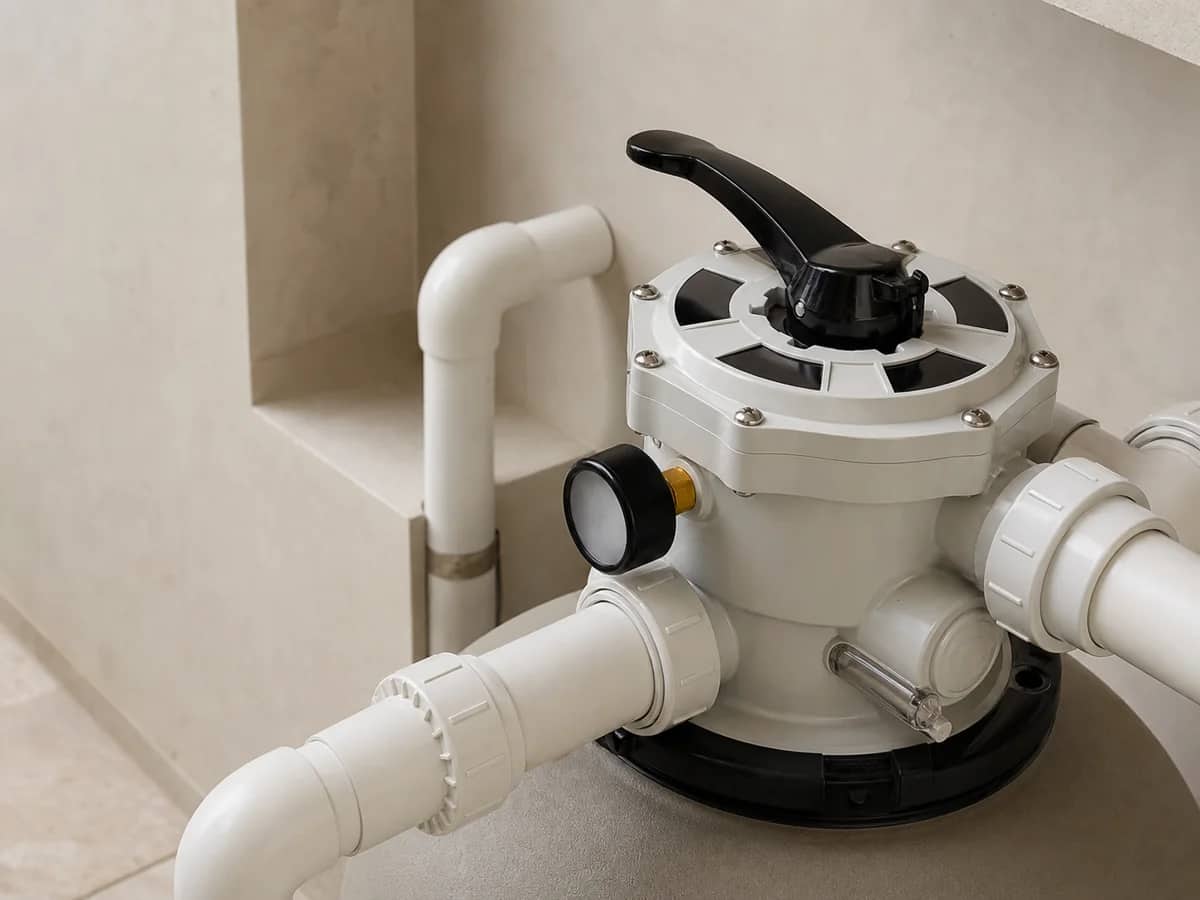 02
02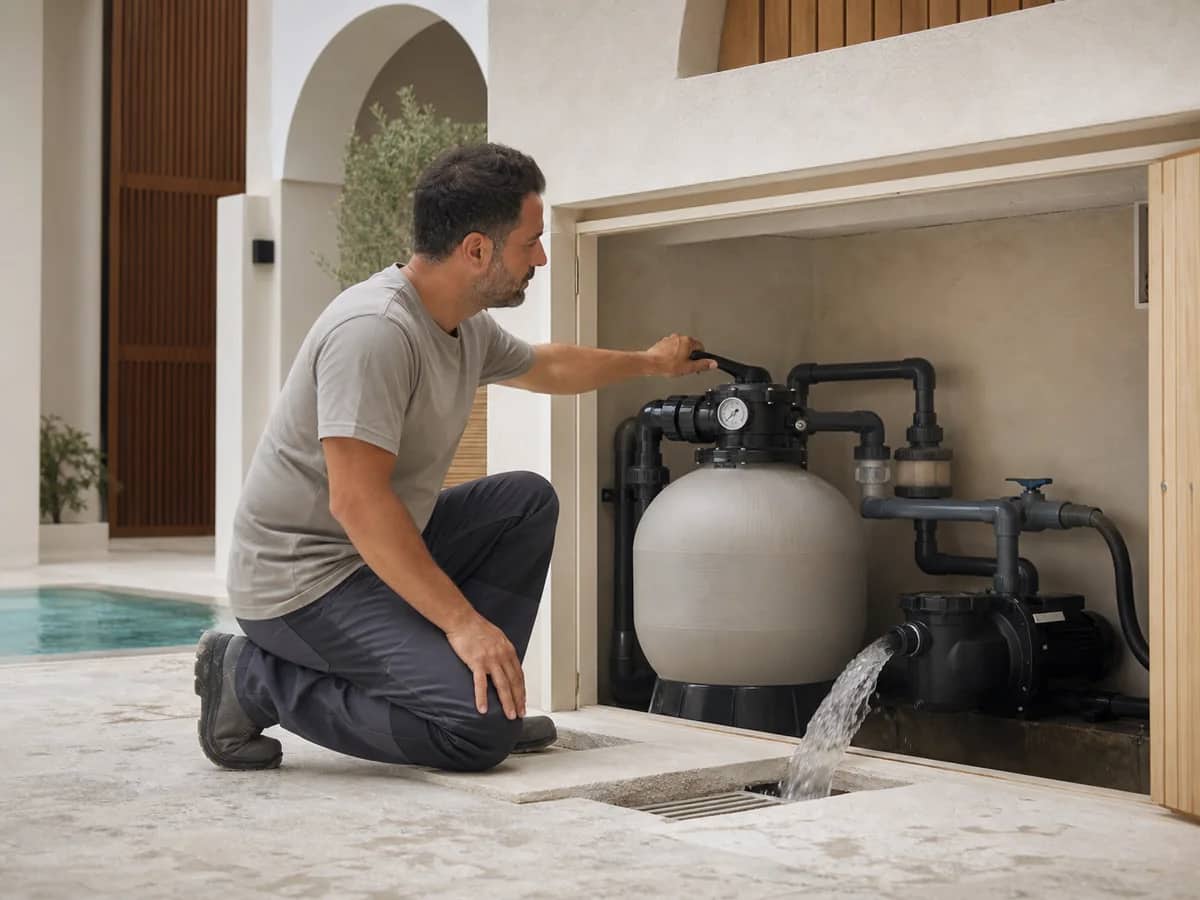 03
03 04
04// 01 · Product groups
Compare the products on this topic on their category pages.
Each card leads to a product category; models, technical sheets and list prices are there.
 Product category
Pool Filter Models
Sand filters and cartridge filters for residential pools. A sand filter is cleaned by backwashing; a cartridge filter is taken out and rinsed, and it fits a small plant room. The filter is chosen together with the pump flow rate. Filters for commercial and public pools are on the mechanical equipment page.
View- Product category
Pool Valve Models
Manual and automatic multiport valves for sand filters, a hydraulic safety valve for the waste line of the automatic valve, and PVC ball valves for the pipework. The multiport valve is chosen by the filter's valve inlet, the ball valve by the pipe diameter. The pressure gauge panel and PVC pipe clamp set are on this page too.
View- 6 products
- Product category
Pool Mechanical Equipment
Circulation pumps, filters, valves and automation: the mechanical infrastructure that forms the heart of the pool.
View- 65 products
Product category
Pool Filter Models
Sand filters and cartridge filters for residential pools. A sand filter is cleaned by backwashing; a cartridge filter is taken out and rinsed, and it fits a small plant room. The filter is chosen together with the pump flow rate. Filters for commercial and public pools are on the mechanical equipment page.
Product category
Pool Valve Models
Manual and automatic multiport valves for sand filters, a hydraulic safety valve for the waste line of the automatic valve, and PVC ball valves for the pipework. The multiport valve is chosen by the filter's valve inlet, the ball valve by the pipe diameter. The pressure gauge panel and PVC pipe clamp set are on this page too.
6 productsProduct category
Pool Mechanical Equipment
Circulation pumps, filters, valves and automation: the mechanical infrastructure that forms the heart of the pool.
65 products
// 02 · Related service
The work in this article, we deliver from design to handover.
Çilek Havuz service
Pool Maintenance
Water chemistry, equipment and periodic maintenance.
How we work
- 01Initial meeting and site surveyWe inspect the site and listen to the brief.
- 02Design and quotationWe give the cost item by item, in writing.
- 03ExecutionThe same team builds to a written schedule.
- 04Handover and commissioningWe start the systems and explain their use.
- 05Maintenance and technical supportWe provide periodic maintenance and support.
// 03 · Guides
On Maintenance, more articles to read.
First the articles directly related to this one, then the newest articles on the topic.
 Maintenance
Pool Equipment Buying Guide: Pumps, Filtration, Disinfection, Robots and Automation
Start pool equipment shopping with the total cost of ownership, not the lowest price. We compare five categories, from pumps to automation, on one page.
View- 27 August 2026
- 9 min read
 Maintenance
Pool filter sand replacement: when, how, how many kilograms?
Pool filter sand replacement is the complete emptying and renewal of the media in the tank. Symptoms, lifespan ranges, disassembly steps and kilograms by tank diameter.
View- 9 September 2026
- 9 min read
 Maintenance
Pool Filter Types: Comparing Sand, Glass and Zeolite Media
The filter media in the tank sets your pool's water clarity. We compare sand, glass and zeolite by filtration fineness, lifespan, backwash needs and cost.
View- 17 April 2026
- 5 min read
 Maintenance
Pool clarifier and flocculant: differences, uses and selection
Clarification, flocculation and filter compatibility compared for cloudy pool water. The right choice follows the product instructions, not the name.
View- 13 September 2026
- 3 min read
 Maintenance
Chlorine tablets and granules: dissolution, use and selection
Chlorine products differ in active ingredient, concentration and intended use. Shape alone does not determine strength or dosing method.
View- 13 September 2026
- 3 min read
 Maintenance
Winter pool chemicals: purpose, limits and product selection
Winter treatment depends on the actual pool system and product formulation. Water care, equipment freeze protection and ongoing checks are separate tasks.
View- 13 September 2026
- 3 min read
- Maintenance · 27 August 2026Pool Equipment Buying Guide: Pumps, Filtration, Disinfection, Robots and AutomationStart pool equipment shopping with the total cost of ownership, not the lowest price. We compare five categories, from pumps to automation, on one page.9 min read
- Maintenance · 9 September 2026Pool filter sand replacement: when, how, how many kilograms?Pool filter sand replacement is the complete emptying and renewal of the media in the tank. Symptoms, lifespan ranges, disassembly steps and kilograms by tank diameter.9 min read
- Maintenance · 17 April 2026Pool Filter Types: Comparing Sand, Glass and Zeolite MediaThe filter media in the tank sets your pool's water clarity. We compare sand, glass and zeolite by filtration fineness, lifespan, backwash needs and cost.5 min read
- Maintenance · 13 September 2026Pool clarifier and flocculant: differences, uses and selectionClarification, flocculation and filter compatibility compared for cloudy pool water. The right choice follows the product instructions, not the name.3 min read
- Maintenance · 13 September 2026Chlorine tablets and granules: dissolution, use and selectionChlorine products differ in active ingredient, concentration and intended use. Shape alone does not determine strength or dosing method.3 min read
- Maintenance · 13 September 2026Winter pool chemicals: purpose, limits and product selectionWinter treatment depends on the actual pool system and product formulation. Water care, equipment freeze protection and ongoing checks are separate tasks.3 min read
// 04 · Company & Contact
To talk about your project, call or write to us.
Legal Name
Çilek Havuz
Founded
1998 · Istanbul
Head Office
Çilek Plaza, Eyüp Sultan Mah. Yakacık Cd. Feshane Cd. No: 2 D:4 D:1, 34885 Sancaktepe / İstanbul
Service Area
All of Türkiye · exports to 14 countries
Branches
Kyrgyzstan · Egypt · Algeria · Iraq
Showroom
Plan a showroom visit
At our showroom in Çilek Plaza, Sancaktepe, you can discuss your project with our team. We recommend booking an appointment by phone before your visit.
Working Hours
- Monday – Friday · 08:00 – 17:30
- Saturday · 08:00 – 12:30
- Closed on Sunday
Frequently Asked Questions
About Pool Filter Backwashing, frequently asked questions.
Çilek Havuz Corporate
Pool and Wellness Engineering
- Response Time
- Same day
- Channels
- Phone · Email · WhatsApp
If the answer you are looking for is not here, send your question directly to us and our team will reply as soon as possible.
+90 216 475 39 37Every backwash discharges a visible amount of water from the pool and the water level drops. This is why you need to top up the water after the process. Backwashing more often than necessary means both water costs and the cost of chemicals to rebalance it. Backwashing according to the gauge threshold therefore prevents waste.
Çilek Havuz Corporate
Backwashing cleans the dirt in the sand bed, but over time the edges of the sand grains wear down. The grains become rounded and their filtering capacity drops. At that point backwashing is no longer enough. If the clean starting pressure keeps rising and the water never quite clears, it may be time to renew the sand. The life of the sand varies with the intensity of use.
Çilek Havuz Corporate
The most common cause is skipping the RINSE step. When you return to filtration without rinsing, loose sand from the lifted sand bed escapes into the pool. If there is a more persistent problem, there may be a crack in the laterals (distributor pipes) inside the filter. First check your RINSE habit; if the problem continues, the inside of the filter needs to be inspected.
Çilek Havuz Corporate
Pressure that never rises is not always good news. A blockage before the pump, a closed valve or a clogged skimmer basket can also reduce the flow and therefore the pressure. If you notice the water flow weakening, look at the whole flow as well as the gauge. Abnormally low pressure can be a sign of a fault.
Çilek Havuz Corporate
In systems without a sight glass, the backwash duration is set by a general time interval, usually a few minutes. You cannot judge it by the clearing of the waste water. If possible, confirm that the water has cleared by observing the outlet of the waste line. An overly long backwash is an unnecessary loss of water, while a short backwash does not fully clean the sand.
Çilek Havuz Corporate
No; backwashing is specific to sand filters and some diatomaceous earth (DE) filters. Cartridge filters are not backwashed; they are cleaned by removing the cartridge and washing it by hand, or by replacing it. Knowing the type of your system determines the correct maintenance method; applying the wrong method can damage the filter.
Çilek Havuz Corporate
Yes, there is a marked difference. A sand filter's backwash and rinse cycle uses approximately 700 litres of water, while a cartridge filter's own cleaning routine corresponds to approximately 60 litres of water. If you consider water cost a priority, this difference is a concrete figure to take into account when choosing the filter type.
Çilek Havuz Corporate
Yes, this value is for a single backwash and rinse cycle. This is why repeating backwashing more often than necessary multiplies this water cost as well. Acting according to the gauge threshold reduces this consumption to a cost incurred only when it is really needed and prevents unnecessary waste of water.
Çilek Havuz Corporate