

Pool filter sand replacement: when, how, how many kilograms?
Pool filter sand replacement is the complete emptying and renewal of the media in the tank. Symptoms, lifespan ranges, disassembly steps and kilograms by tank diameter.
Pool filter sand replacement is the complete emptying and renewal of the media in the tank. Symptoms, lifespan ranges, disassembly steps and kilograms by tank diameter.
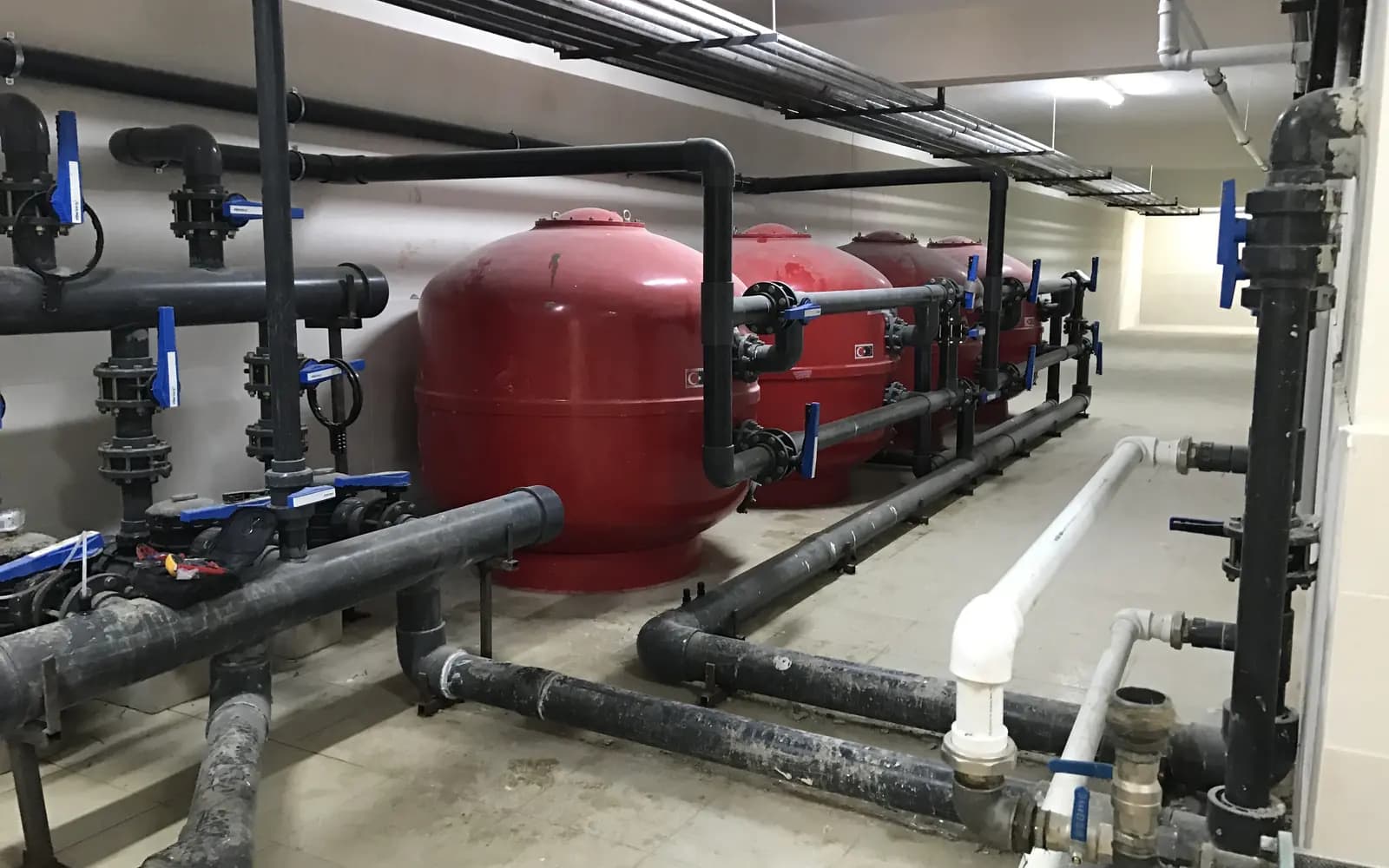
Pool filter sand replacement is the process of completely emptying all the fill media in the sand filter tank and replacing it with new silica sand, glass media or zeolite. Pool sand replacement is not a single action but a sequence of steps: stopping circulation, draining the tank, removing the top cover or the multiport valve, taking out the old pool filter sand, checking the collector laterals at the tank base, and refilling with the kilogram amount calculated for the tank diameter. Once the process is finished, the pool filter returns to the pressure and flow values it had at initial commissioning.
This process is not the same as backwashing. Backwashing is reversing the flow direction to flush the dirt held in the bed out to the drain, and it is part of the weekly pool maintenance programme; it cleans the media but does not replace it. This article also does not discuss which of sand, glass or zeolite to choose; the subject is how to recognise when replacement time has arrived and how to carry it out, whatever media is in use.
The decision is not made by calendar but by three measurable symptoms. The first is pressure: the manometer reading taken right after a backwash with clean media is the system's reference, and a rise of about 0.5 bar above this value is accepted as the wash threshold in fast pressure sand filters. If pressure after backwashing no longer returns to its old reference, settling 0.1 to 0.2 bar higher with every wash, the bed has clogged permanently. The second is backwash interval: if a system washed once a week has started needing washing every two or three days, the media is exhausted. The third is clarity: if pool water with correctly balanced chemistry stays cloudy despite chemical intervention, and fine particle passage is seen at the filter outlet, the bed is no longer holding.
| Media | Typical grain size (mm) | Expected lifespan (years) | Replacement sign |
|---|---|---|---|
| Silica sand | 0.4 to 0.8 | 5 to 7 | Grains losing their edges and rounding off, backwash interval halving |
| Glass media | 0.5 to 1.0 | 10 to 12 | Flow drop, clumping on the bed surface |
| Zeolite | 0.5 to 1.0 | 6 to 8 | Ammonium-holding capacity filling up, pressure not dropping after backwash |
A fourth symptom is seen when the tank is opened. If pressing the bed surface by hand moves it as a single rigid piece, and hardened lumps come away in the hand, lime scale and oil have glued the grains together. In this case the media is replaced regardless of remaining lifespan.
Both processes start from the same valve and both lower pressure; that is where the confusion comes from. Backwashing is passing water upward through the bed so the dirt it holds is flushed to the drain. During this, the bed expands, the grains scrub against each other and clean themselves, and flow rises to roughly three times the normal filtration rate; bed expansion is on the order of 30 percent. Once the process finishes, the media stays in place; only the dirt on it has gone.
In sand replacement, the media itself is exhausted. A grain of silica sand is angular in its early years, and the gaps between the edges mechanically trap fine particles. Years of backwash friction wear these edges down, the grain becomes rounded, and the pore structure becomes uniform; water now passes through the bed with little resistance. Backwashing cannot reverse this wear. Likewise, a bed glued together by lime scale cannot be loosened by washing either, because expansion cannot separate a mass that has become one solid piece.
Glossary of terms
- Silica sand
- Washed and sieved quartz sand with a high silicon dioxide content. In pool filters, a sieved grade in the 0.4 to 0.8 mm range is used for the main layer.
- Effective grain size
- The grain diameter below which 10 percent by mass falls, in sieve analysis. Given as 0.5 to 1.2 mm in rapid sand filters, this is the value that sets the bed's retention limit.
- Collector (lateral)
- Slotted arms branching star-shaped from the central pipe at the tank base. They collect filtered water and, during backwash, distribute water evenly into the bed. Slot width is smaller than a sand grain.
- Gravel underbed
- A layer of washed gravel, typically 2 to 4 mm, covering the collector. It protects the collector arms from the weight of the sand and spreads flow during backwash.
- Channeling
- The formation of low-resistance paths preferred by water within the bed. Water passes through these channels unfiltered; the rest of the bed remains unused.
- Media cleaner
- A chemical added to circulation water to dissolve oil, sunscreen residue and lime scale on the bed surface. Delays replacement, but does not renew exhausted media.
In pool sand replacement, the order is binding. Opening the tank under pressure can end with the cover bolts flying off; for this reason the first three items are never skipped.
Order of disassembly and refill
- Stop the pump, cut its power and lock it out at the panel. Close the suction and discharge valves between the pool and the filter.
- Zero the tank's pressure by opening the manometer and the air bleed valve. No bolt is removed until the manometer reads zero.
- Open the drain plug at the bottom of the tank and empty it completely. Wait for all the water to drain out; most of the weight is this water.
- Remove the multiport valve or the top cover. While removing the valve, cover the central pipe with a cloth; if sand gets into it, the valve's channels will clog.
- Remove the old media. In small tanks use a wet vacuum or a long-handled scoop; in large tanks use the tank's side access port. Remaining residue is removed by hosing out the tank.
- Check the collector. An arm that is broken, cracked, or has widened slots is replaced. Sand passing through a broken collector goes into the pool or the drain during backwash.
- Position the central pipe upright and centred, and cap its top opening. Fill the tank about halfway with clean water; this water stops the poured media from striking the collector directly.
- Lay the gravel underbed. Washed 2 to 4 mm gravel is poured to a height that covers the collector arms, spread evenly.
- Fill the main media. For silica sand, choose a 0.4 to 0.8 mm grain size; fill so it does not exceed roughly two-thirds of the tank height. The space left at the top is for bed expansion during backwash.
- Level the surface, clean the cover or valve seal gasket and refit it, and tighten the bolts alternately in sequence with equal torque.
- Set the valve to backwash, run the pump, and wash until the water at the drain is completely clear. Then run in rinse position for 30 to 60 seconds before switching to filter position.
- Mark the pressure read in filter position on the manometer dial. This value is the reference for future wash decisions.
The first backwash of new media is the step most often skipped. Sand from the bag, even when sieved, carries fine dust on it. If this dust enters the system unwashed, the pool water turns milky within the first hours, and the cloudiness is chased with chemicals. Running the first wash until the drain clears removes this problem from the start.
The required amount grows with the square of the tank diameter, so a small difference in diameter creates a large difference in kilograms. The table below gives typical fill amounts for common market tank diameters. The exact value is always on the filter's label or in its user manual; the table is only for rough planning before ordering.
| Tank diameter (mm) | Approximate silica sand (kg) | Gravel underbed (kg) | Number of 25 kg bags |
|---|---|---|---|
| Ø400 | 25 | 0 to 5 | 1 |
| Ø500 | 50 to 75 | 5 to 10 | 2 to 3 |
| Ø600 | 100 to 125 | 10 to 15 | 4 to 5 |
| Ø750 | 200 to 250 | 20 to 25 | 8 to 10 |
| Ø900 | 350 to 400 | 25 to 50 | 14 to 16 |
The amount decision is checked against flow rate as well as volume. Dividing the flow passing through the filter in pool water circulation by the tank's cross-sectional area gives the surface velocity; this is the value that sets tank diameter in pool filter selection. If the existing filter is already running at its limit, increasing bed height during sand replacement does not fix it; since surface velocity stays the same, retention performance stays the same too. Increasing bed height only eats into the expansion space above and leads to media loss during backwash.
Channeling is the common result of these three mistakes. When the bed surface crusts over, or distribution at the base is disrupted, water opens a narrow channel where resistance is lowest and passes through it. The filter appears to be working, pressure may even read normal; but because most of the bed is left out of the flow, retention surface drops by several factors. The only reliable sign of channeling is cloudiness that does not clear despite low pressure. Adding an annual tank opening and surface check to the regular pool maintenance plan makes this picture visible before replacement time actually arrives.
The pool filter is equipment carried over from drinking water treatment. Slow sand filters work with fine sand at 0.15 to 0.30 mm effective grain size and a biological layer; rapid sand filters use coarser sand in the 0.5 to 1.2 mm range, with a bed depth of 0.6 to 1.2 m, and a filtration rate on the order of 3,000 to 6,000 litres per square metre per hour. The pressure sand filter in pool plumbing is the closed-tank form of this second family, operating in the 2 to 5 bar range, and in pressurised systems the wash threshold is a pressure drop of about 0.5 bar.
Backwashing comes from the same source. In water treatment, the wash decision is made by one of three criteria: a set duration, the outlet water turbidity exceeding a limit, or the pressure differential across the bed crossing a threshold. In pool applications, two of these three criteria can be used directly; a visual clarity check replaces turbidity measurement. Water passing evenly through the bed, with no preferential flow paths forming, is defined as the basic requirement of sand filter design. Pool filter sand replacement is the maintenance work that re-establishes this requirement years later; the media itself is a consumable and does not last a lifetime the way a pump or valve does.
Solutions for your project
Explore services and product categories related to this topic.
Company & Contact
To talk about your project, we are one call away.
Legal Name
Çilek Havuz
Founded
1998 · Istanbul
Head Office
Çilek Plaza, Eyüp Sultan Mah. Yakacık Cd. Feshane Cd. No: 2 D:4 D:1, 34885 Sancaktepe / İstanbul
Service Area
All of Türkiye · exports to 14 countries
Related articles
Keep reading.
References
- 1.Sand filter — Wikipedia, 2026
- 2.Rapid sand filter — Wikipedia, 2026
- 3.Swimming pool sanitation — Wikipedia, 2026
- 4.Backwashing (water treatment) — Wikipedia, 2026
- 5.Filtration — Wikipedia, 2026
Frequently Asked Questions
Our readers' most asked; with expert answers.
Çilek Havuz Content & Technical Team
Guides & Technical Content
- Response Time
- Same day
- Channels
- Phone · E-mail · WhatsApp
If the answer you are looking for is not here, send your question directly to us and our team will reply as soon as possible.
Book a free site surveyFor silica sand the typical range is 5 to 7 years; glass media is expected to last 10 to 12 years, zeolite 6 to 8 years. The duration is not fixed. The decision is made when post-backwash pressure no longer returns to its reference, the wash interval shortens, and clarity does not improve.
Çilek Havuz Content & Technical Team
For the main layer in pool filters, 0.4 to 0.8 mm sieved silica sand is common; in rapid sand filters the effective grain size is given as 0.5 to 1.2 mm. Washed gravel of 2 to 4 mm is laid beneath the collector. Fine sand gives high pressure drop, coarse sand gives low retention performance.
Çilek Havuz Content & Technical Team
Common manufacturer tables give roughly 100 to 125 kg of silica sand for an Ø600 mm tank, with 10 to 15 kg of gravel underbed added. Because tank height varies at the same diameter, the exact value should be read from the filter label.
Çilek Havuz Content & Technical Team
A media cleaner delays replacement by dissolving oil and lime scale on the bed surface. It cannot reverse the rounding of grains caused by years of backwash friction. If pressure does not return to its reference after washing, the problem is wear, not dirt, and a cleaner will not help.
Çilek Havuz Content & Technical Team
Fine dust on new media passes into the pool if it enters the system without a first backwash. Run the valve in backwash position until the drain water clears, then run rinse position for 30 to 60 seconds. If cloudiness persists, look for a break in the collector arms.
Çilek Havuz Content & Technical Team