

Pool Cleaning: Choosing the Right Equipment and Building a Routine
Clear water is chemistry's job; a clean pool is mechanics'. We explain which vacuum, brush and skimmer net you need and how to build a lasting routine.
Project Manager · Mechatronics Engineer · Çilek Havuz
- Published
- Updated
- Reading
- 5 min read
- Category
- Maintenance
Clear water is chemistry's job; a clean pool is mechanics'. We explain which vacuum, brush and skimmer net you need and how to build a lasting routine.
Swimming pool maintenance rests on two pillars: water chemistry and physical mechanical cleaning.
Chemistry protects water against invisible microorganisms: bacteria and algae. Physical cleaning extracts visible organic debris, leaves, dust, and pollen. Neither replaces the other; no amount of chlorine will dissolve sunken leaves on the pool floor.
These two pillars are interdependent: decomposing organic matter on the pool floor rapidly consumes free chlorine, driving up chemical costs. A mechanically clean pool maintains chemical balance with significantly less chemical consumption.
Chemical dosing is a separate subject and stays out of this page. The focus here is physical cleaning: the right tools, the right technique and a weekly routine you can actually keep up.
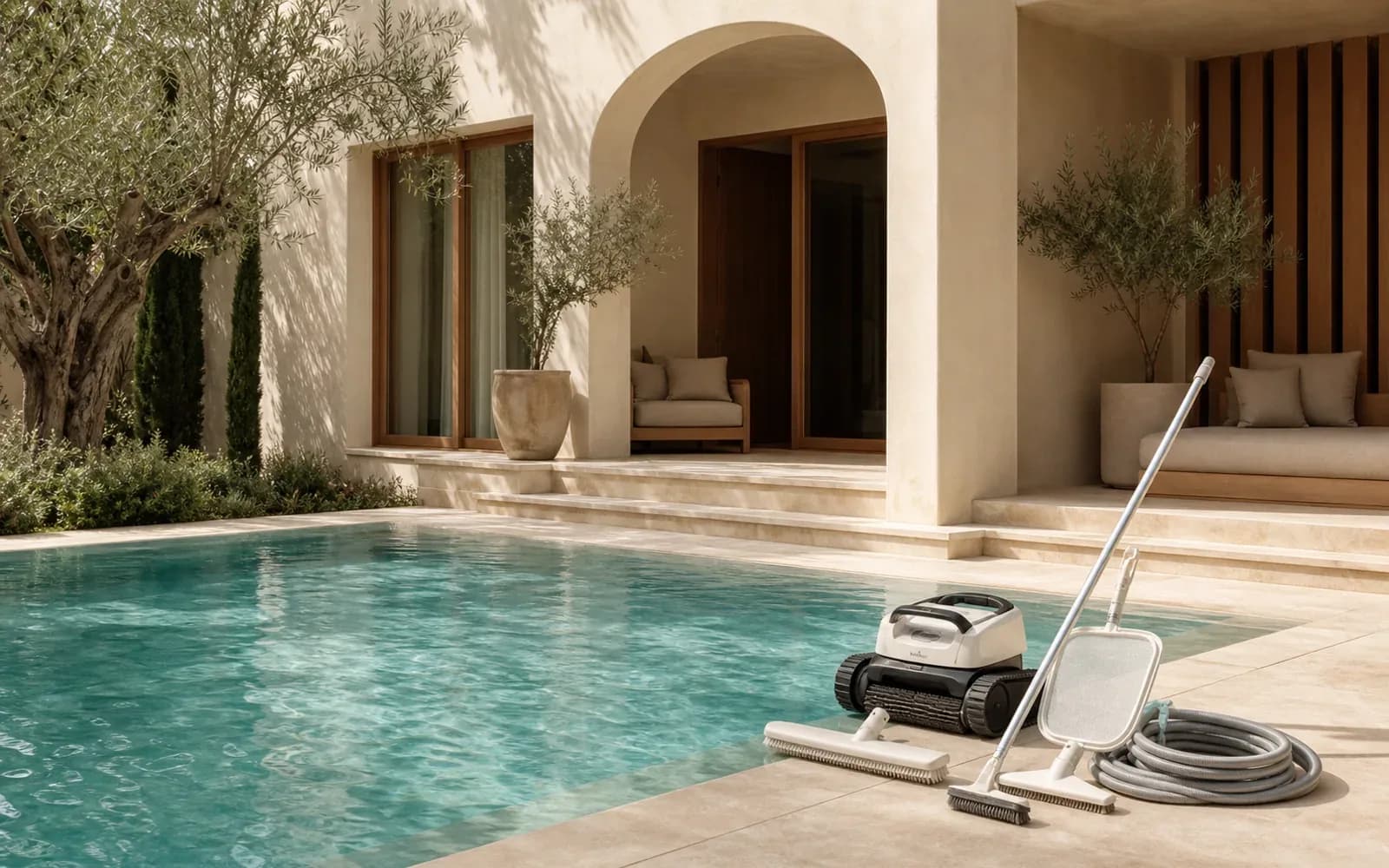
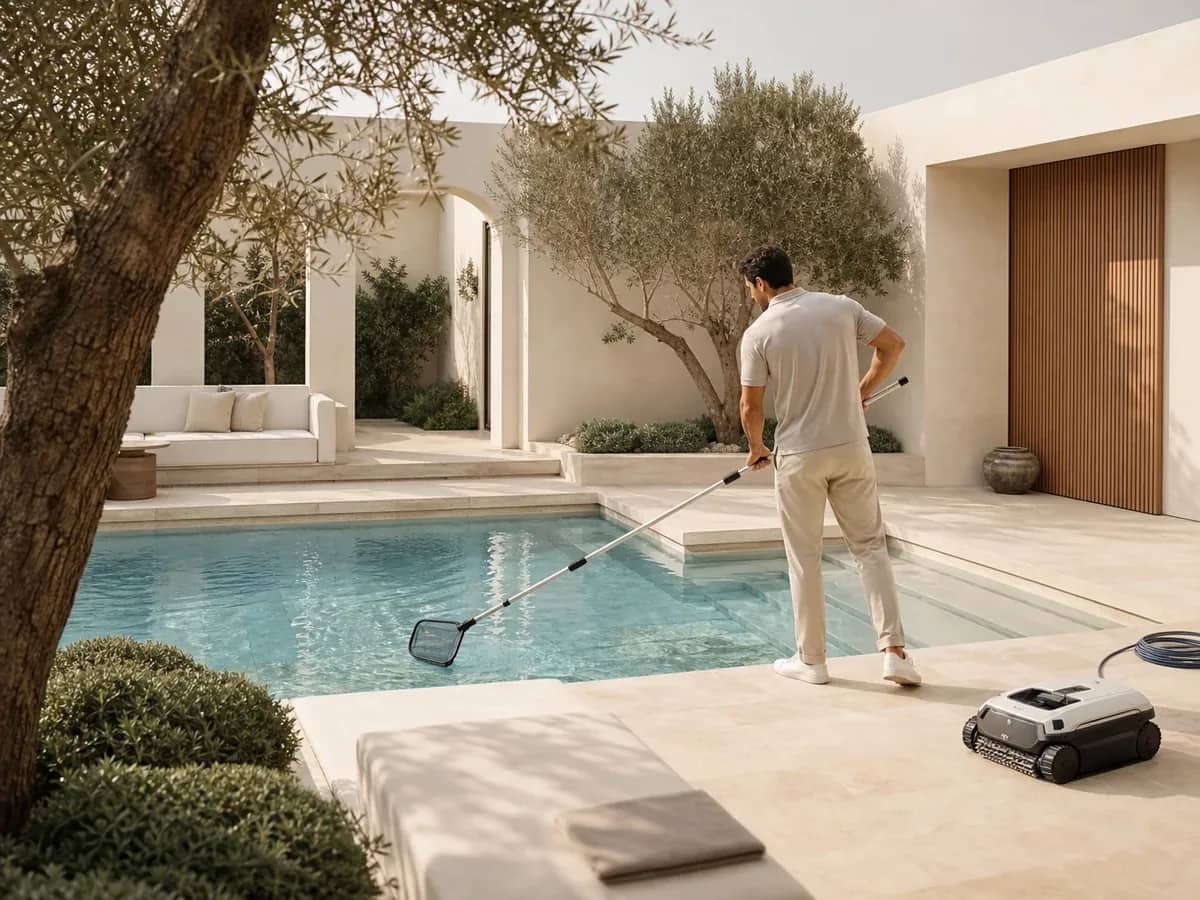
Every pool owner needs four core tools attached to a sturdy telescoping pole: first, a leaf skimmer net with fine mesh to skim leaves, insects, and floating debris off the surface before they sink.
Second, a pool brush: curved nylon bristles for PVC liner and fiberglass pools, or stainless steel wire bristles for concrete and plaster pools. Brushing physically disrupts microscopic algae biofilms on walls, steps, and corners.
Third, a manual vacuum head and vacuum hose connected to the skimmer or dedicated suction point. Fourth, a heavy-duty leaf rake with a deep bag for scooping heavy debris off the pool floor. These four tools form the foundation of manual pool care.
Think of the pool in three distinct zones: surface, water column, and floor.
On the surface, skim floating leaves daily before they waterlog and sink. Skimmer baskets continually collect surface debris.
The water column is cleaned by circulation and filtration. Suspended particles cannot be scooped manually; they are trapped as water circulates through the filter media. Maintaining adequate daily pump runtime is the invisible key to a crystal-clear water column.
The pool floor requires vacuuming. Vacuum methodically in overlapping parallel passes, starting from the shallow end towards the main drain. If heavy silt or dead algae blankets the floor, vacuum directly to WASTE to protect the filter from clogging.
A pool vacuum consists of a head fitted to a telescopic pole, connected by a hose to the skimmer or to a separate vacuum port; the pump's suction is carried through the hose to the head, and debris collected on the pool floor is drawn to the filter or to waste.
A manual pool vacuum works with four head types: a brush head for concrete and tile, a wheeled head for liner, a triangular head for corners, and a weighted wide head for the floor of large pools. Suction power depends on hose diameter: a 38 mm hose is sufficient for a residential pool, while a 50 mm hose is used for semi-Olympic pools and larger.
A leaf skimmer net does not replace the vacuum, it comes before it: if leaves, insects and floating debris are not removed with the net before vacuuming, the hose clogs and the pump basket fills prematurely. What determines pool leaf net prices is the mesh density of the net and the material of the frame; a deep-net aluminum frame lasts several times longer than a shallow-net plastic net. The weekly routine follows this order: first the surface with the net, then the walls with a brush, and finally the floor with the vacuum; whether vacuuming is done through the filter or to waste is chosen according to how dirty the water is.
Automatic pool cleaners save significant labor.
Pressure-side cleaners use dedicated booster pumps and catch debris in onboard filter bags. Suction-side cleaners attach to skimmers and use pool pump suction.
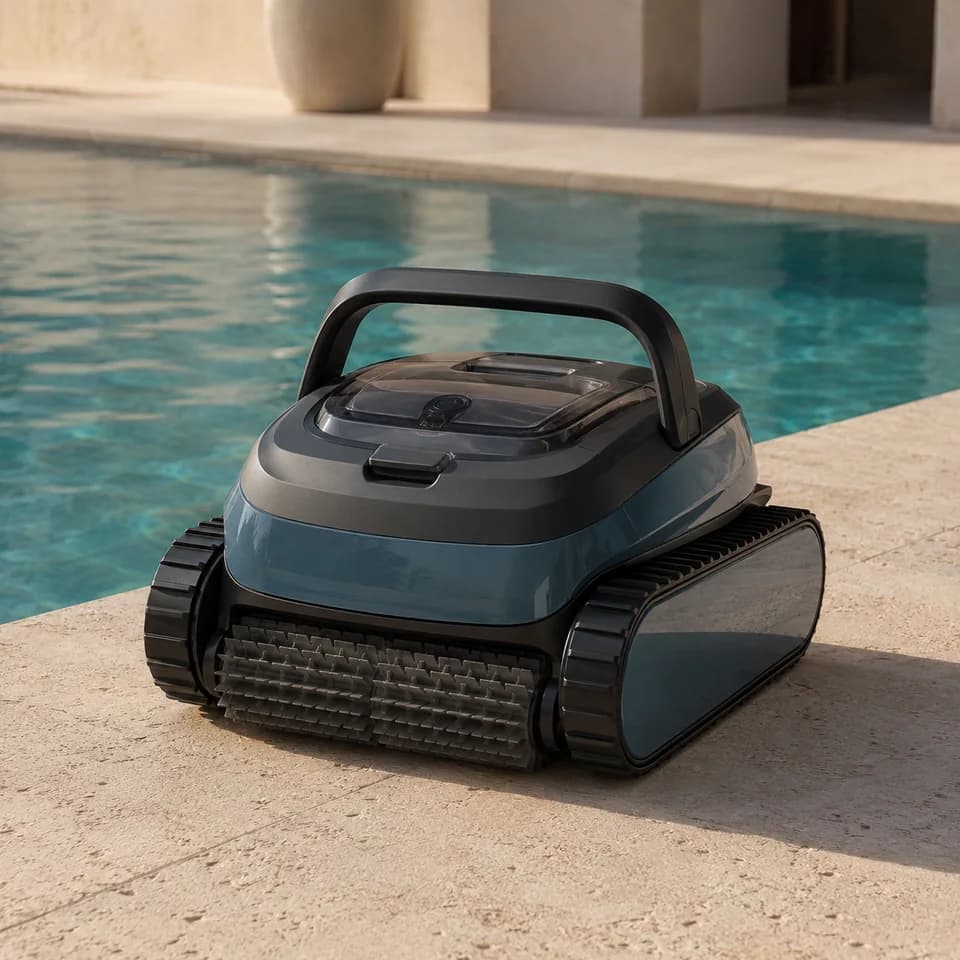
Robotic pool cleaners are the most advanced type, operating independently from pool hydraulics with low-voltage internal electric motors and micro-filter canisters. They scrub floors, climb walls, clean the waterline, and filter down to 3 microns without loading the main filter.
While a robot does not eliminate manual surface skimming or basket emptying, it automates the most labor-intensive chore of floor vacuuming.
Skimmer baskets catch coarse floating debris, while the pump strainer basket catches finer matter before it reaches the impeller.
When baskets fill with leaves, water flow is restricted, straining the pump and dropping circulation turnover.
A clogged basket starves the pump of water, causing cavitation, reduced filtration efficiency, and uneven chemical distribution. Empty skimmer baskets weekly, and daily during autumn leaf fall.
Always turn off the pump before opening the pump strainer pot. Inspecting baskets also provides an early warning indicator of abnormal debris or sand.
The waterline is where sunscreen oils, body lotions, pollen, and airborne dust accumulate, forming a dark, greasy bathtub ring.
If neglected, this line bakes in the sun and stains tiles or PVC liners permanently.
Wipe the waterline weekly with a soft microfiber sponge and specialized non-foaming pool tile cleaner. Shading oils with oil-absorbing foam sponges in skimmers prevents scum lines from forming.
Encouraging bathers to shower before swimming significantly reduces the introduction of oils and organic cosmetics.
A sustainable routine involves small, regular actions: Daily (2-3 minutes): skim surface leaves and glance at skimmer baskets.
Weekly (20-30 minutes): brush walls and steps, vacuum the floor (or launch your robot), empty all skimmer and pump baskets, and wipe down the waterline.
Monthly: inspect filter pressure, backwash as needed, and check cleaning brushes and vacuum hoses for wear. Small, regular jobs keep the big clean-ups away.
Next step
Let us discuss your project in the way that suits you best.
You can fill in the form for a written quote, schedule a video project presentation or ask us to survey your project site.
Get a Quote
Send us your dimensions and expectations in writing.
Online presentation
Video project presentation
On-site survey
Inspection at your project site
Image gallery
Photos: 04
 01
01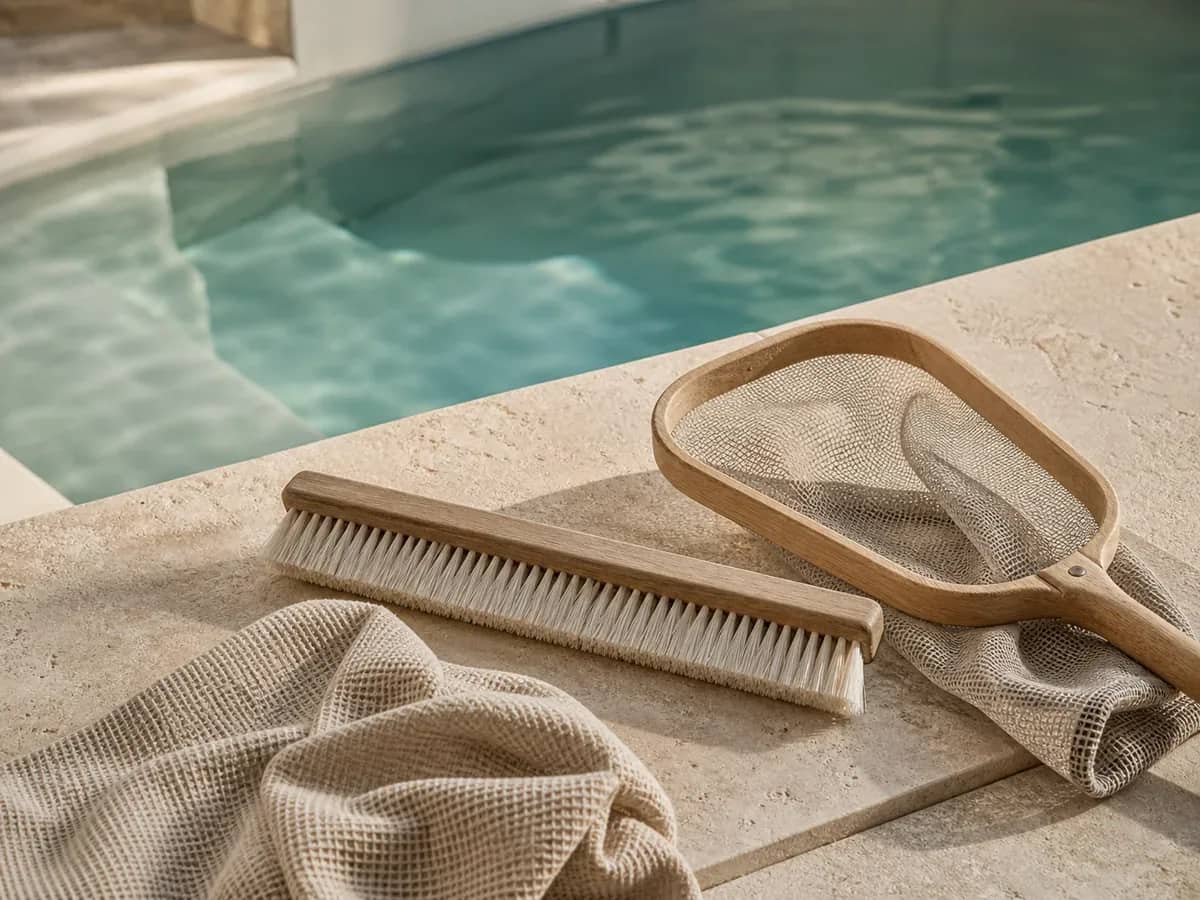 02
02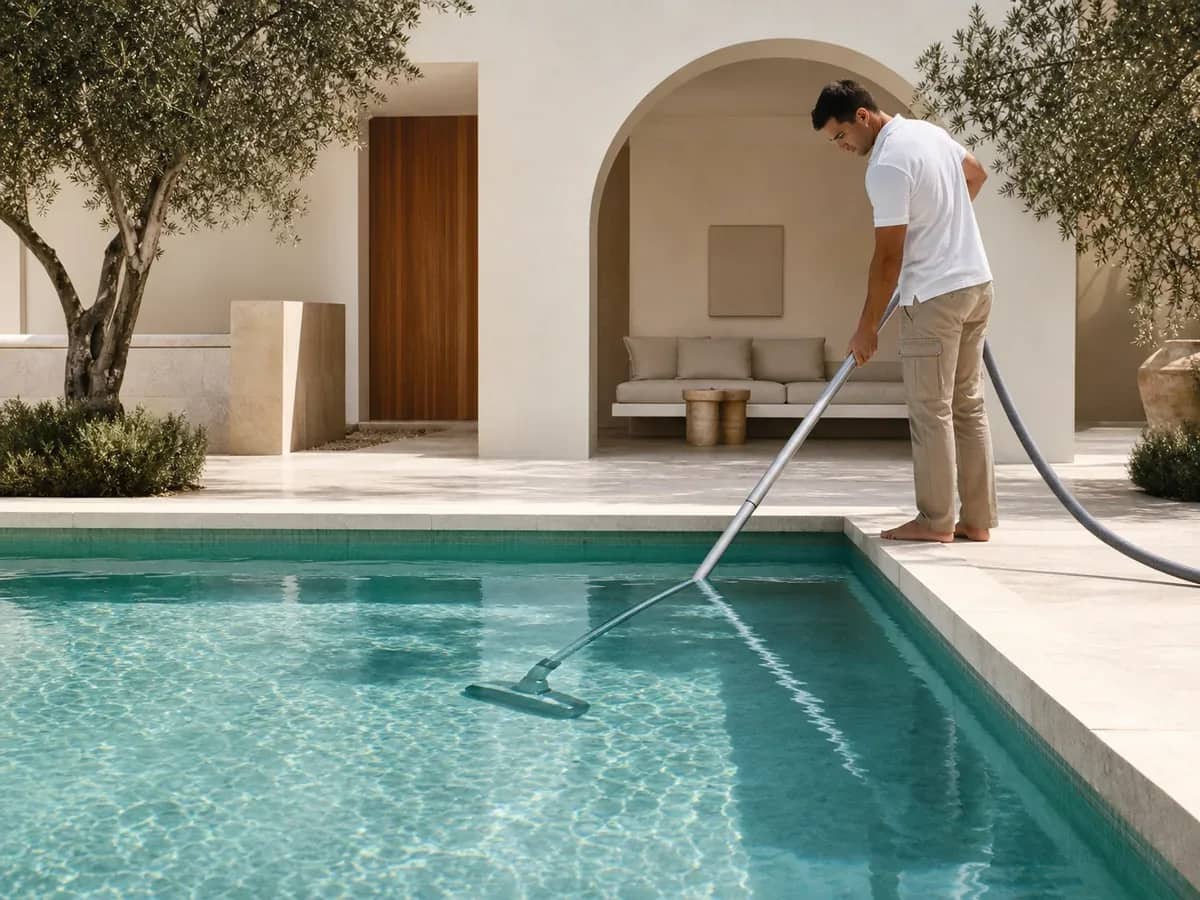 03
03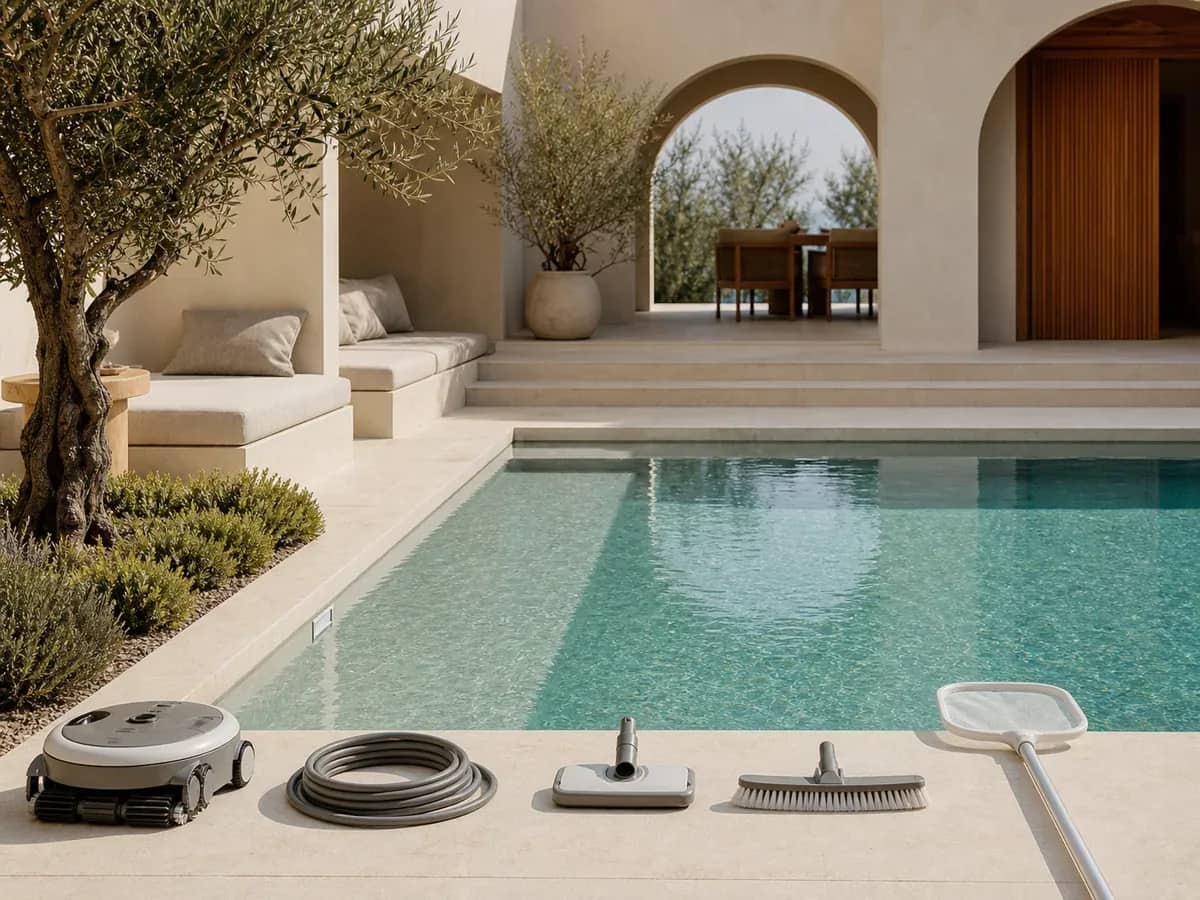 04
04// 01 · Product groups
Compare the products on this topic on their category pages.
Each card leads to a product category; models, technical sheets and list prices are there.
 Product category
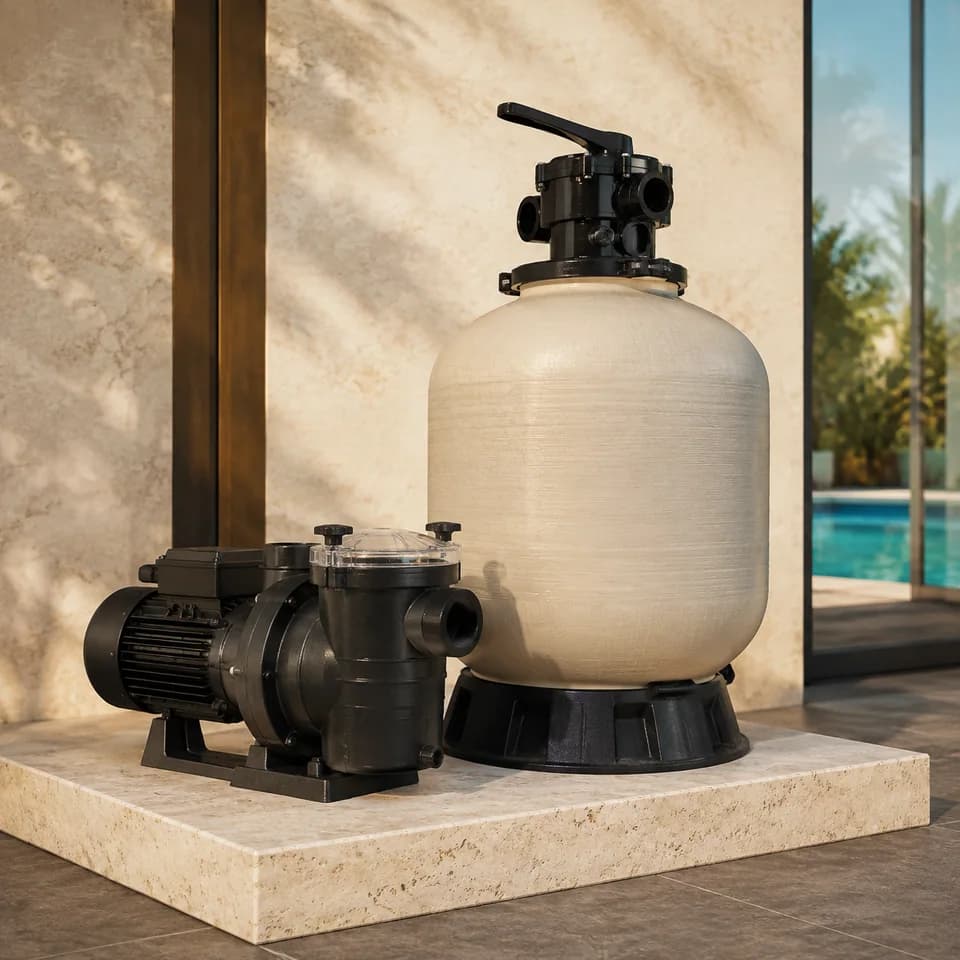
Pool Mechanical Equipment
Circulation pumps, filters, valves and automation: the mechanical infrastructure that forms the heart of the pool.
View- 65 products
 Product category
Pool Cleaning Robots
Automate floor, wall and waterline maintenance without manual cleaning, using cordless, intelligent pool cleaning robots.
View- 24 products
 Product category
Manual Pool Cleaning Equipment
Pool floor/wall vacuum heads, cleaning brushes, leaf nets, telescopic poles and floating hoses in the Blue Line, Shark, Classic and Serenit ranges, the hand tools of everyday maintenance.
View- 16 products
Product category
Pool Mechanical Equipment
Circulation pumps, filters, valves and automation: the mechanical infrastructure that forms the heart of the pool.
65 productsProduct category
Pool Cleaning Robots
Automate floor, wall and waterline maintenance without manual cleaning, using cordless, intelligent pool cleaning robots.
24 productsProduct category
Manual Pool Cleaning Equipment
Pool floor/wall vacuum heads, cleaning brushes, leaf nets, telescopic poles and floating hoses in the Blue Line, Shark, Classic and Serenit ranges, the hand tools of everyday maintenance.
16 products
// 02 · Related service
The work in this article, we deliver from design to handover.
Çilek Havuz service
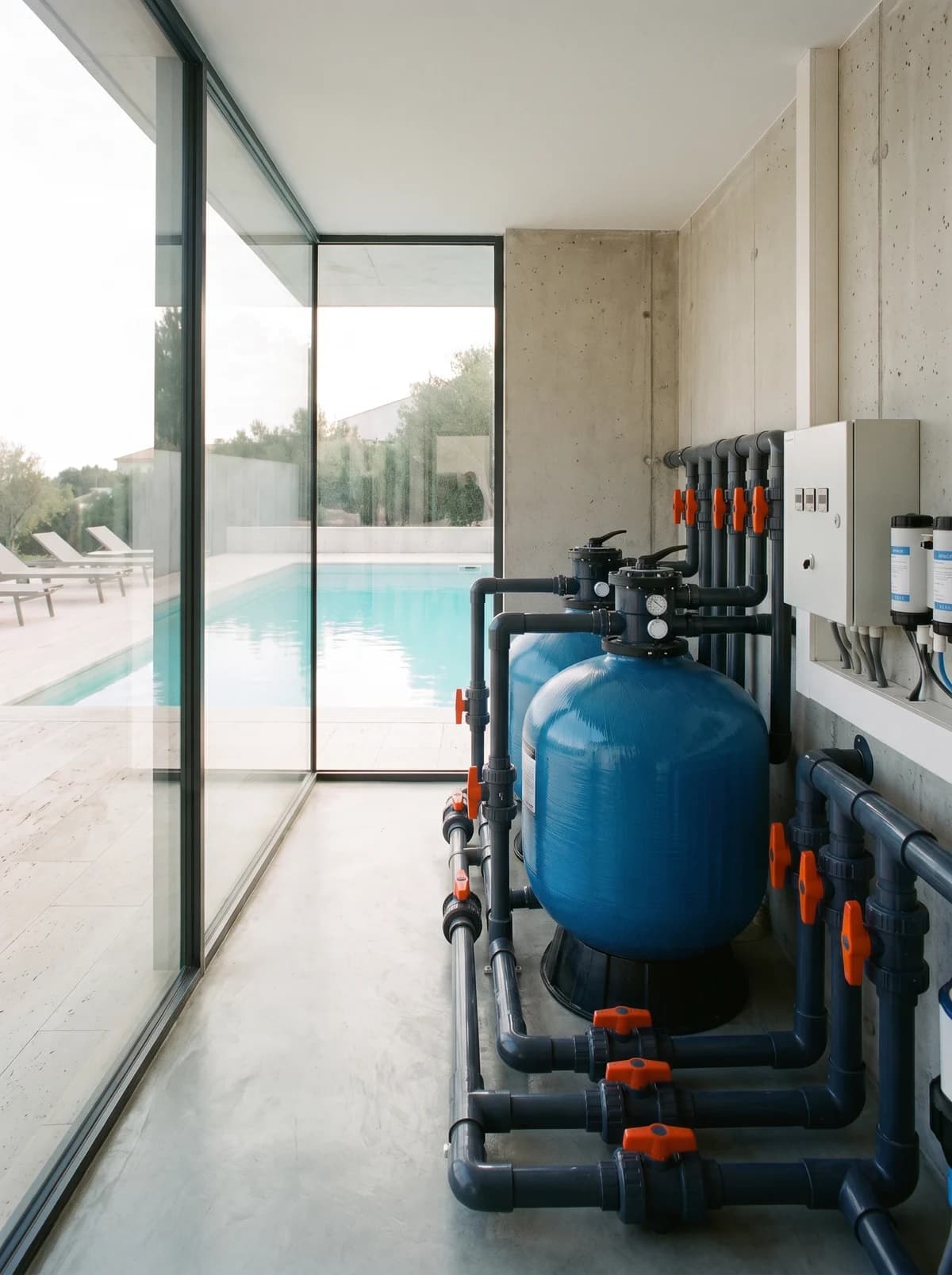
Pool Maintenance
Water chemistry, equipment and periodic maintenance.
How we work
- 01Initial meeting and site surveyWe inspect the site and listen to the brief.
- 02Design and quotationWe give the cost item by item, in writing.
- 03ExecutionThe same team builds to a written schedule.
- 04Handover and commissioningWe start the systems and explain their use.
- 05Maintenance and technical supportWe provide periodic maintenance and support.
// 03 · Guides
On Maintenance, more articles to read.
First the articles directly related to this one, then the newest articles on the topic.
 Maintenance
Pool equipment: how to choose each item and what to base it on
Pump flow rate, filter diameter, chemicals, robot type and lighting should be chosen by calculation, not guesswork. Here is how to size each item.
View- 4 September 2026
- 9 min read
 Maintenance
Pool Winterizing: Shock Treatment, Closing and Equipment Care
Plan winter pool care around water balance, equipment and cover requirements. Check what needs professional attention before closing your pool.
View- 28 June 2026
- 10 min read
 Maintenance
Pool Equipment Buying Guide: Pumps, Filtration, Disinfection, Robots and Automation
Start pool equipment shopping with the total cost of ownership, not the lowest price. We compare five categories, from pumps to automation, on one page.
View- 27 August 2026
- 9 min read
 Maintenance
Pool clarifier and flocculant: differences, uses and selection
Clarification, flocculation and filter compatibility compared for cloudy pool water. The right choice follows the product instructions, not the name.
View- 13 September 2026
- 3 min read
 Maintenance
Chlorine tablets and granules: dissolution, use and selection
Chlorine products differ in active ingredient, concentration and intended use. Shape alone does not determine strength or dosing method.
View- 13 September 2026
- 3 min read
 Maintenance
Winter pool chemicals: purpose, limits and product selection
Winter treatment depends on the actual pool system and product formulation. Water care, equipment freeze protection and ongoing checks are separate tasks.
View- 13 September 2026
- 3 min read
- Maintenance · 4 September 2026Pool equipment: how to choose each item and what to base it onPump flow rate, filter diameter, chemicals, robot type and lighting should be chosen by calculation, not guesswork. Here is how to size each item.9 min read
- Maintenance · 28 June 2026Pool Winterizing: Shock Treatment, Closing and Equipment CarePlan winter pool care around water balance, equipment and cover requirements. Check what needs professional attention before closing your pool.10 min read
- Maintenance · 27 August 2026Pool Equipment Buying Guide: Pumps, Filtration, Disinfection, Robots and AutomationStart pool equipment shopping with the total cost of ownership, not the lowest price. We compare five categories, from pumps to automation, on one page.9 min read
- Maintenance · 13 September 2026Pool clarifier and flocculant: differences, uses and selectionClarification, flocculation and filter compatibility compared for cloudy pool water. The right choice follows the product instructions, not the name.3 min read
- Maintenance · 13 September 2026Chlorine tablets and granules: dissolution, use and selectionChlorine products differ in active ingredient, concentration and intended use. Shape alone does not determine strength or dosing method.3 min read
- Maintenance · 13 September 2026Winter pool chemicals: purpose, limits and product selectionWinter treatment depends on the actual pool system and product formulation. Water care, equipment freeze protection and ongoing checks are separate tasks.3 min read
// 04 · Company & Contact
To talk about your project, call or write to us.
Legal Name
Çilek Havuz
Founded
1998 · Istanbul
Head Office
Çilek Plaza, Eyüp Sultan Mah. Yakacık Cd. Feshane Cd. No: 2 D:4 D:1, 34885 Sancaktepe / İstanbul
Service Area
All of Türkiye · exports to 14 countries
Branches
Kyrgyzstan · Egypt · Algeria · Iraq
Showroom
Plan a showroom visit
At our showroom in Çilek Plaza, Sancaktepe, you can discuss your project with our team. We recommend booking an appointment by phone before your visit.
Working Hours
- Monday – Friday · 08:00 – 17:30
- Saturday · 08:00 – 12:30
- Closed on Sunday
Frequently Asked Questions
About Pool Cleaning, frequently asked questions.
Çilek Havuz Corporate
Pool and Wellness Engineering
- Response Time
- Same day
- Channels
- Phone · Email · WhatsApp
If the answer you are looking for is not here, send your question directly to us and our team will reply as soon as possible.
+90 216 475 39 37No, plaster and tiled pools can handle stiff wire/nylon brushes. Vinyl liner and fiberglass pools require soft nylon bristles to prevent scratching the lining. Always match brush bristle stiffness to your pool surface material.
Çilek Havuz Corporate
Robotic cleaners are the most energy-efficient and independent, cleaning floors, walls, and waterlines without loading your pool filter. Suction cleaners are economical for fine sand, while pressure cleaners excel at large leaves. Robotic cleaners offer the highest convenience for private villas.
Çilek Havuz Corporate
For light routine dirt, vacuum through the filter on normal FILTER mode. If the pool floor has heavy sediment, flocculant sludge, or dead algae post-shock, vacuum on WASTE directly to the drain to avoid blinding your filter media.
Çilek Havuz Corporate
Always brush walls and steps first to suspend algae biofilms into the water column. Allow particles to settle to the floor for an hour, and then vacuum.
Çilek Havuz Corporate
Yes, a telescoping pole, surface skimmer net, and corner brush remain necessary. They handle quick spot cleaning, skimming floating leaves, and brushing tight steps where robots cannot reach.
Çilek Havuz Corporate
Replace brush heads when bristles become splayed or brittle, and replace vacuum hoses if cracked. Air leaks in hoses cause pump cavitation and loss of suction.
Çilek Havuz Corporate