

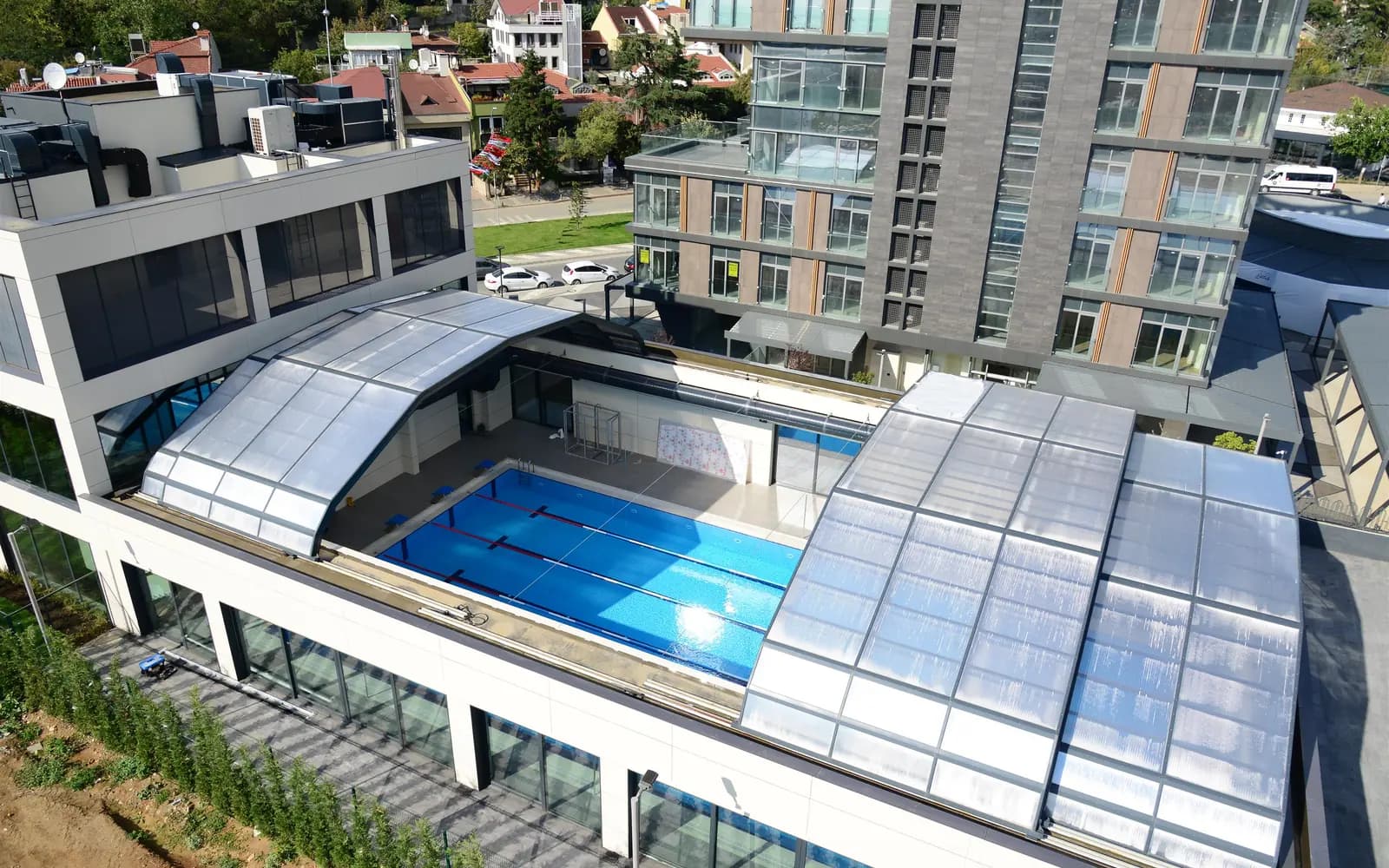
Pool covering systems: which cover suits which pool?
Pool covering systems are the cover and enclosure solutions that separate the water surface or the whole pool volume from the outside environment. A technical comparison of five types.
Pool covering systems are the cover and enclosure solutions that separate the water surface or the whole pool volume from the outside environment. A technical comparison of five types.
Pool covering systems is the umbrella term for the cover, lid and enclosure solutions that separate the water surface or the entire pool volume from the outside environment. Under the heading of pool cover, five main types are grouped: solar cover, automatic slatted pool cover, safety cover, winter cover and telescopic enclosure. A pool cover does the same three jobs in every type, only in different proportions: it reduces evaporation, it lowers heat loss, and it closes the surface off against leaves, dust and falls. The types differ in how good they are at each of these three jobs, in their drive method (motorised or manual), and in the load they can carry.
This article is not a product catalogue or an installation manual. Indoor pool buildings, dehumidification plants and fixed roof solutions are outside its scope; a telescopic enclosure differs from these in that it can be retracted back over the pool. Winterising chemistry, filtration and turnover calculation are also not covered here; those belong under pool maintenance. What is covered is the measurable performance differences between the five covering types, the standards behind safety covers, the relationship between height class and permits for telescopic enclosures, and the selection logic by climate.
Producing a single score for the comparison is misleading; each type is designed to cover a different requirement. A solar cover is made for heat and evaporation, a safety cover for load-bearing, a winter cover for dirt and the freezing period, a slatted cover for daily automatic use, and a telescopic enclosure for extending the season. The table below sets these five types side by side under seven headings.
| System | Heat retention | Evaporation reduction | Safety class | Drive | Winter use | Installation time | Permit requirement |
|---|---|---|---|---|---|---|---|
| Solar (bubble) cover | High: daytime solar gain, night-time surface insulation | Above 90 percent, when the surface is fully covered | None; cannot be walked on, increases drowning risk | Manual or reel | Not suitable; cannot carry snow and ice load | Half a day, including the reel | None |
| Automatic slatted pool cover | High: hollow PVC or polycarbonate slats create an air gap | Around 90 percent | Partial; surface is covered but not intended for load-bearing | Motorised, rolled at floor level or into a recess | Limited; manufacturer limit should be checked for snow load and ice jamming | 1 to 3 days; the recessed type is planned together with the shell | None |
| Safety cover (mesh or vinyl) | Low to moderate; mesh type has no insulation | High for vinyl type, low for mesh type | Standard-defined: NF P90-308, ASTM F1346 | Manual, tensioned with spring anchors | Suitable; designed for snow and leaf load | 1 day, including drilling anchor holes in the deck | None |
| Winter cover (opaque vinyl) | Moderate; closes off the water, insulation is a secondary goal | High, though evaporation is already low in winter | None; water pools on the surface, no defined load capacity | Manual, edge rope and weights | This is its main use period | Half a day | None |
| Telescopic enclosure (cabin) | Very high; encloses the volume, raises water and air temperature through a greenhouse effect | Above 90 percent; also blocks wind | Locked modules block child access; not a walkable class | Manual track or motorised | Suitable; snow load determined by structural calculation | 2 to 5 days; track concrete and anchoring are a separate item | Varies by height; not required in most places for low types |
The row most often misread in the table is the safety cover. A mesh-type safety cover carries load but does not retain heat and does not meaningfully reduce evaporation; on its own it is not enough for a project with a heat target. A solar cover, on the other hand, retains heat the cheapest way but will not carry a child who falls onto it, and even obstructs visibility because it covers the surface. Projects that want both goals combine either a vinyl-type safety cover, or a slatted cover together with a separate barrier.
In an outdoor pool, heat is lost through four paths: evaporation from the surface, radiation from the surface, convection between water and air, and conduction from the shell to the ground. Of these, the largest item is evaporation, and the reason is water's enthalpy of vaporisation. According to the Wikipedia "Enthalpy of vaporization" article, water's enthalpy of vaporisation is 40.66 kJ/mol at 100 °C, or 2,257 J/g by mass; the same article notes that this energy is more than five times the energy needed to heat the same amount of water from 0 °C to 100 °C. In other words, every kilogram of water that evaporates carries roughly 2,257 kJ of energy out of the pool with it.
Putting a number to this is easy. Take an outdoor pool with a 32 m2 surface losing 5 mm of water on a summer day; that is 5 kg per square metre, 160 kg in total. The energy carried away is 160 x 2,257 = 361,120 kJ, or roughly 100 kWh. The energy needed to heat the same pool by 1 °C overnight, with 48 m3 of water and a specific heat of 4.18 kJ/kg·K, is roughly 56 kWh. A single day's evaporation loss is the equivalent of a two-degree heating job. Because a cover stops this loss directly, between 50 and 70 percent of total heat loss disappears on nights the pool is kept covered.
Variables that determine evaporation rate
- Water temperature: as the kinetic energy of surface molecules rises, escape rate rises; a pool held at 28 °C loses noticeably more water than the same pool at 24 °C.
- Relative humidity: as water vapour concentration in the surrounding air rises, evaporation slows; on summer nights in coastal areas, loss is lower than inland.
- Air movement: when wind sweeps away the saturated air layer above the surface, evaporation speeds up; an enclosure that blocks wind reduces loss, though not as much as a cover.
- Surface area: loss is directly proportional to the open water surface; in a partly covered pool, the uncovered 20 percent of surface produces exactly 20 percent of the loss.
- Surface agitation: massage jets, waterfalls and fountains effectively enlarge surface area; in heated pools, this equipment is switched off while the cover is closed.
The second consequence of evaporation is in water chemistry. Evaporated water leaves as pure water, leaving dissolved salts and chemicals behind in the pool; make-up water, in turn, adds its own hardness and total dissolved solids. In a pool operated with a cover, because the make-up amount drops, the rise in total dissolved solids slows and the pool maintenance load decreases. For the same reason, stabiliser and chlorine consumption also drop; because less ultraviolet light reaches the covered surface, free chlorine's breakdown by photolysis slows down.
The two items most often confused on site are the safety cover and the winter cover; both sit over the pool outside the season, both are manual, and both appear side by side on a price list. Technically they do different jobs. A winter cover is an opaque vinyl sheet that protects the pool from leaves, dust and precipitation; it is fastened at the edges with rope, sandbags or water bags, water pools on top of it, and it has no defined load capacity. If a child or a pet steps onto this cover, the cover collapses downward under them.
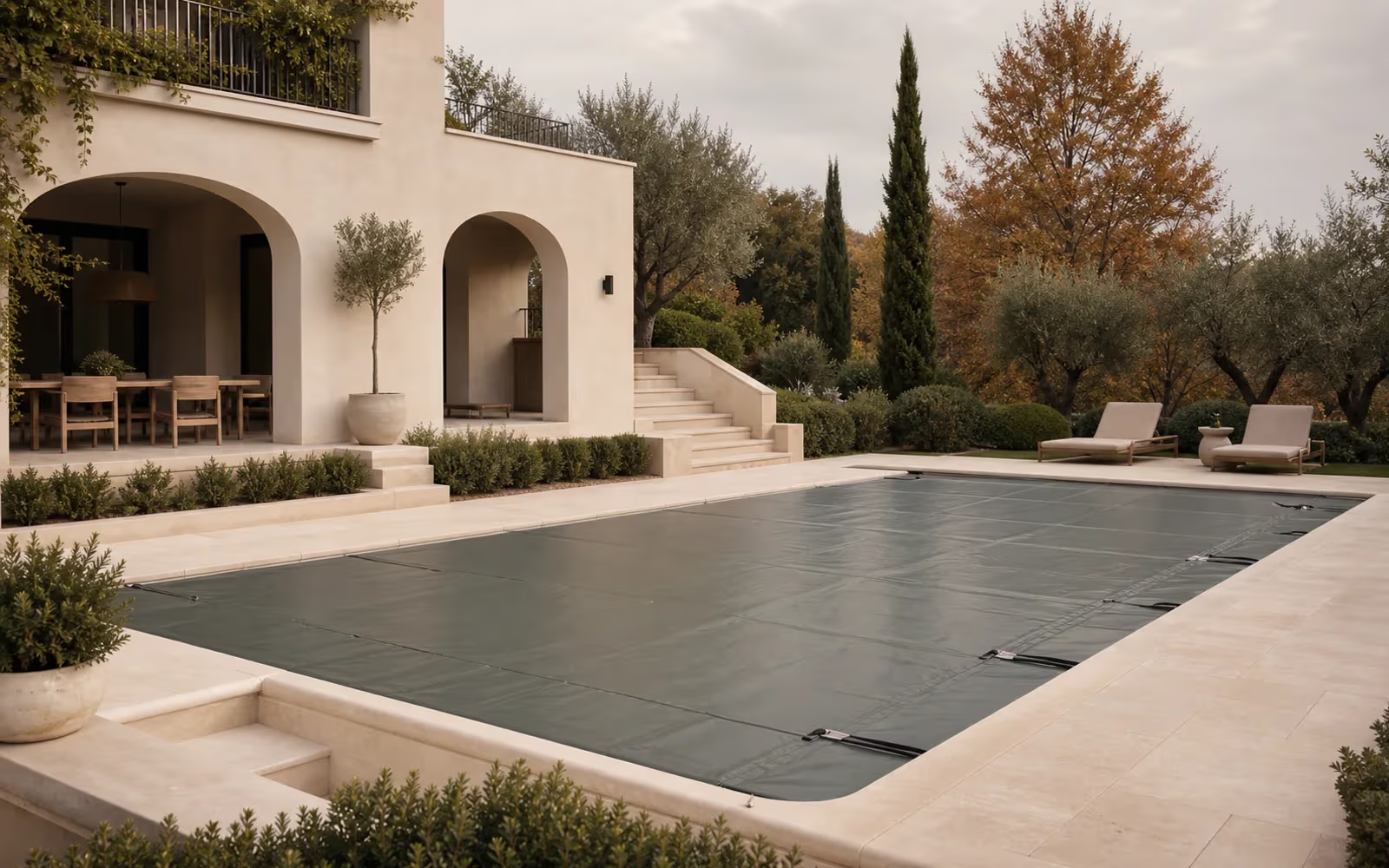
A safety cover, on the other hand, is a tensioned system anchored to the deck, designed to carry load. It has two international references: the French standard NF P90-308 defines the performance of safety covers and lids used on private in-ground pools, while the American ASTM F1346 is the safety cover performance specification for swimming pools, hot tubs and spas. Both standards work on a similar logic: the cover must carry a defined static load, must leave no gap between the edge and the deck through which a child could pass, and must not let a person who steps onto it slide underneath. For a cover to count as a safety cover, the manufacturer is expected to provide a test report against one of these standards; being a "thick vinyl sheet" is not enough.
Glossary of terms
- Solar (bubble) cover
- An air-bubble polyethylene sheet that floats freely on the water surface. The bubbles both create an insulating air gap and keep the cover afloat. Its life depends on ultraviolet exposure; it is usually replaced every three to five seasons.
- Slat
- The hollow-chambered PVC or polycarbonate profile that makes up an automatic cover. Because the chambers hold a closed air volume, they provide both flotation and insulation; in the solar type the top face is made transparent and the underside dark.
- Roll-in recess
- The volume left at the pool edge or below water level to hide the slatted cover's roller shaft and the rolled-up slats. Because it is poured together with the shell concrete, it must be decided during the pool construction phase; adding it later means intervening in the shell.
- Safety cover
- A cover anchored to the deck, with static load-bearing and gap criteria defined by a standard. NF P90-308 and ASTM F1346 are the reference documents for this type.
- Telescopic enclosure
- A movable cabin built with an aluminium profile frame and polycarbonate panels, whose modules nest into each other and collect at one end of the pool. Operates on a track or on trackless wheels.
- Anchoring and wind load
- The points where a covering system is fixed to the deck or the track beam, and the uplift force reaching those points. In telescopic enclosures, because the cabin behaves like an airfoil section, the calculation is driven more by wind suction than snow load.
The first decision in a telescopic enclosure is height; material, track type, structural calculation and administrative process all depend on this decision. Three classes are distinguished in practice. The low class has a peak point below 1 m and cannot be walked on at the pool edge; it covers the water surface, extends the season, and in most places counts as a garden fixture. The mid class is between 1 and 1.8 m; it can be entered into the pool area, with movement at the edge done stooped. The high class is above 1.8 m, can be walked upright inside, and effectively behaves like a structure; because it creates an enclosed area, in most municipalities it requires a building permit or at least a simple structure notification under zoning legislation. If this class is not chosen at the start of the project, changing the height after the track concrete has been poured is not possible.
Items to be determined for a telescopic enclosure
- Height class and the resulting permit status; for the high class, checking the plot's floor area ratio and setback distance.
- Panel material and thickness: solid sheet of 3 to 6 mm is common on the side faces, multi-wall polycarbonate of 8 to 16 mm on the roof; polycarbonate's Izod impact strength is in the range of 600 to 850 J/m, and its thermal conductivity is 0.19 to 0.22 W/(m·K) at 23 °C.
- Ultraviolet protection: polycarbonate's ultraviolet resistance is moderate and it yellows under prolonged sun exposure; a co-extruded UV layer on the outer face is a requirement.
- Profile alloy and coating: 6063 aluminium is standard for window, door and roof profiles because it gives a smooth surface in complex sections and anodises well; its minimum tensile strength is on the order of 140 MPa in T5 temper and 190 MPa in T6.
- Wind load and anchoring: calculated separately for the cabin open and closed; a fixing point is also left for the modules when collected.
- Snow load: for high-class cabins, roof pitch and profile spacing are chosen for the region's snow load; in the low class, snow slides off before it accumulates on the cover.
- Track and drainage: the track beam is poured at the same time as the pool deck, and a point drain is left to clear water entering the track channel.
The reason polycarbonate is chosen is not a single property but the combination of three. Its density of 1.20 to 1.22 g/cm3 makes it half the weight of glass at the same thickness; its impact resistance is high, and a solid sheet does not shatter into sharp pieces when broken; its visible light transmission is better than many types of glass, so daytime lighting is not needed inside a closed cabin. Its operating temperature range, from -40 °C to between 115 and 130 °C, is never approached in any climate in Turkey. On the other hand, even though its thermal conductivity is lower than glass, a single-layer panel is not an insulating element; the temperature rise inside the cabin comes not from insulation but from blocking wind and the greenhouse effect.
The choice narrows down to three questions: is the pool heated, will water stay in the pool outside the season, and is there child access to the pool area. In an unheated outdoor pool, a cover's job is to extend the season; in a heated pool, it enters the fuel calculation directly, because a heated pool run without a cover gives back most of the heat it gained overnight through evaporation. In any development with child access, the decision is made by the load-bearing criterion before heat performance.
Climate shapes the decision in a second round. On the Mediterranean and Aegean coast, winter temperatures are high and sunshine hours are long; here a solar cover combined with a heat pump carries the season from April to November, and a telescopic enclosure makes sense for villas wanting year-round use. On the Black Sea coast, relative humidity stays high year-round, so evaporation loss is relatively low, but rainfall and leaf load are heavier; because a mesh-type safety cover lets water through, it causes fewer problems here than the vinyl type. In Central and Eastern Anatolia, the temperature difference between night and day is large; since night-time loss is decisive, a slatted cover or a low telescopic enclosure makes a noticeably bigger difference than a solar cover. In provinces with high snow load, a solar or winter cover is never left alone over the pool in winter.
In the specification, a covering system is never written as a single line. System type, the net surface size to be covered, drive method and motor protection class, the reference standard and test report requirement for safety covers, panel thickness and UV layer for a telescopic enclosure, profile alloy and temper, track detail and drainage, and anchor type and count are all written as separate items. An operational clause is added as well: how often the cover will be cleaned and how chemical dosing will be carried out while the cover is closed. Because gases accumulating under a closed surface and rising chlorine concentration wear on the cover material over time, this clause is part of the pool maintenance plan.
The standardisation of safety covers begins with administrative measures taken against pool-related child drownings. In France, following a regulation requiring safety equipment on private pools, a family of standards from NF P90-306 to NF P90-309 was established, in which barriers, alarms, enclosures and covers are each defined separately; NF P90-308 is the cover and lid section of this family. In the United States, ASTM F1346 serves the same function as a performance specification for swimming pools and spas. The two texts use different test setups, but ask the same two questions: does the cover carry an adult's weight, and can a child slip in at the edge.
On the material side, two components are decisive. Polycarbonate is an engineering plastic used in construction for dome skylights, surfaces replacing flat and curved glass, roof sheeting and noise barriers; a telescopic enclosure is this body of experience carried over to the top of a pool. On the aluminium side, the 6063 alloy is the most common alloy in the extrusion industry and is used in window, door and roof profiles; the load-bearing frame of a telescopic cabin is manufactured with the same profile logic. In slatted covers, the engineering comes from a hollow profile geometry that combines flotation and insulation in a single cross-section.
The common conclusion across the five systems is this: a pool cover is the only passive measure that directly targets the largest item in a pool's heat balance, and its working principle is not thermal insulation but blocking a phase change. So whichever type is chosen, the system's value is measured by how long it stays closed; a cover left open ten hours a day never delivers whatever figure its catalogue states, no matter what that figure is.
Solutions for your project
Explore services and product categories related to this topic.
Company & Contact
To talk about your project, we are one call away.
Legal Name
Çilek Havuz
Founded
1998 · Istanbul
Head Office
Çilek Plaza, Eyüp Sultan Mah. Yakacık Cd. Feshane Cd. No: 2 D:4 D:1, 34885 Sancaktepe / İstanbul
Service Area
All of Türkiye · exports to 14 countries
Related articles
Keep reading.
References
- 1.Evaporation — Wikipedia, 2026
- 2.Enthalpy of vaporization — Wikipedia, 2026
- 3.Polycarbonate — Wikipedia, 2026
- 4.6063 aluminium alloy — Wikipedia, 2026
- 5.Swimming pool — Wikipedia, 2026
- 6.NF P90-308, Éléments de protection pour piscines enterrées: couvertures de sécurité (Protective elements for in-ground pools: safety covers) — AFNOR, 2013
- 7.ASTM F1346, Standard Performance Specification for Safety Covers for Swimming Pools, Spas and Hot Tubs — ASTM International, 2021
Frequently Asked Questions
Our readers' most asked; with expert answers.
Çilek Havuz Content & Technical Team
Guides & Technical Content
- Response Time
- Same day
- Channels
- Phone · E-mail · WhatsApp
If the answer you are looking for is not here, send your question directly to us and our team will reply as soon as possible.
Book a free site surveyWhen the surface is fully covered, roughly 50 to 70 percent of an outdoor pool's total heat loss disappears. The reason is not insulation but stopping evaporation: every kilogram of water that evaporates carries roughly 2,257 kJ of energy, water's enthalpy of vaporisation, out of the pool. The gain is directly proportional to the number of hours the cover stays closed.
Çilek Havuz Content & Technical Team
It cannot. A solar cover floats freely on the water surface, has no anchoring, and has no defined load capacity. A child who falls onto it sinks under the water together with the cover, and because the surface is covered, they are not visible. Safety covers are products tested under NF P90-308 or ASTM F1346 and anchored to the deck.
Çilek Havuz Content & Technical Team
It can, but the roller shaft and slats cannot be hidden inside the pool. The underwater recess is a volume poured together with the shell concrete; opening it up afterwards means intervening in the shell and its waterproofing. In existing pools, the solution is to house the shaft in a bench or a lid at the pool edge.
Çilek Havuz Content & Technical Team
It depends on the height class. Low cabins with a peak point below 1 m count as a garden fixture in most municipalities and require no permit. Cabins above 1.8 m that can be walked upright inside create an enclosed area and may require a building permit or notification; the plot's floor area ratio and setback distance are checked at the start of the project.
Çilek Havuz Content & Technical Team
A winter cover is an opaque vinyl sheet that protects the pool from leaves, dust and precipitation; it is fastened at the edge with weights and has no defined load capacity. A safety cover is a system anchored to the deck, with static load and gap criteria set by a standard. Even though both may be used during the same period, only the latter counts as safety equipment.
Çilek Havuz Content & Technical Team