

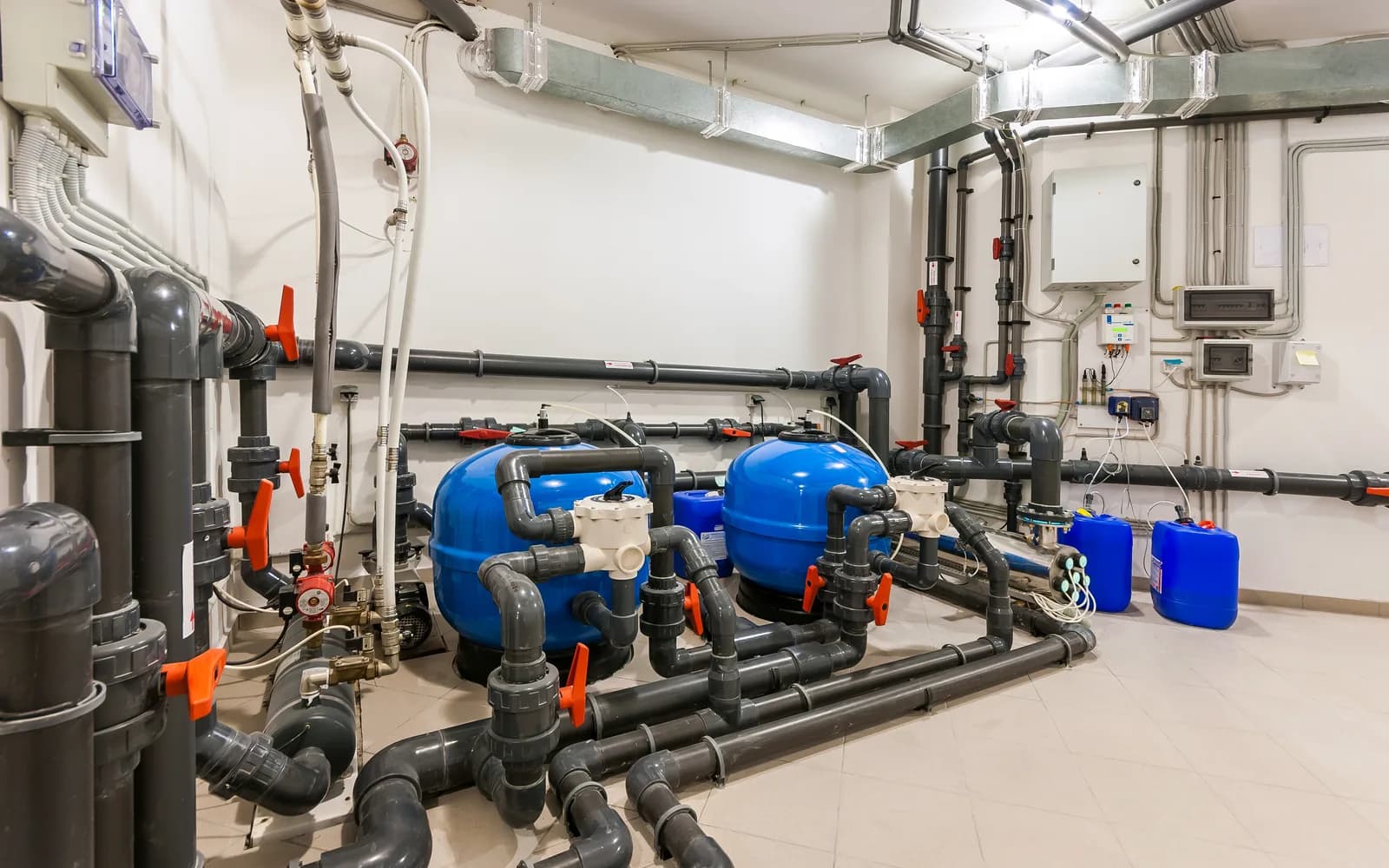
What are pool chemicals? Product identity, function and storage
Pool chemicals are the consumables that disinfect pool water, set the pH and alkalinity balance, adjust hardness and stabiliser level, and clarify the water.
Pool chemicals are the consumables that disinfect pool water, set the pH and alkalinity balance, adjust hardness and stabiliser level, and clarify the water.
Pool chemicals is the collective name for the consumable products dosed into pool water to keep it fit for swimming. They fall into six functional groups: disinfectants (chlorine sources and salt electrolysis), pH adjusters, alkalinity adjusters, hardness adjusters, chlorine stabiliser, algaecides and clarifiers. Even two products with the same function (calcium hypochlorite and trichlor, for instance) leave different by-products in the water and are subject to different storage rules.
Pool chemicals should not be confused with the construction chemicals used during pool construction (waterproofing mortar, epoxy grout, concrete admixtures). Construction chemicals are applied once to the concrete pool shell; pool chemicals are dosed into the water circuit continuously and consumed throughout pool maintenance. Dosage per m³ is the subject of a separate dosing article on this site and is not repeated here.
The table lists the products most often met on site, grouped by function. The available chlorine values given for trichlor and dichlor are theoretical upper limits calculated from the molecular formula; the commercial label value may be lower.
| Group | Product (trade name) | Chemical formula | Verifiable value | Function |
|---|---|---|---|---|
| Disinfectant | Calcium hypochlorite (granular chlorine, HTH) | Ca(OCl)2 | 65-70% available chlorine in the commercial product; pure substance 99.2% | Chlorination; leaves calcium, hardens the water |
| Disinfectant | Sodium hypochlorite (liquid chlorine) | NaOCl | Pool/industrial solution 10-25%; household bleach 3-8% | Chlorination; fast acting, short shelf life |
| Disinfectant | Trichloroisocyanuric acid (trichlor tablet, TCCA) | (CONCl)3, C3Cl3N3O3 | Theoretical available chlorine about 91%; solubility in water 1.2% | Slow-dissolving continuous chlorine; adds cyanuric acid |
| Disinfectant | Sodium dichloroisocyanurate (dichlor, NaDCC) | C3Cl2N3NaO3 | Theoretical available chlorine about 64% in the anhydrous form, about 55% in the dihydrate | Fast-dissolving shock chlorine; adds cyanuric acid |
| Disinfectant | Salt electrolysis (salt chlorine generator) | NaCl solution, electrolysis | 3,000-5,000 ppm salt in the pool; seawater about 35,000 ppm | In-situ production of hypochlorous acid/sodium hypochlorite in the cell |
| pH reducer | Sodium bisulfate (dry acid, pH minus) | NaHSO4 | 1 M solution slightly below pH 1; pKa 1.99 | Lowers pH; granular, easier to handle than liquid acid |
| pH reducer | Hydrochloric acid (muriatic acid) | HCl(aq) | Commercial solution 20-32%; 30-35% technical grade | Lowers pH and alkalinity; vapour is a respiratory hazard |
| pH increaser | Sodium carbonate (soda ash, pH plus) | Na2CO3 | Alkaline solution in water; hygroscopic solid | Raises pH |
| Alkalinity | Sodium bicarbonate | NaHCO3 | Mildly alkaline solution; begins to decompose at 80-100 °C | Raises total alkalinity, pH buffer |
| Hardness | Calcium chloride | CaCl2·nH2O (n = 0, 1, 2, 4, 6) | Dissolution is exothermic; strongly hygroscopic | Raises calcium hardness |
| Stabiliser | Cyanuric acid (chlorine stabiliser) | C3H3N3O3 | Extends free chlorine half-life 4-6 times; 20-50 ppm in salt pools | Protects free chlorine from UV light |
| Algaecide | Quaternary ammonium compounds / copper-based products | e.g. benzalkonium chloride; Cu2+ salts | Acts by disrupting the cell membrane | Suppresses algae growth |
| Clarifier/flocculant | Aluminium sulfate, PAC (polyaluminium chloride) | Al2(SO4)3 | Forms a gelatinous Al(OH)3 precipitate in neutral/mildly alkaline water | Flocculates and settles suspended solids |
| Winterising | Winterising liquid (mostly a quaternary ammonium + copper blend) | Varies by product | Read from the label | Suppresses algae and scale out of season |
The most decisive column in the table is what the product leaves behind in the water. Calcium hypochlorite adds calcium with every dose and hardens the water; Wikipedia notes that sodium hypochlorite is preferred for general-purpose disinfection for this reason. Trichlor and dichlor add cyanuric acid with every dose. Sodium hypochlorite adds neither, but it degrades with light and heat: a 13.6% solution has been recorded losing 17% of its strength in one year at 7 °C.
The distinction most often confused on site is between inorganic chlorine (calcium hypochlorite, sodium hypochlorite, salt electrolysis) and organic chlorine (trichlor, dichlor). Both form hypochlorous acid in water; the difference lies in the carrier of the chlorine. In inorganic products the carrier is calcium or sodium, and it stays in the water. In organic products the carrier is the cyanuric acid ring; as trichlor reacts, the cyanuric acid concentration in the pool accumulates.
The practical consequence is this: pool water run on organic chlorine reaches a high cyanuric acid level within a few months even if no stabiliser is ever added; the only remedy is to drain part of the water and replace it with fresh. With inorganic chlorine the stabiliser is a separate product and the level is under the operator's control. When a pool project is being prepared, the disinfectant type is treated as an input that affects the fresh-water make-up rate.
The second confused pair is sodium bisulfate and hydrochloric acid. Sodium bisulfate is a dry granule that can be handled and stored safely; the anhydrous form is hygroscopic and cakes in an open package. Hydrochloric acid is a liquid; at 25% and above it is classified GHS H314 (severe skin burns and eye damage), and its vapour is hazardous to the respiratory tract. In indoor pool plant rooms granular acid is common; in outdoor pools hydrochloric acid is common for cost reasons.
Glossary of pool chemicals
- Available chlorine
- The ratio of a product to the mass of Cl2 gas that would give the same disinfecting power. Calcium hypochlorite is at 65-70% in the commercial product, bleaching powder at about 20%. It is the only common yardstick for comparing labels.
- Free chlorine / combined chlorine / total chlorine
- Free chlorine is the hypochlorous acid and hypochlorite ion in the water that can disinfect. Combined chlorine is the chloramines formed by chlorine with ammonia and nitrogenous contaminants; it is the source of odour and eye irritation. Total chlorine is the sum of the two.
- Stabiliser (cyanuric acid)
- C3H3N3O3. It binds to free chlorine and releases it slowly; it slows the consumption of chlorine by sunlight and extends the free chlorine half-life 4-6 times. In salt pools it is kept at 20-50 ppm.
- Total alkalinity
- The capacity of the water to hold its pH against added acid; the pool target is 80-120 ppm. Raised with sodium bicarbonate, lowered with acid.
- Calcium hardness
- The amount of dissolved calcium in the water; the pool target is 200-400 ppm. Low hardness draws calcium out of grout and plaster surfaces, high hardness deposits scale. Raised with calcium chloride.
- Flocculant / clarifier
- A product that neutralises the charge on fine suspended particles so they clump to a size the filter can hold or that settles to the floor. Aluminium sulfate works by forming a gelatinous Al(OH)3 precipitate in neutral or mildly alkaline water.
Most incompatibilities between pool chemicals rest on two mechanisms: the hypochlorite + acid reaction and the organic chlorine + inorganic chlorine reaction. Wikipedia gives the reaction for calcium hypochlorite explicitly: Ca(ClO)2 + 4 HCl → CaCl2 + 2 Cl2 + 2 H2O. The same source states that sodium hypochlorite solution releases toxic chlorine gas when mixed with an acid such as hydrochloric acid or vinegar.
| First substance | Second substance | What happens |
|---|---|---|
| Calcium hypochlorite / sodium hypochlorite | Hydrochloric acid, sodium bisulfate, vinegar, any acid | Release of chlorine gas (Cl2) |
| Trichlor (TCCA) | Calcium hypochlorite | Heat, chlorine gas and formation of explosive nitrogen trichloride (NCl3); fire/explosion risk |
| Trichlor (TCCA) | A small amount of water (damp bucket, wet scoop) | Heats up without dissolving; can produce chlorine gas and NCl3 |
| Calcium hypochlorite | Organic matter (oil, grease, sawdust, leaves, paper) | Oxidiser; ignition and rapid decomposition |
| Hypochlorite (any type) | Ammonia, ammonium-containing cleaning products, quaternary ammonium algaecide (concentrated mix) | Formation of monochloramine, dichloramine and nitrogen trichloride; toxic |
| Hypochlorite (any type) | Hydrogen peroxide | Violent reaction, release of oxygen gas |
| Calcium chloride | Water (small volume, fast addition) | Exothermic dissolution; the container heats up |
The rule covers the dosing sequence as well as the bucket: putting a trichlor tablet and then calcium hypochlorite into the same skimmer basket means the two products meet with a little water. In automatic dosing the acid and hypochlorite lines are not connected to the same injection point; enough distance is left between them for the water to mix.
Storage rules derive from the chemistry of the product. Calcium hypochlorite is not stored wet or hot; it is not placed next to acid, organic matter or metal; in humid air it slowly decomposes and gives off a chlorine smell. Sodium hypochlorite degrades with light and heat; in production the solution is kept below 40 °C, on site the drums are kept in a cool place out of the sun and used up within the season. Sodium bisulfate, calcium chloride and sodium carbonate are hygroscopic; an open package turns to stone. Trichlor tablets are kept dry in a closed container, away from wet scoops.
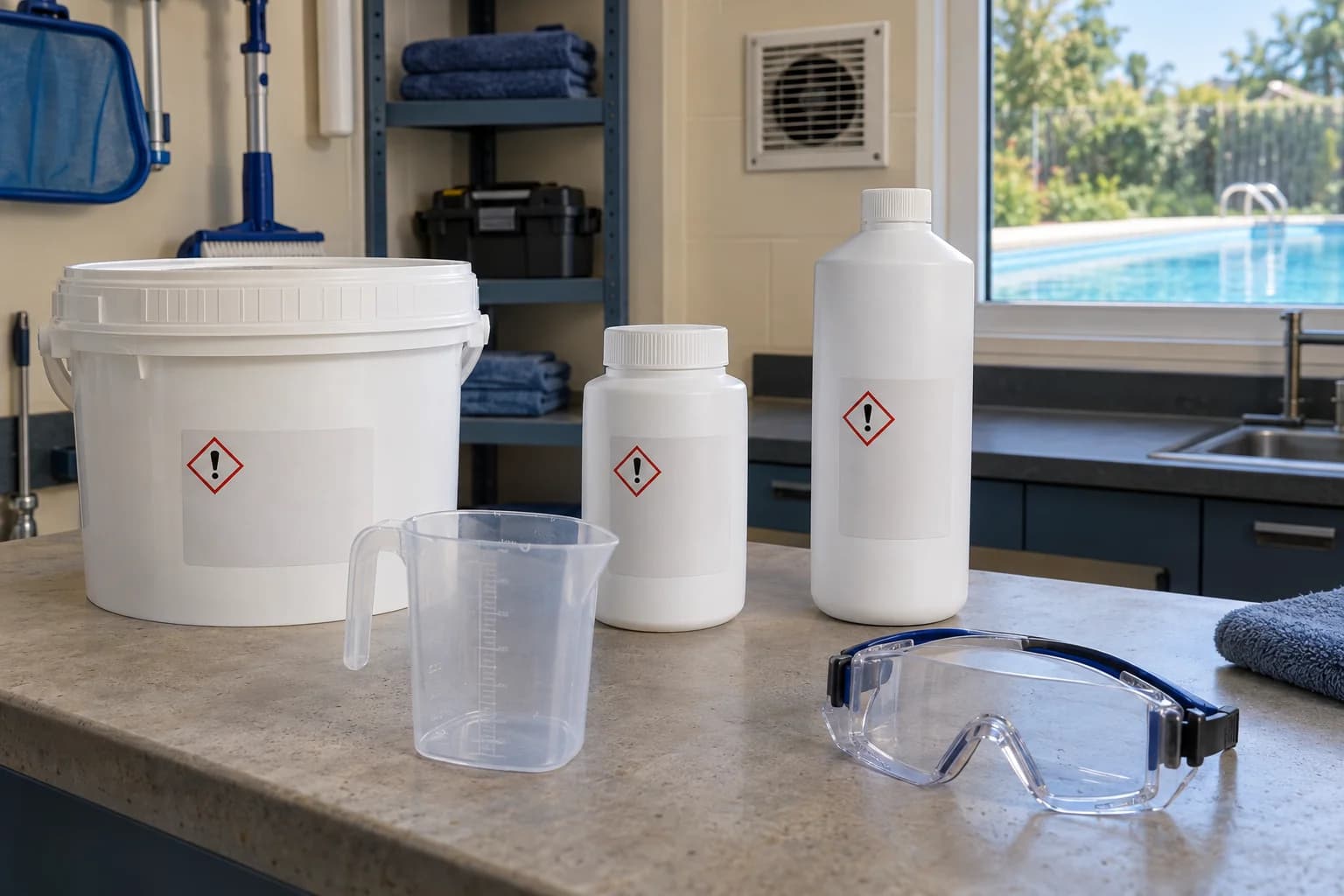
Minimum conditions for a pool chemical store
- A cool, dry, ventilated room out of direct sun; separate from the boiler room and pump room.
- Acids and chlorine sources on separate shelves and in separate spill trays; liquids on the lower shelf.
- Original packaging, lid closed, label legible; product is not decanted into another container.
- A separate, dry scoop for each product.
- Products carrying GHS pictograms (GHS03 oxidiser, GHS05 corrosive, GHS07 irritant) in a locked cabinet, away from children and unauthorised persons.
- An eyewash station or clean-water tap at the store exit; safety data sheets (SDS) to hand.
The first value to look for on the label is the active ingredient percentage. For calcium hypochlorite, 65-70% available chlorine is the commercial standard; a lower value means filler or a degraded product. For sodium hypochlorite the pool solution is 10-25%; 3-8% household bleach does not do the same job. For hydrochloric acid the 20-32% range defines the grade. On algaecide and winterising liquid, the active ingredient line (quaternary ammonium percentage or copper content) is what to read.
Test kits are also part of the purchasing decision. DPD tablet kits measure free chlorine (DPD 1) and total chlorine (DPD 3); the difference is combined chlorine. Phenol red measures pH. Test strips show the same parameters roughly on a colour scale and are not sufficient for operating records. A photometer reads the DPD colour intensity optically and gives chlorine, pH, alkalinity, cyanuric acid and calcium hardness as numbers. In commercial pools the daily pool maintenance record is kept with a photometer.
The seasonal consumables list is the purchasing side of the pool maintenance plan. The list gives product types, not quantities; quantity depends on volume, bather load and climate.
Seasonal consumables list
- Season opening (spring): flocculant, fast-dissolving chlorine for shock (calcium hypochlorite or dichlor), sodium bicarbonate, calcium chloride, cyanuric acid; full parameter measurement in the first week.
- Summer operation (weekly): continuous chlorine source (trichlor, liquid chlorine or salt generator), pH reducer, pH increaser when needed, algaecide, DPD and pH reagent.
- After heavy use: shock chlorine, then clarifier.
- Season closing (winterising): pH and alkalinity balance, final shock, winterising liquid, filter cleaner; stock count and separation of degraded products.
The history of chlorine disinfection in pools comes from drinking water treatment. Calcium hypochlorite became widespread as the 70% available chlorine product that replaced bleaching powder (20% available chlorine) and came to be known as HTH. Sodium hypochlorite has been standardised as a 12% solution in water utilities and 15% in wastewater plants. Trichlor and dichlor are obtained by chlorinating cyanuric acid; cyanuric acid entered pool chemistry first as the stabiliser that extends the free chlorine half-life 4-6 times, then as the carrier skeleton of these products. Salt electrolysis produces the same hypochlorous acid at the pool; 3,000-5,000 ppm salt is one tenth of seawater.
In terms of the pool project and specification, the counterpart is these items: disinfectant type and the fresh-water make-up rate that depends on it; whether the pH reducer is liquid or granular, and the store ventilation flow rate; a shelf with separate spill trays for acid and chlorine; the distance between the acid and chlorine injection points in automatic dosing; a chemical store that is a cool, ventilated room separate from the pump room; the DPD photometer and the recording frequency. If these rooms do not enter the project at the pool construction stage, the chemicals pile up in the pump room and the ground is laid for the field incidents above.
The pool water target range (pH 7.2-7.8; alkalinity 80-120 ppm; calcium hardness 200-400 ppm; cyanuric acid 20-50 ppm) appears in the specification as a separate table; the product used to reach that range is chosen from the classification table. Product selection does not change between a concrete pool and a liner pool; only the calcium hardness target differs.
Solutions for your project
Explore services and product categories related to this topic.
Company & Contact
To talk about your project, we are one call away.
Legal Name
Çilek Havuz
Founded
1998 · Istanbul
Head Office
Çilek Plaza, Eyüp Sultan Mah. Yakacık Cd. Feshane Cd. No: 2 D:4 D:1, 34885 Sancaktepe / İstanbul
Service Area
All of Türkiye · exports to 14 countries
Related articles
Keep reading.
References
- 1.Calcium hypochlorite — Wikipedia, 2026
- 2.Sodium hypochlorite — Wikipedia, 2026
- 3.Trichloroisocyanuric acid — Wikipedia, 2026
- 4.Sodium dichloroisocyanurate — Wikipedia, 2026
- 5.Cyanuric acid — Wikipedia, 2026
- 6.Sodium bisulfate — Wikipedia, 2026
- 7.Hydrochloric acid — Wikipedia, 2026
- 8.Sodium carbonate — Wikipedia, 2026
- 9.Sodium bicarbonate — Wikipedia, 2026
- 10.Calcium chloride — Wikipedia, 2026
- 11.Aluminium sulfate — Wikipedia, 2026
- 12.Salt water chlorination — Wikipedia, 2026
- 13.Chlorine-releasing compounds — Wikipedia, 2026
- 14.Swimming pool sanitation — Wikipedia, 2026
Frequently Asked Questions
Our readers' most asked; with expert answers.
Çilek Havuz Content & Technical Team
Guides & Technical Content
- Response Time
- Same day
- Channels
- Phone · E-mail · WhatsApp
If the answer you are looking for is not here, send your question directly to us and our team will reply as soon as possible.
Book a free site surveyPool chemicals fall into six functional groups: disinfectants (calcium hypochlorite, sodium hypochlorite, trichlor, dichlor, salt electrolysis), pH adjusters (sodium bisulfate, hydrochloric acid, sodium carbonate), alkalinity adjuster (sodium bicarbonate), hardness adjuster (calcium chloride), stabiliser (cyanuric acid), and algaecides together with clarifiers. Winterising products are a blend of the last two groups.
Çilek Havuz Content & Technical Team
When the two products come into contact with a small amount of water, heat is released and chlorine gas and explosive nitrogen trichloride can form. The same bucket, the same scoop or the same skimmer basket is enough to create that contact. If both are to be used in the same pool, they are dosed at separate times, with separate equipment, directly into the water.
Çilek Havuz Content & Technical Team
Granular calcium hypochlorite keeps its strength far longer when stored dry and closed. Sodium hypochlorite solution degrades with light and heat; a 13.6% solution has been recorded losing 17% of its strength in one year at 7 °C, and the loss is much faster in a hot store. Liquid chlorine is bought in quantities that will be used within the season.
Çilek Havuz Content & Technical Team
Granular products are dissolved in a separate bucket filled with clean water and added to the pool while circulation is running; the chemical goes into the water, not the water into the chemical. Tablets go into a feeder or a floating dispenser, not directly onto the pool floor. Liquid products are added by dosing pump or spread from the pool edge. A separate scoop and a separate bucket are used for each product.
Çilek Havuz Content & Technical Team
Available chlorine is the ratio of the product to the mass of chlorine gas that would give the same disinfecting power. Calcium hypochlorite is at 65-70% in the commercial product, sodium hypochlorite at 10-25% in the pool solution. Comparing two products in the same group by price per unit of available chlorine is the soundest purchasing yardstick.
Çilek Havuz Content & Technical Team